Signs a Blend Door Actuator Is Causing No Heat in Your Car
A stuck blend door actuator can cause one-side-only heat, a temperature setting that stays on cold, or no defrost change; if both heater hoses are hot, the HVAC box is often the first place to check. Ignore it and you can waste money on coolant, heater core, or blower repairs that won’t fix the cabin temperature. This guide gives a winter no-heat triage checklist to confirm the actuator before you buy parts.
Blend door actuator basics

- Bidirectional control helps pinpoint problems
- Scans all systems for broader diagnostics
- Includes AI repair guides and assistant
The blend door actuator is a small electric motor that sits in the HVAC system and moves the blend door, also called the temperature door or mixture door. That motion lets the HVAC box send air through the heater core or the evaporator, then mix hot and cold air for the cabin.
Most blend door actuators sit behind the dashboard near the blower fan, though some vehicles place one unit where you can reach it through the glove box. Others need dashboard disassembly, and dual-zone or tri-zone systems can use more than one actuator.
What the actuator moves
The actuator turns a shaft that shifts the blend door. That door changes how much air passes through the heater core versus the evaporator. If the door sticks, the cabin may get the wrong temperature even while the blower still pushes air normally.
Why multiple actuators matter
Dual-zone and tri-zone climate control systems can have separate actuators for each temperature zone. That is why one side can blow warm while the other stays cold. A single-zone fault usually affects the whole cabin, while a zone-specific fault often points to one actuator or one door.
Signs your actuator is failing
The most common clues are control problems and strange noises from the vents. Inconsistent temperature, wrong temperature from the vents full-time, and inconsistent airflow all fit blend door actuator trouble. Clicking behind the dash is one of the clearest signs when it appears with temperature errors.
Clicking or popping behind the dash
A worn actuator often makes a clicking or popping noise behind the dashboard. That sound usually comes from plastic gears inside the unit slipping or skipping teeth. Noise alone does not prove failure, but noise plus wrong cabin temperature makes the actuator a strong suspect.
Heat changes when you move the temperature knob
If the air gets warmer or colder only when you turn the temp knob, the actuator may be hunting for position or losing calibration. A healthy system should change smoothly and stop where you set it. Sudden jumps, delayed changes, or no response point to an actuator or control problem.
One side of the cabin stays cold
One-side warm and one-side cold complaints are common in dual-zone and tri-zone systems. That pattern often means one actuator is moving correctly while another is stuck or reading the wrong position. If both sides fail the same way, look harder at low coolant, thermostat, blower, or heater core flow issues.
Can a bad actuator cause no heat?
A bad blend door actuator can cause no heat while the blower still moves air, because the air may stay routed around the heater core or sit at the wrong mix point. It can also make the temperature change when it should not, or stay cold even with a warm engine.
Air still blows, but the temperature is wrong
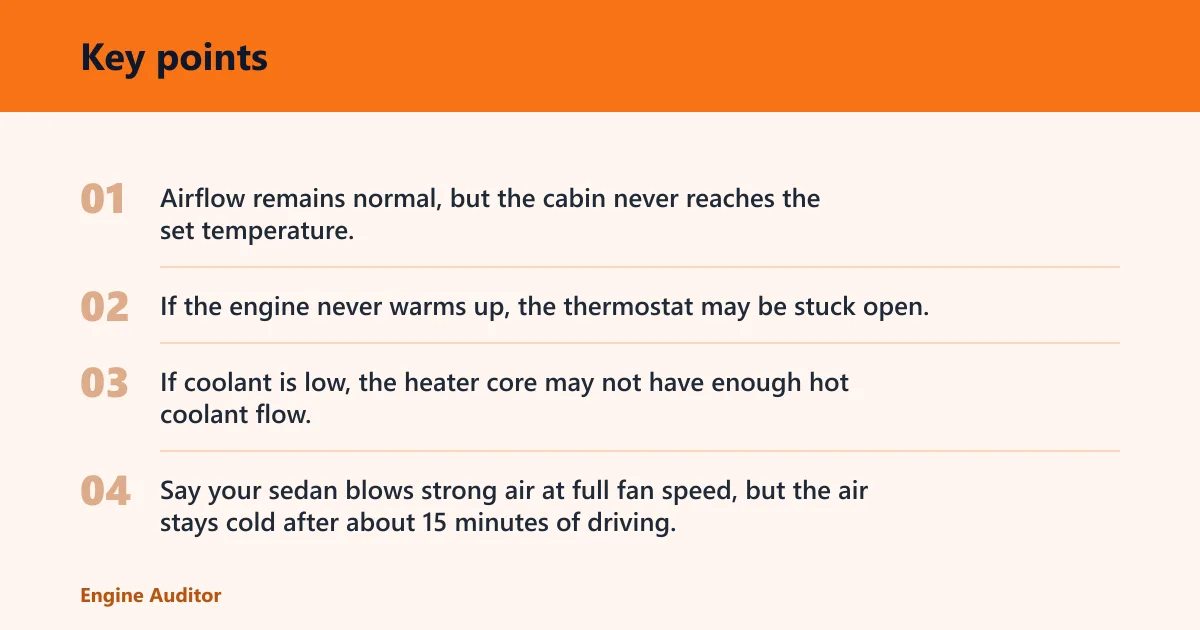
This is the classic clue. Airflow remains normal, but the cabin never reaches the set temperature. That pattern points toward the blend door path rather than a dead blower motor, because the fan still works and the problem is the air mix, not the air movement.
Why total no-heat can still be a different fault
If the engine never warms up, the thermostat may be stuck open. If coolant is low, the heater core may not have enough hot coolant flow. If the blower is weak or the mode door is stuck, heat may be present in the HVAC box but not delivered to the vents you expect.
Say your sedan blows strong air at full fan speed, but the air stays cold after about 15 minutes of driving. That points away from the blower and toward coolant flow, heater core flow, or a blend door that never moves to the heat side.
Actuator clues versus other faults
Use the symptom pattern before opening the dash. The same complaint can come from different parts, and winter repair time is easier to spend on the right one. A hot engine with cold vents is not enough by itself; the next test decides whether the actuator is the likely cause.
Heater core flow problem versus actuator fault
A heater core flow issue often leaves both heater hoses with poor or uneven heat, and the cabin may stay cold even if the actuator moves normally. A blend door fault usually leaves the heater core hot, but the air never gets routed through it correctly. That difference matters.
Low coolant or thermostat problem versus actuator fault
Low coolant can cause weak heat, gurgling, or heat that fades at idle. A thermostat issue can keep the engine from reaching operating temperature, which means the heater core never gets fully hot. If the engine temp gauge stays low, check coolant and thermostat before blaming the actuator.
Blower or mode-door problem versus actuator fault
A blower fault changes how much air comes out, while a mode-door fault changes where that air goes. A bad blend door actuator changes the temperature mix. If air is strong but comes from the wrong outlet, or defrost never gets the right airflow, the mode door may be the better fit.
Defrost and winter safety signs
Defroster failure is a safety problem, not a comfort issue. If the windshield will not clear properly, visibility drops fast in freezing weather. A blend door actuator can cause that when the HVAC system cannot route hot air to the defrost setting, and a mode-door fault can cause the same result.
When the defroster points to blend-door trouble
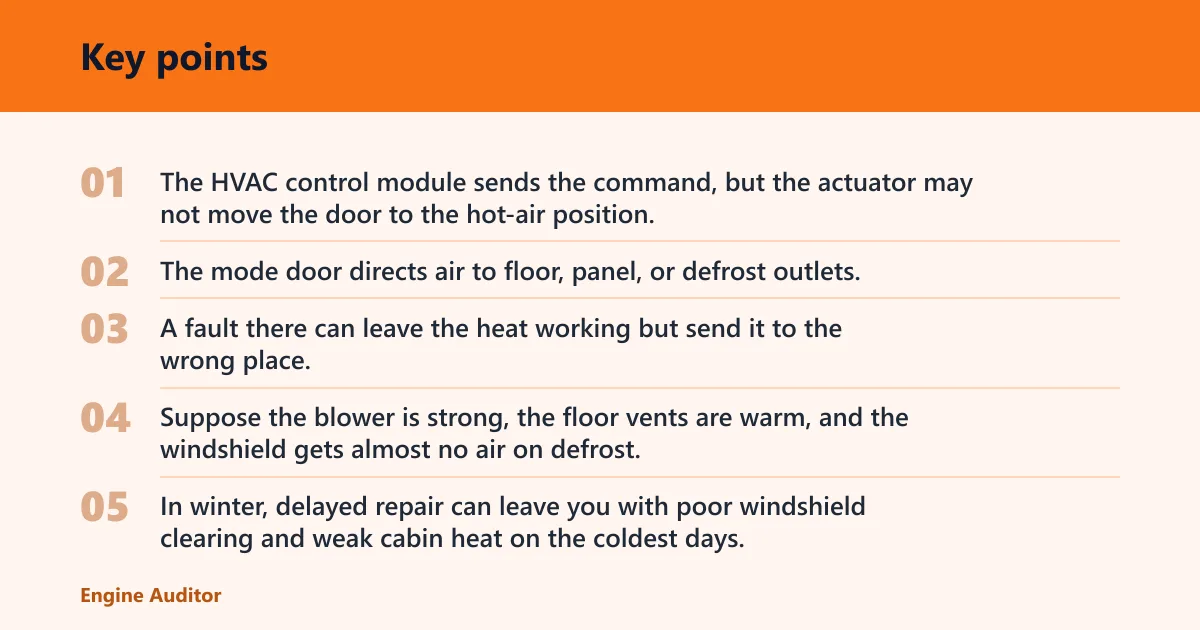
If the defrost setting changes nothing, or the windshield gets only cool air while the cabin heat seems wrong too, the blend door path may be stuck. The HVAC control module sends the command, but the actuator may not move the door to the hot-air position.
When a mode-door fault is the better fit
If cabin heat works at the floor or vents but defrost does not get air, the mode door is a stronger suspect than the blend door. The mode door directs air to floor, panel, or defrost outlets. A fault there can leave the heat working but send it to the wrong place.
A common first-timer mistake is to blame a dead thermostat when the vents stay cold on one side and warm on the other, even though the blend door actuator is stuck. Suppose the blower is strong, the floor vents are warm, and the windshield gets almost no air on defrost. That points more toward mode-door control than a coolant problem.
Why weak windshield clearing needs prompt attention
In winter, delayed repair can leave you with poor windshield clearing and weak cabin heat on the coldest days. That affects comfort and visibility at the same time. If the defroster will not route warm air properly, do not wait for a deeper dash tear-down before confirming the control side.
Blend door symptom table
Use this checklist before opening the dash. It separates actuator clues from coolant, heater core, blower, and mode-door problems in a few minutes.
| Symptom | Likely actuator clue | Likely non-actuator clue | Next test |
|---|---|---|---|
| Clicking behind dash | Clicking repeats when you change temperature, especially with wrong or stuck cabin heat | Noise comes from the blower area or only happens with fan speed changes | Turn the temp knob from cold to hot and listen near the glove box and center dash |
| One side cold, one side warm | One zone stays wrong in a dual-zone or tri-zone system | Both sides are equally weak, which points to coolant, thermostat, or heater core flow | Change both zones separately and note whether only one side responds |
| Heat changes when temp knob moves | Air changes late, jumps suddenly, or never settles at the set temperature | Engine temperature is low or coolant level is low, so the heat source is weak | Check engine temp first, then watch for delayed or erratic vent changes |
| No defrost | Defrost command does not change air routing or temperature at the windshield | Floor or panel outlets still work, which points to a mode-door fault | Switch between defrost, panel, and floor and watch where the air actually goes |
| No air vs air at wrong temperature | Air still blows, but it is the wrong temperature full-time | No airflow at all points to blower, resistor, fuse, or switch problems | Set fan on high and compare airflow strength with the temperature complaint |
How to test it at home
You can narrow this down without tearing the dash apart. Start with sound, then check vent temperature, then use scan data if the vehicle supports it. If the clues stay mixed after those checks, stop guessing and move to a scan tool or shop diagnosis.
-
Listen for movement noise. Key on the vehicle and turn the temperature from full cold to full hot. A repeated clicking or popping behind the dash is a strong clue, especially if the vents also stay wrong.
-
Watch the vent response. Hold the blower on a steady setting and move the temperature knob one step at a time. If the air stays cold, jumps unpredictably, or changes on one side only, the actuator or its feedback circuit deserves attention.
-
Check defrost routing. Switch between floor, panel, and defrost. If the air volume stays similar but the outlets never change correctly, the mode-door side may be at fault rather than the blend door.
-
Use a scan tool. An HVAC-capable OBD-II scanner can often command actuators and read HVAC codes. This is the cleanest way to confirm a position sensor fault, a motor fault, or a calibration problem without removing the whole dash.
What a scan tool can confirm
Some tools can command the actuator to full hot and full cold, then read whether the position feedback follows. If the command changes but the feedback does not, the actuator or control circuit may be failing. If the code points to calibration, a reset may help after a battery disconnect.
Reset and replacement basics
A reset can help when the HVAC control module loses its learned position after a battery disconnect or low-voltage event. It will not fix stripped plastic gears or a motor that no longer moves. If the door is mechanically worn, replacement is the real fix.
When an HVAC reset can help
Some systems need recalibration before the actuator knows where full hot and full cold are located. A battery disconnect reset is one common method used for actuator recalibration. If the system only started acting odd after battery service, reset is worth trying.
Why access varies by vehicle
Replacement cost can range from $30 to $500+ depending on vehicle type. The part itself may be accessible through the glove box on some models, while others require dashboard disassembly. Multi-zone systems can need more than one actuator, so confirm the failed unit before buying parts.
Frequently asked questions
What are the signs a blend door actuator is causing no heat in my car?
The strongest signs are wrong cabin temperature, clicking or popping behind the dash, and heat that changes when you move the temp knob. If the blower still pushes air and the engine is warm, the actuator or blend door is a better suspect than the fan.
Can a bad blend door actuator cause no heat but still blow air?
Yes. The blower can work normally while the blend door stays in the wrong position, so the air keeps moving but never gets hot enough. That is one reason actuator faults can look like heater problems even when the heater core still has flow.
How do I tell a blend door actuator from a heater core problem?
Focus on where the fault shows up. A heater core problem usually affects the heat source itself, while an actuator fault affects how cabin air is mixed and routed. Hot heater hoses with cold cabin air often point toward the HVAC box and its doors.
Why does my car heater blow cold air only on one side?
That pattern often points to dual-zone or tri-zone climate control with more than one actuator. One side can be stuck cold while the other side works normally. If both sides fail together, the problem is more likely coolant, thermostat, heater core flow, or the blower.
Will a blend door actuator make the defroster stop working?
It can. If the blend door cannot move to the right temperature mix, the defrost air may come out too cold to clear the glass well. A mode-door fault can also stop proper defrost routing, so the outlet pattern matters as much as the temperature.
Can resetting the HVAC system fix a blend door actuator problem?
Sometimes. A reset can help after a battery disconnect or if the control module lost its learned position. It will not fix worn plastic gears, a dead motor, or a broken door. If clicking continues, the mechanical fault is still there.
Can I drive with a bad blend door actuator in winter?
You usually can move the vehicle, but winter comfort and visibility may suffer. If the defroster cannot clear the windshield properly, that becomes a safety issue. Weak heat and poor defrost performance are good reasons to diagnose the system before the weather gets worse.
How do you test a blend door actuator without tearing the dash apart?
Start with the noise test, then watch how the vents respond when you change the temperature knob. After that, use an HVAC-capable OBD-II scan tool if the vehicle supports it. That sequence can confirm many faults before any trim panels come off.
Does a bad blend door actuator make clicking noises behind the dashboard?
Yes, that is one of the most common signs. The noise usually comes from worn plastic gears inside the actuator as they slip or fail to track position. Clicking by itself is not enough, but clicking plus wrong temperature is a strong clue.
Why is my car heater not working even though the engine is warm?
If the engine is warm but the cabin stays cold, check whether the heater hoses are hot, whether airflow is strong, and whether the temperature changes when you move the controls. Warm engine coolant, strong airflow, and cold vents often point to the HVAC box rather than the engine.
Products related to this article
Sponsored / affiliate links. As an Amazon Associate I earn from qualifying purchases. I may earn additional commission from eligible campaigns.