Rear Defroster Not Working in Winter: Grid, Fuse, or Switch?
In winter, a dead rear defroster is usually a blown fuse, failed relay, broken switch, detached tab, or a cracked grid line; if both glass heat and heated mirrors fail, suspect a shared circuit first. Ignoring it leaves fogged glass, poor rear visibility, and wasted time replacing parts that still pass power. This guide walks you through the winter fault-tree for glass heat, mirrors, tabs, grid breaks, fuse checks, and switch checks.
Rear defroster diagnosis matrix


| Symptom pattern | Likely failed part | Quick test | Next action |
|---|---|---|---|
| Total failure: no heat, no mirror response, no click | Fuse, relay, power feed, or shared circuit fault | Check the owner’s manual or fuse chart, then test the rear window fuse and relay with a test light or multimeter | Confirm power and ground before replacing parts; inspect the relay and mirror feed if equipped |
| Only some lines stay cold | Broken grid line | Look for a narrow strip of fog or frost that never clears on the same path each time | Repair the damaged line with conductive grid repair paint if the break is hairline |
| Mirrors also dead | Shared fuse, relay, or BCM command issue | Check whether heated exterior mirrors are supposed to come on with the rear window defroster on that vehicle | Trace the shared feed, relay coil, and BCM signal before touching the glass |
| Switch light on, but no heat | Rear defroster switch, relay, or BCM input fault | Run a continuity test at the switch and scan for a code such as B1007 | Test the switch contact and voltage signal, then move to the relay if the input is correct |
| Works only after a long drive or only on mild days | Intermittent winter-only fault | Inspect terminals for moisture, corrosion, loose tabs, and weak battery voltage | Clean the connections, load-test the battery, and recheck after the glass is cold-soaked |
Why is my rear defroster not working?
In winter, a dead rear defroster is usually a blown fuse, failed relay, broken switch, detached tab, or a cracked grid line. If both glass heat and heated mirrors fail, suspect a shared circuit first. Ignoring it leaves fogged glass, poor rear visibility, and wasted time replacing parts that still pass power.
Total failure: what to check first
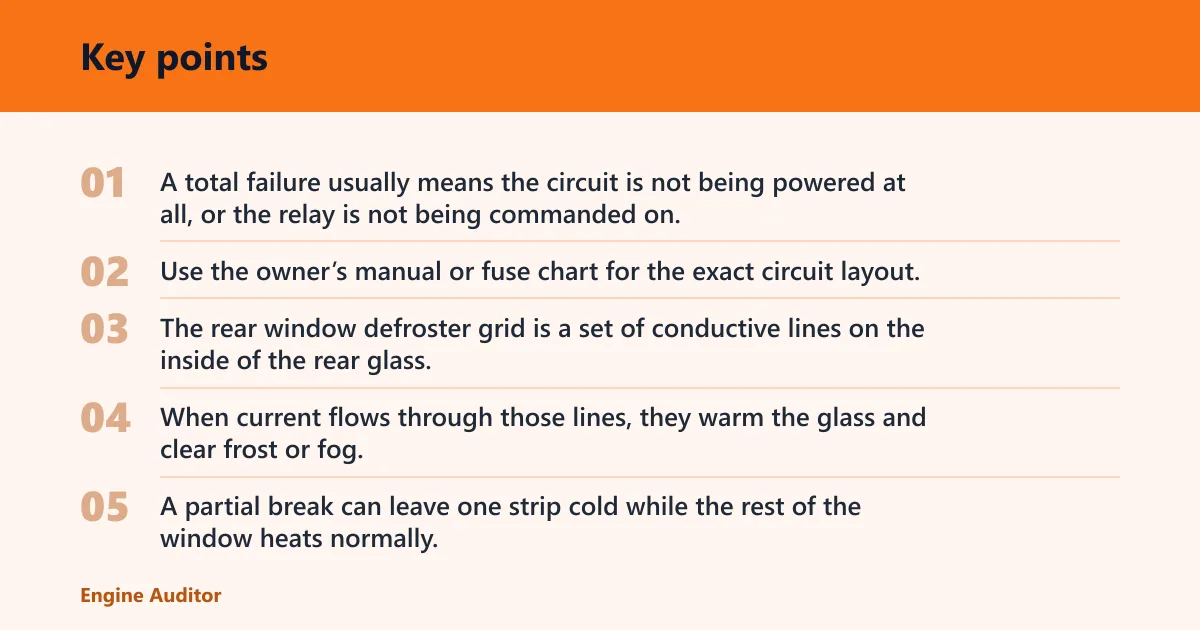
If the rear defroster is completely dead, start with the fuse, relay, and power feed before replacing the switch or glass. A total failure usually means the circuit is not being powered at all, or the relay is not being commanded on. Use the owner’s manual or fuse chart for the exact circuit layout.
How the rear window grid heats the glass
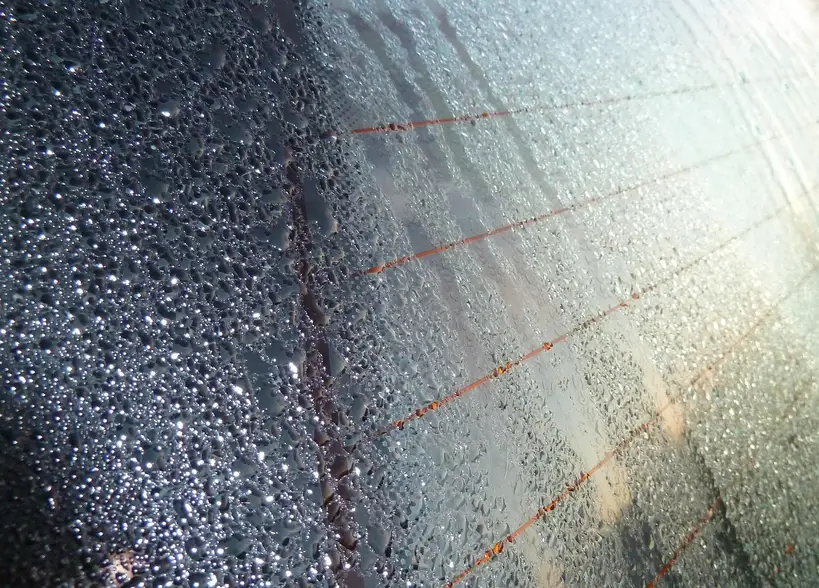
The rear window defroster grid is a set of conductive lines on the inside of the rear glass. When current flows through those lines, they warm the glass and clear frost or fog. A partial break can leave one strip cold while the rest of the window heats normally.
That is why a partial defog pattern matters. If a single band stays fogged, the fuse is usually not the first suspect. Damaged lines often point to scraping, decals, or a razor blade used on the inside of the glass, and Ford warns not to use sharp objects there.
Mirrors also dead: what that points
If the rear glass and the heated mirrors both stop working together, the fault often sits in a shared fuse, relay, or control signal rather than in the glass itself. That pattern is a strong clue that the upstream circuit is open, not that both heating elements failed at once.
Use the vehicle’s fuse chart to confirm whether the mirrors share the same feed. Some vehicles combine the rear window and mirror heat, while others separate them. The chart is the safest way to avoid chasing a branch that is not part of the circuit.
Switch lamp on, but no heat
When the switch lamp turns on but the rear glass stays cold, the control side may be faulty even if the indicator light works. The switch can light up and still fail to send the correct command to the relay or BCM. A code such as B1007 can support that diagnosis on vehicles that monitor the switch circuit.
That is why the lamp alone is not enough. If the command signal is missing, the relay never closes and the grid never gets power. If the command is present, the problem moves downstream to the relay or the heated glass circuit.
Only some lines cold: broken grid or detached tab
When only part of the glass stays cold, the rear defroster is usually working in one section and not another. That points to a broken grid line or a detached feed tab. A narrow, repeatable cold strip is the classic sign of a line break, while a larger dead area can point to the tab or connector.
Look for the exact same cold band each time you switch the system on. A consistent pattern helps separate a line break from a wider power loss. If the cold area changes with vibration or temperature, the issue may be an intermittent tab or terminal connection.
Intermittent cold-soak fault
Some rear defroster problems only show up after the vehicle sits outside overnight. Moisture can affect terminals, corrosion can weaken contact, and a weak battery can make the system behave normally only when conditions are mild. A cold-soaked vehicle is often the best time to catch the fault.
If the system works after a long drive but not on a cold start, inspect the connectors, tabs, and battery condition first. That pattern often points to a marginal connection rather than a completely failed grid or switch.
What a healthy system should do in cold weather
Ford says the engine should be running before using the heated rear window, and Ford also says heated exterior mirrors switch on automatically with the heated rear window. A healthy system usually draws noticeable current, often in the 10 to 20 amp range on some applications, then shuts off after about 5 to 10 minutes on many vehicles.
If the glass warms evenly and the mirrors warm with it, the circuit is probably alive. If nothing happens at all, start at the fuse and relay. If the switch lamp comes on but the grid stays cold, the control side or relay side deserves attention before the glass.
How do you tell a fuse, relay, or switch fault?
Start with the fuse when the whole system is dead, then move to the relay and switch if the fuse is intact. Do not assume one location fits every vehicle. The owner’s manual or fuse chart is the correct map because build and equipment changes can move the fuse, relay, or both.
Defroster fuse checks
A defroster fuse protects the rear window heating circuit. The same source lists F22 as a 25A heated rear window fuse in the luggage-compartment panel on one application, but that location and amperage are vehicle-specific examples rather than a universal rule. Some vehicles also use a separate mirror-circuit fuse, so check the chart before pulling parts.
-
Find the fuse chart.
Check the owner’s manual or fuse chart for the exact rear defroster listing. Do not guess by slot position alone, because the same panel can carry different circuits by trim or build. -
Inspect the fuse.
Pull the fuse and look for a melted bridge or darkened blade. If the fuse is open, replace it only with the listed amperage, not a larger one. -
Verify power both sides.
Use a test light or multimeter on the fused circuit with the defroster commanded on. Power on one side only usually means the fuse failed; power on neither side points back to the feed.
Defroster relay checks
The relay switches power to the heated rear window circuit. The same source lists R3 as the heated rear-window relay and R6 as the heated outside-mirror relay on one application, which is useful as an example because the mirror circuit can help separate a relay fault from a glass fault. Ford also lists F46 as a 5A heated outside-mirror relay coil fuse on that same setup.
If the fuse is good but the relay does not click or pass power, the relay can be the missing link. A quick check is to swap only with an identical relay in the chart, if one exists and serves the same type of load. Do not swap random relays with different ratings or pin layouts.
Rear defroster switch checks
The rear defroster switch can fail mechanically or electrically. A continuity test should beep when the switch is pressed. On vehicles with body control module logic, the BCM expects a specific voltage signal when the defroster button is pressed, and a B1007 code indicates a rear defroster switch circuit malfunction on some applications.
-
Check the scan data.
Look for B1007 or related switch-input faults in the BCM. If the module does not see the expected voltage signal when you press the button, the switch circuit may be open or shorted. -
Test switch continuity.
Remove the switch access panel as needed and probe the contacts with a multimeter. The meter should beep when the button is pressed and stop beeping when released. -
Confirm output change.
Reconnect the switch and watch for the command to the relay or BCM input. A lighted button can still fail internally, so the lamp alone is not proof that the switch is sending the right signal.
Suppose the dash light turns on, but the rear glass never warms and the BCM stores B1007. That points more strongly to the switch circuit than to the glass itself, especially if the fuse and relay check out.
Can heated mirrors point to the same fault?
Yes. On some vehicles, the heated mirrors are tied to the rear window defroster circuit, so mirror behavior can separate a shared-circuit problem from a glass-only problem. If both glass heat and mirrors fail together, suspect a fuse, relay, or feed issue first. If the glass works but the mirrors do not, the mirror branch or its relay path may be at fault.
Shared-circuit mirror behavior
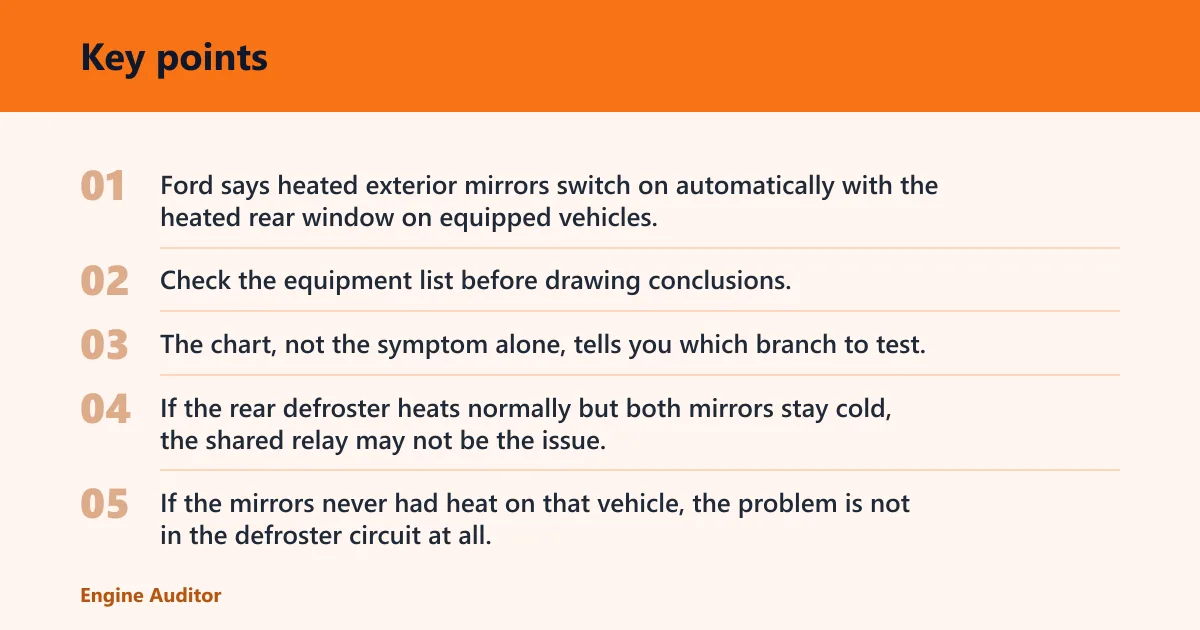
The same source says heated exterior mirrors switch on automatically with the heated rear window on equipped vehicles. That means mirror operation can act as a diagnostic clue. If the rear glass warms and the mirrors stay cold, the mirrors may have their own open circuit, or the vehicle may not be equipped with mirror heat at all.
Check the equipment list before drawing conclusions. Heated mirrors are not present on all vehicles, and some models separate the mirror feed or relay from the rear glass feed. The chart, not the symptom alone, tells you which branch to test.
What mirror failure means when the rear glass still works
If the rear defroster heats normally but both mirrors stay cold, the shared relay may not be the issue. That pattern can point to a mirror-specific fuse, the mirror relay coil, or a wiring break in the door or mirror wiring path. If the mirrors never had heat on that vehicle, the problem is not in the defroster circuit at all.
Heated mirror clues matter because they prevent parts swapping that does not solve the problem. They also help you avoid replacing a good rear glass when the fault sits in a common feed upstream.
Why do some grid lines stay cold?
Some grid lines staying cold usually means the rear window heater is partly damaged, not completely dead. A broken grid line can leave a narrow strip of frost or fog that never clears. A detached tab can do the same if it interrupts power to part or all of the grid.
Broken grid line symptoms
Look for a straight, repeatable cold band that matches one heating track. That usually means the conductive line is open at a specific point. Conductive grid repair paint is commonly used for a hairline break, but it is not a fix for a missing connector tab or a heavy tear.
-
Clean the glass carefully.
Wipe the inside of the rear glass with a soft cloth and a mild cleaner. Avoid scraping, razor blades, and aggressive pads that can widen the break. -
Map the cold spot.
Turn the defroster on and trace the exact line that stays cold. Mark both sides of the break so you can place the repair on the correct path. -
Repair the hairline gap.
Mask the line, apply conductive grid repair paint, and let it cure per the product directions. Keep the repair thin and aligned so current can pass without building a bump on the glass.
Detached tab damage
A detached tab is different from a broken grid line. The tab is the metal terminal that feeds the glass, and it needs a conductive bond to work. Standard superglue is an insulator, so it should not be used for an electrical repair. Use conductive epoxy for tab reattachment.
A common first-timer mistake is trying to glue the loose tab with ordinary adhesive because it looks strong. The bond may hold the metal in place, but the circuit still stays open. Conductive epoxy is made to carry current; standard glue is not.
When repair paint is enough
Repair paint can work when the damage is a narrow break in a single line and the tab is still secure. It is not suitable for load-bearing tabs, burnt connector pads, or a wide missing section of grid. If the damage spans several lines or the glass has a larger damaged area, repair becomes less reliable.
Do not replace the whole rear window for every grid issue. Replace the glass only when the damage is too broad for a stable repair, when the tab area has failed beyond bonding, or when the heating pattern is too degraded to restore safely.
How do you repair a damaged defroster tab?
A detached tab is repaired with conductive epoxy, not standard glue, because the tab must carry current back into the grid. Clean metal, solid alignment, and cure time matter more than speed. If the surrounding glass is cracked, the pad is burned away, or the tab area keeps lifting, the repair may not hold.
Conductive epoxy for tab reattachment
-
Prepare the contact area.
Clean off old adhesive, oxidation, and grime from both the tab and the glass pad. The surfaces need to be dry and bare enough for the conductive epoxy to bond. -
Align the tab squarely.
Hold the tab in the original position so the electrical contact matches the grid trace. A crooked tab can leave part of the line unpowered or stress the joint when the glass warms. -
Apply conductive epoxy.
Use a product rated for electrical conductivity, then let it cure for the full time listed on the package. Do not power the defroster early, because heat can weaken an uncured bond.
When to stop repairing and replace the glass
Stop repairing and move toward glass replacement when the tab pad is too damaged to bond, when multiple grid lines are missing across a wide section, or when the repair fails after a correct cure. Replacement is also the better choice if the glass damage came from repeated scraping, tint work, or a large peeled area that cannot support a stable conductive patch.
Use the owner’s manual or fuse chart again after any repair. A correct fix on the glass still needs the right fuse, relay, and switch command to prove the system is complete.
Frequently asked questions
How do I know if the defroster fuse is blown?
Check the chart first, because the rear defroster fuse location and amperage vary by vehicle. Then inspect the fuse element and test for power on both sides with the defroster commanded on. The same source lists F22 as a 25A heated rear window fuse on one application, but your vehicle may differ.
Can a broken grid line stop the whole rear defroster?
A single broken grid line usually does not stop the entire system. It usually leaves a narrow band of fog or frost that never clears while the rest of the glass heats normally. A larger break or a detached feed tab can take out a bigger section, but a full dead system points first to fuse, relay, or switch.
Why do my heated mirrors not work with the rear defroster?
On some vehicles, the mirrors are supposed to come on with the rear window defroster. If both fail, the shared fuse, relay, or BCM command is a strong suspect. If the rear glass works but the mirrors do not, the mirror branch may have its own open circuit, or the vehicle may not have heated mirrors.
How do I test a rear defroster switch?
Use a scan tool to check for a switch-circuit code such as B1007, then test the switch with a multimeter. A continuity test should beep when the button is pressed. The BCM expects a specific voltage signal, so a lamp that lights up is not proof that the switch is passing the right command.
Can tint damage rear defroster lines?
Yes. Tint work can damage the conductive lines if the film is scraped off aggressively or if tools nick the inside of the glass. Sharp blades, harsh cleaning, and decal removal can do the same. If the damage leaves a clean open gap in one line, conductive grid repair paint may fix it.
Products related to this article
Sponsored / affiliate links. As an Amazon Associate I earn from qualifying purchases. I may earn additional commission from eligible campaigns.