How to Diagnose No Heat in a Hybrid Car During Winter
Start by checking whether the engine reaches normal coolant temperature and whether cabin heat returns only when the engine is running. If coolant stays low, suspect low coolant, a stuck thermostat, or a pump fault before you blame the climate controls. Ignoring it can mean frozen glass, poor defrost, and an overheated engine if coolant loss is the real cause. This guide separates normal hybrid warm-up behavior from coolant, airflow, heater core, blend door, and electronic climate-control faults.
Why hybrid heat acts different in winter
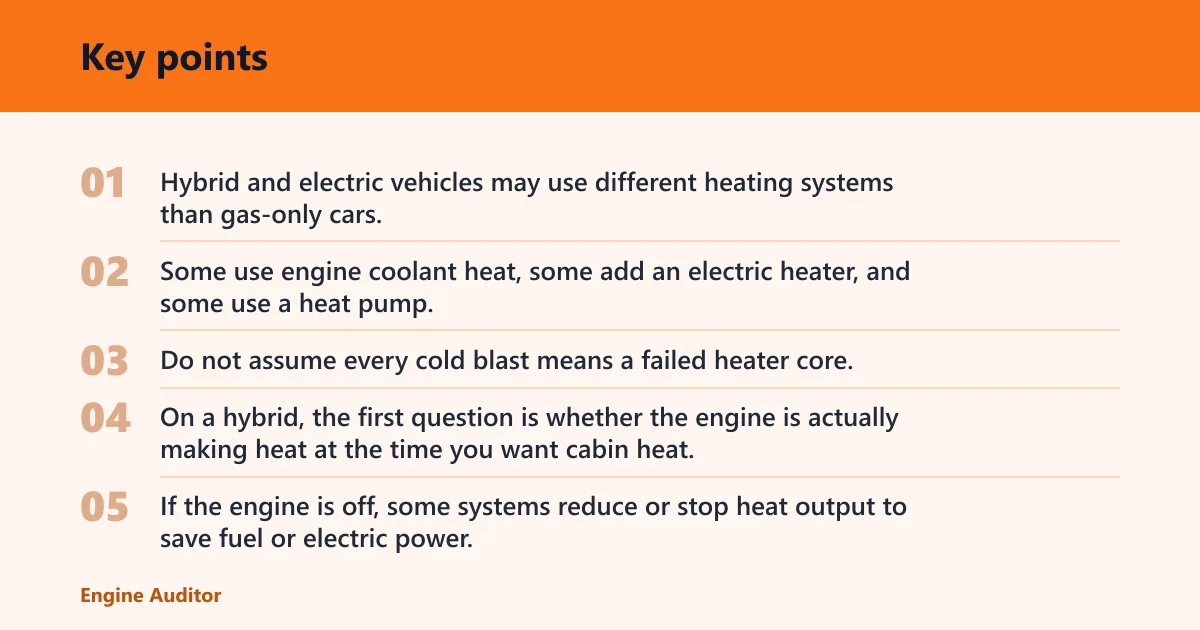


Hybrid and electric vehicles may use different heating systems than gas-only cars. Some use engine coolant heat, some add an electric heater, and some use a heat pump. That means cabin heat can drop when the engine shuts off or the car enters EV mode, even though that behavior may be normal on some models.
Do not assume every cold blast means a failed heater core. On a hybrid, the first question is whether the engine is actually making heat at the time you want cabin heat. If the engine is off, some systems reduce or stop heat output to save fuel or electric power.
Engine coolant heat versus electric heating
In many hybrids, hot engine coolant passes through the heater core, then the blower pushes air across that core into the cabin. Other models use an electric heater to supplement heat during warm-up or low-engine operation. Heat-pump systems add another path, which can behave differently in very cold weather.
A cabin that warms normally at speed but goes cold at stoplights often points to hybrid operation rather than a simple HVAC failure. That pattern matters because the next check changes: coolant level, engine temperature, and circulation come before blend doors or a control panel diagnosis.
What stop-start and EV mode change
When the engine shuts off at a stop or the vehicle enters EV mode, the source of heat may shrink or disappear. If the heater uses engine coolant, the cabin can cool until the engine restarts. That is normal only if heat returns promptly when the engine runs again.
If the heat does not return with engine operation, or the temperature stays cold even after a long drive, the issue is no longer normal hybrid behavior. Then you move to coolant, thermostat, heater core, airflow, and control checks in that order.
Heat diagnostic matrix
This matrix separates symptom patterns from likely faults so you can choose the next test instead of guessing. Start with the symptom that matches your car, then work across to the first check and urgency.
| Symptom | Likely subsystem | First check | Urgency |
|---|---|---|---|
| Cold only at idle | Normal hybrid stop-start behavior, low coolant, weak circulation | Watch whether engine temperature drops at the stop and rises again when driving | Moderate if heat returns; urgent if coolant is low or a warning light appears |
| Heat returns while driving | Coolant circulation, thermostat, heater core flow | Check coolant level and compare upper and lower heater hoses after warm-up | Moderate, rising to urgent if the engine overheats |
| One hose hot and one cool | Heater core restriction or flow problem | Feel both heater hoses at the firewall with the engine warm and heater on high | Moderate; high if there is a sweet smell or coolant loss |
| No heat with normal engine temp | Blend door, actuator, airflow restriction, heater core blockage | Check blower speed, cabin filter, and whether temperature changes when you move the dial | Moderate |
| Heat disappears during EV mode | Hybrid climate strategy, electric heater, heat pump, control logic | See whether heat returns as soon as the engine restarts or only at higher load | Low to moderate unless defrost is weak or the car cannot clear the windshield |
| Warm air on the highway, cold at stops | Low coolant, thermostat stuck open, circulation issue | Check engine gauge, coolant level, and whether the heater gets weaker as engine speed falls | Moderate; urgent if the gauge rises above normal |
| Weak defrost with warm engine | Airflow, cabin filter, blower motor, blend door | Switch to defrost and full fan, then watch whether airflow changes at the vents | Moderate because visibility is affected |
Why does your hybrid blow cold air?
Cold air in a hybrid often appears at idle, during EV-only operation, or right after the engine shuts off. That can be normal if the car is managing fuel economy, but it is not normal if heat never returns, the engine never reaches normal temperature, or the windshield stays fogged even after several minutes of driving.
Cold at idle or stoplights
When the heater goes cold at a stoplight, the first question is whether the engine is shutting off. Some hybrids may reduce cabin heat during stop-start events, so a brief drop in heat can happen. If the temperature drops hard and stays cold, look at coolant level, engine temperature, and circulation.
Suppose the cabin is warm at 40 mph but turns cold every time the car sits at a red light for more than a minute. That pattern fits hybrid-specific engine shutoff or low coolant more than a failed control panel.
Heat that returns while driving
If heat returns while driving, coolant flow is often the clue. F9 says that if the heater blows cold air while driving, coolant level or circulation may be the issue. A thermostat that is stuck open can make the engine warm up slowly, and a weak heater can show up most clearly in cold weather.
Check whether the engine temperature gauge rises to normal and stays there. If the car warms only after a long highway run, the thermostat may be stuck open or the engine may be running too cool for cabin heat.
No heat with a normal engine temperature reading
When the engine gauge looks normal but the cabin stays cold, the fault may be inside the HVAC box rather than in the engine bay. A blend door can stay on cold, an actuator can fail, or the heater core can be partly blocked. Weak airflow can also make a warm heater core seem weak.
If the vents blow strong air but it never gets warm, focus on the temperature-mix system. If the air is weak and the filter is dirty, the heater core may be fine and the airflow side may be the real fault.
Can low coolant cause no heat in a hybrid car?
Yes. Low coolant can prevent enough hot coolant from reaching the heater core, and a falling coolant level often points to a leak. A sweet smell can indicate a coolant leak, and some vehicles will show a low-coolant warning light before cabin heat disappears completely.
How to check coolant level safely
Do not open the radiator cap when the engine is hot. Check the coolant reservoir only when the engine is cool, and compare the level to the marks on the tank. If the level is below the minimum line, top off only with the correct mix for that vehicle, then check for where the coolant may be going.
- Let the engine cool. Park on level ground and wait until the system is cool enough to touch. This avoids burns and gives a more accurate reservoir reading.
- Inspect the reservoir. Check the level against the molded marks on the tank. A level below minimum means the system may not send enough hot coolant to the heater core.
- Look for leak clues. Check under the vehicle, around hose joints, and near the firewall for dampness or crusty residue. A sweet smell also points toward a coolant leak.
- Watch the gauge. Drive only if the engine temperature stays normal and there is no warning light. If the gauge rises, stop and get help.
What a falling coolant level means
A one-time low level may come from a bad fill or recent service, but a level that keeps dropping points to a leak. That leak can be external or internal. If the heater gets weaker over a few days and the reservoir keeps losing fluid, the cooling system needs inspection before more driving.
An overheating engine with lost cabin heat is serious. F7 applies here: treat that combination as urgent, because continuing to drive can turn a heater complaint into engine damage.
When to stop driving and get help
Stop driving if the temperature warning light comes on, the gauge climbs above normal, or the coolant level appears to be dropping quickly. Those signs mean the problem is not a simple cabin comfort issue anymore. A professional inspection is the right move if the car is overheating or the level falls again after a top-off.
How do you check the thermostat and heater core?
A stuck-open thermostat can make the engine warm up slowly, and that leaves heat weak in cold weather. A clogged heater core can also cut output. If one heater hose is hot and the other is cool once the engine is warm, the core may not be flowing as it should.
Signs of a thermostat stuck open
With a stuck-open thermostat, the engine often takes a long time to reach normal temperature, especially in cold weather. Heat may be weak at speed, then improve only after extended driving. The temperature gauge may sit lower than normal instead of settling near its usual midpoint.
That pattern is different from a blend door fault. A blend door problem can give you full cold with a normal engine gauge, while a thermostat problem usually shows up as slow warm-up or a low operating temperature reading.
Signs of a clogged heater core
A clogged heater core can reduce heat output even when the engine is warm and the coolant level is correct. You may get lukewarm air, uneven heat, or heat that changes when engine speed changes. If the core is leaking, a sweet smell can appear inside or near the car.
If the defroster is weak at the same time, do not ignore it. F8 says a weak heater can affect defrost performance and winter visibility, so poor windshield clearing belongs in the diagnosis.
What one hot hose and one cool hose can mean
At full operating temperature, both heater hoses should usually feel hot, though one may be slightly cooler than the other. If one hose is hot and the other stays cool, coolant may not be flowing through the heater core. That points toward a restriction, trapped air, or a valve problem.
- Warm the engine fully. Set the heater to hot and the fan on medium. Let the engine reach normal operating temperature before judging hose temperature.
- Feel both hoses carefully. At the firewall, compare the inlet and outlet heater hoses. One hose being hot and the other cool can suggest reduced flow through the heater core.
- Check for air or blockage. If coolant is full but the core still gets only one hot hose, the system may need bleeding or further diagnosis for blockage.
Why airflow and blend doors matter
Heat output depends on more than coolant temperature. The blower motor must move air through the heater core, the cabin air filter must allow that air through, and the blend door must route the air across the warm core instead of around it. Any of those faults can make a warm heater feel useless.
Blower motor clues
A car heater can fail because of a failed blower motor. If fan speed does not change, air only comes out weakly, or the fan works on some settings but not others, airflow is part of the problem. A weak blower can make a heater core seem cold even when the core is hot.
Cabin air filter restriction
Weak airflow can come from a clogged cabin air filter. F5 and F11 both point to this. A dirty filter can reduce airflow and cabin comfort, and it can also make defrost performance worse because the windshield gets less warm air.
Check the filter early in the diagnosis, especially if the fan sounds normal but little air comes from the vents. A clogged filter is simpler to verify than a heater core or control module.
Blend door and actuator faults
A blend door or actuator can cause full cold, full hot, or uneven cabin temperatures. On dual-zone or automatic climate systems, one side may heat while the other stays cold, or the temperature may change without input from the driver. That points to control hardware, not coolant flow.
If moving the temperature knob changes nothing, or changes only one side of the cabin, the actuator deserves attention. If the blower is strong and the engine is warm, but the vents stay cold, this is one of the cleaner next checks.
When is it an electronic climate fault?
Some hybrids use climate control electronics that can fail, and the symptom may look mechanical at first. A Toyota or Lexus hybrid can show intermittent heat, heat that appears only while driving, or temperature changes that do not match the engine’s actual warm-up. That is why symptom order matters.
Automatic climate control problems
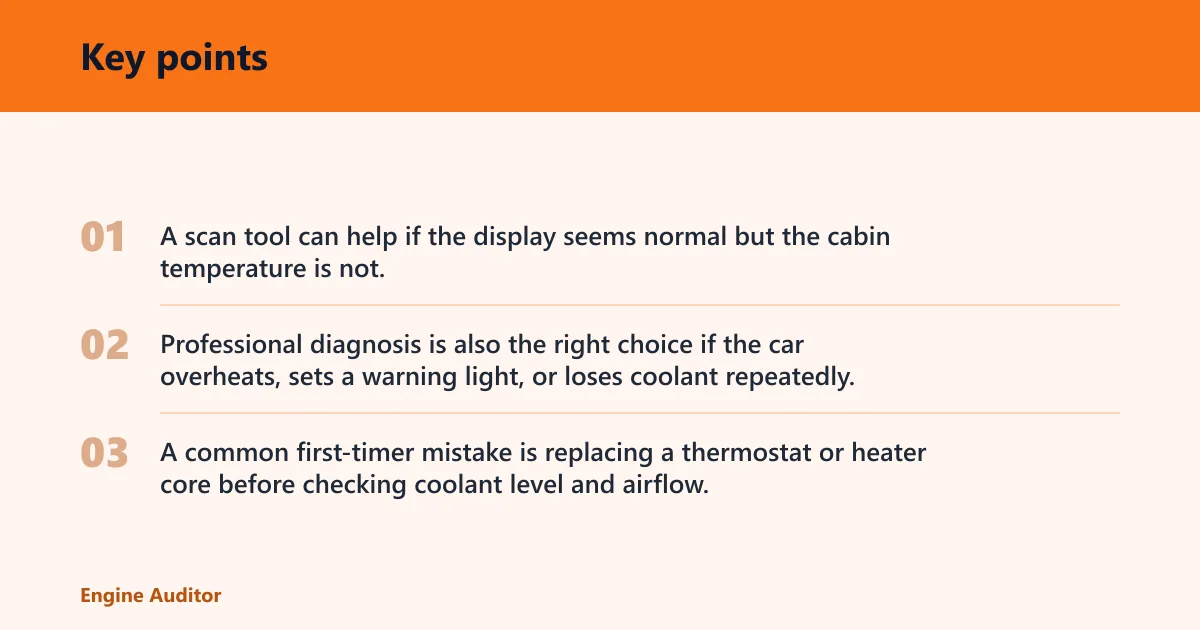
If the car has automatic climate control, the system may be commanding the wrong blend-door position or limiting heat during certain operating modes. A scan tool can help if the display seems normal but the cabin temperature is not. That is especially useful when the heater works sometimes and fails other times.
Model-specific hybrid heater control issues
Hybrid-specific climate control logic can change when the engine stops, the car is in EV mode, or battery power is being managed. A 2006 Highlander Hybrid owner reported cold air most of the time despite showing fully warmed up, which is the kind of symptom pattern that calls for a deeper system check rather than a quick guess.
That does not prove the same fault on every vehicle. It does show why a hybrid heater must be diagnosed by pattern: when it fails, when it recovers, and whether the engine, airflow, or control system changes at the same time.
When a scan tool or professional diagnosis helps
If the temperature gauge looks normal, coolant is full, airflow is strong, and the heater still goes cold at the wrong times, a scan tool can reveal command data, stored faults, or actuator position issues. Professional diagnosis is also the right choice if the car overheats, sets a warning light, or loses coolant repeatedly.
A common first-timer mistake is replacing a thermostat or heater core before checking coolant level and airflow. The symptom may be real, but the wrong part gets blamed when the engine is shutting off, the filter is clogged, or the blend door is not moving.
Frequently asked questions
Why does my hybrid car blow cold air in winter?
Cold air can come from normal hybrid stop-start behavior, low coolant, a stuck-open thermostat, weak airflow, a heater core restriction, or a blend door fault. The key clue is when it happens. If the heat returns while driving or when the engine restarts, hybrid operation may be the main reason.
Why does my hybrid heater only work while driving?
That pattern often points to coolant circulation, engine warm-up, or hybrid engine shutoff behavior. At speed, the engine may stay on and produce more heat. If the heater is cold only at stops, check coolant level, thermostat function, and whether the engine is shutting off normally.
Why does my hybrid heater go cold at stoplights?
Some hybrids reduce or stop engine heat at idle to save fuel, so a short cold spell can be normal. If the cabin stays cold, the engine temperature drops, or the defroster weakens badly, the problem may be low coolant, a thermostat issue, or a control fault.
How do I check if a hybrid thermostat is stuck open?
Watch the engine temperature gauge during a cold start. A stuck-open thermostat can make the engine warm up slowly and keep the heater weak in cold weather. If the gauge stays below normal for too long and the heat improves only after a long drive, the thermostat is a strong suspect.
How do I know if a heater core is clogged in a hybrid?
A clogged heater core often shows up as weak heat even when the engine is warm and coolant is full. One heater hose may be hot and the other cool. If airflow is normal and the temperature controls work, poor core flow becomes more likely.
Can a blend door actuator cause no heat in a hybrid car?
Yes. A blend door actuator can leave the system on cold, on hot, or stuck between positions. That can cause full cold air, uneven temperatures, or one side of a dual-zone cabin to stay colder than the other even when the engine and coolant are fine.
Why is my hybrid defroster weak even when the engine is warm?
Weak defrost can mean the heater is not making enough warm air, but it can also point to airflow trouble. A clogged cabin air filter, weak blower motor, or blend door fault can reduce windshield clearing. Because visibility matters, treat poor defrost as part of the diagnosis.
Should I top off coolant if my hybrid has no heat?
Yes, if the reservoir is low and the engine is cool enough to inspect safely. Top off only with the correct coolant mix. If the level drops again, or if there is an overheating warning or rapid loss, do not keep driving without checking for leaks.
Is no heat in a hybrid a coolant problem or an electric heater problem?
It can be either, but coolant and circulation come first on many hybrids. Start with coolant level, engine temperature, and heater hose heat. If those are normal, move to airflow, blend doors, and then the electric heater or climate-control electronics if the model uses them.
Products related to this article
Sponsored / affiliate links. As an Amazon Associate I earn from qualifying purchases. I may earn additional commission from eligible campaigns.