Honda Civic Tire Pressure Guide: Recommended PSI by Model
Set your Civic’s cold tire pressure to the driver-door placard. Many trims land at 32 to 35 psi, but the placard controls the number. Wrong pressure can change tread wear, braking feel, ride quality, and fuel economy. This guide maps recommended PSI by model year, trim, wheel size, and load.
Reading cold PSI and handling unit conversions


Tire pressure should be read as cold inflation pressure, which means the tires have sat long enough to match ambient temperature. Driving warms the air inside the tire and raises PSI, so a hot reading can look higher than the factory target. Treat the door placard as the source value.
Honda may list pressure in PSI, and some placards also show bar or kPa. A common conversion is 1 bar = 100 kPa and 1 psi ≈ 6.9 kPa. If your gauge reads only PSI, that is fine as long as you match the placard value in PSI.
Front and rear settings can differ on some Civics. That usually reflects axle load, steering response, and tire setup. If the placard lists the same figure front and rear, set all four tires to that number. If it lists different numbers, follow the placard, not a single universal target.
Where to find the Civic placard
The factory-correct tire pressure is on the driver-door jamb label. Open the driver door and look along the door edge or the door frame for the sticker. It typically shows the recommended cold PSI for the front and rear tires and may also list the original tire size.
That label is the first reference because it matches the vehicle as built. It also separates normal-load pressure from full-load pressure when Honda lists both. If the car has replacement wheels or non-stock tires, the placard still matters, but fitment changes may need manual review.
Read the label line by line. One line usually covers the normal passenger-cargo setup. A second line, when present, gives the higher pressure for heavier loading. If you only see one pressure value, use that value for normal driving and confirm any special load guidance in the owner’s manual.
Honda Civic tire pressure reference table
This reference is built around common Civic placard patterns and the trim-and-wheel sizes called out in Honda’s 2010 sizing information. Use it as a trim guide, then confirm the exact numbers on your door sticker before inflating.
| Model year / trim | Factory tire size | Front PSI | Rear PSI | Cold-check interval | Light load vs full load |
|---|---|---|---|---|---|
| 2010 DX | P195/65R15 | 32 | 32 | Monthly and before long trips | Use the placard value for normal load; confirm the manual if passengers and cargo push the car toward full-load use. |
| 2010 LX | P195/65R15 | 32 | 32 | Monthly and before long trips | Normal driving usually matches the placard figure; heavier loading may call for the higher placard line if the sticker lists one. |
| 2010 EX | P205/55R16 | 32 | 32 | Monthly and before long trips | Stay with the door label first. The 16-inch setup changes the tire size, not the rule that the placard controls pressure. |
| 2010 EX-L | P205/55R16 | 32 | 32 | Monthly and before long trips | Check the placard for the exact load setting. Leather or option changes do not replace the factory pressure label. |
| 2010 Si | P215/45R17 | 35 | 35 | Monthly and before long trips | Sport trim and 17-inch tires may call for a higher factory setting. Use the sticker, since the sporty setup can differ from base models. |
| 2010 Hybrid | 195/65R15 | 32 | 32 | Monthly and before long trips | Hybrid trim does not mean a different inflation rule. Follow the placard and the owner’s manual for normal load and any full-load note. |
| 2010 GX | 195/65R15 | 32 | 32 | Monthly and before long trips | Base-model packaging can still share the same pressure target as other 15-inch trims. Confirm the sticker before inflating. |
| 2010 LX-S | 17-inch tire dimensions | 35 | 35 | Monthly and before long trips | Sportier 17-inch fitments may use the higher placard value. Do not assume the same PSI as the 15-inch car. |
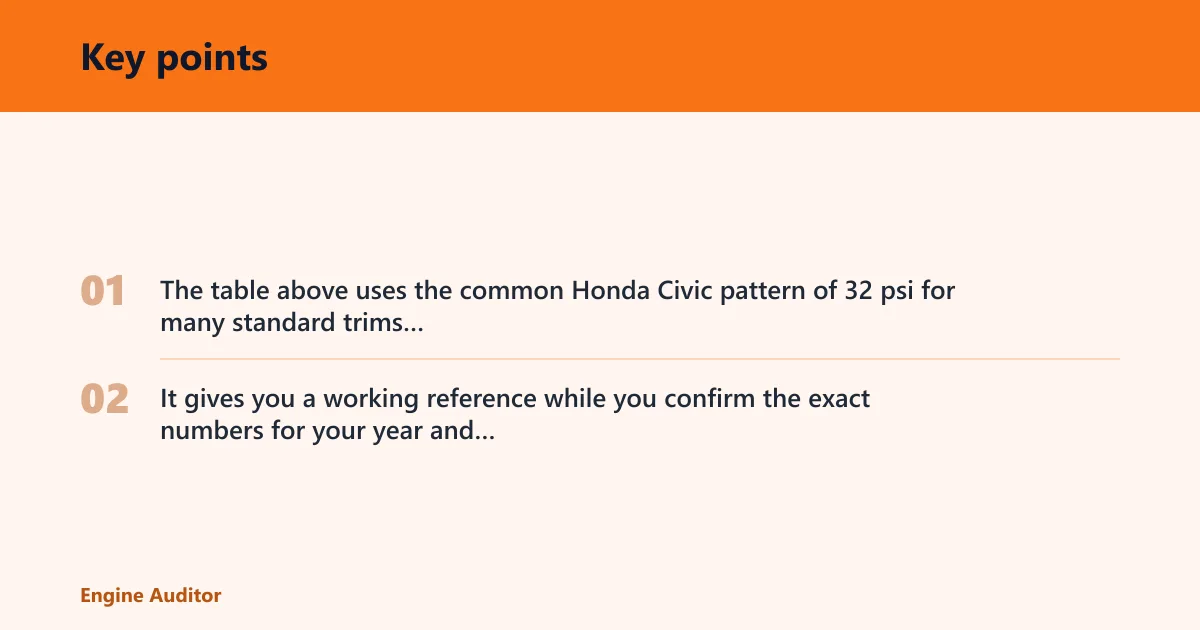
The table above uses the common Honda Civic pattern of 32 psi for many standard trims and 35 psi for some sportier 17-inch setups. That does not replace your sticker. It gives you a working reference while you confirm the exact numbers for your year and trim.
Does Civic PSI change by trim or wheel size?
Yes. Civic tire pressure can change with trim, wheel diameter, and tire size, because factory-fitted tire sizes vary across trims and affect handling and fuel efficiency. The 2010 DX and LX trims typically use P195/65R15 tires, the EX uses P205/55R16, the Si uses P215/45R17, and the Hybrid uses 195/65R15.
The 2010 DX and GX are base models. The Si is the sporty trim. The LX-S can use sportier 17-inch tire dimensions. Those differences matter because a 15-inch tire and a 17-inch tire are not treated the same by every placard, even when the car badge looks similar.
Say your Civic moves from 195/65R15 winter tires to 205/50R17 summer wheels. The new wheel and tire package may need a different pressure target, even if the car is still a Civic. In that case, the door placard and owner’s manual stay first, but the replacement setup deserves a fitment check.
Honda’s 2010 tire sizing information also points to load index values that commonly range from 87 to 91 and speed ratings that typically range from H to V. Those markings belong to tire selection, not a blanket PSI number, but they show why trim-specific tire choice matters.
How much PSI should you run with a load?
Use the normal-load placard setting for everyday driving. Move to the full-load figure only when the owner’s manual and the placard show a higher setting for extra passengers or cargo. A sedan with two adults and light luggage is not the same as a fully occupied car with a loaded trunk.
Load changes how the tire flexes and how the car sits on its suspension. More weight can make a properly inflated tire run hotter and wear differently. Honda’s label language is the safest guide because it ties pressure to the car’s actual axle loads and original tire size.
A common first-timer mistake is to add air for a road trip without checking the placard. Suppose a Civic LX has four passengers and a full trunk, but the driver leaves the tires at a lower normal-load setting. The car may feel softer, but the pressure may be below what Honda intended for the heavier condition.
How to check and adjust pressure
Check tire pressure when the tires are cold. That means the car has been parked long enough that the tires are near outside temperature. Use a reliable gauge, compare the reading with the door placard, and add air at a gas station or compressor until you reach the target.
Do not bleed air from a warm tire to “match” a cold placard reading. The tire will cool and the pressure will drop further. Instead, make adjustments when the tires have not been driven recently, then recheck all four after inflation.
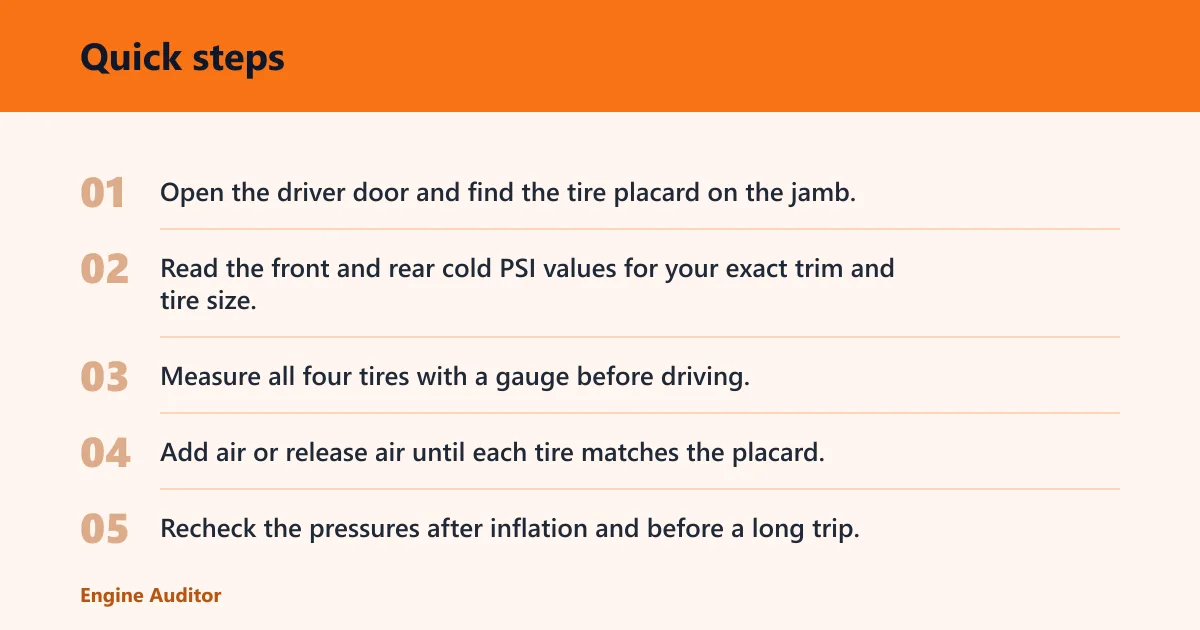
- Open the driver door and find the tire placard on the jamb.
- Read the front and rear cold PSI values for your exact trim and tire size.
- Measure all four tires with a gauge before driving.
- Add air or release air until each tire matches the placard.
- Recheck the pressures after inflation and before a long trip.
For tire-related work, follow the vehicle manual, never work under a vehicle held only by a jack, never exceed the vehicle’s rated roof, hitch, or tow limit, keep items out of airbag zones and the driver’s view, and check local laws. That caution matters when you are loading the car, changing wheels, or working near the body and interior.
What TPMS is telling you
The TPMS warning light usually means one or more tires has dropped below the system’s low-pressure threshold. It does not tell you which tire is low by itself on every Civic, and it does not replace a gauge. If the light comes on, check all four tires cold and look for slow leaks, a puncture, or a seasonal pressure drop.
Cold weather can lower PSI enough to trigger the light even when nothing is visibly wrong. If you add air and the warning stays on, some Civics may need a reset or relearn after inflation. Follow the owner’s manual for the exact reset steps on your trim and model year.
Picture a Civic that sits outside overnight during a cold snap. The next morning, the TPMS light appears after several colder days in a row. That is a cue to check all four tires, not just the one that looks flat, because air density changes with temperature and all four tires can drift downward together.
Frequently asked questions
What is the recommended tire pressure for my Honda Civic?
Use the driver-door placard for the exact value. Many Civics fall in the 32 to 35 psi range, but the correct number depends on your model year, trim, wheel size, and load setting. If the sticker shows different front and rear values, match each axle to its own number.
How much PSI should I run on a Honda Civic with 15-inch tires?
Many 15-inch Civic trims use 32 psi front and rear in normal driving, including setups such as P195/65R15 and 195/65R15. That said, the placard still controls the final number. Check for a separate full-load line if you carry extra passengers or cargo often.
How much PSI should a 2010 Honda Civic LX use?
Confirm the door-jamb label on the specific car, because Honda can list load-dependent pressure notes that override a simple single-number guess.
Does tire pressure change by Civic trim or wheel size?
Yes. Civic trim and wheel size can change the factory tire size, and that can change the placard pressure.
Can I use the same PSI front and rear on a Honda Civic?
Sometimes. Many Civic placards list the same front and rear PSI for normal driving, especially on base trims. Other cars may show different values front to rear, and in that case you should not equalize them. Follow the door sticker exactly, axle by axle.
Does tire pressure need to change when I switch from 15-inch to 17-inch wheels?
It might. A wheel-size change can alter the correct pressure target because the tire size, load rating, and fitment may change with it. The safest move is to treat the placard and owner’s manual as the first reference, then confirm the setup if the new wheels are aftermarket or non-stock.
Products related to this article
Sponsored / affiliate links. As an Amazon Associate I earn from qualifying purchases. I may earn additional commission from eligible campaigns.