What is a Honda Civic Touring Car: Features, Specs & Performance
The Honda Civic has long been a symbol of reliability, efficiency, and style for millions of drivers around the world. But when you hear the term Honda Civic Touring Car, you might wonder what sets this version apart from the standard models on the road. The answer takes us deep into the world of motorsport and performance engineering, where the Civic transforms from a practical daily driver into a serious racing machine.
Whether you’re a racing fan, a car enthusiast, or simply curious, understanding the Honda Civic Touring Car opens a window into modern motorsport, technology, and the passion that drives automotive innovation.
Understanding Touring Cars: The Basics
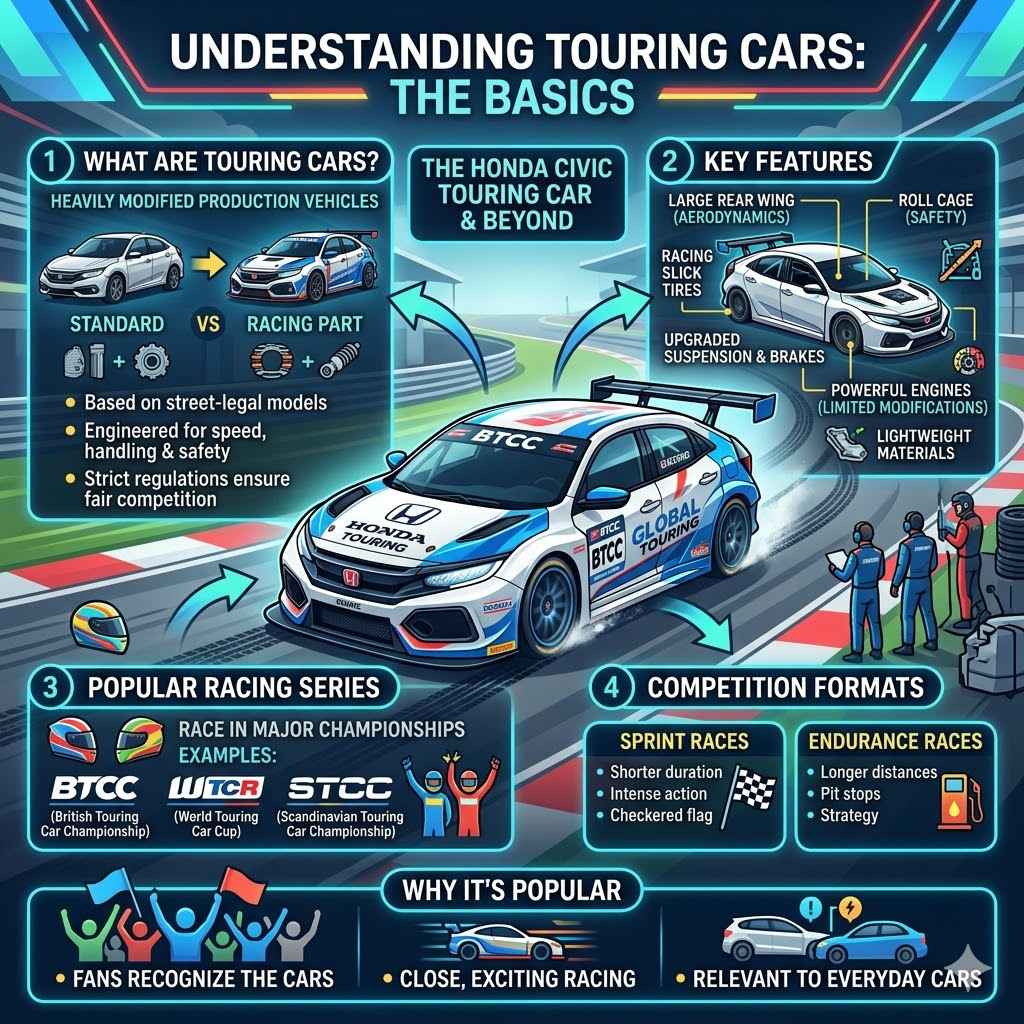
To grasp what a Honda Civic Touring Car really is, it helps to know what touring cars are in general. Touring car racing is a motorsport discipline featuring heavily modified versions of regular production cars. These vehicles must follow strict rules to keep the racing fair and exciting. Races often take place on closed circuits, with cars that look familiar but perform at a much higher level.

EcoNour
EcoNour Windshield Sunshade Compatible for Honda Civic…
- Compatible for Honda Civic 11th Gen 2022-2026 Windshield Sun Shade: Precisely designed windshield sunshade fit for Honda Civic 11t…
- Maximum Heat & UV Blocking Windshield Sunshade: Reflective windshield sun shade with a 4-layer cover blocks 99.89% of UVA & 99.95%…
- Premium Insulated Sunshade Material: High-density 280T front windshield sunshade with multi-layer reflective insulation effectivel…
As an Amazon Associate I earn from qualifying purchases.
Key features of touring cars:
- Based on production models available to the public
- Modified for better safety, speed, and handling
- Race in popular series like the British Touring Car Championship (BTCC) and the World Touring Car Cup (WTCR)
- Compete in both sprint and endurance formats
Touring car racing is popular because fans can easily recognize the vehicles on track. Unlike open-wheel racing such as Formula 1, where cars are purpose-built for the sport, touring cars retain much of their original appearance.
The Honda Civic’s Journey Into Touring Car Racing
The story of the Honda Civic Touring Car begins with Honda’s desire to showcase its engineering skills and promote the Civic as more than just an everyday compact car. The Civic has been part of touring car racing since the late 1970s, but its most famous appearances have come in the last two decades.
Why The Civic?
The Civic is an excellent base for a touring car because:
- It’s lightweight and compact, giving good balance and agility
- Honda engines are known for their reliability and ability to produce high power
- The hatchback design provides aerodynamic advantages
Honda’s racing division, known as Honda Racing (Honda Racing Team or JAS Motorsport in Europe), takes the standard Civic and re-engineers it for touring car competition. Over the years, the Civic Touring Car has raced in:
- BTCC (British Touring Car Championship)
- WTCC (World Touring Car Championship), now called WTCR
- TCR International Series
- National championships in countries like Japan, China, and Scandinavia
Evolution Of The Civic Touring Car
From the early days with the Civic EG and EK hatchbacks to the modern Type R-based racers, the Civic Touring Car has constantly evolved. The latest versions use the Civic Type R as a starting point, but almost every part is strengthened or replaced for racing.
Notable Civic Touring Car generations:
- Civic EG/EK (1990s): Early successes in Asian and European series
- Civic EP3 (early 2000s): Gained popularity in BTCC
- Civic FK2/FK8 (2010s): Dominated WTCC and TCR with turbocharged engines
- Civic FL5 (2020s): The newest platform, combining advanced aerodynamics with proven Honda performance
What Makes A Honda Civic Touring Car Different?
At first glance, a Civic Touring Car might look similar to the hot hatch you see on the street. But under the skin, it’s a very different animal. Let’s break down the key differences between a Honda Civic Touring Car and a standard Civic or Civic Type R.
Engineering And Modifications
Engine And Powertrain
A touring car engine is tuned for maximum performance within the rules. While the base engine often comes from the Civic Type R, the racing version gets upgrades like:
- Reinforced pistons and connecting rods
- Larger turbochargers (if allowed by series rules)
- Upgraded cooling systems
- Race-spec engine control units (ECUs)
- Power outputs often range from 330 to 360 horsepower, depending on regulations
The gearbox is also swapped out. Most Civic Touring Cars use a sequential racing gearbox, which allows for faster, more precise gear changes compared to the standard manual or automatic.
Suspension And Handling
Handling is critical in touring car racing. The Civic Touring Car receives:
- Adjustable racing dampers and springs
- Stronger anti-roll bars
- Reinforced suspension arms
- Lowered ride height for better stability
- Wider track (distance between wheels) for improved grip
Braking System
Stopping power is just as important as speed. Upgrades include:
- Large, ventilated racing brakes (often with six-piston calipers)
- Racing brake pads
- Advanced brake cooling ducts
Aerodynamics
Aerodynamics help the car stick to the track at high speeds. Changes include:
- Large front splitters and rear wings
- Flat underfloor panels
- Wider fenders to cover racing tires
- Ducts and vents for cooling
Safety Features
Safety is non-negotiable in motorsport. The Civic Touring Car features:
- Full FIA-approved roll cage
- Racing seats with six-point harnesses
- Fire suppression system
- Built-in data loggers and emergency shut-off switches
Interior And Weight Reduction
The inside is stripped of non-essential items. No infotainment system, air conditioning, or plush seats. Instead, there are:
- Lightweight carbon fiber or aluminum panels
- Single digital display for vital information
- Racing steering wheel with integrated controls
Visual Comparison: Touring Car Vs. Standard Civic
Here’s a quick side-by-side look at how the Civic Touring Car compares to the road model:
| Feature | Standard Civic Type R | Civic Touring Car |
|---|---|---|
| Engine Power | 315 hp | 330–360 hp |
| Transmission | 6-speed manual | Sequential racing gearbox |
| Interior | Full comfort features | Stripped, racing seat only |
| Brakes | Performance, street-legal | Motorsport-grade, larger |
| Weight | ~1,430 kg (3,150 lbs) | ~1,200 kg (2,645 lbs) |
| Aero | Factory spoiler, subtle | Large wings/splitters |
| Safety | Airbags, standard belts | Roll cage, harness, extinguisher |
Honda Civic Touring Car In Racing: Series And Achievements
Major Racing Series
The Civic Touring Car has competed (and often won) in some of the world’s top touring car competitions:
- British Touring Car Championship (BTCC): One of the oldest and most watched series, with Civic Touring Cars regularly claiming podiums and titles.
- World Touring Car Cup (WTCR): Formerly WTCC, this series features top manufacturers and drivers. The Civic Type R TCR has won multiple races and championships.
- TCR International Series: A global touring car platform using TCR technical rules, now adopted by dozens of national series. Honda has sold many Civic TCR cars to private teams worldwide.
Notable Achievements
- In 2013, the Civic WTCC won the manufacturers’ title in the World Touring Car Championship.
- The Civic Type R TCR has secured over 50 wins in TCR competitions since 2017.
- Honda drivers have achieved multiple drivers’ championships in both BTCC and WTCR.
Recent Performance (2020s)
The latest Civic FL5 Touring Car, based on the newest Type R, continues to perform strongly. Its competitive record includes race wins in the TCR Europe and TCR Asia series, showing Honda’s commitment to constant improvement.
What Is The Tcr Formula, And Why Is It Important?
One key reason the Honda Civic Touring Car is so visible today is the rise of the TCR formula. TCR stands for “Touring Car Racing,” a set of rules introduced in 2015. The TCR rulebook aims to keep costs down and competition close by:
- Limiting engine size (usually 2.0-liter turbocharged)
- Standardizing key parts (gearbox, brakes, suspension points)
- Allowing only front-wheel drive layouts
- Capping maximum power and weight
This means cars from different brands can race together on equal terms. The Honda Civic TCR is one of the most popular and successful cars built to these rules.
Tcr Vs. Wtcc/btcc
While WTCC and BTCC have their own technical rules, TCR cars can compete in many series worldwide. This flexibility helps Honda sell the Civic Touring Car to private teams, not just factory-backed squads. The result is more Civics on more grids, making the car a common sight in touring car paddocks globally.
Building A Honda Civic Touring Car: Step By Step
Turning a regular Civic into a race-winning touring car is a complex process. Here’s an overview of how manufacturers like Honda or JAS Motorsport do it.
- Start with a base Civic Type R shell—chosen for its strong chassis and performance parts.
- Disassemble the car completely, removing all road-going parts except the bare shell.
- Install a roll cage welded to FIA regulations. This strengthens the body and protects the driver.
- Add lightweight panels and racing-specific bodywork, including aerodynamic parts.
- Fit a racing engine built for high power and reliability within the rules.
- Install a sequential gearbox and a motorsport clutch for fast shifting.
- Upgrade the suspension with racing dampers, springs, and bushings.
- Equip top-level brakes with racing calipers and rotors.
- Wire a racing electrical system with data logging, custom dashboards, and emergency cutoffs.
- Fit competition wheels and slick tires for maximum grip.
- Complete the interior with a single racing seat, harness, and steering wheel.
- Test the car on track and fine-tune every setting for performance.
This process takes hundreds of hours and requires deep engineering knowledge. The final product is far more than a tuned street car—it’s a precision instrument for competition.
Costs And Accessibility
Building or buying a Honda Civic Touring Car is not cheap. The price for a new Civic Type R TCR, ready to race, is typically between $120,000 and $160,000 USD. This includes the car, spare parts, and technical support.
Running costs can add up quickly:
- Replacement parts (brakes, tires, body panels)
- Entry fees for races
- Transportation and logistics
- Team salaries
However, compared to top-level GT or prototype racing, TCR cars like the Civic are more affordable. This makes them popular with private teams and “gentleman drivers” who want to compete at a high level without factory budgets.
The Driving Experience: What It Feels Like
Driving a Honda Civic Touring Car is very different from taking a regular Civic for a spin. On track, the car feels raw, precise, and brutally fast. The steering is sharp, the brakes are powerful enough to pin you to your harness, and the suspension keeps the car glued to the asphalt.
Unique aspects of the Civic Touring Car driving experience:
- Minimal body roll, even at high speed
- Instant throttle response from the turbocharged engine
- Intense noise from stripped interior and racing exhaust
- Physical demands on the driver: Heat, vibrations, G-forces
- No driving aids like traction control or ABS (in most series)
A common mistake for beginners is underestimating the need for precise car control. Touring cars are fast, but also require careful handling—especially in close racing, where contact is frequent.
The Honda Civic Touring Car For Private Teams And Amateur Racers
Unlike many factory-built race cars, the Civic Touring Car is sold to private teams and individuals. This has helped Honda become one of the most successful brands in TCR and other touring car competitions.
Benefits for private buyers:
- Proven reliability and speed
- Factory support and spare parts from Honda or JAS Motorsport
- Technical manuals and engineering help
- Wide network for resale and upgrades
Some teams even use older Civic Touring Cars for track days or lower-level club racing. This gives new drivers a way into the sport without starting from scratch.
How Civic Touring Cars Influence Road Cars
You might wonder if all this racing technology affects the Hondas you see on the street. The answer is yes—racing often leads to improvements in production vehicles.
Examples of racing technology in road Civics:
- Advanced turbocharging and cooling systems
- Stronger suspension parts
- Improved brakes
- Aerodynamic lessons applied to body design
Honda’s “race on Sunday, sell on Monday” philosophy means that lessons learned in touring car racing often filter down to the cars regular people drive every day.
Common Myths And Misunderstandings
Myth 1: Touring Cars Are Just Tuned Street Cars
While the Civic Touring Car starts as a production model, it’s almost entirely rebuilt. Everything from the roll cage to the engine internals is designed for racing.
Myth 2: All Touring Cars Are The Same
Rules vary between BTCC, WTCR, and TCR. That means a Civic built for one series might need changes to compete in another. Always check the technical regulations before buying or building a car.
Myth 3: Racing Civics Are Only For Professionals
Many amateur drivers and private teams race Civic Touring Cars. You don’t need to be a factory driver to compete—although the learning curve is steep.
Civic Touring Car Vs. Other Touring Cars
How does the Honda Civic stack up against its rivals? Here’s a quick comparison with other popular TCR cars:
| Car Model | Engine | Power (hp) | Weight (kg) | Drive |
|---|---|---|---|---|
| Honda Civic Type R TCR | 2.0L Turbo I4 | 340 | 1,250 | FWD |
| Hyundai i30 N TCR | 2.0L Turbo I4 | 350 | 1,285 | FWD |
| VW Golf GTI TCR | 2.0L Turbo I4 | 350 | 1,285 | FWD |
| Peugeot 308 TCR | 1.6L Turbo I4 | 340 | 1,250 | FWD |
The Civic is competitive in power and weight, but its reputation for reliability and support gives it an edge for many teams.
Two Non-obvious Insights For Beginners
- Setup Flexibility Is Key: Many new racers focus on raw power, but in TCR and other touring car classes, the setup (suspension, tire pressures, aero) has a bigger impact on lap times than sheer horsepower. Teams spend hours tuning these details for each track.
- Racecraft Matters More Than Speed: Touring car races are known for close battles, frequent overtaking, and even light contact. Drivers must be skilled at defending, attacking, and making split-second decisions. Pure speed won’t win races if you can’t navigate the pack.
Where To See Honda Civic Touring Cars In Action
If you want to watch these cars compete, look for events like:
- BTCC races (UK, televised and streamed)
- WTCR rounds (Europe, Asia, Middle East)
- TCR Europe and TCR Asia series
- National TCR championships (USA, Australia, Scandinavia, etc.)
Schedules, driver lists, and results are available from the FIA WTCR official site.
The Future Of The Honda Civic Touring Car
As motorsport evolves, Honda shows no sign of slowing down. New rules on hybrid and electric touring cars are coming, and Honda is likely to adapt its Civic platform for these changes. Expect to see more advanced technology, even closer racing, and continued success for the Civic on circuits worldwide.
For car fans, the Honda Civic Touring Car proves that even an everyday compact car can become a world-class racer with the right engineering and passion.

Frequently Asked Questions
What Is The Main Difference Between A Honda Civic Touring Car And A Normal Civic?
A Honda Civic Touring Car is a race-prepared version of the Civic, with major upgrades for speed, handling, and safety. It keeps the basic shape but adds a roll cage, racing suspension, powerful brakes, and a stripped interior. The engine and gearbox are also tuned for racing.
Can You Buy A Honda Civic Touring Car For Personal Use?
Yes, private teams and individuals can buy Civic Touring Cars, usually from Honda’s motorsport partners like JAS Motorsport. However, these cars are not street legal and are intended for use on racetracks only.
How Much Does A Honda Civic Touring Car Cost?
A new Civic Touring Car built to TCR rules typically costs between $120,000 and $160,000 USD. Running costs (maintenance, parts, race entry fees) are extra.
Has The Honda Civic Touring Car Won Any Major Championships?
Yes, the Civic Touring Car has won multiple manufacturer and driver championships in series like the WTCC, WTCR, BTCC, and TCR International. It is one of the most successful touring cars in recent years.
Is The Civic Touring Car Only For Professional Drivers?
No, many amateur and semi-professional drivers race Civic Touring Cars. Honda’s support for private teams means the car is common in both top-level and club racing.
The world of Honda Civic Touring Cars is rich with history, technology, and excitement. Whether you’re a fan, a racer, or just curious about motorsport, the Civic’s journey from street car to touring car legend is proof of Honda’s racing spirit and engineering excellence.
Related pick: Check today's price on Amazon
Products related to this article
Sponsored / affiliate links. As an Amazon Associate I earn from qualifying purchases. I may earn additional commission from eligible campaigns.