Ford Rough Idle in Cold Weather: Ford-specific Fixes
Start with battery voltage and cranking speed first, then scan for Ford misfire or fuel-trim codes. If battery voltage drops below about 9.6 volts while cranking, address that first before chasing injectors, coils, or plugs. Skipping that order burns money on parts that will not cure a cold idle stumble and can leave you with a no-start on the next freezing morning. This guide gives a Ford-specific test sequence for EcoBoost, naturally aspirated, and battery-related cold-start rough idle causes, in the right order before you replace anything.
What you’ll need


- OBD-II scan tool with live data, pending codes, and misfire counters
- Basic hand tools
- MAF-safe cleaner
- Flashlight
- Gloves
- Battery tester or multimeter
- Smoke tester, if available
Why does my Ford idle rough only when it is cold?
Cold weather changes the first minute of Ford engine management. The PCM adds cold-start fuel enrichment, raises idle speed, and watches misfire detection more closely while adaptive fuel trims relearn. If a battery is weak, a plug gap is wide, or air enters where it should not, the fault may show up only during the first cold idle.
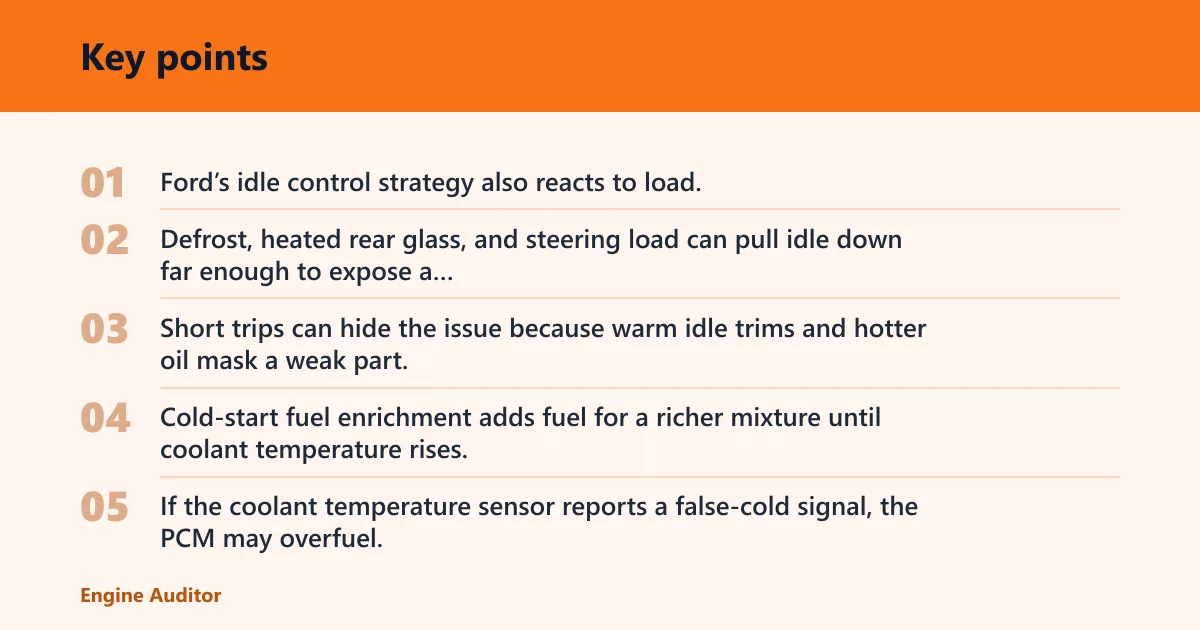
Ford’s idle control strategy also reacts to load. Defrost, heated rear glass, and steering load can pull idle down far enough to expose a borderline coil, a sticky PCV valve, or a MAF signal that looks acceptable once the engine is warm. Short trips can hide the issue because warm idle trims and hotter oil mask a weak part.
How Ford cold-start fueling changes idle quality
Cold-start fuel enrichment adds fuel for a richer mixture until coolant temperature rises. If the coolant temperature sensor reports a false-cold signal, the PCM may overfuel. If fuel pressure is low or an injector leaks down, the first restart after an overnight soak can idle rough, then improve as pressure stabilizes.
How battery voltage and fast idle can expose a weak part
Low voltage slows starter speed and can reduce coil output, injector response, and sensor accuracy. Ford modules can also set pending codes without a warning lamp when voltage is marginal. Fast idle helps a weak engine keep running, so a problem may appear only as the PCM drops idle speed after the first minute.
How short-trip warmup can mask the real fault
A short commute may never let the engine reach stable closed-loop operation. That can hide vacuum leaks, intake tract leaks, or a dirty throttle body. If the rough idle appears again after an overnight soak, cold starts matter more than steady cruising.
Ford cold idle diagnosis table

| Symptom pattern | Likely cause | What to check first | Scan-tool clue | Next step |
|---|---|---|---|---|
| Rough only during first 30 to 90 seconds | Weak battery, slow crank, or cold-start fuel issue | Battery voltage, cranking speed, freeze-frame data | Low cranking volts, rich trims, pending misfire code | Test charging output, then inspect plugs and coils |
| Rough idle with high idle speed on cold start | Vacuum leak, PCV leak, intake boot crack | PCV hoses, intake boots, brake booster hose | Positive fuel trims at idle that improve off-idle | Smoke test the intake and repair the leak |
| Rough idle after rain, car wash, or snow melt | Water ingestion, intake tract leak, coil boot issue | Air filter box, intake snorkel, coil boots | Random misfires, often one or two cylinders | Dry the intake path and inspect ignition parts |
| Rough idle only on EcoBoost cold start | Carbon buildup, direct-injection fuel, coil boot, injector issue | Misfire counters, plugs, coil boots, fuel pressure | Cylinder-specific misfire counts, no turbo codes | Clean intake valves if verified, then retest |
| Idle smooths as soon as coolant warms | False coolant signal, MAF contamination, adaptive trims | Coolant temperature reading, MAF airflow, trims | Coolant temp far from ambient after overnight soak | Test the sensor and inspect the MAF |
Ford cold idle diagnosis steps
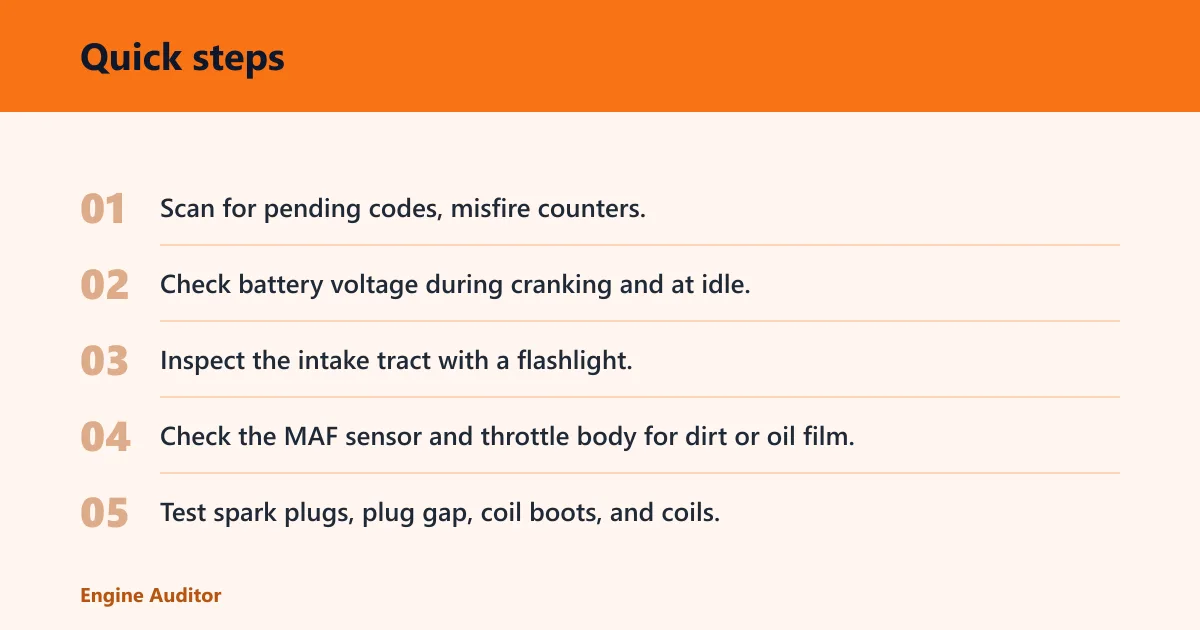
- Scan for pending codes, misfire counters, and freeze-frame data with the key on and engine off, then again at cold idle. Look for cylinder-specific misfires, fuel-trim codes, or coolant temperature data that does not match ambient temperature.
- Check battery voltage during cranking and at idle. A common rule of thumb is that cranking voltage should stay above about 9.6 volts; if it falls lower, test the battery and charging system before checking engine parts.
- Inspect the intake tract with a flashlight. Check the air filter, air box, intake boot, throttle body, PCV hoses, and the brake booster hose for splits, loose clamps, oil residue, or ice. Any gap can create a cold vacuum leak.
- Check the MAF sensor and throttle body for dirt or oil film. Clean the MAF only with MAF-safe cleaner; if trims and airflow data still look wrong after cleaning, move to leak testing instead of replacing parts.
- Test spark plugs, plug gap, coil boots, and coils. Cold weather raises misfire risk on worn plugs and marginal coils, especially on EcoBoost engines where coil boots can track or leak under moisture.
- Verify fuel pressure and injector behavior. If the engine roughs up after sitting overnight and then improves, look for injector leak-down or weak cold-start enrichment rather than assuming a turbo fault.
- Check coolant temperature sensor readings from a full cold soak. The scan tool should usually show a coolant temperature value close to outside air temperature before start; a false-cold signal can command too much fuel and unstable idle.
Say your Ford idles rough only for 45 seconds after an overnight freeze. That pattern points to cold-start enrichment, voltage drop, or a cylinder misfire that clears as the PCM trims fuel. Check freeze-frame data, then compare coolant temperature to ambient. If the sensor reads 20 degrees higher or lower than outside air, that reading deserves attention before fuel parts.
Suppose the idle shakes most when the defroster is on. Added electrical load can reveal weak battery or charging output, and it can also drag down a marginal idle control strategy. Check charging voltage at the battery, then watch short-term fuel trim at idle with the defroster on and off. A large trim swing often points to unmetered air.
Can a bad battery cause rough idle on a Ford?
Yes. A weak battery can cause rough idle on a Ford in cold weather because low cranking voltage affects starter speed, ignition energy, and module behavior. If voltage sags hard during cranking or the charging system is weak at idle, fix that first; engine parts may test fine while voltage is the real fault.
Check battery voltage during cranking and at idle
Use a multimeter at the battery posts. A rested battery should usually read about 12.6 volts, and the charging system should typically show about 13.5 to 14.7 volts with the engine running. If cranking voltage falls under about 9.6 volts, the test order starts with the battery, not the coils.
Look for low-voltage control-module behavior
Ford modules may set pending misfire or fuel-trim codes before a warning lamp turns on. Low voltage can also make adaptive fuel trims slow to settle after startup. If the scan tool shows erratic idle control values right after start, compare them with battery and alternator readings before replacing sensors.
Confirm charging-system output before replacing engine parts
Check for voltage drop at idle with lights and rear defrost on. If output is weak, the engine may rough up only when electrical load rises. Repair the charging problem first, then clear codes and retest after a cold soak.
Does EcoBoost rough idle mean the turbo is failing?
Usually no. On Ford EcoBoost engines, rough idle is more often tied to misfire, vacuum leaks, carbon buildup, ignition faults, or injector issues than to turbo failure. Turbo problems usually bring boost loss, whistle, smoke, or underboost codes, not a cold idle shake by itself.
Separate turbo symptoms from misfire and air-leak symptoms
If the engine idles rough but drives normally under load, focus on the intake, PCV system, plugs, coils, and fuel trims first. A turbo fault usually shows up as poor boost response, unusual noises, or a consistent power loss. Cold idle alone is a weaker sign.
Check for carbon buildup, coil boots, and injector clues
EcoBoost direct injection can be more sensitive to intake valve carbon buildup than port-injected engines. That can cause cold idle stumble and cylinder-specific misfires. Inspect coil boots for tracking, read misfire counters, and review fuel pressure before condemning the turbo or replacing injectors.
Use Ford-specific data before you condemn the turbo
Watch live data for manifold pressure, commanded idle speed, fuel trims, and misfire counts. If trims are lean only at idle and improve with rpm, a leak is more likely than a turbo fault. If one cylinder misfires repeatedly, ignition or injector work comes before turbo replacement.
Common mistakes
Replacing coils or plugs without checking misfire data wastes time. A rough idle on a Ford can come from a vacuum leak, a bad PCV valve, or low voltage, and those faults leave different clues in live data. Start with the scan tool, then work outward from the intake and ignition.
Cleaning the MAF when the real problem is an intake boot crack is another common miss. MAF contamination usually changes airflow readings, while a leak often drives fuel trims positive at idle and improves off-idle. Use smoke testing or a close visual inspection before buying a sensor.
Do not ignore the battery or coolant sensor just because the engine starts. A false-cold coolant reading changes startup fueling, and low battery voltage can upset control modules. Say your Escape shakes only on 20-degree mornings, then smooths out after one minute; that pattern deserves voltage and coolant data before parts.
For prevention, keep the battery tested before winter, replace worn plugs on schedule, and inspect the PCV routing and intake hoses at regular service intervals.
Frequently asked questions
Why does my Ford idle rough only when it is cold outside?
Cold weather can expose weak ignition, low battery voltage, vacuum leaks, or a sensor that reads wrong during startup. Start with a scan for pending codes and a battery check, then compare coolant temperature data to ambient temperature. If trims or misfires appear only cold, the fault is usually early in the warm-up sequence.
What Ford parts most often cause cold-start rough idle?
On many Ford models, the usual suspects are spark plugs, ignition coils, PCV hoses, intake boots, the MAF sensor, and the coolant temperature sensor. EcoBoost engines add carbon buildup and coil-boot sensitivity to the list. A scan tool should guide the next step before any parts are replaced.
How do I tell if my Ford has a vacuum leak in cold weather?
Look for high or unstable idle, positive fuel trims at idle, and a change in idle quality when you spray around the intake only if a proper test method is available. A smoke test through the intake is better. Check the PCV hose, brake booster hose, throttle body gasket, and intake boots first.
Does Ford EcoBoost rough idle mean the turbo is failing?
Not by itself. A cold idle shake on EcoBoost more often points to misfire, carbon buildup, a vacuum leak, or an injector issue. Turbo faults usually show boost-related symptoms too. Review misfire counters, fuel trims, and boost data before condemning the turbocharger.
What should I check first if my Ford shakes at idle on startup?
Check battery voltage, pending codes, and freeze-frame data first. Then inspect the intake tract, PCV hoses, and coil boots. If the scan tool shows a coolant temperature reading that is far off ambient, test that sensor next. This order avoids replacing parts that are not the cause.
Can old spark plugs cause rough idle only in winter?
Yes. Worn plugs or a wide plug gap can misfire more easily in cold dense air, especially during the first minute after startup. On Ford engines, that can show up as a winter-only rough idle even if the engine runs better once warm. Check plug condition and gap against the service spec.
Is a Ford rough idle in cold weather safe to drive?
If the engine only stumbles briefly and then clears, short trips may be possible, but a flashing check-engine light, severe shaking, fuel smell, or repeated stall risk usually means stop driving. Rough idle can worsen in freezing weather and can turn into a no-start if the underlying fault is ignored.
Do I need a scan tool to diagnose cold idle problems on a Ford?
Yes, if you want a useful diagnosis. A scan tool gives pending codes, misfire counters, live fuel trims, freeze-frame data, and coolant temperature readings. Without that data, you are guessing between battery, fuel, air, ignition, and sensor problems, which leads to unnecessary parts replacement.
Products related to this article
Sponsored / affiliate links. As an Amazon Associate I earn from qualifying purchases. I may earn additional commission from eligible campaigns.