How Cold Weather Changes Oil Pressure at Startup
How Cold Weather Changes Oil Pressure at Startup vs at Operating Temperature
Answer box: High oil pressure right after a cold start is usually normal because thick oil flows slowly. What is not normal is a warning light that stays on, flashes, or pressure that stays below spec once the engine is fully warm. Shut the engine off immediately if hot-idle pressure is low or the light does not go out.
If oil pressure is high at cold start and then drops as the engine warms, that is usually expected; if hot idle falls below spec or the warning light flickers, treat it as a fault. Ignoring that difference can hide bearing damage or send you after a healthy engine. This guide explains startup, warm-up, and operating-temperature pressure behavior, and how to tell normal winter thickening from a real oiling problem.
| Factor | How Cold Weather Changes Oil Pressure at Startup | at Operating Temperature | Winner |
|---|---|---|---|
| Pressure level | High oil pressure right after a cold start is usually normal because thick oil flows slowly and creates more resistance through the pump, filter, and galleries. | Pressure is lower than the cold-start peak because the oil thins and moves with less resistance. | Tie |
| Warm-up behavior | Pressure may stay high for a short time, then gradually drop as the engine warms; a brief delay to light-out can be normal in freezing weather. | Pressure should stabilize once the oil is fully warm and remain within the manufacturer-approved range. | at Operating Temperature |
| Warning light | The oil light may go out after a short delay at cold start, but a steady or flashing light is not normal. | A warning light that stays on, flashes, or flickers at hot idle is treated as a fault and should prompt shutdown and diagnosis. | at Operating Temperature |
| Diagnostic value | Cold-start pressure alone can be misleading because thick winter oil can make a healthy engine look unusually high. | Hot-idle pressure is the reading that exposes wear, pump weakness, low oil level, or relief-valve leakage. | at Operating Temperature |
| Risk of hidden problems | Ignoring the difference between cold-start and warm pressure can hide bearing damage or send you after a healthy engine. | Low pressure after full warm-up is the condition that points toward a real mechanical fault. | at Operating Temperature |
| Oil viscosity effect | Cold ambient temperature raises oil viscosity, making oil thicker and harder to pump. | Oil thins at operating temperature and flows more easily. | Tie |
| Engine type differences | Gas engines often show a cold-start spike; diesel engines can have longer cranking, slower pressure rise, and heavier pump load in cold weather. | At operating temperature, gas engines should be steady within spec; diesel engines with low idle pressure, flicker, or near-spec readings may indicate wear or leakage. | Tie |
| Best-fit use | Best for checking whether the pressure rise and warning-light delay match freezing conditions and oil grade during startup. | Best for determining whether pressure is truly healthy because it should be compared against hot-idle spec and manufacturer-approved range. | at Operating Temperature |
| Maintenance action | Usually normal if the oil is the approved viscosity and the light goes out after a short delay; verify level if needed. | If pressure is below spec or the light remains on, shut the engine off immediately and diagnose with a mechanical gauge if needed. | at Operating Temperature |
| Effect of short parking vs overnight soak | Overnight soak increases cold-start pressure effects; short parking changes less because the engine and oil retain more heat. | Operating temperature is less affected by parking duration because the oil has already warmed and stabilized. | at Operating Temperature |
How cold viscosity and SAE grades affect startup pressure
Cold ambient temperature raises oil viscosity, so the pump must push a thicker fluid through galleries, filter media, and bearing clearances. That raises pressure at startup and can delay stabilization after an overnight soak. Short parking usually changes less than a full night outside. SAE J300 viscosity grading is why the winter rating matters for cold cranking and pumpability.
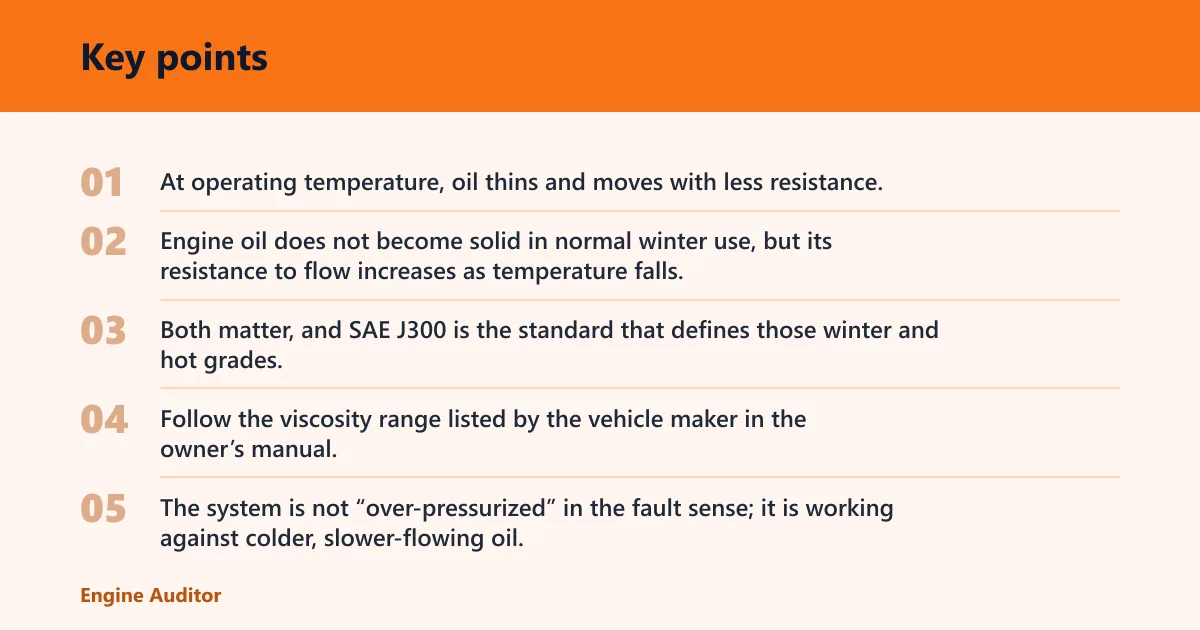
At operating temperature, oil thins and moves with less resistance. Pressure often drops from the cold-start peak, and that drop can be normal if the reading stays within the manufacturer-approved range in the owner’s manual. Compare the phase, not just the number.
Why does viscosity rise in freezing weather?
Engine oil does not become solid in normal winter use, but its resistance to flow increases as temperature falls. A 0W-20, 5W-30, or 10W-30 grade has two jobs: cold-crank performance for startup and high-temperature viscosity for hot running. Both matter, and SAE J300 is the standard that defines those winter and hot grades.
For cold weather, the first number and the W rating tell you how the oil behaves during cranking and the first seconds after start. For hot operation, the second number matters more because it governs film strength and pressure once the oil is fully warm. Follow the viscosity range listed by the vehicle maker in the owner’s manual.
Why is cold-start pressure often higher?
Thicker oil creates more resistance through the pump, filter, and engine galleries, so the gauge or sensor may show higher pressure right after start. That is expected. The system is not “over-pressurized” in the fault sense; it is working against colder, slower-flowing oil.
Cold-start pressure can be especially noticeable after an overnight soak. A five-minute stop in mild weather usually does not produce the same cold-start pressure spike, because the oil may not have drained fully back to the pan and the engine mass may not have cooled as deeply.
How do startup, warm-up, and operating temperature differ?
Pressure should stabilize as the oil warms, coolant climbs toward operating temperature, and the thermostat opens. The engine may reach usable heat faster than the oil does, especially on short trips. Oil temperature can lag well behind coolant temperature, and OEM service information commonly treats oil-pressure warning behavior as a separate issue from coolant warm-up.
That lag matters because hot-idle pressure is the reading that exposes wear, pump weakness, or low oil level. If the engine sounds normal at cold start but pressure sags once fully hot, the concern shifts away from winter thickening and toward a mechanical fault.
What changes at startup?
At startup, the important question is whether the pressure rise and warning-light delay fit the ambient temperature and the oil grade. A brief delay to light-out can be normal in freezing weather, especially after an overnight soak. A steady or flashing light is not normal.
What is the difference between overnight soak and short parking?
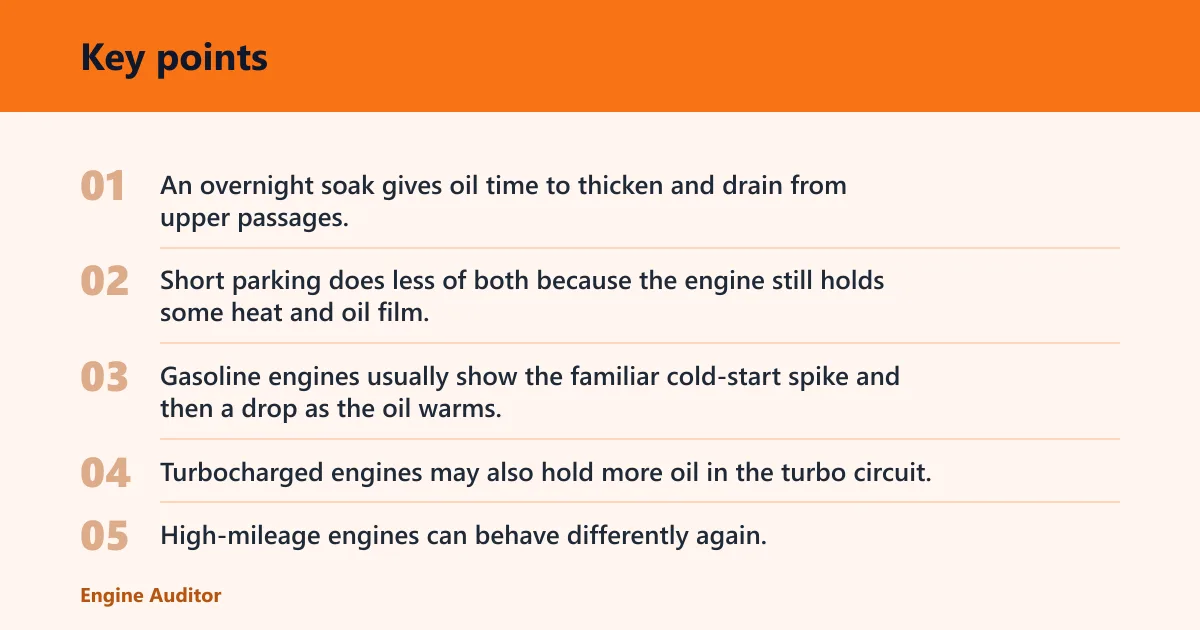
An overnight soak gives oil time to thicken and drain from upper passages. That can produce a higher initial reading and a slightly longer delay before the pressure light goes out. Short parking does less of both because the engine still holds some heat and oil film.
Suppose a car sits outside at 10°F overnight and shows a high pressure reading for the first minute, then settles down as the block warms. That can be normal. If the same car sits for 20 minutes in the same weather and behaves almost identically, the shorter stop probably preserved enough heat to soften the effect.
How do gas engines and diesel engines differ at startup?
Gasoline engines usually show the familiar cold-start spike and then a drop as the oil warms. Diesel engines, especially pickup diesels, can show longer cranking, slower oil warm-up, and a heavier load on the pump because of larger oil volumes and tight cold-flow demands. Turbocharged engines may also hold more oil in the turbo circuit.
High-mileage engines can behave differently again. Worn bearings and larger clearances can pull hot-idle pressure down faster than a fresh engine, even if the cold-start number still looks normal. That is why you should not judge the engine from cold pressure alone.
What should the oil-pressure light do?
The oil-pressure warning light is an electrical warning, not a direct mechanical gauge. It usually comes on when the switch or sensor sees pressure below a low threshold, then goes out as pressure rises. The exact seconds before light-out vary with temperature, oil grade, and engine design.
A flashing or steady oil light after the engine is running is generally treated as a stop-and-check event. If the light stays on after the start sequence, shut the engine off and diagnose immediately. Do not keep driving on the assumption that winter oil is the only cause.
Which oil grades work best in winter?
Use the manufacturer-approved viscosity range first. A 0W-20 may be correct for one engine and wrong for another, even in the same cold climate. The right choice balances cold-crank performance with hot viscosity and oil-film protection.
How does the SAE grade format affect cold-crank behavior?
The first part of the SAE grade tells you how the oil behaves in cold cranking. A lower winter rating generally means better pumpability and less startup delay in freezing conditions. That is one reason synthetic oil often helps cold-start behavior; it usually flows better at low temperature than conventional oil.
This does not mean thinner is always better. If the manufacturer approves 5W-30 for your engine, moving to a lower winter grade without approval may change hot oil pressure and film strength in ways the engine was not designed for.
How does high-temperature viscosity affect hot idle?
The second number in the SAE grade matters once the engine is fully warm. Hot idle pressure depends on how well the oil resists thinning at operating temperature, especially in engines with looser bearings or higher wear. A grade that is too thin for the design can show low hot-idle pressure.
That is why a winter complaint should be checked in two phases. A high cold-start reading can be normal, while a low hot-idle reading can point to a problem. Those are different clues, not the same symptom in different clothing.
How do you choose the manufacturer-approved range?
- Check the owner’s specification. Use the approved SAE grades listed for your engine, not a general winter guess. The correct range accounts for pump capacity, bearing clearances, and hot-film needs.
- Match the climate to the grade. If freezing starts are common, choose the approved oil with the better cold-crank rating for that range. That can shorten startup delay without sacrificing hot protection.
- Do not chase the light blindly. If the warning lamp still behaves abnormally after the right oil is installed, look for sensor, filter, pump, or wear issues instead of jumping to a thicker grade.
What does a good or bad oil pressure pattern look like?
| Ambient temperature | Observed oil-pressure symptom | Likely cause/action |
|---|---|---|
| Below freezing, overnight soak | High reading immediately after start, then gradual drop over 1 to 5 minutes; light goes out after a short delay. | Usually expected cold thickening. Verify oil level, confirm approved viscosity, and watch for stable hot-idle pressure. |
| Below freezing, overnight soak | Oil light stays on more than a few seconds, flashes, or pressure remains near zero on a gauge. | Shut the engine off. Check oil level, filter installation, sensor wiring, and pump pickup; do not keep driving. |
| About 20°F to 40°F after 5 minutes of running | Pressure drops from the cold peak but remains above the maker’s hot-idle spec; no warning light. | Normal warm-up. Oil is thinning as temperature rises and flow is improving. |
| About 20°F to 40°F after 5 minutes of running | Pressure falls sharply as engine speed returns to idle, or the lamp flickers at stops. | Check for low oil level, wrong viscosity, weak pump output, or a sensor/switch fault. Mechanical gauge confirmation is important. |
| Fully hot idle, gas engine | Pressure is lower than cold start but stable and within spec. | Normal. Hot oil always reads lower than cold oil. |
| Fully hot idle, high-mileage gas or diesel engine | Pressure is near or below spec, especially with the warning light flicker at idle. | Possible bearing wear, pump wear, relief valve leakage, or low oil level. Diagnose with a mechanical gauge. |
How do you tell a bad sensor from real pressure loss?
The warning light can lie in either direction. A bad oil pressure sensor or switch can mimic low pressure, while a wiring fault can cause a false lamp even when the mechanical pressure is fine. That is why the electrical signal and the actual oil pressure are not the same thing.
What warning light behavior points to common failure modes?
A failing switch may stick open or closed, read erratically when cold, or react badly to vibration. A sensor can drift enough to show odd live-data values without matching actual pressure. Water intrusion, damaged wiring, and poor connectors can create the same complaint.
Flashing light behavior matters. A brief flicker at hot idle is more concerning than a stable reading that simply sits lower than the cold-start peak. Either way, the light itself is only a clue until you verify pressure mechanically.
How does scan tool live data compare with a mechanical gauge?
A scan tool can show what the engine computer thinks the sensor is reporting. That helps you see whether pressure changes smoothly with rpm and temperature, or whether the signal jumps around. If the live data looks unstable, suspect the sensor circuit before you assume the engine is failing.
A mechanical gauge is commonly used as the confirmation tool for oil-pressure diagnosis. If the gauge shows healthy pressure while the dash lamp complains, the problem is likely electrical. If both agree on low pressure at hot idle, treat it as a real lubrication fault until proven otherwise.
- Compare cold and hot readings. Note the pressure right after start and again when the engine is fully warm. A normal pattern is high cold pressure, then lower but stable hot pressure.
- Check live data first. Read the sensor signal with a scan tool and compare it to engine speed and temperature. Erratic data points to a wiring or sensor problem.
- Confirm with a gauge. Install a mechanical oil-pressure gauge if the light, scan data, or sound of the engine does not match. That separates electrical faults from true low pressure.
When does a sensor point to a wiring issue?
If the warning lamp behaves oddly only when the engine bay is wet, hot, or vibrating, the sensor circuit is suspect. A bad ground, damaged wiring, or connector issue can create intermittent readings. That is more common than a serious oiling fault showing up only when the weather changes.
Picture a truck that flashes the oil light in a snowstorm but shows normal mechanical pressure and stable live data once the wiring is dried and checked. That pattern points to an electrical fault, not a winter pressure crisis.
Why does pressure drop when the engine is warm?
Pressure often drops as the engine heats up because oil viscosity falls and internal leakage paths open slightly with temperature. That drop is expected. The danger is when the hot-idle number falls below the maker’s spec or keeps falling with mileage.
How do bearing clearances and wear affect hot idle?
Main and rod bearing clearances determine how much oil leaks past the journals at idle. A new engine has manufacturing tolerances that allow some variation, but worn bearings increase the escape path and lower hot pressure. That is why a tired engine can show acceptable cold pressure and weak hot pressure.
Low hot-idle pressure is not always from bearings, but bearings are one of the first places to look when the engine has high mileage and the oil level is correct. If the number improves noticeably with rpm, the pump may still be moving enough oil under load while idle leakage is too high.
How do the oil pump and relief valve affect pressure?
The oil pump’s output changes with temperature because thicker cold oil loads the pump more and thinner hot oil flows easier through the system. At cold idle, the pump may build pressure quickly. At hot idle, the same pump may struggle if it is worn or if the pressure relief valve is leaking open too early.
Internal wear and excess clearances reduce pump efficiency. A weak pump can still pass a casual check at startup and fail the real test once the oil is hot and thin. That is why the operating-temperature reading matters so much.
How do the filter and bypass valve affect startup pressure?
A cold oil filter can restrict flow until the oil warms. If the media is loaded or the oil is very thick, the bypass valve may open to protect flow. That bypass event can keep the engine alive, but it also means unfiltered oil may circulate until pressure and flow normalize.
The anti-drainback valve also matters after parking. If it leaks, oil can drain from the filter and upper passages overnight, which increases startup delay and makes the first pressure rise slower. That is common enough to check before blaming the pump.
When should you shut the engine off?
Shut the engine off immediately if the oil-pressure light stays on, flashes steadily, or comes on with a mechanical gauge reading that is clearly low. Do not assume cold weather explains it. A real pressure loss can damage bearings fast.
What does a steady or flashing warning light mean?
A steady or flashing warning light after the engine is running is a stop signal, not a “drive carefully” signal. If it appears after warm-up, the problem is less likely to be winter oil thickening and more likely to be a fault in the sensor circuit, pump, pickup, or bearing clearances.
Even if the engine sounds normal, the light can warn you before noise starts. Low oil pressure often damages parts first and makes noise later.
What does low hot-idle pressure after warm-up mean?
If pressure is acceptable cold but poor at fully hot idle, treat that as a mechanical diagnosis problem. The likely causes include wear, a weak pump, a leaking relief valve, low oil level, or a filter issue. Temperature is exposing the weakness.
Some engines, especially high-mileage ones, sit near the lower end of the spec at hot idle and are still acceptable. The key phrase is within spec. Below spec is not normal just because the engine is hot.
What immediate checks should you make?
- Check the dipstick first. Low oil level can cause pressure loss under braking, cornering, or at idle. Refill to the proper mark before anything else.
- Inspect the filter. Make sure it is the correct part, tightened properly, and not leaking. A poor filter or stuck bypass valve can create winter complaints.
- Stop if the light stays on. If the lamp is steady or flashing after those quick checks, shut the engine off and diagnose the cause before driving farther.
Should you compare startup or operating temperature?
Choose How Cold Weather Changes Oil Pressure at Startup vs at Operating Temperature if you are trying to separate a normal winter spike from a real cold-start problem. It is the better lens for overnight soak behavior, oil-grade choice, filter drain-back, and the first seconds before the light goes out.
Choose at Operating Temperature if you want the safer diagnostic answer. It is the better lens for hot-idle pressure loss, bearing wear, pump output, relief-valve problems, and any case where the warning light flickers after the engine is fully warm.
Verdict: How Cold Weather Changes oil pressure at Startup or at Operating temperature?
Choose How Cold Weather Changes Oil Pressure at Startup if your car sits outside at 10°F overnight and shows a high pressure reading for the first minute, then the oil light goes out after a short delay as the block warms.
Choose at Operating Temperature if the engine is fully warm and the hot-idle pressure falls below spec or the warning light flickers, because that is the phase where the article says to confirm with a mechanical gauge and shut down if pressure is below spec.

Frequently asked questions
Why is my oil pressure higher on a cold start?
Cold oil is thicker, so the pump has to push against more resistance through galleries, the filter, and the bearing clearances. That raises pressure temporarily after startup. If the reading falls to a stable hot-idle level once the engine warms, that pattern is usually normal.
Is low oil pressure at idle normal when the engine is warm?
Low hot-idle pressure is only normal if it stays within the manufacturer’s specification. A drop from the cold-start peak is expected, but a lamp flicker or a reading below spec points to wear, low oil level, pump issues, or a sensor fault that needs diagnosis.
How long does oil take to warm up in winter?
It depends on ambient temperature, trip length, engine size, and whether the vehicle sat overnight or only briefly. Coolant often warms faster than oil, so a five-minute drive may not fully heat the oil. Short trips can leave oil cold for much longer than the gauge suggests.
Can cold weather cause the oil pressure light to come on?
Yes, but the reason is often startup delay or a false signal rather than true engine damage. Thick oil can slow pressure rise, and a weak sensor, switch, or wiring connection can mimic low pressure. A steady or flashing light after the engine starts still calls for immediate shutdown and diagnosis.
What oil viscosity should I use for freezing temperatures?
Use the manufacturer-approved SAE grade for your engine, such as 0W-20, 5W-30, or 10W-30, rather than guessing. For freezing weather, the lower winter rating usually helps cold-crank flow. The second number still has to match the engine’s hot-running needs.
Does synthetic oil help with cold-start oil pressure?
Often, yes. Synthetic oil generally flows better in the cold than conventional oil, so it can shorten startup delay and reduce pump strain. That said, the oil still has to match the approved viscosity range. Synthetic is not a fix for worn bearings, a weak pump, or a bad sensor.
Products related to this article
Sponsored / affiliate links. As an Amazon Associate I earn from qualifying purchases. I may earn additional commission from eligible campaigns.
 ECOGARD X10023 Cartridge Engine Oil Filter for Conventional Oil - Premium Replacement | Fits 2018-2023 Volkswagen Atlas 3.6L; 2020-2023 Atlas Cross Sport 3.6L
 ECOGARD X10040 Cartridge Engine Oil Filter for Conventional Oil - Premium Replacement | Fits 2011-2026 Jeep Grand Cherokee, Dodge Durango 3.6L; 2012-2026 Wrangler 3.6L; 2014-2022 Cherokee 3.2L