Why Does My Gas Pedal Stick in Cold Weather?
If your gas pedal sticks in cold weather, first inspect the driver floor area for a mat that overlaps the pedal, frozen slush, or loose debris; if the pedal still binds, stop driving and check the linkage or electronic throttle before the engine warms. A stuck or slow-return pedal can cause unintended acceleration, poor control, or a tow bill after the fault turns from minor drag into a jam. This guide helps you split the problem into pedal obstruction, frozen mechanical friction, or an electronic throttle fault, then choose the safest next step.
Why does my gas pedal stick in cold weather?

- Universal application for many setups
- Stainless braided cable construction
- U-cut-to-fit housing for customization
Cold weather can change three things at once: clearances shrink, moisture freezes, and parts that were already worn start dragging. That can affect the accelerator pedal assembly, the cable path on older vehicles, or the electronic throttle system on newer ones. Warm air may make the pedal feel normal again, but that does not rule out a fault.
How cold changes pedal return force
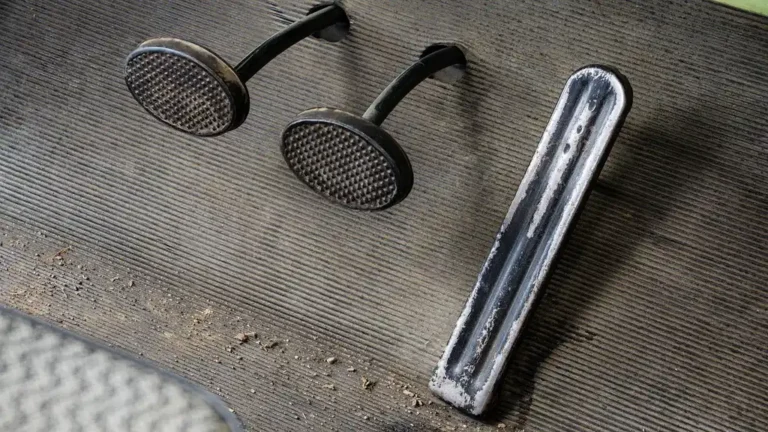
The accelerator pedal assembly depends on a pivot point, a pedal arm, bushings, and a return spring. If the pivot has contamination, worn bushings, or weak spring tension, cold can turn light drag into a sticky feel. Ice or road grime at the hinge can add enough resistance to slow the pedal’s return.
On cable-throttle vehicles, a cold cable sheath can stiffen and increase friction. On electronic throttle vehicles, the pedal is still mechanical at your foot, but the response comes from sensors and a throttle actuator, so a pedal that feels normal can still be paired with a throttle fault.
Why the symptom may fade after warm-up
Warm-up can melt frozen moisture, soften stiff cable grease, and free a hinge that was packed with slush. It can also hide marginal wear. That is why a pedal that feels fine after 10 to 20 minutes may still point to ice, contamination, cable friction, or a weak return spring.
Suppose the pedal is sticky only after an overnight freeze and returns to normal after a short drive. That pattern points more toward ice, condensation, or cable stiffness than toward a sudden mechanical break. It still deserves inspection, because the same condition can return the next morning.
Gas pedal diagnosis checklist
This checklist separates the three common causes: blocked pedal travel, mechanical friction in the pedal or cable path, and electronic throttle faults. Use it to narrow the problem fast. If the pedal sticks while moving, treat the situation as urgent before any detailed inspection.
| Symptom | Likely cause | Safest next step |
|---|---|---|
| Pedal does not move far, or feels wedged at the floor | Floor mat interference, stacked mats, or an object under the pedal | Park safely, remove the mat, check retention hooks, and verify driver-side clearance before driving again |
| Pedal moves, then returns slowly or feels gritty at the hinge | Ice, contamination, worn bushings, or weak pedal return spring | Inspect the pivot point and hinge area for slush, debris, corrosion, or damage; do not force the pedal |
| Pedal feel is normal, but engine speed lags, surges, or enters limp mode | Electronic throttle control fault, sensor issue, actuator problem, or wiring connector fault | Check for warning lights or diagnostic trouble codes and arrange service soon; avoid normal driving if response is erratic |
| Sticky feel disappears after the cabin warms up | Frozen moisture, cable friction, or marginal wear that loosens with heat | Do not assume it is fixed; inspect the affected area after the engine is off and cool enough to touch |
Could the pedal be blocked?
Yes. A blocked pedal is the first thing to rule out because it is common, easy to see, and dangerous when ignored. Floor mats, snow, slush, loose debris, or ice near the pedal can stop full travel or slow the return enough to feel like a mechanical fault.
Floor mat interference and retention hooks
Check whether the floor mat reaches the accelerator pedal travel path. Aftermarket mats, stacked mats, or a mat that is not clipped to the retention hooks can slide forward and catch the pedal arm. Even a small overlap at the driver-side clearance zone can create a sticky or wedged feel.
A common first-timer mistake is assuming any mat that fits the footwell is safe. A mat can look centered and still crowd the pedal when the seat is moved forward or when the mat curls at the edge.
Snow, slush, and under-dash contamination
Snow carried in on shoes can melt and refreeze under the dash. Slush intrusion, leaf debris, and road grit can collect around the lower pedal area and interfere with the return spring or pivot point. If the pedal feels sticky after winter driving, look for contamination near the hinge and the carpet edge.
Ice or debris at the pedal hinge
The accelerator pedal assembly can bind at the pivot point if ice forms around the bushing or if contamination packs into the hinge. Signs include a pedal that snaps back weakly, feels rough at the top of travel, or sticks only when the cabin is very cold.
Do not spray random lubricant into the pedal assembly. Wrong lubricant use can attract dust, and overspray can create a temporary sticking problem that returns when grit builds up.
Could the pedal or cable be binding?
Mechanical binding is common on older cable-throttle cars, but it can also happen at the pedal itself. The usual causes are wear, corrosion, frozen moisture, cable friction, or a return spring that no longer has enough force. These faults often feel worse in cold weather because clearances tighten and lubricant thickens.
Accelerator pedal assembly wear points
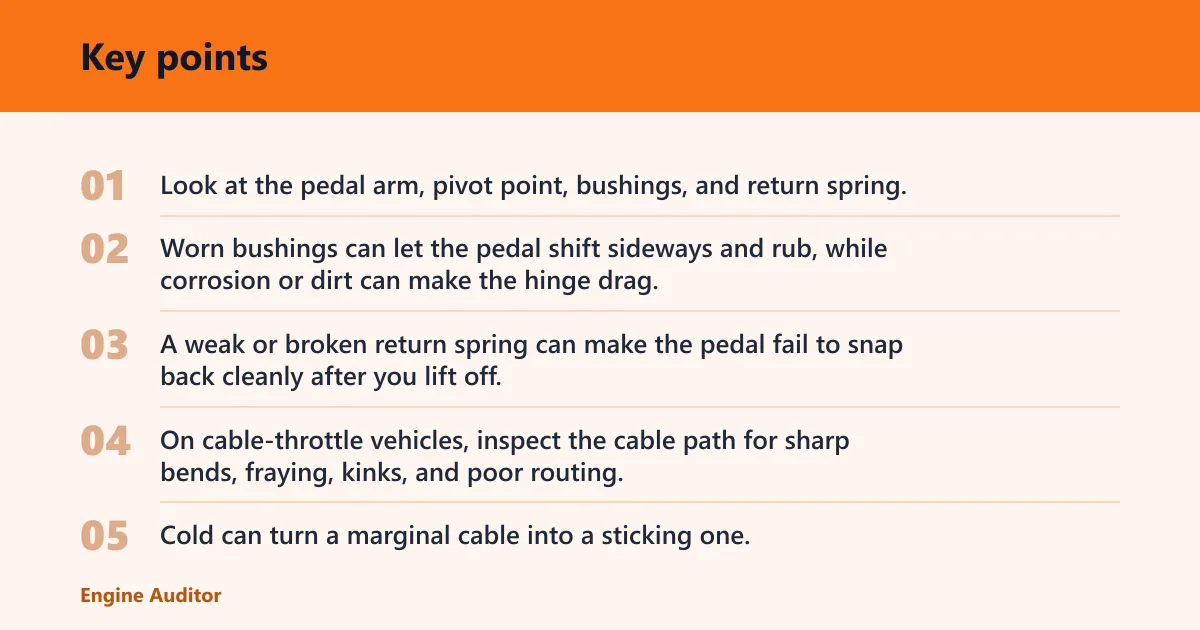
Look at the pedal arm, pivot point, bushings, and return spring. Worn bushings can let the pedal shift sideways and rub, while corrosion or dirt can make the hinge drag. A weak or broken return spring can make the pedal fail to snap back cleanly after you lift off.
Throttle cable friction, routing, and frozen moisture
On cable-throttle vehicles, inspect the cable path for sharp bends, fraying, kinks, and poor routing. A stretched cable can reduce free play, while frozen moisture inside the cable housing can make the pedal feel heavy or slow to return. Cold can turn a marginal cable into a sticking one.
If the pedal moves more freely with the engine off but binds when the front end is cold-soaked, that points toward cable friction or hinge drag rather than a throttle-body issue alone. A cable that is frayed or sticky should be replaced, not lubricated as a long-term fix.
Pedal return spring problems
A return spring with corrosion, weak tension, or a partial break can let the pedal hang up after you lift off. The symptom may be subtle at first: a slower return, a pedal that sits lower than usual, or a pedal that fails to snap back with the same force as before.
Picture a car that sits outside at 10°F overnight. The pedal feels fine for the first mile, then starts returning slowly at every stoplight. That pattern can come from a spring or cable that is only marginal once cold, not from the same warm-engine feel you get later in the day.
Could the throttle system be at fault?
Yes. A sticky pedal feel is not always a pedal problem. On many vehicles, the throttle body, electronic throttle control, sensors, or wiring can create hesitation, binding symptoms, or limp mode that feels like the pedal is stuck even when the foot pedal itself moves normally.
Throttle body binding and carbon buildup
The throttle body contains the throttle plate, which should move freely. Carbon buildup around the plate can cause binding, especially during cold-start behavior when deposits are stiff and clearances are tighter. This is more likely when the vehicle is already dirty or has idle-quality complaints.
Cold weather can make a marginal throttle body feel worse, but a dirty throttle body is not the only explanation. If the pedal feels normal yet engine response is delayed or uneven, the throttle plate or its control system needs attention.
Electronic throttle control faults
Electronic throttle control uses the accelerator pedal position sensor, wiring connectors, and a throttle actuator to open the throttle. A fault here may trigger a limp mode, warning lights, or diagnostic trouble codes. The pedal may feel unchanged under your foot, but the engine may not respond correctly.
On these systems, a sticking sensation can come from response logic, not physical drag. Do not ignore a check engine light, traction-control light, or reduced-power message, especially if the issue appears only in cold weather or after moisture exposure.
Wiring connectors and warning lights
Water intrusion, corrosion, or a loose connector can interrupt pedal sensor signals or actuator commands. Cold can make a marginal connection fail more often. If the pedal issue appears with warning lights, the safest assumption is an electronic fault until proved otherwise.
What should I do if it sticks while driving?
If the gas pedal sticks while driving, treat it as a driving emergency and focus on control rather than diagnosis. Shift to neutral if needed, turn on the hazard lights, and pull to a safe shoulder or parking area as soon as traffic allows. Shut the engine off only once the vehicle is controlled.
-
Release the pedal.
Lift your foot off the accelerator and see whether the pedal returns on its own. If it does not, do not pump it repeatedly. That can worsen the surge or distract you from the road. -
Shift to neutral.
If the engine keeps pulling, move the transmission to neutral. This usually disconnects engine power from wheel speed and can give you time to slow the vehicle safely without panic braking. -
Turn on hazard lights.
Warn nearby drivers immediately. Use them while you move toward a safe shoulder, turnout, or parking area with enough space to stop without abrupt steering. -
Brake smoothly.
Apply steady brake pressure and avoid hard, repeated braking unless traffic or road conditions require it. Smooth braking helps keep the vehicle stable while you manage the powertrain problem. -
Shut the engine off.
Turn the engine off only after the vehicle is controlled and stopped. Do not reach for the key or start button while still trying to steer around traffic.
If the pedal sticks more than once, or if the vehicle enters limp mode, normal driving should stop. Have the throttle body, pedal assembly, cable path, sensors, and wiring checked before the next trip.
How do I safely check a sticky accelerator pedal at home?
You can do a limited, safe check at home if the vehicle is parked, the engine is off, and the area is clear. Focus on visible blockage, pedal travel, and obvious damage. Do not force the pedal, spray random chemicals, or start disassembly unless you already know the system layout.
-
Park and secure the vehicle.
Set the parking brake, place the transmission in park or neutral as appropriate, and switch the engine off. This removes load from the drivetrain and keeps the vehicle from moving during inspection. -
Remove the driver mat.
Take out the floor mat and check the retention hooks and mat shape. Make sure there is clear space in front of the pedal arm and no stacked mat, snow clump, or object under the footwell. -
Inspect the pedal hinge.
Look for ice, dust, debris, broken plastic, or corrosion at the pivot point and return spring. The pedal should move smoothly and snap back with clear spring force. -
Check the throttle path.
On older cable-throttle cars, look at the cable routing for kinks, fraying, or frozen moisture. On electronic throttle vehicles, look for warning lights and connector damage rather than trying to adjust the pedal itself.
Keep the check simple. If the pedal still feels rough after the mat is removed and the hinge is visibly clear, the problem likely sits deeper in the pedal assembly, cable path, throttle body, or electronic throttle control system.
When should I stop driving if the gas pedal sticks?
Stop driving as soon as the pedal is unsafe, returns unpredictably, or changes engine speed without matching foot movement. You should also stop if the vehicle shows reduced-power behavior, warning lights, or repeated sticking after warm-up. The risk rises fast when the pedal is not predictable.
Do not keep driving just because the pedal loosened up for a few minutes. Warm-up can hide ice, moisture, or wear that will return on the next cold start. If the problem comes back, the safest move is service, not continued use.
Frequently asked questions
Why is my gas pedal sticking in cold weather?
Cold weather can freeze moisture around the pedal hinge, stiffen a throttle cable, or make worn bushings and return springs drag more than usual. A floor mat, snow, or road debris can add a blockage on top of that. Warm-up may hide the fault, but it does not remove the cause.
What should I do if my gas pedal sticks while driving?
Lift off the pedal, shift to neutral if the engine keeps pulling, turn on hazard lights, and move to a safe shoulder or parking area. Apply smooth braking and shut the engine off only after the vehicle is controlled. If it happens again, do not continue normal driving.
Can cold weather make the accelerator pedal hard to press?
Yes. Cold can increase friction in the pedal pivot, stiffen a cable, or make a weak return spring feel weaker. It can also freeze moisture near the hinge or under the dash. A pedal that feels heavy only in cold weather usually points to a mechanical or contamination issue.
Is a stuck gas pedal a sign of a bigger throttle problem?
It can be. A sticky pedal may be a floor mat, a frozen hinge, or a cable issue, but it can also point to throttle body binding, sensor faults, or wiring problems in electronic throttle control. Warning lights, limp mode, or erratic response make the larger-throttle problem more likely.
Could a floor mat cause my gas pedal to stick?
Yes. An aftermarket mat, a stacked mat, or a mat that slips off its retention hooks can interfere with pedal travel. Check driver-side clearance carefully, because even a small overlap can stop the pedal from returning fully. This is one of the first things to rule out.
Why does my gas pedal feel normal after the car warms up?
Warm air can melt ice, soften stiff cable grease, and reduce hinge drag, so the pedal may feel normal again. That does not mean the fault is gone. It often means the underlying issue is moisture, contamination, or wear that returns when the vehicle sits in the cold again.
Products related to this article
Sponsored / affiliate links. As an Amazon Associate I earn from qualifying purchases. I may earn additional commission from eligible campaigns.