What Are Engine Sensors and Why Do They Matter?
Engine sensors are the ECU’s data sources. They measure air, temperature, speed, crank position, cam position, and exhaust oxygen so the computer can adjust timing, fuel delivery, idle speed, and emissions in real time. When a sensor lies or fails, the engine may run rich, stall, waste fuel, or trigger a check-engine light that sends diagnosis in the wrong direction. This guide explains the main sensors, what each one tells the ECU, and how to separate sensor faults from mechanical problems.
What engine sensors do
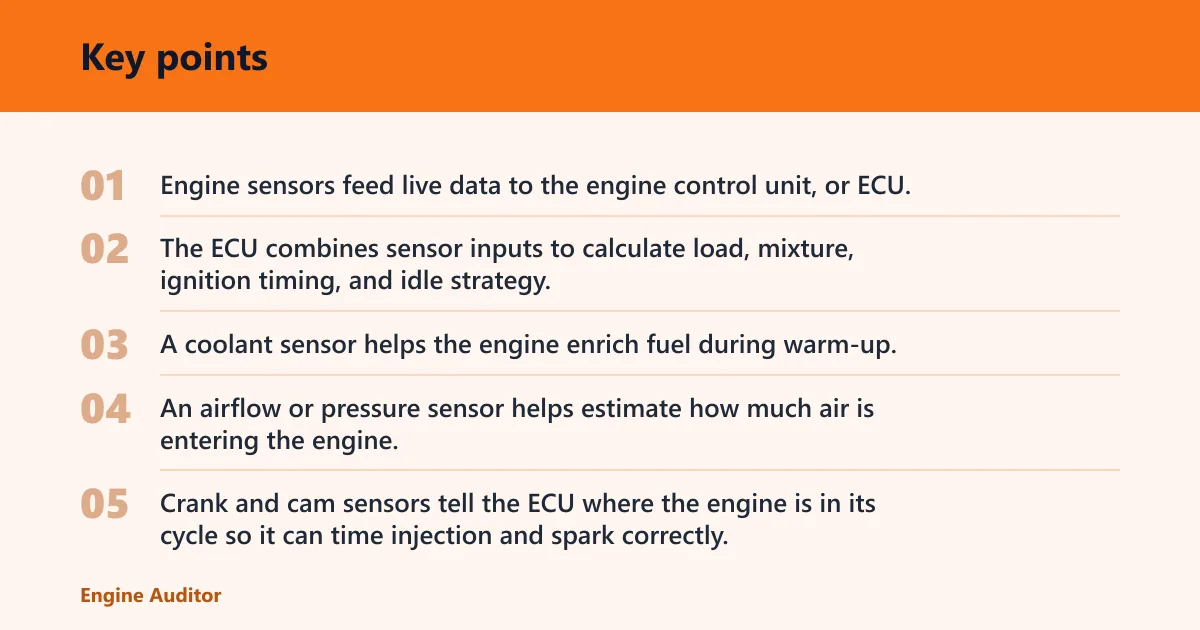


Engine sensors feed live data to the engine control unit, or ECU. The ECU reads those signals in real time and uses them to decide how much fuel to add, when to fire the spark, and how to manage idle speed. On some sensors, the computer sends a constant 5-volt reference signal through the circuit, then watches the return signal to judge temperature, pressure, or position.
That matters because the ECU is not guessing. It reacts to changing conditions every second: cold start, hot restart, climbing a hill, coasting, or a sudden throttle stab. Modern engines use sensors that monitor everything from airflow to exhaust gases, so one bad input can distort several decisions at once.
How the ECU uses sensor data
The ECU combines sensor inputs to calculate load, mixture, ignition timing, and idle strategy. A coolant sensor helps the engine enrich fuel during warm-up. An airflow or pressure sensor helps estimate how much air is entering the engine. Crank and cam sensors tell the ECU where the engine is in its cycle so it can time injection and spark correctly.
When the data do not agree, the ECU may choose a backup strategy. That can keep the engine running, but it can also cause rough idle, hard starts, poor mileage, or reduced power.
Why sensors matter for fuel, spark, and idle control
Sensors matter because they let the ECU adjust fuel delivery, spark timing, and idle speed, the three controls that shape most engine complaints. If the ECU sees false cold data, it may add too much fuel. If it loses a position signal, it may stop injection or spark control altogether. If it reads incorrect air data, idle quality and throttle response can suffer.
Which engine sensors matter most?
The most important sensors are the ones that can stop the engine, upset fuel delivery, or mislead the ECU about load and temperature. Start with crank, cam, coolant temperature, oxygen, mass air flow, and manifold pressure. These are the sensors most likely to create hard starting, stalling, poor fuel economy, and a check engine light.
Sensors that affect starting and stalling
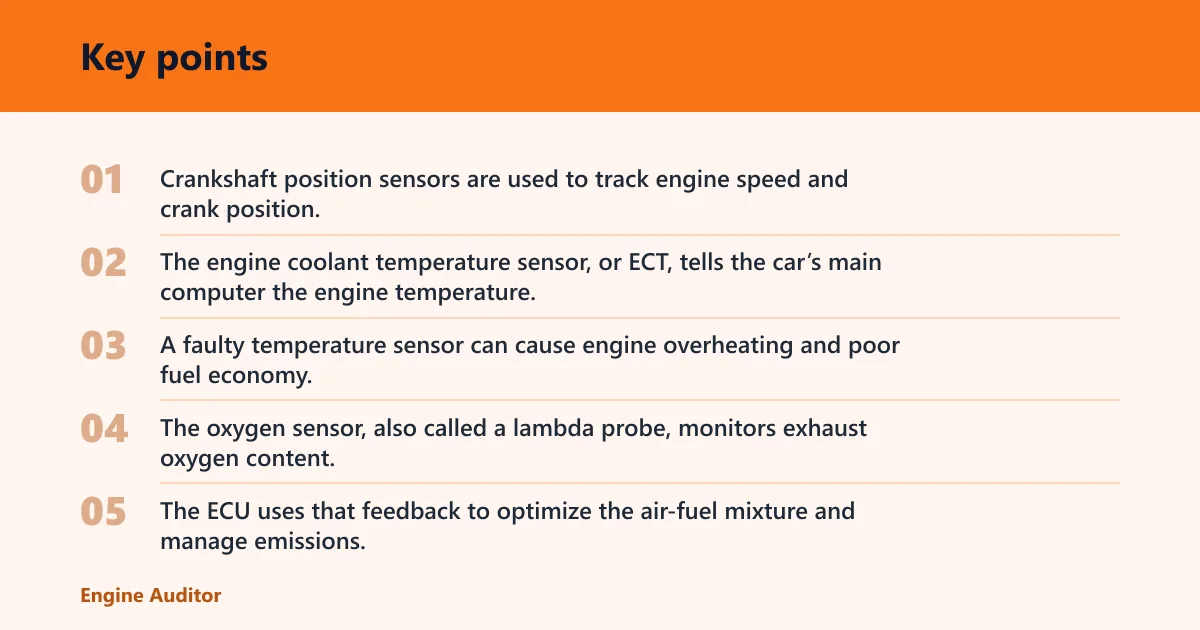
Crankshaft position sensors are used to track engine speed and crank position. Without that signal, the ECU cannot reliably time ignition or injection, so the result can be a no-start or an engine that stalls suddenly. Camshaft position sensors sync valve timing with the ECU and help sequential injection and ignition, so a failing cam signal often shows up as hard starting, rough running, or extended cranking.
The engine coolant temperature sensor, or ECT, tells the car’s main computer the engine temperature. It supports warm-up fueling and helps protect against overheating. Most traditional automotive temperature sensors rely heavily on NTC technology, and the vehicle’s computer passes a constant 5-volt reference signal through the sensor. A faulty temperature sensor can cause engine overheating and poor fuel economy.
Sensors that affect fuel economy and emissions
The oxygen sensor, also called a lambda probe, monitors exhaust oxygen content. The ECU uses that feedback to optimize the air-fuel mixture and manage emissions. A faulty oxygen sensor can push the mixture rich or lean, which raises fuel use and can damage emissions performance.
The mass air flow sensor, or MAF, measures incoming air volume or mass. That data helps calculate fuel delivery. Dirt, oil contamination, or an electrical fault can cause driveability issues such as hesitation, surging, or weak acceleration. The manifold absolute pressure sensor, or MAP, measures intake manifold pressure and helps estimate engine load. Many engines use MAP instead of, or alongside, a MAF.
Decision table
| Sensor name | What it measures | Common symptoms | Likely scan-tool clue or DTC family | Driving risk | Urgency |
|---|---|---|---|---|---|
| Engine coolant temperature sensor (ECT) | Coolant temperature | Hard cold starts, rich running, overheating warning, poor mileage | P0115-P0119 family | Overheating risk, fuel economy loss | Urgent if overheating; soon otherwise |
| Oxygen sensor / lambda probe | Exhaust oxygen content | Check engine light, poor fuel economy, emissions failure, rough idle | P0130-P0167 family | Usually drivability and emissions risk | Soon |
| Mass air flow sensor (MAF) | Incoming air volume or mass | Hesitation, surging, weak acceleration, stalling at idle | P0100-P0104 family | Driveability and stalling risk | Soon; urgent if it stalls |
| Crankshaft position sensor | Engine speed and crank position | No-start, sudden stall, tachometer drop, intermittent cutout | P0335-P0339 family | High no-start or stall risk | Urgent |
| Camshaft position sensor | Cam position for engine sync | Hard starting, rough running, misfire-like symptoms | P0340-P0349 family | Starting and driveability risk | Soon; urgent if it will not start |
| Intake air temperature sensor (IAT) | Incoming air temperature | Small fuel trim errors, worse hot/cold behavior, poor economy in extremes | P0110-P0114 family | Usually moderate | Monitor to soon |
| Manifold absolute pressure sensor (MAP) | Intake manifold pressure | Wrong load calculation, weak power, rough idle, bad throttle response | P0105-P0109 family | Driveability and fuel economy risk | Soon |
Diagnostic trouble codes, or DTCs, are stored by the onboard computer and read with a scan tool. They narrow the search, but they do not confirm the failed part. Faulty oxygen or mass airflow sensors are common diagnostic findings, but wiring, vacuum leaks, exhaust leaks, and mechanical problems can point the ECU in the same direction.
What happens when a sensor fails?
When a sensor fails, the check engine light often comes on and the ECU stores one or more DTCs. The engine may still run, but it can run poorly, stall, or lose fuel economy. The code tells you which system is unhappy, not always which part is bad.
Check engine light and DTC clues
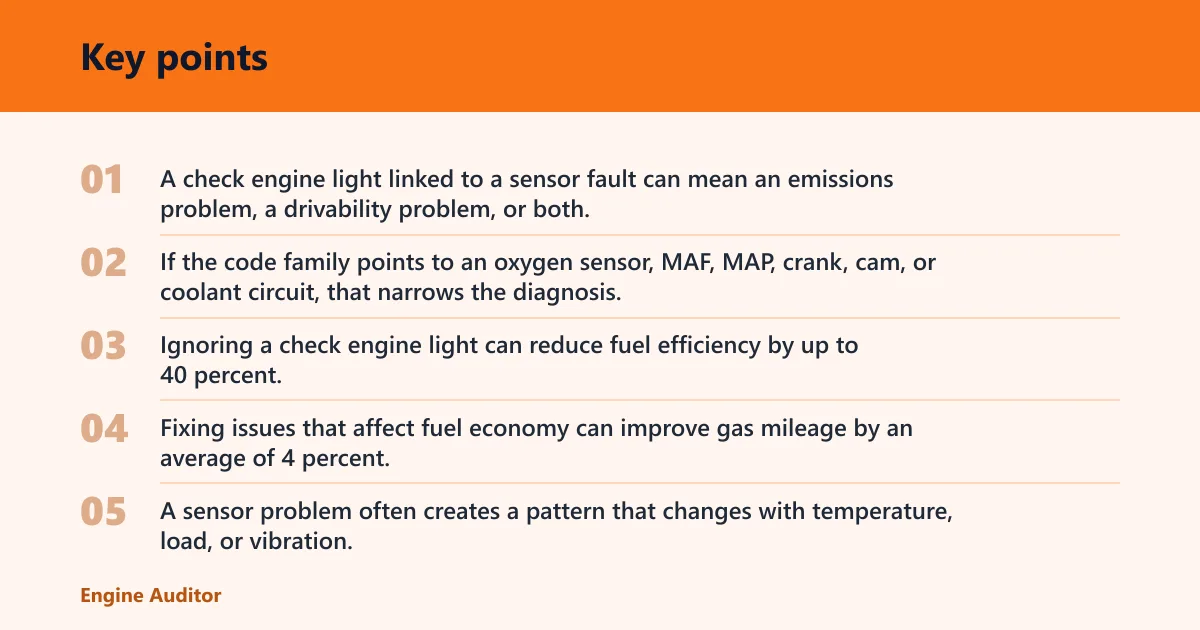
A check engine light linked to a sensor fault can mean an emissions problem, a drivability problem, or both. If the code family points to an oxygen sensor, MAF, MAP, crank, cam, or coolant circuit, that narrows the diagnosis. A scan tool can show live data, freeze-frame data, and code history, which helps separate a bad sensor from a wiring fault.
Ignoring a check engine light can reduce fuel efficiency by up to 40 percent. That does not mean every light causes that loss, but it does mean waiting can be expensive. Fixing issues that affect fuel economy can improve gas mileage by an average of 4 percent.
Symptoms that point to a sensor versus a mechanical fault
A sensor problem often creates a pattern that changes with temperature, load, or vibration. A mechanical problem often creates noise, compression loss, fluid loss, or a problem that does not change when the sensor is unplugged or cleaned. That distinction matters because a vacuum leak can mimic a bad MAF, and a misfire can look like a bad oxygen sensor.
Say your 2.0-liter engine stumbles only at idle, then clears up above 1,500 rpm. If the scan tool shows a high or unstable MAP reading, the issue could be a vacuum leak, a cracked hose, or the MAP sensor itself. The code family helps, but it does not settle the question alone.
How do sensors affect fuel economy?
Sensors affect fuel economy by shaping the ECU’s fuel calculation. If the computer sees false cold air, false cold coolant, or the wrong airflow number, it may add too much fuel. If the oxygen sensor reports the wrong exhaust content, the ECU may correct in the wrong direction and keep the mixture off target.
Rich or lean fueling from bad data
A rich condition wastes fuel and can foul plugs or dilute oil over time. A lean condition can cause hesitation, surge, pinging, or higher combustion temperatures. In both cases, the sensor may be the cause, but the same result can come from a vacuum leak, low fuel pressure, restricted injectors, or an exhaust leak ahead of the oxygen sensor.
When dirty sensors create worse mileage
Dirty MAF sensors are common because they live in the intake stream. A light film on the sensing element can skew airflow data enough to change fuel delivery. Oxygen sensors age too, and response slows with time and contamination. Both cases can trigger mileage loss without a dramatic drivability change at first.
Picture a daily driver that starts fine, but the fuel economy drops after a filter change and the idle feels slightly uneven. If the intake tube has a loose clamp, unmetered air can reach the engine and make the MAF reading inaccurate. If the clamp is tight and the MAF is dirty, the sensor itself moves higher on the list.
Sensor problems or mechanical problems?
Separate sensor trouble from mechanical trouble by looking at the pattern, the code family, and the live data. A sensor fault usually produces data that are impossible, stuck, or out of range. A mechanical problem often produces realistic sensor data that reflect a real air, fuel, compression, or cooling problem.
Misfire, vacuum leak, or sensor fault
A misfire can trigger oxygen and fuel trim codes, but the root cause may be spark plugs, coils, injectors, compression loss, or a vacuum leak. A vacuum leak often causes lean codes and rough idle, which can look like a bad MAF or MAP. Before replacing parts, compare short-term fuel trims, coolant temperature, airflow, and manifold pressure with the engine’s actual behavior.
- Read the code family. Pull DTCs with a scan tool and note whether the complaint points to airflow, temperature, or position sensing. That gives you the first filter before any parts are swapped.
- Check live data. Compare coolant temperature, intake air temperature, MAP or MAF readings, and oxygen sensor behavior with a cold engine, idle, and light throttle. A flat or impossible value is a stronger clue than the warning light alone.
- Inspect wiring and connectors. Look for loose pins, oil in connectors, broken insulation, and rubbed-through harnesses. Many sensor faults are electrical, not internal to the sensor.
- Rule out air leaks and overheating. Check hoses, clamps, intake boots, and cooling-system condition. A mechanical leak or overheating problem can produce the same symptom pattern as a sensor failure.
- Confirm before replacement. Replace the part only after the data and inspection point to that sensor. That avoids the common mistake of buying a good part for the wrong problem.
Overheating, wiring fault, or failed part
A temperature-related complaint needs extra care. If the gauge climbs, the coolant fan behaves oddly, or the scan tool shows a coolant temperature that does not match the engine’s state, do not assume the sensor is the only issue. A faulty temperature sensor can cause engine overheating, but low coolant, air pockets, thermostat problems, and fan faults can do the same.
If the symptom changes when you wiggle the harness or tap the connector, wiring becomes more likely. If the signal stays wrong in a way that matches the fault code and the engine behavior, the sensor itself moves up the list.
Frequently asked questions
Why do we use sensors?
Engine sensors let the ECU react to conditions that change by the second. Airflow, temperature, engine speed, crank position, and exhaust oxygen all affect how the engine should run. Without those inputs, the computer would have to use fixed settings that waste fuel and leave more room for stalling, rough running, and emissions problems.
Why are sensors important?
Sensors are important because they guide the ECU’s fuel, spark, and idle decisions. They also give you a way to narrow faults with DTCs and live data. A warning light alone is not enough, but sensor data can show whether the problem is electrical, mechanical, or a mix of both.
What is the importance of sensors?
The importance of sensors is practical, not abstract. They help the engine start, stay smooth, and stay efficient while keeping emissions in check. A bad sensor can create poor mileage, hard starting, or a stall, and those symptoms often waste more time and money than the sensor itself.
How do engineers use sensors?
Engineers use sensors to measure real operating conditions and feed that data into control logic. In a car, that means the ECU can adjust injection, timing, and idle speed based on actual engine behavior. The same idea also supports diagnostics, because the ECU stores DTCs when readings fall outside expected ranges.
Which engine sensors are most important?
The key sensors are often the crankshaft position sensor, camshaft position sensor, ECT, MAF or MAP, and oxygen sensor. Those five can affect starting, stalling, fuel economy, and emissions more than the others. If one fails, the engine may still run, but the symptoms can be immediate and costly.
How do engine sensors affect fuel economy?
Engine sensors affect fuel economy by shaping how much fuel the ECU adds and when it trims the mixture. Bad coolant, airflow, pressure, or oxygen data can push the engine rich or lean. That can cut mileage sharply, and ignoring the check engine light can reduce fuel efficiency by up to 40 percent.
Products related to this article
Sponsored / affiliate links. As an Amazon Associate I earn from qualifying purchases. I may earn additional commission from eligible campaigns.