Questions to Ask a Mechanic Before Paying for Car Heater Repairs
A common rule of thumb is to ask about seven questions before approving heater repairs: the likely fault, how it was diagnosed, whether there is a separate diagnostic fee, the parts brand, expected labor time, coolant refill, and warranty. Skip those checks, and you can pay for a thermostat, heater core, or blend-door job that never fixed the cold air. This guide gives you the quote-check questions that separate diagnosis from repair and help you judge the price before you authorize it.
What exactly is wrong with the heater?
The first question is not price. It is the exact fault the shop found: no heat, weak heat, cold air, no airflow, vent-specific heat, fogging, or a coolant-loss complaint. Those symptom groups point to different repairs, and the shop should name which one it is before you approve anything.
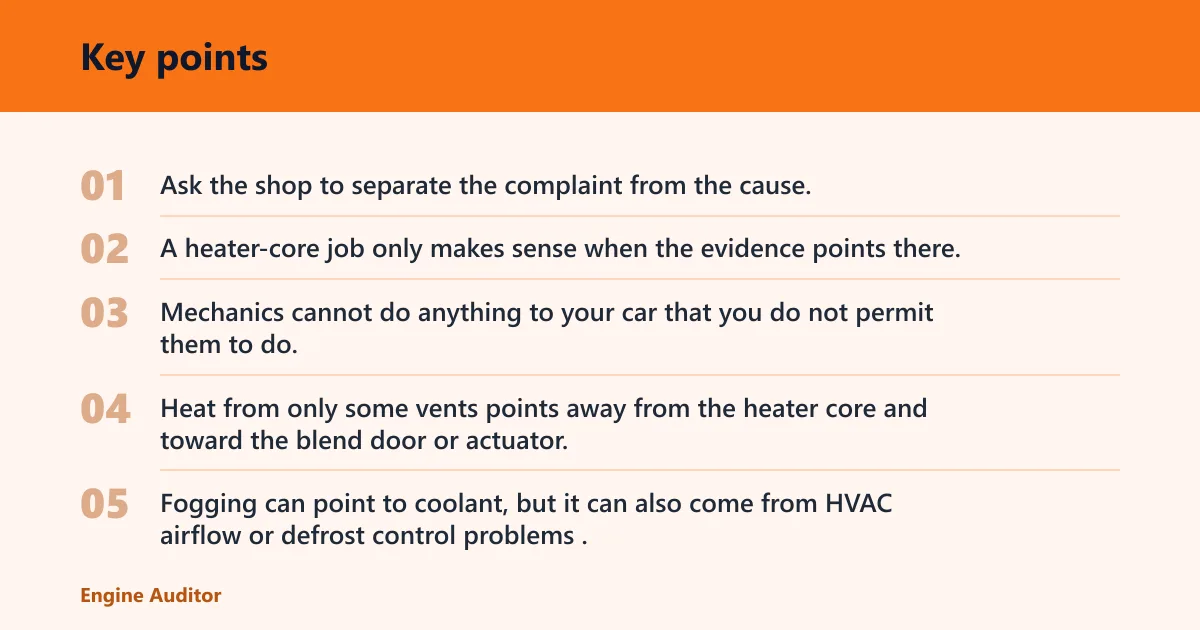
Ask the shop to separate the complaint from the cause. “Cold air” can sometimes mean low coolant, a thermostat stuck open, a blower motor problem, a clogged cabin air filter, or a blend-door fault. A heater-core job only makes sense when the evidence points there.
Mechanics cannot do anything to your car that you do not permit them to do. That is why the fault description matters before payment, not after the bill is written.
Use the symptom pattern to narrow the quote. No airflow is different from weak heat. Heat from only some vents points away from the heater core and toward the blend door or actuator. Fogging can point to coolant, but it can also come from HVAC airflow or defrost control problems.
Separate no heat, weak heat, cold air, and vent-specific heat
A shop should treat these as different complaints. No heat with normal airflow often points toward coolant flow, thermostat operation, or heater-core restriction. Weak heat with poor airflow can often point toward the blower motor, resistor, relay, wiring, or cabin air filter. Vent-specific heat usually points to a blend-door issue.
Say your vents blow hard on the floor setting but the defroster stays cool. That pattern does not fit a simple heater-core quote by itself. It points the conversation toward blend-door control and HVAC routing before parts are ordered.
How do you prove the fault?
Ask for proof, not just a verbal guess: test results, readings, visible leaks, scan data, airflow checks, pressure-test results, or the failed part itself. Remote advice cannot confirm a fault that needs physical testing, so the shop should show what it checked and what it ruled out.
That proof matters because several heater complaints look alike from the driver seat. A shop that cannot separate symptom, cause, and repair plan has not finished the diagnosis. In that case, pay for testing first, not a full repair package.
Ask for specific measurements. If the complaint is no heat, ask what the engine coolant temperature reached, whether the heater hose temperatures matched, whether airflow was normal at each vent setting, and whether the blower drew the expected air through the cabin filter. If the complaint is coolant loss, ask for leak-test results before any heater-core approval.
Ask for test results, readings, or the failed part
-
Request the exact fault. Ask the shop to say whether the problem is the heater core, coolant level, thermostat, blower motor, blend door, or another HVAC part. “Heater problem” is too vague to authorize money against.
-
Ask for the test used. Pressure test, scan data, temperature readings, and airflow checks all mean different things. You want the method and the result, not just “it needs a heater core.”
-
Request visible proof. Ask to see the leaking part, the stuck actuator, the clogged filter, the blown fuse, or the scan data that supports the diagnosis. If the shop says the part failed, it should be able to point to what failed.
-
Confirm what was ruled out. A heater diagnosis should separate coolant loss, thermostat behavior, blower operation, and vent control. If those were not checked, the quote is still a guess.
Suppose the cabin blows warm air at idle but goes cold on the highway. That pattern can fit low coolant or airflow issues, and it should trigger proof such as coolant level verification, hose temperature comparison, or a leak test before a heater-core sale. A blanket parts quote is too early.
What should I approve now?
Approve the repair that matches the proven fault, and keep testing separate from replacement when the cause is still uncertain. If the shop has confirmed a blown fuse, clogged filter, failed resistor, or leaking hose, that can justify a direct repair. If the evidence is thin, approve diagnosis first.
Ask what is necessary and what is optional. Necessary work fixes the verified fault. Optional work includes related maintenance, flushes, or add-on parts that may be sensible but are not required to restore heat. The shop should label those lines clearly before you sign.
Ask for a detailed explanation of the bill before paying. That explanation should split diagnosis, parts, labor, coolant refill, and any shop supplies. If the quote combines all of them into one line, you cannot compare it against other shops or judge whether the repair is fair.
Distinguish diagnosis from repair
Diagnosis is the testing that proves the fault. Repair is the part replacement or labor that fixes it. You should not be charged for a heater-core replacement until the shop can show why the core is the fault rather than a low coolant problem, thermostat issue, blower fault, or blend-door problem.
Common first-timer mistake: approving a full heater-core job because the cabin air is cold, then learning the real issue was a low coolant level from a leak elsewhere. The shop should prove the source first if coolant keeps dropping.
Ask what is necessary and what is optional
- Necessary: the part or labor that directly fixes the proven fault.
- Necessary: any coolant refill or bleed required after an opened cooling circuit.
- Optional: extra maintenance the shop recommends, such as unrelated fluid service.
- Optional: parts upgrades unless the shop can explain why the original-spec part is unsuitable.
Heater repair checklist
Use this table as a quote checkpoint. Match your symptom to the likely fault, then ask for the proof that supports the repair. If the shop cannot answer the proof question, the work should usually stay in diagnosis mode.
| Symptom | Likely fault | Question to ask | Proof to request | Approve now or diagnose further? |
|---|---|---|---|---|
| No heat, normal airflow | Low coolant, thermostat stuck open, heater-core restriction | What made you rule out coolant level and thermostat operation? | Coolant level check, engine temperature reading, heater hose temperature comparison | Diagnose further if those checks are missing |
| Weak heat, weak airflow | Cabin air filter, blower motor, resistor, relay, wiring | Is the airflow loss from the filter, the blower, or the control circuit? | Filter inspection, blower power test, fuse or relay result | Approve repair if the failed part is shown |
| Heat only at some vents | Blend door or actuator | Did you verify the door moves through all positions? | Actuator test, command data, air-temp change at each vent setting | Approve repair if the actuator fault is proven |
| Cold air after coolant loss | Cooling-system leak, heater-core leak, hose leak, cap issue | Did you perform a cooling-system leak test before quoting parts? | Leak-test result, visible leak point, pressure loss record | Diagnose further if coolant keeps dropping |
| Sweet smell, damp carpet, fogging | Heater-core leak | Can you show coolant evidence inside the cabin or at the core? | Leak evidence, residue, pressure-drop result, cabin dampness report | Approve repair if the leak is confirmed |
| Slow warm-up, then heat returns | Thermostat stuck open or low coolant | Did the engine reach normal operating temperature? | Temperature reading, warm-up timing, coolant level check | Diagnose further if temperature is unproven |
Could low coolant be the real problem?
Yes. Repeated coolant loss can create cold cabin air because the heater core needs hot coolant flowing through it. If coolant is low again after topping off, the problem is not solved. That pattern usually means there is a leak somewhere in the cooling system that should be found before parts are replaced.
Coolant is commonly checked only when the engine is completely cool. Never open a hot cooling system. If the level keeps dropping, ask for a cooling-system leak test before approving a heater-core quote, because the leak may be elsewhere in the hoses, radiator, water pump, cap, or core.
Why repeated coolant loss points to a leak
Low coolant can cause cold cabin air because the heater core cannot transfer engine heat without enough flow. A heater-core replacement does not solve repeated loss if the real source is a hose seep, radiator crack, or another leak point. The shop should prove why the heater core, not the rest of the system, is the issue.
When a leak test should come before parts replacement
-
Verify the coolant level. Check only with the engine completely cool. If the level is low again, the problem is not random.
-
Ask for a leak test. A cooling-system leak test helps locate the source before any heater-core estimate is approved. It is the right next step when coolant loss repeats.
-
Compare the evidence. If the test points to the heater core, ask for the proof. If it points elsewhere, the quote should change with it.
What symptoms point to the thermostat, blower, or blend door?
Thermostat, blower, and blend-door symptoms overlap, but they do not lead to the same bill. A thermostat problem usually changes warm-up behavior. A blower problem changes airflow. A blend-door problem changes where and how warm the air comes out. A shop should separate those before selling parts.
FreeHome lists thermostat trouble, restricted heater core, failed blower motor, and clogged cabin air filter as common heater-failure causes. That list is useful only if the shop ties the symptom to the right cause. Otherwise, the quote is still broad.
Thermostat symptoms and warm-up problems
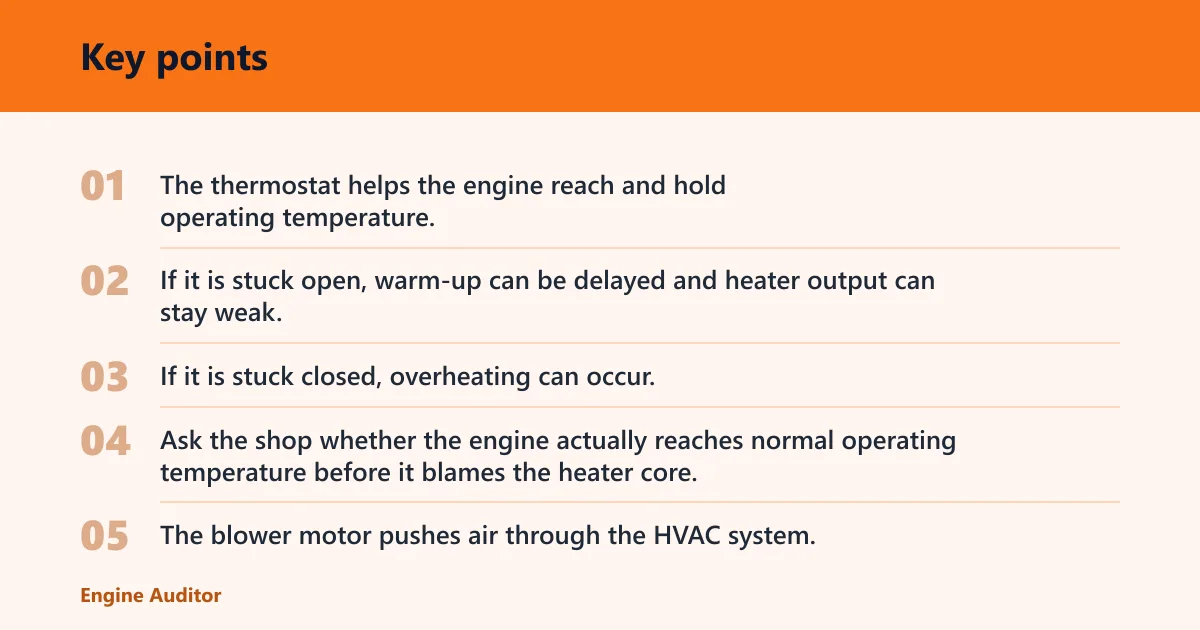
The thermostat helps the engine reach and hold operating temperature. If it is stuck open, warm-up can be delayed and heater output can stay weak. If it is stuck closed, overheating can occur. Ask the shop whether the engine actually reaches normal operating temperature before it blames the heater core.
Blower motor, fuse, relay, and wiring checks
The blower motor pushes air through the HVAC system. Failure can cause no airflow or weak airflow. But a blown fuse, failed relay, bad resistor, or wiring issue can create the same complaint, so the shop should not jump straight to the blower motor without checking the circuit.
Blend door and cabin air filter clues
A blend-door fault can cause heat on only some vents or temperatures that change when you switch modes. Modern vehicles often use a blend-door actuator for that job. A clogged cabin air filter can also reduce airflow, so the shop should inspect the filter before blaming a heater-core restriction.
Picture a car with strong heat at the floor vents but cool air at the dash vents. That points much more toward blend-door control than toward a heater-core replacement. The quote should reflect that difference.
How much should the repair cost?
Ask for parts and labor separately. That split tells you whether the number is high because the part is expensive, because the job is labor-heavy, or because both are true. It also lets you compare quotes without confusing diagnosis time with repair time.
Ask whether a cheaper fix exists than replacing the whole heater core. In some cases, the right answer is a thermostat, blower circuit repair, cabin air filter, or leak repair. A heater-core replacement is justified only when the fault points there, because the core sits inside the dashboard and is often labor-intensive to reach.
Ask for parts and labor separately
- What is the part cost?
- How many labor hours are listed?
- Is diagnostic time included or separate?
- Does the price include coolant refill or bleed service?
- What warranty applies to the part and labor?
Keep the invoice itemized. If the shop cannot separate the part price from labor hours, you cannot tell whether the quote reflects a difficult repair or just a padded total.
Ask whether a cheaper fix exists than a heater-core replacement
A heater-core quote should come with evidence of heater-core restriction or leak, not just cold air. If the complaint is weak airflow, a clogged cabin air filter may be the cheaper fix. If the complaint is delayed warm-up, the thermostat may be the cheaper fix. If the complaint is no airflow, the blower circuit may be the cheaper fix.
Ask the shop to explain why less expensive causes were ruled out. That one question often separates a careful diagnosis from a replacement-first estimate.
Frequently asked questions
What exactly is wrong with my car heater?
Ask the shop to name the fault in plain terms: no heat, weak heat, no airflow, vent-specific heat, fogging, or coolant loss. Those symptoms do not all point to the same repair. A useful answer should identify the failing part or the tested system, not just repeat the complaint.
Can you show me the failed part or the test result?
Yes, and you should ask for it. A solid heater diagnosis may include temperature readings, airflow checks, scan data, a pressure test, or the failed part itself. If the shop cannot show proof, the repair may still be a guess rather than a confirmed fix.
What repairs are necessary, and what is optional?
Necessary work fixes the verified fault. Optional work covers add-ons that may be sensible but are not required to restore heat. Ask the shop to label both categories on the estimate so you can approve only the repair that matches the proven problem.
How much will parts and labor cost separately?
Ask for the part price, labor hours, diagnostic fee, and any coolant refill as separate lines. That breakdown shows whether the quote is expensive because the part is costly or because the job is labor-heavy. It also makes it easier to compare shops.
Is there a cheaper fix than replacing the whole heater core?
Sometimes, yes. Low coolant, thermostat trouble, blower circuit faults, a clogged cabin air filter, or a blend-door problem can all cause heater complaints that look worse than they are. A heater-core replacement should come with evidence that the core is restricted or leaking.
What should I monitor after the repair if the heat still feels weak?
Watch coolant level, engine warm-up time, airflow strength, and whether heat comes from all vents. If weak heat returns, ask whether the system still has a leak, a thermostat issue, a blower circuit problem, or a blend-door fault. The next step should match the symptom that remains.
Products related to this article
Sponsored / affiliate links. As an Amazon Associate I earn from qualifying purchases. I may earn additional commission from eligible campaigns.