Why Your Car Heater Only Works on High Fan Speed in Winter
If your blower works only on the highest setting, the usual fault is the blower motor resistor or control module, not the heater core; if low speeds are dead but high works, start there before replacing the motor. Ignoring it leaves you with no defrost on cold mornings and can waste money on the wrong parts. This guide shows how to separate resistor, module, wiring, switch, and blower faults with simple checks.
What the symptom usually means

- Measures voltage, resistance, and continuity
- Auto-ranging with backlit LCD
- Includes safety fuses for overload protection
Only the highest fan speed working often points to a speed-control problem. Lower settings may be silent while the highest setting brings the fan to life. That pattern suggests more than a generic “heater is broken” claim, because the fault often sits in the fan-speed circuit rather than the temperature blend side.
The key is to track what happens when you change speed, not every cause of cold air or odor. If the blower responds on high, the motor is not completely dead. The fault may be in the resistor, control module, switch, wiring, or a connector that has overheated.
When the highest setting still works, the symptom points away from the heater core. Cabin heat and cabin airflow are different checks. Air can be warm but weak, or strong but cold, and those are different problems.
Manual vs automatic climate controls
Manual controls need a step-by-step speed check. Automatic climate control needs both the request and actual response described. The diagnosis changes because the system may choose fan speed on its own, and that normal behavior should not be mistaken for a fault.
Manual fan speeds and fixed steps
On a manual system, the fan switch usually selects fixed steps. If low, medium, and other lower positions fail but high works, the speed-control path is the first place to look. That is the classic pattern many drivers notice.
Automatic climate control and commanded speed
On automatic climate control, the panel may request a certain blower output and then adjust it based on cabin temperature, sun load, or defrost demand. That means you have to describe what the system requested and what the blower actually did. A normal control decision is not the same as a failed fan circuit.
Blower resistor and module
The blower motor resistor is a common suspect, but the symptom alone does not prove it. On some vehicles, the resistor is part of the speed-control system. On others, a blower control module replaces it or works alongside it. The exact layout varies by vehicle.
Blower motor resistor on manual systems
Many manual systems use the resistor to drop voltage for the lower fan speeds. When that part fails, lower settings often disappear first while high speed still works. That can happen because the highest setting may bypass the resistor path entirely.
Blower control module on some designs
Some vehicles use an electronic blower control module rather than a simple resistor pack. The symptom can look the same from the cabin, but the failed part is different. Replace the part only after matching it to the actual system.
How connector heat damage fits the pattern
Heat damage at the connector can look like a resistor failure. Melted plastic, browned terminals, or a loose fit can interrupt low-speed current before high-speed current is affected. That is why a visual check matters before any parts are ordered.
Say your compact car has four manual fan steps. Low, medium-low, and medium do nothing, but high blasts air immediately. That pattern fits a speed-control fault far more than a heater-core problem, and it also suggests the motor itself may still be capable of spinning.
Heater airflow diagnosis
Separate fan speed, airflow, and temperature symptoms before guessing at parts. Weak airflow after a cabin filter change is not the same thing as a fan-speed fault. A cold vent complaint is also different from a blower that only runs on one speed.
Airflow versus temperature at the vents
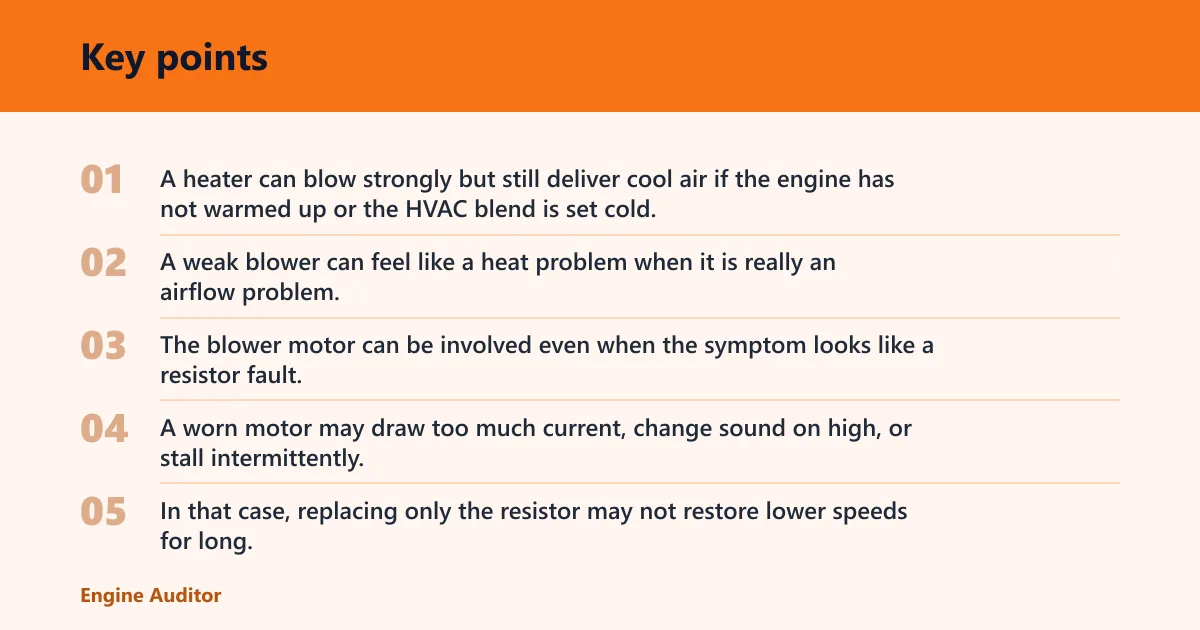
Airflow is how much air comes out. Temperature is how warm that air feels. A heater can blow strongly but still deliver cool air if the engine has not warmed up or the HVAC blend is set cold. A weak blower can feel like a heat problem when it is really an airflow problem.
Why the blower motor can still matter
The blower motor can be involved even when the symptom looks like a resistor fault. A worn motor may draw too much current, change sound on high, or stall intermittently. In that case, replacing only the resistor may not restore lower speeds for long.
Cabin air filter restriction after service work
A cabin air filter can restrict airflow and mimic a fan-speed issue without being the root fault. If the problem started after filter replacement or other ventilation work, check that the filter is installed in the correct direction and that no packaging, debris, or broken trim is blocking the intake path.
Picture a sedan that still has warm air, but the strongest setting only moves a soft stream through the vents after a filter swap. That points more toward restriction or installation error than a failed speed-control circuit, especially if the fan noise and command response are otherwise normal.
Only-high diagnosis matrix
| Symptom pattern | Most likely subsystem | What to verify next | What would rule it out |
|---|---|---|---|
| Manual controls: lower steps dead, high works | Blower resistor or resistor circuit | Check whether each individual speed is missing, then inspect the resistor, connector, and related wiring | All speeds work after connector repair, or the vehicle does not use a resistor-based design |
| Automatic climate control: requested fan changes, little or no response | Blower control module, control head, or related wiring | Compare the requested setting with actual blower output and scan for control faults if available | Output matches command across several settings, or the system is behaving normally by design |
| Intermittent failure: fan sometimes starts or stops without a changed command | Wiring, connector heat damage, control module, or motor brushes | Wiggle-test connectors gently, inspect for heat discoloration, and note when the fault appears | Stable operation returns after cleaning or repairing a loose connector |
| Only-high-only: all lower speeds dead, high still strong | Speed-control path that feeds reduced fan speeds | Match the part to the system: resistor on many manual systems, module on some others | High and lower speeds both fail, which shifts attention to power, ground, fuse, or the motor |
| Burning smell from dash or footwell | Heat-damaged connector, resistor area, or motor circuit | Stop testing, inspect for melted plastic, and look for discoloration at the plug and wiring loom | No smell, no heat marks, and no damaged plastic after a careful inspection |
| Weak airflow after cabin-filter replacement | Cabin filter, filter installation, or intake restriction | Confirm the filter direction, fit, and whether debris is blocking the intake | Airflow returns to normal with the same fan setting after the filter issue is corrected |
What to check before parts
Record the exact fan-speed pattern before booking a repair. Note whether the vehicle has manual climate controls or automatic climate control, because that changes the diagnostic path. Also note whether the blower is quiet, noisy, weak, or intermittent.
-
List the failed speeds.
Write down which settings work and which do not. If only the highest setting works, say that directly. If the fan sometimes drops out and then comes back without a new command, note that too. -
Separate sound from airflow.
Listen for a change in blower noise, but also feel the air at the vents. A blower can sound normal on high while airflow stays weak because of restriction, or it can grow noisy because of motor wear. -
Inspect the connector area.
Look for melted plastic, browned pins, or a loose connector at the blower resistor or module. Heat damage often explains why lower speeds fail first. It can also make the fault come and go. -
Check the fuse correctly.
Verify the proper fuse first, then replace only with the specified rating if it is open. Do not fit a higher-rated fuse. That can defeat thermal protection and hide a fault that still needs repair.
What you tell the mechanic matters. Give the model, year, control type, and exact symptom pattern. Add whether the cabin filter was recently changed, whether the fan is noisy on high, and whether any smoke, smell, or melted connector was seen. Those details narrow the search quickly.
When to stop testing
Smoke or a burning smell means stop using it immediately. Visible melting or damaged connectors are the same kind of warning. At that point, continued testing can turn a repairable electrical fault into a larger wiring or module problem.
Do not bypass control components or protective parts. Do not use a higher-rated fuse as a workaround. Thermal protection is there to limit damage, and defeating it removes the safeguard that is trying to save the circuit.
Frequently asked questions
Why does my car heater only work on high fan speed?
That pattern usually points to a speed-control fault in the blower circuit. Lower speeds often fail first because they depend on the resistor or control module. The highest speed may still work because it uses a different current path. That makes the symptom more useful than a vague “heater is broken” description.
Is it the blower motor resistor or the blower motor itself?
Either can be involved, but the resistor or control module is the more common first suspect when only high works. A weak or worn motor can also create noise, intermittent behavior, or excess current draw. The part should match the vehicle’s actual system before anything is replaced.
Can a bad cabin air filter make the heater only work on high?
Yes, a clogged or misinstalled cabin filter can reduce airflow enough to mimic a fan-speed problem. That said, it is not the same fault as a dead low-speed circuit. If the blower still responds to each command but airflow is weak, check the filter and intake path first.
Why does the fan make noise on high but not low?
High speed can expose a worn motor, debris in the blower cage, or airflow restriction that is not obvious at lower settings. More air movement also makes normal fan noise easier to hear. If the sound changes with speed, that helps separate a motor issue from a resistor or module issue.
Is it safe to keep driving if only the highest fan speed works?
Usually it is inconvenient rather than an immediate roadside emergency, but it depends on the warning signs. If there is smoke, a burning smell, or visible damage, stop testing and get help. If not, use the highest setting only as a temporary measure and plan a diagnosis soon.
Can automatic climate control have the same problem as manual fan speeds?
Yes, but the diagnosis is different. Automatic systems may vary blower speed on purpose, so you need to compare the requested setting with the actual response. Manual systems use fixed steps, so the missing speeds are easier to map directly to the speed-control path.
Products related to this article
Sponsored / affiliate links. As an Amazon Associate I earn from qualifying purchases. I may earn additional commission from eligible campaigns.