How to Restore Cloudy Car Windows and Mirrors
Identify the clouding first: greasy film wipes off with glass cleaner, hard white spots need vinegar or a dedicated mineral remover, and etched haziness usually needs polishing or replacement. Scrubbing the wrong cause can scratch coated glass, smear residue, and make mirrors unsafe at night. This guide shows how to tell film, minerals, oxidation, and damage apart, then pick the least risky fix for each.
Cloudy glass troubleshooting matrix


| Symptom | Likely cause | Safe test | Best DIY fix | Risk level | When to replace |
|---|---|---|---|---|---|
| Hazy windshield inside, worse at night | Interior oil film from skin oils, smoke, or off-gassing | Wipe about a 12 x 12 in. area with glass cleaner; if it clears, the film is likely surface residue. | Automotive-safe glass cleaner, clean microfiber towel, repeat on both sides | Low | Replace only if pitting, delamination, or damage remains after cleaning |
| Hard white rings or dots on exterior glass | Mineral deposits from calcium and magnesium in dried water | Drip white vinegar on one spot; if it softens, the deposit is surface-level | A dedicated mineral remover is commonly used first, then 0000-grade steel wool with lubrication if needed. | Medium | Replace if etching stays after deposit removal |
| Cloudy side mirror after cleaning | Film on the glass, or haze inside the mirror housing or backing failure | Inspect from different angles; if the haze does not change with cleaning, look for internal clouding | Clean the outer surface first; if the image stays milky, inspect the housing seam | Medium to high | Replace if the mirror backing is damaged or the housing has internal moisture |
| Cloudiness returns after every wash | Residual cleaner, hard water, or wiper film | After drying, wipe with a fresh microfiber; if haze returns, residue is still present | Rinse harder, dry fully, then finish with a streak-free automotive glass cleaner | Low | Replace only if the surface is etched or coated film is failing |
What you’ll need
- Automotive glass cleaner with a streak-free formula
- Two or more clean microfiber towels, ideally waffle weave or a premium glass towel
- Distilled or clean rinse water
- 0000-grade steel wool
- Melamine foam pad
- Bucket or spray bottle with car wash soap for lubrication
- Optional hydrophobic glass treatment for follow-up protection
How do you tell film from mineral spots?
Start with location and behavior. Interior haze wipes differently from mineral spots, and both behave differently from etched damage. Clean both sides before judging results, because oily film, grime, and residue can make glass look cloudy even when the surface itself is fine.
Quick tests for interior haze
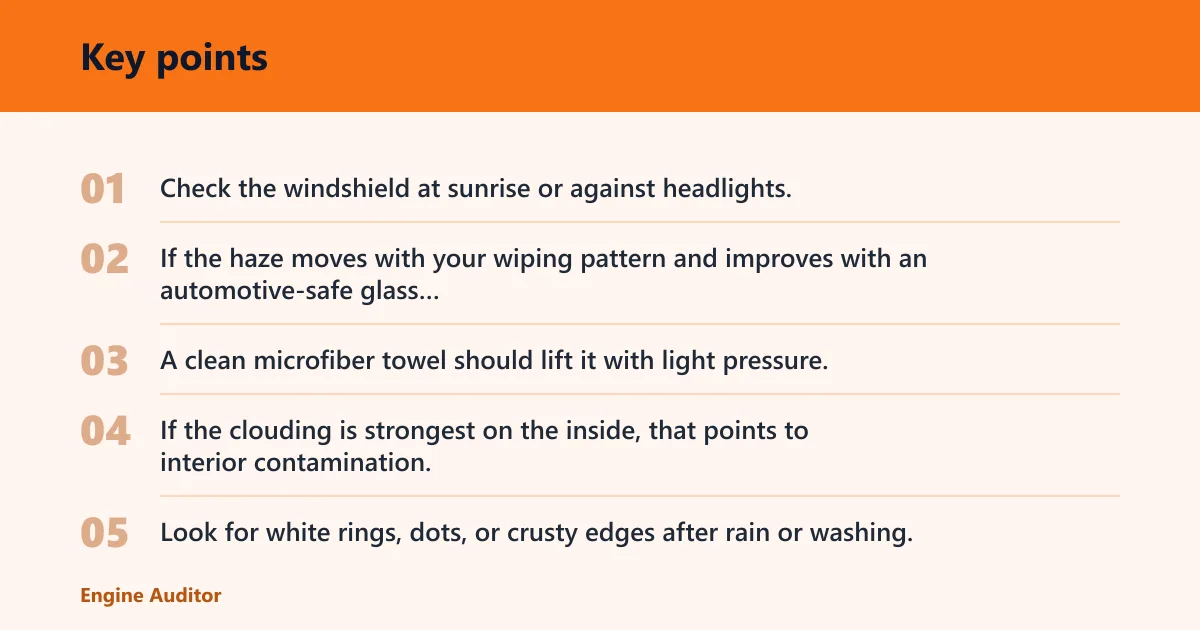
Check the windshield at sunrise or against headlights. If the haze moves with your wiping pattern and improves with an automotive-safe glass cleaner, it is usually oil film. A clean microfiber towel should lift it with light pressure. If the clouding is strongest on the inside, that points to interior contamination, not exterior water spots.
Quick tests for hard-water spotting
Look for white rings, dots, or crusty edges after rain or washing. If a vinegar-soaked cloth softens the mark but ordinary cleaner does not, you are likely dealing with calcium and magnesium buildup rather than glare-causing oil.
Signs the glass is etched or needs replacement
If the cloudiness stays after cleaning, feels rough, or shows rainbow-like distortion in strong light, the surface may be etched. At that point, polishing may help only a little. Deep pitting, delamination, or a mirror that looks milky from inside the housing usually points toward repair or replacement instead of more scrubbing.
Step 1: Clean the glass on both sides
- Open each door and clean the inside and outside of one pane before moving on.
- Spray automotive glass cleaner onto the towel, not the glass, to limit overspray on trim.
- Wipe in overlapping straight passes, then dry-buff with a second microfiber towel.
- Inspect the pane in bright light before deciding whether the haze is gone or only masked.
Use an automotive glass cleaner for windshields, windows, and mirrors to remove road film and interior haze. That makes ordinary cleaner the right first step for loose dirt and residue, but not for bonded deposits.
Use the right towel motion
A waffle weave or premium glass towel leaves less lint and streaking than a worn bath towel. Use one towel for the cleaner pass and another for dry-buffing. Do not chase streaks with repeated wet passes, because that often spreads residue instead of removing it.
Step 2: Remove haze or film
- Work on the worst pane first so you can judge the effect clearly.
- Use a microfiber towel with light pressure and a side-to-side motion on the cloudy area.
- For stubborn film, lightly dampen a melamine foam pad and pass it only over bare exterior glass, then rinse or wipe again.
- Stop if the cloudiness appears to come from inside a mirror housing or behind the glass.
Melamine foam may help lift some film on bare exterior glass, but it is risky on tinted glass, coated glass, and interior surfaces where abrasion can leave marks. Picture a side mirror that looks dull even after two wipes. If the outer lens clears but the center still looks gray from certain angles, the problem may be inside the assembly, not on the face of the mirror.
Step 3: Treat water spots and stubborn deposits
- Rinse the panel first to remove loose grit.
- Lubricate the glass with soapy water, then use 0000-grade steel wool only on bare exterior glass or chrome nearby.
- Use straight strokes with almost no pressure, then recheck the spot after each short pass.
- Rinse and dry thoroughly, then finish with glass cleaner or a rain repellent.
Use 0000-grade steel wool only on bare exterior glass that is not tinted, heated, coated, or otherwise specialty-treated, and keep it away from paint and plastic trim. Use it only with lubrication. Never substitute a coarser grade. Coarse abrasives can scratch glass fast.
Why ordinary cleaner fails here
Once deposits are bonded, you need a remover that can break them loose, followed by rinse water and a dry towel so the loosened residue does not dry back on the surface. For water spots, choose either a vinegar-based remover for light mineral buildup or a dedicated mineral cleaner for stubborn calcium and magnesium deposits; test a small area first and stop when the mark softens instead of forcing repeated dry passes.
How do you clean cloudy mirrors and side windows safely?
Start with the mirror face, then inspect the housing seam and backing. If the mirror is cloudy from surface film, the same cleaner-and-towel routine used on glass works well. If the image looks milky inside the housing, the issue may be moisture, backing failure, or a degraded seal rather than dirt on the front.
Mirror-specific checks
A cloudy side mirror can share the same result for the same practical reason: if the face is clean but the image still looks milky, the problem is likely in the housing, seal, backing, or moisture trapped behind the glass, so cleaning the face alone will not cure it.
Use a treatment after cleaning if you want water to bead and move across treated glass more easily. That kind of treatment belongs after cleaning. It does not remove deposits by itself.
Safety cautions near paint and trim
Keep melamine foam off painted surfaces, rubber seals, and tinted film unless the film maker allows it. 0000-grade steel wool is generally used on bare exterior glass and chrome, not plastic trim. Wipe away residue before it dries on black pillars, mirror caps, or weatherstripping.
If that didn’t work, try this next
Suppose the windshield still looks cloudy after a full clean and a mineral treatment. Move up one step at a time, not all at once. That keeps the risk low and shows which layer is causing the problem.
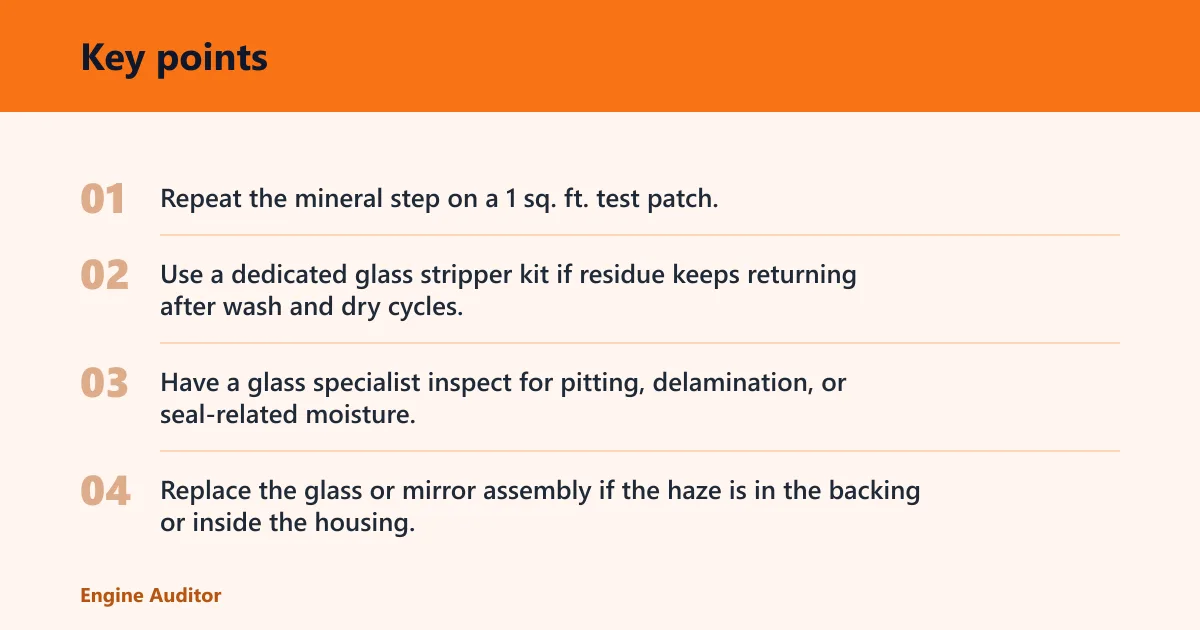
- Repeat the mineral step on a 1 sq. ft. test patch.
- Use a dedicated glass stripper kit if residue keeps returning after wash and dry cycles.
- Have a glass specialist inspect for pitting, delamination, or seal-related moisture.
- Replace the glass or mirror assembly if the haze is in the backing or inside the housing.
Cost and time usually rise with each step. Cleaner and microfiber towels are the cheapest and fastest. Mineral removers and glass stripper kits cost more but still stay in DIY range. Professional inspection makes more sense when the haze is internal, the mirror backing is failing, or the glass remains rough after treatment.
Common mistakes
Do not start with dry scrubbing. Dry abrasives can grind grit into the glass and make the haze worse. Do not skip the inside of the windshield; interior haze often creates the biggest glare. Do not leave cleaner, minerals, or lint behind, because all three can make the pane look cloudy again.
A common first-timer mistake is cleaning only the outside of a rear window and calling it done. If the inside still carries smoke film or off-gassing residue, the glass will look hazy in low sun even after the outside is spotless. Clean both sides before deciding anything is permanent.
How do you stop cloudy film from coming back on car windows?
Prevention is mostly about residue control and water control. Dry glass fully after washing, especially where mineral-rich water dries on the surface. If hard water is common, use a final rinse with cleaner water or distilled water where practical. Finish with a hydrophobic glass treatment after the glass is already clean.
Prevention routine
Use a streak-free automotive glass cleaner for weekly wipe-downs, keep interior dressings off the dash, and replace worn wiper blades that smear road film. If you wash in a hard-water area, dry the glass before the droplets evaporate. That is the simplest way to prevent calcium and magnesium buildup from returning.
Frequently asked questions
How to clean cloudy windshield
Clean both sides before choosing a harsher method. Start with a streak-free glass cleaner, then check for hard white spots in strong light. If spots remain, move to a vinegar-based remover or a dedicated mineral cleaner, then 0000-grade steel wool with lubrication only on the bare exterior surface. Finish by drying completely with a glass towel.
How to remove water spots from car windows
Use a vinegar-based remover or a dedicated mineral cleaner on a small test area first. If the spot softens, repeat, then rinse and dry. For stubborn deposits, 0000-grade steel wool with soapy water can help. If the mark remains after removal, the glass may be etched rather than spotted.
How to tell if my car windows are cloudy from film or mineral deposits
Film usually wipes clearer with automotive glass cleaner and shows up as a broad haze. Mineral deposits usually leave hard white dots or rings and resist standard cleaner. A vinegar test is useful: if the mark softens, you likely have surface deposits. If it does not change, the surface may be etched.
Can I use steel wool on car glass to remove haze?
Yes, but only 0000-grade steel wool, only on bare exterior glass, and only with soapy water lubrication. Use light pressure and short passes, then rinse and dry. Do not use coarser grades. Keep it away from paint, tint, heated rear windows, coatings, and rubber seals, because the wrong abrasive can scratch or dull nearby surfaces.
Products related to this article
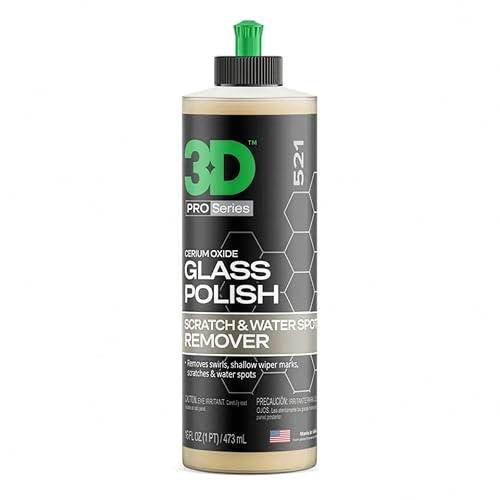
Sponsored / affiliate links. As an Amazon Associate I earn from qualifying purchases. I may earn additional commission from eligible campaigns.