How Long Do Car Batteries Last in Real-World Use?
Most car batteries last 3 to 5 years in normal use, but heat, short trips, and age can make replacement wise by year 4 even if the car still starts. Industry guidance and battery-maker specs consistently show that lifespan varies sharply by climate, duty cycle, and charging behavior, so the best clue is not age alone but whether the battery still has dependable reserve for your driving pattern. Ignore warning signs and you risk a no-start, towing, and dead electronics at the worst time.
Battery chemistry, temperature, and use patterns

For a 12-volt starter battery, age is only part of the answer. A battery can still crank the engine and yet be weak enough to fail after a cold night, a long parked stretch, or a week of short errands. The real question is whether it still has dependable reserve for your climate and driving pattern.
Three variables change lifespan fastest: battery chemistry, temperature, and use pattern. Battery makers and vehicle-service guidance consistently note that heat, short trips, and chronic undercharging shorten life, while steadier charging and milder temperatures extend it. A battery in a hot engine bay with many short trips ages far faster than the same battery in mild weather with longer drives and regular charging.
How long car batteries decision table
| Battery type | Climate and use pattern | Expected service window | Parking behavior | Replace-now risk rating |
|---|---|---|---|---|
| Flooded lead-acid | Hot climate, many short trips, accessory-heavy use | 3–4 years | Parked several days at a time | Replace now |
| Flooded lead-acid | Mild climate, mixed trips, regular highway charging | 4–5 years | Driven most days | Likely dependable this season |
| AGM | Hot or cold climate, stop-start traffic, high electrical load | 4–6 years | Parked overnight or for weekends | Test soon |
| AGM | Mild climate, longer drives, steady charging | 5–7 years | Driven regularly | Likely dependable this season |
| EFB | High-demand conventional vehicle, mild stop-start use | 4–6 years | Daily use with limited parking gaps | Test soon |
| EFB | Heat, repeated short trips, long idle periods | 3–5 years | Often left unused | Replace now |
| Lithium-ion EV battery | Managed by battery system, normal EV use | 10+ years | Usually charged and monitored by the vehicle | Likely dependable this season |
| Flooded lead-acid | Hot climate, airport-style parking, car sits 1–2 weeks between drives | 3–4 years | Long parking intervals | Replace now |
| AGM | Cold climate, daily commute, mostly highway trips | 5–7 years | Driven most days | Likely dependable this season |
| EFB | Mild climate, school-run pattern, 10–15 minute trips | 4–5 years | Parked overnight | Test soon |
| AGM | Hot climate, lots of accessories, repeated short errands | 4–5 years | Parked overnight | Replace now |
This table is a decision aid, not a lab result. A battery near the low end of its window in a hot climate with short trips should be treated as closer to replacement than age alone suggests. Battery manufacturers commonly warn that heat, deep discharge, and undercharging are the main accelerants of failure, while service-life claims are conditional rather than guaranteed.
How long car batteries checklist
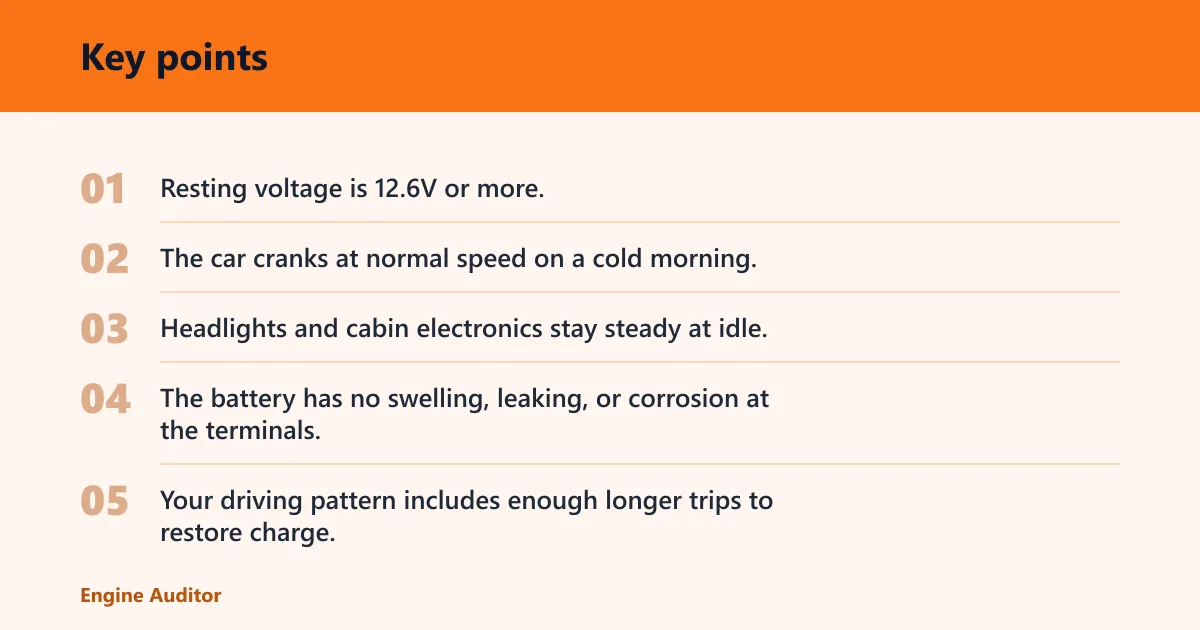
- Resting voltage is 12.6V or more.
- The car cranks at normal speed on a cold morning.
- Headlights and cabin electronics stay steady at idle.
- The battery has no swelling, leaking, or corrosion at the terminals.
- Your driving pattern includes enough longer trips to restore charge.
- The vehicle has not shown repeated low-voltage warnings.
How long should each battery type last?
Flooded lead-acid batteries often last about 3 to 5 years under normal operating conditions, while AGM batteries commonly stretch that to roughly 4 to 7 years and EFB batteries to about 4 to 6 years, depending on climate and charging habits. EV traction batteries are a different category entirely and are engineered for much longer service life, often measured in a decade or more. These ranges are consistent with battery-maker guidance and vehicle-service references, but they are still averages, not guarantees.
Flooded lead-acid battery
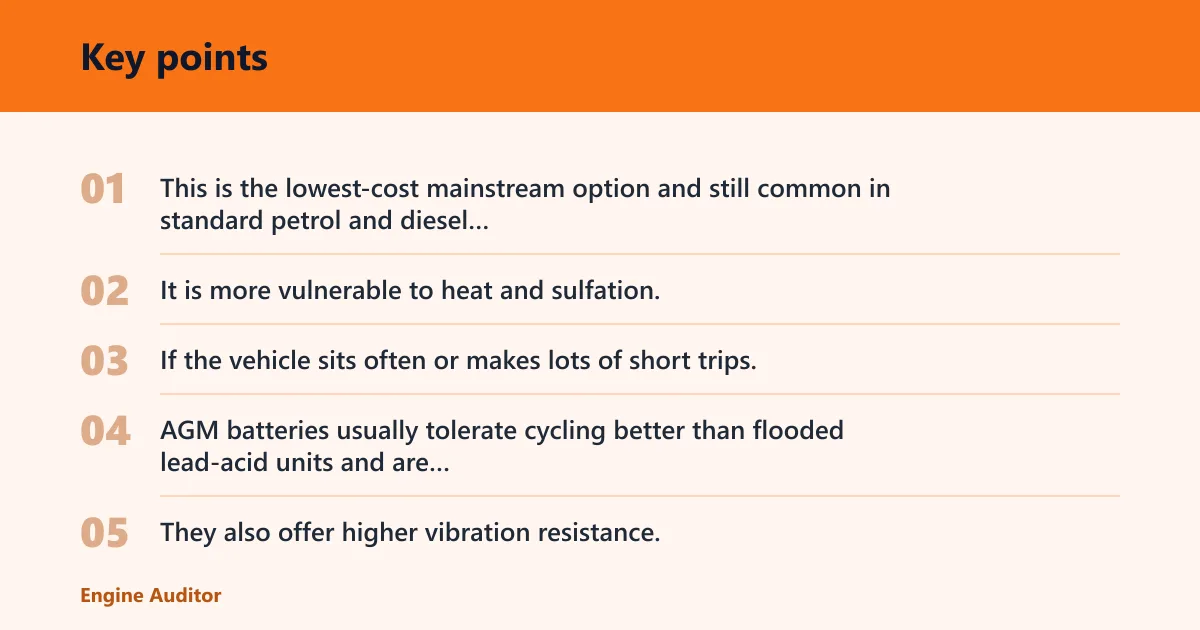
This is the lowest-cost mainstream option and still common in standard petrol and diesel vehicles. It is more vulnerable to heat and sulfation, so repeated undercharging and high under-hood temperatures shorten life quickly. If the vehicle sits often or makes lots of short trips, this type tends to age sooner than its calendar age suggests.
AGM battery
AGM batteries usually tolerate cycling better than flooded lead-acid units and are common in start-stop vehicles. They also offer higher vibration resistance, which helps in vehicles that see rough roads, frequent engine restarts, or higher accessory demand. That extra robustness does not make them immune to heat or chronic undercharging, but it often gives them a longer usable window.
EFB battery
EFB batteries are used in higher-demand conventional vehicles and are common in mild start-stop systems. They have improved cycling stability compared with standard flooded designs, which makes them a better fit when the vehicle repeatedly shuts off and restarts in traffic. In practice, they sit between basic flooded batteries and AGM units in durability and cost.
Lithium-ion EV battery
EV traction batteries are managed by battery management systems and usually retain capacity better than consumer electronics batteries. Most EV warranties use a capacity threshold near 70% for coverage decisions, and many manufacturers back packs for 8 years or 100,000 miles, with some offering 10 years or longer depending on model and market. That makes EV battery replacement patterns fundamentally different from 12-volt replacement cycles. EV traction batteries are also protected by thermal controls, software limits, and charging management that a conventional starter battery does not have.
That is why a 12-volt starter battery and an EV traction battery should not be compared as if they were the same product. They wear in different ways, serve different jobs, and fail on different timelines.
What shortens battery life the fastest?
Heat, short trips, and undercharging age a 12-volt battery fastest. Parasitic draw and smart alternator behavior can add hidden stress, especially when a vehicle is parked often or driven in a pattern that never lets the battery recover fully. Those effects are well documented in battery-service guidance and are more important than small differences in battery brand alone.
Heat and engine bay temperature
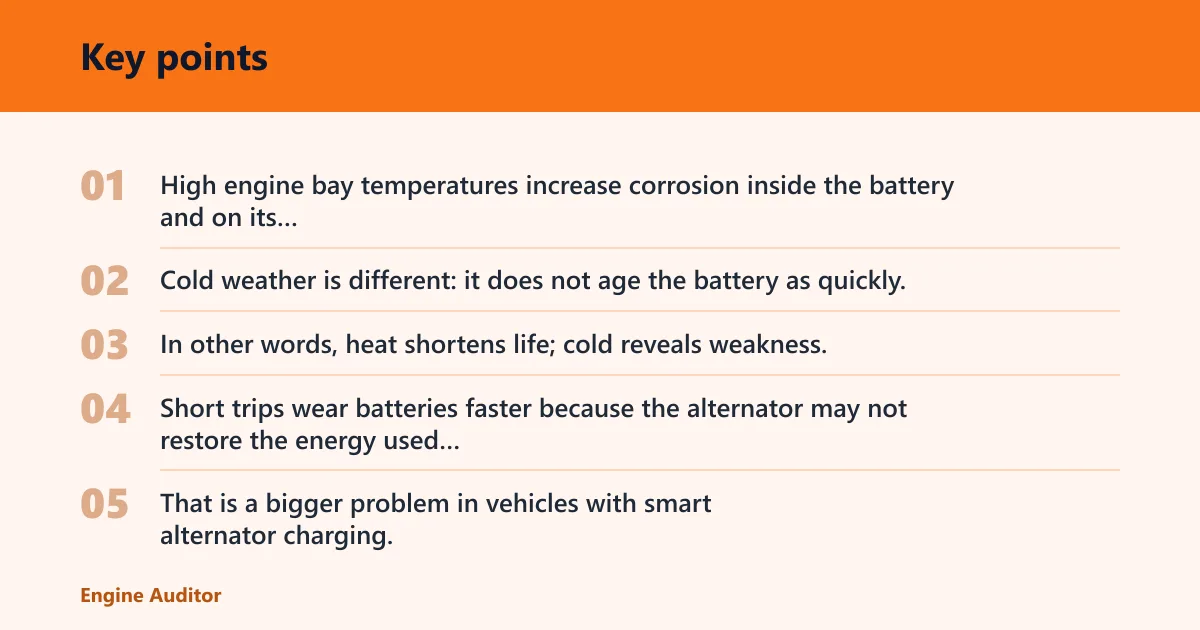
Heat accelerates degradation. High engine bay temperatures increase corrosion inside the battery and on its connections, and hot climates can pull years off service life. Cold weather is different: it does not age the battery as quickly, but it does make cranking performance worse, which exposes a weak battery sooner. In other words, heat shortens life; cold reveals weakness.
Short trips and undercharging
Short trips wear batteries faster because the alternator may not restore the energy used for starting. That is a bigger problem in vehicles with smart alternator charging, which can reduce charging output under acceleration and increase charging during deceleration to save fuel. If the drive never gives the battery enough recovery time, state of charge drifts downward and sulfation risk rises.
Say your sedan is used for two 8-minute school runs each day in winter. The battery may still show decent voltage after shutdown, but repeated shallow recharge cycles can leave it too weak for the next cold start.
Parasitic draw and long parking periods
Parasitic draw is the overnight electrical drain from alarms, modules, memory circuits, and other systems that stay awake after shutdown. Even a modest draw can matter over days, especially if the vehicle sits unused or starts with a partly charged battery. Industry testing and service literature treat anything in the tens of milliamps as something to watch in a vehicle that is parked frequently, because the drain becomes cumulative over time.
Smart alternator charging
Smart alternators are built to save fuel, not to keep every battery at full charge all the time. They can reduce output under acceleration and raise it during deceleration. In city traffic, that strategy can leave the battery chronically undercharged if the car makes only short, stop-and-go trips. That is normal system behavior, but it means the vehicle depends more heavily on the driver’s trip pattern.
How can you tell if a battery is aging?
Aging shows up first as weaker cranking, dimmer electrical behavior, and lower resting voltage. A battery can still start the car and still be near failure, so the goal is to spot declining reliability before a cold morning or long parking period exposes it. The most useful signs are repeatable patterns, not one-off events.
Slow cranking and dim electrical behavior
The starter may turn more slowly, the headlights may dim more at idle, and power windows or infotainment may seem sluggish during cranking. Those signs point to reduced usable capacity, especially if they appear after the car has sat overnight. If the symptoms are getting more noticeable in the same weather and same parking routine, the battery is likely losing reserve.
Voltage checks at rest
Resting voltage gives a simple first read. A reading of 12.6V or more indicates a fully charged battery. Around 12.2V is about 50% charge. Below 12.0V is a weak, high-risk battery condition. Those values are commonly used in automotive service references as practical thresholds, though temperature and recent charging can affect the reading.
What CCA and reserve capacity can tell you
Cold Cranking Amps, or CCA, is a starting power metric. It matters in freezing temperatures, but it is not the same as reserve capacity, and it is not the whole story. Reserve capacity measures how long a battery can sustain load, which can matter more than peak CCA in accessory-heavy vehicles with heated seats, audio systems, and frequent idle time.
A common first-timer mistake is to chase a high CCA number and ignore reserve capacity. That can miss a battery that still looks strong on paper but cannot hold up to daily electrical load.
When should you replace instead of recharge?
Replace instead of recharge when voltage keeps returning to a weak range, when the battery fails a load test, or when symptoms suggest it will not survive the next cold spell. Charging can recover a healthy battery, but it will not restore one that has lost real capacity or has repeated internal damage. In practice, repeated low readings or repeated no-start risk means the battery has moved from serviceable to unreliable.
Voltage ranges that point to trouble
If a charged battery settles below 12.2V at rest, it is already near half charge and should be watched closely. If it falls below 12.0V again soon after charging, the battery is in a high-risk condition. Repeated low readings after a full charge suggest that charging alone is no longer enough. Those thresholds are useful as a screening tool, not a full diagnosis.
When a load test matters more than charging
A load test checks whether the battery can deliver current under demand, which matters more than a resting voltage number alone. If the battery looks acceptable at rest but struggles under load, replace it before winter or before a long trip, not after the first no-start. This is especially important for batteries that sit overnight in cold weather or support a high accessory load.
Signs that winter reliability is already gone
If the car only starts after a long crank, if accessories dip during startup, or if the battery needs a jump after a short parking period, winter reliability is already in question. In that state, a battery may still be usable in mild weather but no longer dependable when temperatures drop. The practical rule is simple: if you do not trust it on the coldest morning, it is time to act.
How can you make a battery last longer?
Longer battery life usually comes from better charging, less idle drain, and earlier testing before cold weather. You cannot stop aging, but you can slow it by reducing deep discharge, avoiding long parked periods, and making sure the charging system actually restores the battery. The most effective habits are routine, not complicated.
Driving pattern fixes that help charging
- Take the car for longer drives when possible so the alternator can recover charge.
- Avoid repeated very short trips that never let the battery recharge fully.
- If the car has a smart alternator, expect more value from steady longer drives than from many brief errands.
- Reduce unnecessary accessory use during idle and immediately after start.
Storage habits that reduce discharge
If the car sits for days or weeks, the battery is more likely to drift into a low state of charge. Keep parking periods shorter when you can, and consider a maintenance charger for stored vehicles. This matters most for vehicles with known parasitic draw or a history of weak starts after sitting. A fully charged battery also tolerates storage better than one that is already partially depleted.
When to check the battery before cold weather
Check the battery before the first sustained cold snap, not after the first no-start. Cold weather exposes weak batteries fast, especially if the vehicle has short-trip use, a start-stop system, or a battery already near the end of its service window. Early testing gives you time to replace on your schedule instead of in the driveway on a freezing morning.
Frequently asked questions
How long do car batteries last in real-world use?
Most 12-volt car batteries last 3 to 5 years in real use, but the range shifts with heat, trip length, parking habits, and charging behavior. A battery can fail earlier in a hot climate with short errands, or last longer with steady driving and full charging. The practical answer is to judge the battery by condition and duty cycle, not by age alone.
What shortens a car battery’s life the fastest?
Heat is one of the fastest aging factors, followed by chronic undercharging from short trips and repeated sitting. A battery that never gets back to full charge after starting the car will age faster, even if the vehicle seems to run normally. High heat and repeated shallow cycling are the most common reasons a battery seems to “die early.”
Do hot climates make car batteries fail sooner?
Yes. Heat speeds internal wear and corrosion, and high under-hood temperatures are especially hard on flooded lead-acid batteries. In hot climates, a battery can look normal one month and become unreliable much sooner than the age-only average suggests. That is why hot-weather owners often need replacement earlier than drivers in mild regions.
Do short trips wear out car batteries faster?
Yes. Short trips use energy to start the engine, but they often do not give the alternator enough time to replace what was used. That pattern can leave the battery undercharged, which shortens life and raises the chance of a weak winter start. The shorter and more frequent the trips, the more important charging recovery becomes.
How can I tell if my car battery is aging?
Watch for slow cranking, dimmer lights during startup, and repeated low voltage after the car has sat. A resting voltage at 12.2V is about 50% charge, and below 12.0V is a high-risk condition. If the pattern repeats after charging, the battery is aging out. One weak reading matters less than a pattern of weak readings.
How long should AGM car batteries last compared with lead-acid?
AGM batteries often last 4 to 7 years, while flooded lead-acid batteries typically last 3 to 5 years. AGM handles cycling better and resists vibration more effectively, which is why it is common in start-stop vehicles and demanding electrical setups. That said, climate and charging habits still control the final outcome.
When does a car battery need replacement instead of charging?
Replace it when low voltage keeps returning after charging, when a load test shows poor output, or when the car becomes unreliable in cold weather. Charging helps a healthy battery recover, but it will not restore a battery that has lost capacity or has repeated internal damage. If charging only buys a short reprieve, replacement is the better fix.
How long do EV batteries last versus 12-volt car batteries?
EV traction batteries often last 10+ years and are managed by battery systems that protect them from the abuse common to 12-volt starter batteries. Many automakers warrant EV packs to about 70% of original capacity for 8 years or 100,000 miles, and some extend coverage beyond that depending on model and market. That is a different lifespan question from a starter battery, which usually needs replacement in a few years rather than a decade or more.
Products related to this article
Sponsored / affiliate links. As an Amazon Associate I earn from qualifying purchases. I may earn additional commission from eligible campaigns.