How Car Tires Are Made: The Full Manufacturing Process
The world of car tires is a fascinating intersection of chemistry, engineering, and precision manufacturing. While tires may appear to be simple black rings of rubber, their production involves a sophisticated process that blends raw materials, advanced technology, and rigorous quality control. Tires are a critical component of automotive safety and performance, connecting vehicles to the road and playing a vital role in braking, handling, and fuel efficiency.
Understanding how car tires are made provides insight into the innovation and expertise behind every journey. From the sourcing of natural and synthetic rubbers to the intricate layering of materials, the tire manufacturing process is a marvel of modern industry.
This comprehensive guide delves into each stage, highlighting the science, technology, and global collaboration involved in producing the tires that keep the world moving.
Key Takeaways
- Car tire manufacturing is a multi-step process involving raw material selection, mixing, component preparation, assembly, curing, and rigorous quality checks.
- Materials used include natural rubber, synthetic rubber, steel, textiles, and chemical additives for strength, flexibility, and durability.
- Modern tire production balances automation and expert oversight to ensure safety, consistency, and performance.
- Environmental considerations and recycling initiatives are increasingly shaping tire manufacturing practices worldwide.
- Quality control and testing are critical, with advanced technology employed to guarantee each tire meets strict standards.
- Understanding the process helps consumers make informed choices about tire purchase, maintenance, and disposal.

Credit: www.youtube.com
The Evolution And Importance Of Car Tires
From Early Wheels To Modern Tires
The journey from wooden wheels to modern pneumatic tires reflects centuries of innovation. The first practical tire was patented by John Boyd Dunlop in 1888, transforming transportation by introducing inflatable rubber casings. Over time, advancements in chemistry and manufacturing led to the development of radial tires, synthetic rubbers, and highly engineered tread patterns.
Before the invention of pneumatic tires, vehicles relied on wooden or iron wheels, which provided a harsh ride and poor traction. The introduction of rubber tires, especially when filled with air, drastically improved comfort and performance. Early rubber tires, however, were solid and did not offer much in terms of cushioning or flexibility.
It was only with the advent of the pneumatic (air-filled) tire that vehicles experienced a revolution in ride quality and safety.
In the early 20th century, the proliferation of automobiles accelerated tire innovation. Companies like Michelin and Goodyear pioneered new technologies, including the use of carbon black to improve rubber durability and the introduction of steel-belted tires. By the mid-20th century, the radial tire emerged as a game-changer, offering improved traction, longer lifespan, and better fuel efficiency compared to traditional bias-ply designs.
Why Tire Manufacturing Matters
Car tires are the only point of contact between a vehicle and the road. Their construction determines:
- Traction and grip
- Fuel economy
- Comfort and noise levels
- Braking performance
- Longevity
A tire failure can have catastrophic consequences, making the manufacturing process critical to road safety.
The quality of a tire also affects how a vehicle responds to emergency maneuvers and adverse weather conditions. For example, an inadequately manufactured tire might suffer from uneven wear or insufficient grip, leading to increased stopping distances or loss of control.
This is why manufacturers invest heavily in research, development, and testing to ensure each tire meets stringent safety standards.
Tire Types And Their Applications
Manufacturers produce a wide range of tires, each tailored for specific vehicles and conditions:
- Passenger car tires: Designed for everyday vehicles, these prioritize comfort, longevity, and balanced performance.
- Performance tires: Engineered for sports cars, these feature softer compounds and aggressive tread patterns for maximum grip and handling.
- SUV and light truck tires: Built to support heavier loads and off-road capability, with reinforced sidewalls and deeper treads.
- Winter and all-season tires: Winter tires use specialized rubber compounds and sipes for enhanced grip in snow and ice, while all-season tires provide a compromise for year-round use.
- Commercial and heavy-duty tires: Used on trucks and buses, these are built for durability, high load capacity, and retreadability.
Each type has distinct requirements for material composition, tread design, and construction, reflecting the diversity of driving environments and vehicle types worldwide.
Case Study: The Radial Tire Revolution
The introduction of the radial tire by Michelin in 1946 marked a turning point in tire technology. Radial tires, with their perpendicular ply cords and flexible sidewalls, significantly improved durability and fuel efficiency compared to the bias-ply designs of the past. Today, radial construction is standard for nearly all passenger vehicles worldwide.
Radial tires offered several technical advantages: the separation of tread and sidewall functions allowed for better handling and increased tread life. This innovation also reduced rolling resistance, leading to improved fuel economy—a crucial factor as fuel prices and environmental concerns have risen. The rapid adoption of radial technology in Europe and later in the United States reflected its superior performance, and it remains a foundation of modern tire engineering.

Credit: www.youtube.com
Raw Materials: The Building Blocks Of Car Tires
Natural And Synthetic Rubber
Modern tires are composed of about 19% natural rubber and 24% synthetic rubber by weight. Natural rubber, harvested mainly from Hevea brasiliensis trees in Southeast Asia, provides elasticity and resilience. Synthetic rubber, such as styrene-butadiene rubber (SBR) and butadiene rubber (BR), is derived from petroleum-based chemicals and offers enhanced abrasion resistance.
The blend of natural and synthetic rubbers allows manufacturers to finely tune the properties of each tire. For instance, natural rubber is particularly valued for its flexibility and ability to maintain performance in a wide range of temperatures. Synthetic rubbers, meanwhile, are engineered for specific performance characteristics—SBR for tread wear and wet traction, BR for low rolling resistance.
This balance enables the creation of tires suited for everything from daily commuting to high-performance racing.
Reinforcing Materials: Steel And Textiles
To withstand the stresses of driving, tires incorporate steel wires and textile cords:
- Steel belts reinforce the tread for stability and puncture resistance.
- Textile fabrics (polyester, nylon, rayon, or aramid) add strength and flexibility to the carcass.
Steel belts are critical for keeping the tread area flat and stable, which is essential for even wear and reliable handling. The use of textile cords in the body plies allows the tire to flex over road imperfections while maintaining its overall shape. Advanced materials like aramid fibers (e.g., Kevlar) are sometimes used in high-performance or specialty tires to provide additional strength without excessive weight.
Chemical Additives
A host of chemicals optimize tire properties:
- Carbon black: Provides color, strength, and resistance to UV degradation.
- Silica: Improves wet traction and reduces rolling resistance.
- Sulfur: Essential for vulcanization (cross-linking rubber molecules).
- Antioxidants and antiozonants: Protect against aging and cracking.
These additives are blended in precise formulations to achieve a balance of grip, wear resistance, and environmental resilience. For example, the inclusion of silica in tread compounds has been one of the most important advancements in recent decades, as it allows for improved wet weather performance without sacrificing rolling resistance—a critical factor for fuel efficiency.
Table: Typical Tire Composition By Weight
| Component | Percentage by Weight (%) | Main Function |
|---|---|---|
| Natural Rubber | 19 | Elasticity, flexibility |
| Synthetic Rubber | 24 | Abrasion resistance, durability |
| Carbon Black | 26 | Reinforcement, color |
| Steel | 12 | Tread reinforcement |
| Textile Fabric | 5 | Carcass strength |
| Other Chemicals | 14 | Vulcanization, protection |
Sourcing And Sustainability
The tire industry is increasingly focused on sustainable sourcing. Leading manufacturers are investing in alternative materials such as guayule rubber and bio-based fillers to reduce environmental impact. For more on sustainable rubber, see Rainforest Alliance.
Sustainability efforts extend to responsible plantation management, fair labor practices, and reducing deforestation. Some manufacturers partner with organizations like the Rainforest Alliance to ensure their supply chains are not contributing to ecological harm. Additionally, the rise of certification programs for sustainable natural rubber—such as the Global Platform for Sustainable Natural Rubber (GPSNR)—demonstrates the industry’s commitment to environmental stewardship.

Credit: www.youtube.com
The Tire Manufacturing Process: Step-by-step
1. Raw Material Preparation
The process begins with weighing and mixing raw ingredients according to precise recipes. Batch mixers combine natural and synthetic rubbers with fillers, oils, and chemicals. The resulting rubber compound must meet stringent specifications for viscosity, elasticity, and curing properties.
This stage is crucial for ensuring that every tire produced will perform consistently. The mixing process can involve multiple passes in specialized mixers, such as Banbury or kneader mixers, to ensure uniform dispersion of ingredients. Quality control at this stage includes testing small samples for tensile strength, elasticity, and chemical compatibility.
2. Component Manufacturing
Modern tires are built from several distinct layers, each produced separately:
- Tread: The outer layer that contacts the road.
- Sidewall: Protects the tire from impacts and weather.
- Inner liner: Provides an airtight seal.
- Carcass plies: Textile-reinforced layers for structure.
- Bead: Steel wires that anchor the tire to the wheel.
- Belt plies: Steel-reinforced layers under the tread.
Each component is extruded or calendered (rolled into sheets) and cut to precise dimensions.
For example, the inner liner is made from a special rubber compound that provides low air permeability, serving as an air retention layer similar to an inner tube but integrated into the tire itself. The sidewall must be flexible yet tough, as it absorbs shocks from potholes and curbs while protecting the internal structure from moisture and ozone.
Steel belts are carefully aligned and positioned to maximize tread stability and puncture resistance.
3. Tire Building (assembly)
Tire assembly is a complex, largely automated process performed on a tire building machine. The machine assembles components in a specific order:
- The inner liner is placed first.
- Carcass plies and bead assemblies are applied.
- Sidewalls and tread are layered on top.
The Assembled, Uncured Tire Is Known As A “green Tire.”
During assembly, precise alignment of each layer is critical to the tire’s final performance and uniformity. Automation ensures repeatability, but skilled workers often oversee the process, making adjustments as needed for specialty or low-volume production runs. After assembly, the green tire is inspected for any visible defects before moving to the next stage.
4. Curing (vulcanization)
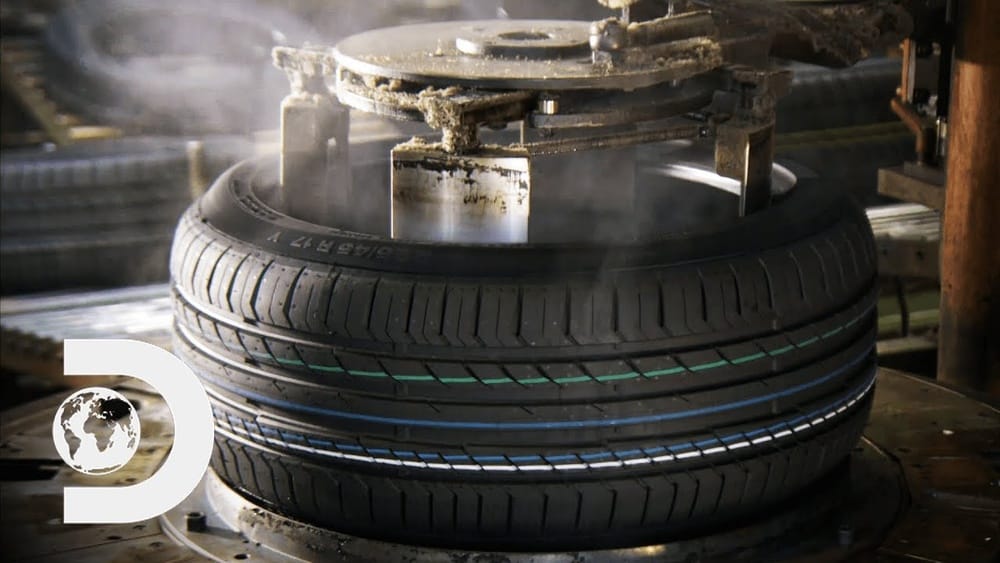
The green tire is placed in a curing press—a heated mold that shapes the tread pattern and sidewall markings. Vulcanization, typically at 300°F (150°C) and high pressure, transforms the soft rubber into a durable, elastic material by forming cross-links between polymer chains.
Curing is one of the most critical steps, as it gives the tire its final shape, tread design, and sidewall branding. The process is carefully controlled for time, temperature, and pressure to ensure optimal cross-linking of the rubber molecules. Insufficient curing can lead to weak spots or poor performance, while over-curing can make the tire brittle.
5. Final Inspection And Testing
After curing, each tire undergoes thorough inspection:
- Visual checks for imperfections.
- Uniformity testing for balance and roundness.
- X-ray inspection to detect internal flaws.
- Sample testing for strength and durability.
Only tires that pass all tests proceed to packaging and distribution.
Some manufacturers go further, conducting random destructive tests—cutting open tires to inspect for hidden defects or testing to failure in controlled conditions. This comprehensive approach ensures that only the highest quality tires reach the market.
Real-world Example: Michelin’s Industry 4.0 Tire Plant
Michelin’s Ladoux plant in France exemplifies the future of tire manufacturing. The facility uses robotics, AI-driven quality control, and real-time data analytics to optimize every step, reducing defects and energy consumption by over 20% compared to traditional plants. For more, see Michelin 4.0 Industry.
This digital transformation allows for continuous process improvements, predictive maintenance, and even remote monitoring of production lines—demonstrating the potential of smart manufacturing in the tire industry.
Advanced Technologies And Automation In Tire Manufacturing
The Role Of Automation
Modern tire plants leverage automation to increase efficiency, consistency, and safety. Automated systems handle:
- Material transport and storage
- Component assembly on building machines
- Curing press operation
- Inspection using machine vision
This reduces human error and enables mass production of high-quality tires.
Automation also enhances worker safety by reducing exposure to hazardous chemicals and heavy machinery. Robotics can perform repetitive tasks such as bead winding or tread extrusion with unmatched precision. In high-volume facilities, automated guided vehicles (AGVs) move materials seamlessly between production stations, further optimizing workflow.
Computer-aided Design And Simulation
CAD software and finite element analysis (FEA) allow engineers to simulate tire performance before physical production. These tools help optimize:
- Tread patterns for wet/dry grip
- Sidewall thickness for comfort and durability
- Material blends for specific vehicle requirements
Simulation software enables rapid prototyping and scenario testing, reducing development time and costs. Engineers can model how a tire will respond to heat, load, cornering forces, and wear, making it possible to fine-tune designs before committing to expensive tooling or materials.
Quality Control Innovations
Non-destructive testing methods, such as laser shearography and X-ray imaging, detect flaws invisible to the naked eye. Some plants use RFID tagging to track each tire’s history from raw material to final inspection.
Laser shearography, for example, uses laser light to reveal internal separations or voids within the tire structure, which might not be apparent during standard visual inspection. RFID technology ensures traceability, helping manufacturers quickly identify and recall any affected batches in the event of a defect or safety issue.
Case Study: Bridgestone’s Smart Factory
Bridgestone’s Hikone plant in Japan employs Internet of Things (IoT) sensors throughout production lines. Data from sensors is analyzed in real time to predict maintenance needs and ensure perfect product consistency. This has led to a 15% reduction in production downtime. Read more at Bridgestone Smart Factory.
The integration of IoT and data analytics not only improves operational efficiency but also provides valuable insights for continuous improvement, allowing plants to adapt rapidly to changing demand or new product requirements.
Environmental Impact And Sustainability Initiatives
Tire Manufacturing’s Environmental Footprint
Tire production is energy-intensive and generates:
- CO₂ emissions from energy use
- Waste rubber and chemical byproducts
- Water consumption in cooling and cleaning
The industry is under pressure to adopt greener practices.
Additionally, the sourcing of raw materials—especially natural rubber—can contribute to deforestation, habitat loss, and biodiversity decline if not managed responsibly. The use of petroleum-based chemicals and the high energy requirements for mixing, curing, and logistics also present sustainability challenges.
Recycling And Circular Economy
Many manufacturers participate in tire recycling programs:
- Used tires are repurposed as crumb rubber for playgrounds, sports surfaces, and road asphalt.
- Pyrolysis processes convert old tires into oil, gas, and steel.
In 2026, the US recycled over 75% of scrap tires, according to the US EPA.
Some countries have established extended producer responsibility (EPR) programs, requiring manufacturers to take back and recycle used tires. Advanced recycling technologies are being developed to recover high-value materials such as carbon black and oil, closing the loop and reducing reliance on virgin resources.
Sustainable Materials And Green Tires
Leading tire brands are experimenting with:
- Bio-based rubbers from dandelion or guayule plants
- Silica from rice husk ash
- Renewable oils instead of petroleum-based oils
For example, Continental’s Taraxagum project uses dandelion roots to produce sustainable natural rubber. Details at Continental Taraxagum.
Development of “green tires” that offer low rolling resistance, longer life, and reduced environmental impact is a major focus. These initiatives not only help meet regulatory requirements but also align with increasing consumer demand for sustainable products.
Table: Comparison Of Traditional Vs. Sustainable Tire Materials
| Material | Traditional Source | Sustainable Alternative | Environmental Benefit |
|---|---|---|---|
| Natural Rubber | Hevea Trees (Asia) | Dandelion, Guayule | Reduces deforestation, shorter growth cycle |
| Carbon Black | Petroleum | Recovered Carbon Black | Lower CO₂ emissions |
| Silica | Sand Mining | Rice Husk Ash | Utilizes agricultural waste |
| Aromatic Oils | Petroleum | Vegetable Oils | Renewable, less toxic |
Real-world Example: Goodyear’s Soybean Oil Tires
Goodyear has introduced passenger tires using soybean oil as a replacement for petroleum-based oils. These tires offer improved tread flexibility in cold weather while reducing reliance on fossil fuels. See Goodyear Soybean Oil Tires.
Such innovations are helping to pave the way for a more sustainable tire industry, benefiting both the environment and consumers.
Tire Performance, Quality, And Safety Testing
Laboratory Testing
Tires undergo rigorous lab tests to evaluate:
- Tensile strength
- Tear resistance
- Aging and ozone resistance
- Heat buildup and rolling resistance
Samples are cut and stretched, compressed, or exposed to harsh environments to simulate years of use in weeks.
For example, ozone chambers accelerate the effects of sunlight and ozone exposure, while dynamic mechanical analyzers simulate the repeated flexing a tire endures over its lifetime. This helps identify potential weaknesses and ensures the tire will not prematurely crack or fail in real-world conditions.
On-vehicle Testing
Prototype tires are mounted on test vehicles and driven on:
- High-speed test tracks
- Wet and dry surfaces
- Extreme temperatures
Data on handling, braking, noise, and comfort is collected using advanced telemetry.
Professional test drivers and engineers assess not only objective performance metrics but also subjective qualities such as steering feel and ride comfort. Some manufacturers have dedicated proving grounds with a variety of surfaces, from ice and snow to cobblestone and high-speed ovals, to replicate global driving conditions.
Regulatory Compliance And Certification
Tires must comply with regulations such as the US DOT and European ECE standards, covering:
- Load capacity
- Speed rating
- Traction and temperature grades
Failure to meet standards results in rejection or recalls, as documented by the National Highway Traffic Safety Administration.
To ensure compliance, manufacturers must submit samples for third-party testing and certification. This process provides consumers with confidence in the safety and reliability of the tires they purchase.
Table: Key Tire Performance Metrics
| Metric | Definition | Significance |
|---|---|---|
| Treadwear | Distance tire can travel before tread is worn | Longevity, cost-effectiveness |
| Traction | Grip on wet or dry surfaces | Safety, braking distance |
| Temperature Resistance | Ability to dissipate heat | Prevents blowouts at high speed |
| Noise Level | Sound generated at various speeds | Passenger comfort, urban regulations |
Case Study: Continental’s Automated Indoor Tire Test Center
Continental’s AITTC in Hannover, Germany, automates tire testing using robotic systems to evaluate tires for up to 100,000 km on simulated road surfaces. This enables rapid development of new models while maintaining strict quality standards. More at Continental AITTC.
Automated test centers allow for consistent, repeatable tests and the ability to accelerate the development cycle for new tire models. Insights gained from such facilities are rapidly integrated into product updates, ensuring consumers benefit from the latest advancements in safety and performance.
From Factory To Market: Distribution And Consumer Considerations
Packaging And Logistics
Once approved, tires are labeled and shipped to warehouses or directly to retailers. Efficient logistics are crucial, as tires are bulky and heavy. Major brands use RFID tracking to monitor inventory and prevent counterfeiting.
Tires are typically shipped in standardized stacks or bundles to minimize space and prevent deformation during transit. Distribution centers use sophisticated warehouse management systems to ensure timely delivery to dealers and minimize stockouts, helping consumers access the right tires for their vehicles quickly and efficiently.
Retail And Installation
Consumers purchase tires from:
- Dealerships
- Specialty tire shops
- Online retailers
Professional installation ensures proper balancing, alignment, and inflation, which are critical for performance and safety.
The rise of e-commerce has transformed tire retail, with many consumers now researching and purchasing tires online before arranging installation at a local shop or service center. Some retailers offer mobile installation services, bringing convenience directly to the consumer.
Tire Maintenance And Replacement
Proper tire care extends lifespan and enhances safety:
- Regular rotation (every 5,000-7,500 miles)
- Wheel alignment and balancing
- Monitoring tread depth (replace below 2/32 inch)
- Checking inflation pressure monthly
Underinflated or unevenly worn tires can decrease fuel efficiency, increase stopping distance, and raise the risk of blowouts. Many modern vehicles are equipped with tire pressure monitoring systems (TPMS), which alert drivers to unsafe pressure levels.
End-of-life Management
When tires reach the end of their usable life, responsible disposal or recycling is essential. Many regions prohibit landfill disposal and mandate recycling to reduce environmental impact.
Consumers are encouraged to return old tires to retailers or recycling centers. Some manufacturers offer “take-back” programs, and numerous municipalities run tire collection events to prevent illegal dumping and promote resource recovery.
Frequently Asked Questions
How Long Does It Take To Manufacture A Car Tire?
The entire process—from raw material mixing to final inspection—typically takes 5 to 10 hours per tire, depending on factory automation and the complexity of the tire design. The most time-consuming step is curing, which lasts 10–20 minutes per tire but is limited by mold and press availability.
In high-volume factories, multiple tires are produced simultaneously, but the bottleneck often remains the curing presses. Planning and efficiency improvements in this stage have a significant impact on overall productivity.
What Is The Difference Between Radial And Bias-ply Tires?
Radial tires have cords running perpendicular to the direction of travel, with steel belts under the tread, offering superior durability, lower rolling resistance, and better handling. Bias-ply tires have cords laid at alternating angles, resulting in a stiffer ride and shorter lifespan. Radial designs are now standard for nearly all passenger vehicles.
Radial tires also provide better fuel efficiency and heat dissipation, making them suitable for high-speed and long-distance driving. Bias-ply tires are still used for certain specialty applications, such as vintage cars, trailers, and some off-road vehicles.
Are Tires Made From 100% Natural Rubber?
No, modern tires use a blend of natural and synthetic rubbers. Synthetic rubbers provide enhanced performance characteristics such as abrasion resistance, heat tolerance, and lower cost. Natural rubber is still vital for its elasticity but typically constitutes only 15–30% of the total rubber content.
The exact composition varies depending on the tire type, performance requirements, and cost considerations. Specialty tires may use higher proportions of natural rubber for unique applications, such as aircraft or racing.
How Are Defective Tires Detected?
Defective tires are identified through visual inspection, machine-based uniformity testing, X-ray, and sometimes ultrasound. Advanced plants employ machine vision and AI to flag anomalies instantly. Tires that fail any test are destroyed or recycled, never reaching consumers.
Regular audits and continuous improvement programs ensure that defect rates remain extremely low, helping to maintain consumer trust and brand reputation.
What Happens To Old Tires After They Are Replaced?
Most used tires are recycled into products like rubberized asphalt, playground surfaces, or fuel through pyrolysis. Some are retreaded for reuse, especially in commercial vehicles. Landfill disposal is discouraged due to environmental concerns, and many regions have robust recycling programs.
Retreading extends the life of commercial tires, reducing waste and saving resources. The recycled materials from scrap tires are increasingly used in construction, landscaping, and even as raw material for new tires.
Car tire manufacturing is a blend of science, engineering, and global logistics, resulting in products that are essential to modern mobility and safety. As technology advances and sustainability becomes a priority, the industry continues to innovate, creating tires that are safer, longer-lasting, and more environmentally friendly. Understanding how tires are made empowers consumers to make informed choices and appreciate the remarkable process behind a seemingly ordinary product.
Products related to this article
Sponsored / affiliate links. As an Amazon Associate I earn from qualifying purchases. I may earn additional commission from eligible campaigns.