Best Cars for Uber and Rideshare Drivers: Practical Choices
The best cars for Uber and rideshare work are hybrid sedans with strong reliability, low depreciation, good rear-seat room, and inexpensive tires and brakes. Safe default picks are the Toyota Camry Hybrid, Toyota Prius, Honda Accord Hybrid, and Hyundai Elantra Hybrid. Choose badly, and fuel savings can disappear into repairs, downtime, faster depreciation, and poor ratings from cramped seats or weak trunk space. This guide ranks practical picks by running cost, comfort, cargo space, reliability, and platform fit for city and airport driving.
What makes a rideshare car profitable?
The most profitable rideshare car keeps total cost per mile low while still staying acceptable to passengers and platform rules. Fuel economy matters, but depreciation, repair exposure, tire and brake cost, and time off the road can matter just as much. A profitable choice has to make sense for the miles you actually drive, not just the miles it can advertise.
The real trade-off
A car that saves 10 mpg on fuel can still lose money if it depreciates faster, needs pricier tires, or sends more trips through a repair bay. For high-mileage drivers, the best value often comes from simple mechanicals, common parts, and a cabin that avoids back-seat complaints. That is why the best overall pick is often a mainstream hybrid rather than a more stylish car with higher ownership risk.
How UberX, Comfort, and XL change the answer
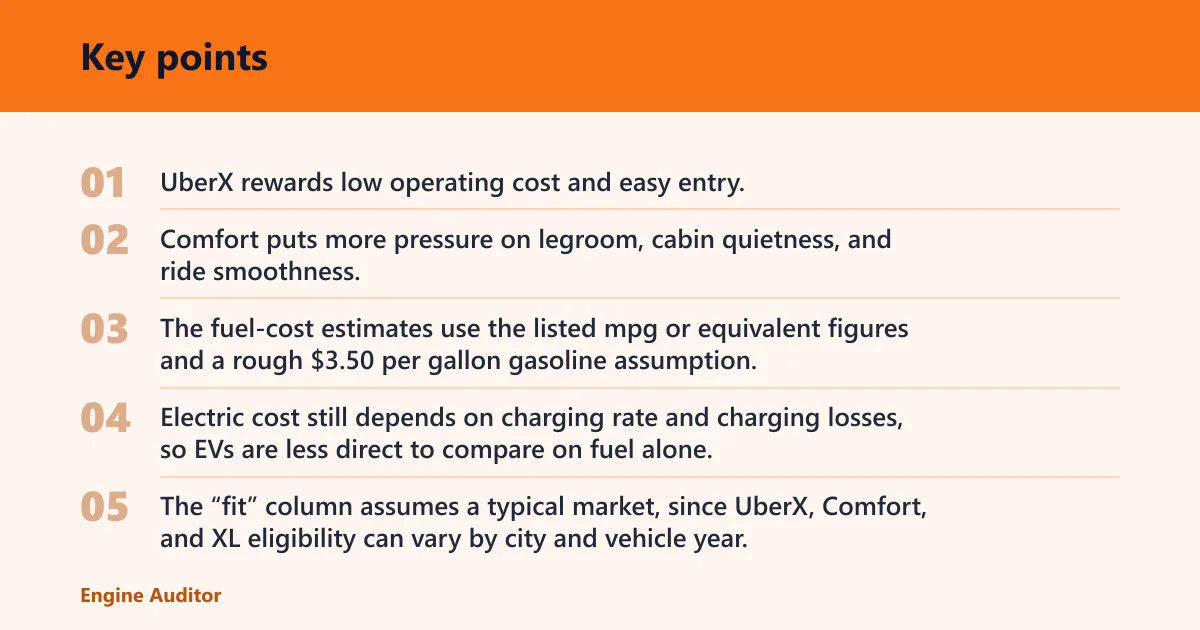
UberX rewards low operating cost and easy entry. Comfort puts more pressure on legroom, cabin quietness, and ride smoothness. XL changes the target again; third-row space matters more than mpg, and a larger vehicle can earn more on airport and group trips if fuel and tire costs do not erase the extra fare. Market rules also matter, since some vehicles qualify in one area and miss Comfort or XL in another, even if the car seems large enough on paper.
Rideshare car scorecard
This matrix is built around a practical rideshare use case: heavy city use, regular airport runs, and mixed weekday mileage. The fuel-cost estimates use the listed mpg or equivalent figures and a rough $3.50 per gallon gasoline assumption. Electric cost still depends on charging rate and charging losses, so EVs are less direct to compare on fuel alone. The “fit” column assumes a typical market, since UberX, Comfort, and XL eligibility can vary by city and vehicle year.
| Model | Powertrain | Combined mpg or equivalent | Fuel cost per mile* | Rear-seat room | Trunk usability | Depreciation risk | Uber tier fit |
|---|---|---|---|---|---|---|---|
| Toyota Prius | Hybrid | 57 mpg | About 6.1¢ | Good headroom, average legroom | Good hatch shape, easy luggage loading | Low | UberX, Comfort in some markets |
| Toyota Camry Hybrid | Hybrid | 51 mpg | About 6.9¢ | Strong legroom and easy entry | Good sedan trunk for two to three bags | Low | UberX, Comfort |
| Honda Accord Hybrid | Hybrid | 48 mpg | About 7.3¢ | Very good legroom, good seat support | Large trunk, wide opening | Low to moderate | UberX, Comfort |
| Hyundai Elantra Hybrid | Hybrid | 54 mpg | About 6.5¢ | Good front-to-back space for class | Small trunk, usable for daily rides | Moderate | UberX |
| Toyota Corolla Cross Hybrid | Hybrid | 42 mpg | About 8.3¢ | Easy entry, upright seating | Better height, less sedan-style depth | Low | UberX, some Comfort |
| Toyota RAV4 Hybrid | Hybrid | 40 mpg | About 8.8¢ | Good access, not luxury-wide | Strong airport utility | Low | UberX, some Comfort |
| Toyota Highlander Hybrid | Hybrid | 35 mpg | About 10.0¢ | Good second row, third row only for short trips | Very good with third row folded | Low | UberXL |
| Toyota Sienna | Hybrid | 36 mpg | About 9.7¢ | Excellent second row, easy entry | Best airport luggage space here | Low | UberXL |
| Tesla Model 3 RWD | Electric | About 132 MPGe | Varies with charging rate | Good enough, low hip point | Good rear trunk and frunk | Moderate | UberX, Comfort in some markets |
| Prius Prime | Plug-in hybrid | High mpg when charged | Low on electric miles, higher once depleted | Rear seat tighter than Prius | Smaller cargo area than Prius | Moderate | UberX |
*Fuel cost per mile uses a rough $3.50 per gallon gasoline assumption and EPA-style combined figures. Electric cost depends on local charging price and charging losses.
Which cars are cheapest to run?
The cheapest car to run is not always the one with the best mpg. The real winner combines fuel economy, reasonable depreciation, tire and brake costs, and a price you can actually recover through rideshare work. For most drivers, hybrids are the easiest balance of those factors.
Best overall
The Toyota Camry Hybrid is the best all-around choice for many drivers because it blends strong mpg, easy rear-seat access, broad used-car demand, and a sedan format that fits UberX and Comfort without giving up too much cargo space. It is the safest “buy once, drive hard” answer for many markets.
Best used value
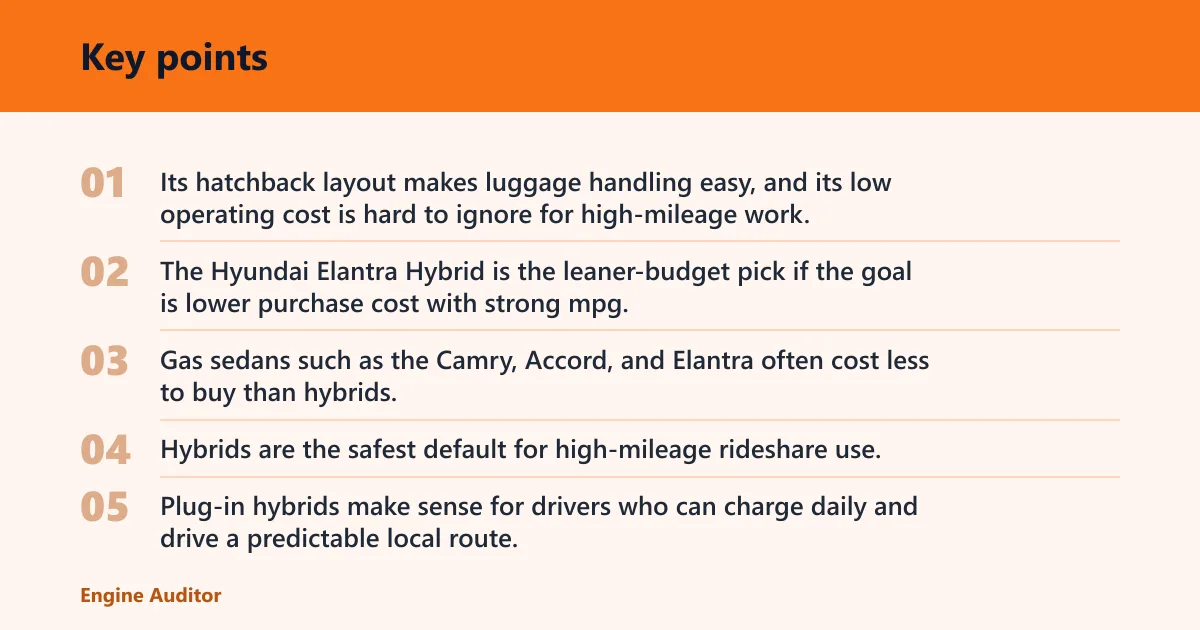
The Toyota Prius is often the best used value when purchase price matters most and you still want excellent fuel economy. Its hatchback layout makes luggage handling easy, and its low operating cost is hard to ignore for high-mileage work.
Best low upfront budget
The Hyundai Elantra Hybrid is the leaner-budget pick if the goal is lower purchase cost with strong mpg. It is not as roomy or cargo-friendly as the larger sedans, but it can make sense when the buyer needs a lower entry price and wants to stay in UberX territory.
Gas sedans
Gas sedans such as the Camry, Accord, and Elantra often cost less to buy than hybrids. They usually lose on fuel, especially in stop-and-go city driving, but they can still be a good buy if the price gap is large and the car will not rack up extreme weekly mileage.
Hybrids
Hybrids are the safest default for high-mileage rideshare use. Their fuel savings show up fastest in city traffic, and they avoid the charging logistics that make EV ownership harder for drivers with long shifts or no home outlet.
Plug-in hybrids
Plug-in hybrids make sense for drivers who can charge daily and drive a predictable local route. They work best when the battery covers a meaningful share of the shift. Once the battery is depleted, the car acts more like a heavier gas car, so the mpg advantage shrinks.
Electric cars
EVs can be very cheap per mile, but the math depends on charging access, local electricity cost, and route pattern. Winter range loss, faster battery use at highway speeds, and time spent charging can matter more than the window sticker suggests. EVs are strongest for drivers who can keep the battery topped up and avoid long dead miles between chargers.
Which cars feel best to passengers?
Passenger comfort is a profit item because cramped seats, hard rear cushions, and awkward entry points lead to complaints, low ratings, and fewer Comfort-level trips. The best rideshare cabin gives adults enough knee room, decent headroom, and a back door opening that does not force a sideways squeeze.
Rear-seat legroom and headroom
The Camry Hybrid and Accord Hybrid stand out among sedans because they give taller riders more legroom than many compact cars. The Prius has good headroom but a lower seating position that some riders dislike. SUVs help with headroom and posture, but they do not automatically offer more knee room.
Entry, exit, and door opening
Entry and exit matter more than many buyers expect. A low sedan can be fine for short hops, but repeated in-and-out airport or downtown trips are easier in a crossover or minivan with a taller doorway and less step-down.
Seat comfort on longer rides
Seat contour and cushion support matter on 20- to 60-minute rides. The Accord Hybrid and Camry Hybrid are usually safer bets than compact sedans here. Third-row seats in midsize SUVs are usually a last row for short riders or short distances, not a comfort feature.
Noise and ride quality
Hybrids often stay quiet at low speeds, which helps with city comfort. A smoother suspension and well-insulated cabin can matter more than raw horsepower. Tire choice also affects noise; some low rolling-resistance tires ride harder than comfort-focused alternatives. If most of the job is highway-heavy, comfort can depend as much on the route as on the badge, which is why long commuters should think about ride calmness as a profit factor, not a luxury extra.
Reliability and downtime
Reliability matters because every day off the road is lost revenue. A car that needs fewer repairs, uses common parts, and has easy service access can beat a cheaper-to-fill vehicle that spends more time in the shop.
Maintenance frequency
Hybrids usually need the same basics as gas cars: oil changes, filters, brake fluid, tires, and suspension checks. Brake wear can be lower because regenerative braking does much of the work. That does not eliminate maintenance; it changes the pattern. For rideshare use, the better question is not whether maintenance exists, but whether the schedule stays predictable enough to avoid surprise downtime.
Parts availability and repair cost
Popular models usually have better parts availability and more independent shop familiarity. Toyota and Honda have strong fleet appeal for that reason. More complex or less common drivetrains can raise repair cost exposure when a sensor, inverter, battery component, or transmission part fails. That is one reason mainstream hybrids tend to outrun more exotic options on total ownership cost.
Why simple powertrains often win for high mileage
For high-mileage driving, simple and common often beats exotic and efficient. A sedan with a widely used hybrid system can be easier to keep on the road than a premium badge car with a pricier suspension, higher insurance, and more expensive body parts. Depreciation usually reinforces that advantage, because used buyers tend to trust familiar nameplates more than niche ones.
What mpg do you need for rideshare driving to be profitable?
There is no single mpg cutoff, but high-mileage drivers often want at least the low- to mid-40s combined if they are buying a gas-only car. Hybrids in the 50 mpg range usually make more sense once weekly mileage rises, because fuel savings compound across every shift. A driver doing 600 miles a week feels the difference much faster than someone doing 250 miles a week.
A common first-timer mistake is choosing a tiny hybrid without considering rear-seat comfort and trunk space. A car that returns 50 mpg but carries a bigger purchase price, worse resale, or expensive tires may not beat a 40 mpg car with low depreciation and cheap service. Profitability comes from the whole package, not just one impressive spec.
-
Estimate weekly miles.
Add city and highway driving from a normal week, then multiply by 4.3 for a monthly picture. A driver covering 600 miles a week is making a different decision from someone at 250 miles a week. -
Price fuel and wear.
Use a fuel price you actually pay, then add a rough allowance for tires, oil, brakes, and routine service. The goal is not penny-level precision; the goal is to avoid buying a car that looks cheap at the pump and expensive everywhere else. -
Check resale sensitivity.
High-mileage rideshare cars lose value fast if the market dislikes large odometer numbers. Choose models with strong fleet demand and broad used-car appeal.
Which used cars are best for Uber drivers?
Used cars are often the smarter buy for drivers who want lower upfront cost and can verify service history. The best used choices are usually mainstream hybrids and sedans with documented maintenance, no accident history, and mileage that matches the asking price.
Best used value: the Prius often stands out
The Prius often stands out here because it combines strong mpg, simple packaging, and long-standing fleet demand. The Camry Hybrid is another strong used buy because it gives more rear-seat comfort without sacrificing much on running costs.
Used-buy risk
Used-car risk rises when the car has missing service records, uneven tire wear, warning lights, or signs of heavy commercial use beyond normal rideshare work. Hybrid batteries, 12-volt batteries, and cooling systems deserve a close look on any used hybrid or EV. A lower-mileage example with cleaner records is often better than a bargain-priced car that looks cheap only because it has been neglected.
Mileage sensitivity
Some cars lose resale value quickly after certain mileage marks, especially when buyers fear future repair bills. For rideshare use, a car with about 80,000 well-documented miles can be a better buy than a cheaper car with about 140,000 miles and poor records.
Fleet-market appeal
Fleet appeal matters because it helps resale later. Cars that taxis, delivery fleets, and commuter buyers also want tend to retain value better. The Camry Hybrid, Prius, Accord Hybrid, and Sienna are strong examples of models with broad demand.
What car features matter most for Uber Comfort or XL?
Uber Comfort and XL reward space, easy access, and a calmer cabin more than bare-bones operating cost. For Comfort, focus on legroom, quietness, and a smooth seat position. For XL, a true third row and useful cargo room matter more than an extra few mpg. In markets where SUV eligibility matters, the difference between a midsize SUV and a sedan can be the difference between a possible upgrade and a dead-end purchase.
Comfort features
Comfort drivers should look for generous rear legroom, decent rear door openings, quiet highway manners, and seat adjustability that keeps riders from feeling boxed in. A large trunk matters too, because riders notice where their bags go. If the car will spend much of its life on long highway trips, the quieter cabin and steadier ride become part of the earning formula.
XL features
XL needs a third row that can actually hold adults or older kids for short trips, not just occasional emergency seating. The Sienna and Highlander Hybrid fit that role better than most midsize sedans. A third row that steals all the cargo room is less useful than it looks on paper.
How much should a rideshare driver spend on a car?
The right budget depends on weekly mileage and how soon the car must start earning back its cost. A lower-mileage driver can justify a cheaper used sedan; a high-mileage driver may save more with a newer hybrid that costs more upfront but loses less to fuel, downtime, and depreciation. The smartest purchase is usually the one that stays affordable after insurance, maintenance, and resale are included.
-
Set a monthly ceiling.
Keep the payment, insurance, and estimated maintenance within a share of your expected rideshare income that still leaves room for repairs and slow weeks. Do not build a budget around peak-demand weeks only. -
Match the car to mileage.
If weekly mileage is high, a strong hybrid often pays back faster than a cheaper gas car. If mileage is modest, the lower purchase price of a used gas sedan may matter more than fuel savings. -
Separate car type from tier.
Do not buy a large SUV unless you can use XL or have regular airport and group trips. Extra seating only helps if your market and platform approvals let you sell it.
Is an electric car worth it for Uber driving?
An electric car can be worth it if you can charge at home or at work, drive predictable routes, and handle winter range loss. It is usually a weaker fit for drivers who rely on fast turnaround, lack reliable charging, or spend a lot of time on long highway trips. For a highway-heavy schedule, the biggest EV question is not just cost per mile; it is whether charging time and range buffer still leave enough productive hours in the day.
Charging access
Charging access is the first filter. Without a dependable overnight charge, an EV can create downtime that eats into earnings. Public charging can work, but only if local stations are reliable and the driver can manage the extra time. If charging becomes a daily hassle, the theoretical fuel savings shrink quickly.
Winter range loss
Cold weather can cut real driving range, and heater use adds more drain. That matters most for airport runs, late-night shifts, and longer Comfort trips. Range planning becomes part of the job, not a background detail.
When EVs make sense
EVs make the most sense when local electricity is cheap, charging is easy, and the driver values low fuel cost more than quick refills. For some city drivers, that trade is excellent. For others, a hybrid is still the simpler profit choice. The best EV use case is usually local, repeatable, and easy to recharge between shifts.
Choose Toyota Camry Hybrid if… / Choose Toyota Highlander Hybrid if…
Choose the Camry Hybrid if your priority is lower running cost, easier ownership, and a strong fit for UberX or Comfort with mostly sedan-sized luggage. Choose the Highlander Hybrid if you need more passenger space, regular airport trips, or the ability to take XL-style fares without moving into a minivan. In short: choose the Camry Hybrid for lower-cost efficiency, and the Highlander Hybrid for a broader passenger mix and more flexibility.
Choose toyota camry hybrid if…
Choose it if your weekly mileage is high and you want a dependable sedan with good rear-seat room, strong mpg, and broad used-car demand. Choose it if you rarely need a third row and want lower tire and fuel cost than a larger SUV.
Choose toyota highlander hybrid if…
Choose it if your market has enough XL demand to justify the extra fuel cost and higher purchase price. Choose it if you regularly carry multiple passengers plus luggage, or if you need a higher seating position and more cargo flexibility than a sedan can provide.
Frequently asked questions
What is the best car for Uber and rideshare driving?
The safest all-around answer is a hybrid sedan, especially the Toyota Camry Hybrid, Toyota Prius, Honda Accord Hybrid, or Hyundai Elantra Hybrid. These cars balance fuel cost, reliability, resale value, and passenger comfort better than most alternatives. The best one for you depends on your weekly miles and whether you need Comfort or XL.
Which cars are cheapest to run for rideshare drivers?
Hybrids are usually the cheapest to run once fuel, maintenance, and downtime are counted together. The Prius and Camry Hybrid are common low-cost picks, while the Elantra Hybrid can also be strong if purchase price is favorable. EVs can be cheaper still, but only with easy charging and a route that fits the battery.
Are sedans or SUVs better for Uber and Lyft?
Sedans are usually better for UberX because they cost less to buy, use less fuel, and wear tires more slowly. SUVs make more sense when you can use Uber XL or need extra cargo room for airport runs. For most drivers, the sedan wins on profit per mile.
Products related to this article
Sponsored / affiliate links. As an Amazon Associate I earn from qualifying purchases. I may earn additional commission from eligible campaigns.