Best Cars with the Best Safety Ratings: Top Crash-test Picks
The safest current cars pair strong IIHS results with standard crash-avoidance tech, and Top Safety Pick+ models sit ahead of the rest. On this shortlist, the Tesla Model 3 is often viewed as the strongest overall buy, with the Tesla Model Y, Hyundai Ioniq 5, and Kia EV6 also looking strong, while the Ford Mustang Mach-E is a close comparison because its standard headlights keep it out of the top tier.
That ranking rests on verified crash-test protection, not badge prestige. The five models below made the cut because they are current EV safety leaders or a close competitor that shows why trim and headlights matter; the table separates award winners from models that can look safer on paper than they are in a showroom order sheet.
Which cars have the best safety ratings right now?
The best-rated current cars on this shortlist are the Tesla Model 3, Tesla Model Y, Hyundai Ioniq 5, and Kia EV6, all tied to IIHS Top Safety Pick+ recognition, with the Ford Mustang Mach-E as a strong but slightly weaker comparator. If you want the safest buy from this group, start with the Model 3, then compare body style, cargo needs, and equipment.
These models matter because they show the split between a full award and a near miss. The strongest IIHS award is generally reserved for models that pass all six crash tests, along with the front-crash-prevention and headlight thresholds.
| Model | IIHS award level | NHTSA star total | Standard crash-avoidance features | Headlight status | Body style | Verdict |
|---|---|---|---|---|---|---|
| Tesla Model 3 | Top Safety Pick+ | Check the current NHTSA listing for the exact trim and model year | Automatic emergency braking, plus other driver-assist features vary by trim and model year | Part of a package that meets Top Safety Pick+ headlight requirements | Compact sedan | Buy if you want the strongest verified safety profile in a lower-riding EV |
| Tesla Model Y | Top Safety Pick+ | Check the current NHTSA listing for the exact trim and model year | Automatic emergency braking, plus other driver-assist features vary by trim and model year | Meets Top Safety Pick+ headlight requirements | Crossover SUV | Buy if you want top-rated safety with higher ride height and family utility |
| Hyundai Ioniq 5 | Top Safety Pick+ | Check the current NHTSA listing for the exact trim and model year | Automatic emergency braking, plus other driver-assist features vary by trim and model year | Meets Top Safety Pick+ headlight requirements | Compact electric crossover | Buy for buyers who want a high-scoring EV with a practical cabin |
| Kia EV6 | Top Safety Pick+ | Check the current NHTSA listing for the exact trim and model year | Automatic emergency braking, plus other driver-assist features vary by trim and model year | Meets Top Safety Pick+ headlight requirements | Compact electric crossover | Buy if you want the same safety tier as the Ioniq 5 with a different body shape |
| Ford Mustang Mach-E | Top Safety Pick | Check the current NHTSA listing for the exact trim and model year | Automatic emergency braking, plus other driver-assist features vary by trim and model year | Standard headlights are a weak point | Electric crossover | Compare carefully; it is strong, but not the cleanest safety buy here |
📊 IIHS conducts six crash tests on over 100 new vehicles each year. Source: Caranddriver.
What is the difference between IIHS Top Safety Pick and Top Safety Pick+?
Top Safety Pick+ is the tougher award. It generally requires Good ratings in all six IIHS crash tests, while Top Safety Pick is less strict and can allow Acceptable headlights, with front crash prevention still required. That difference matters because a car can look strong in crash protection and still fall short on lighting or crash-avoidance performance.
IIHS criteria can change by award year, so you should always match the award to the model year and body style you are shopping. A badge from one year does not guarantee the same result for a redesigned trim, a different headlight package, or a body style with different crash behavior.
Why model year and trim matter
A sedan and its hatchback sibling may not share the same award outcome. The same model can also move between tiers if headlights change, a passenger-side test result changes, or a trim drops standard crash-avoidance equipment. That is why you should check the exact trim before signing paperwork.
Say your budget points to a base trim because the discount looks good. If that trim swaps in weaker headlights or deletes a driver-assist feature that the higher trim includes, the safety badge on the brochure no longer tells the full story.
Are electric cars safer in crashes than gas cars?
Not necessarily. The Tesla Model 3, Tesla Model Y, Hyundai Ioniq 5, and Kia EV6 all show that EVs can earn top crash-test results, but crash safety still depends on structure, restraint tuning, and how the vehicle performs in the IIHS and NHTSA tests. Battery weight can help stability in some situations, but it is not a free pass.
EVs also bring a tradeoff buyers should understand. A heavier vehicle can feel planted in a crash, yet mass alone does not guarantee better occupant protection, and a taller crossover body does not always outscore a lower sedan. The key is the tested result, not the propulsion type.
How the EV examples stack up
The Model 3 and Model Y are the clearest examples of verified EV safety strength because IIHS tested both as Top Safety Pick+ EVs. The Hyundai Ioniq 5 and Kia EV6 also earn Top Safety Pick+, which puts them in the same high-level conversation for shoppers who want electric range without giving up crash-test credibility.
The Mustang Mach-E shows the edge case. It still earns a strong award, but its standard headlights keep it from reaching the higher tier, so it is the right comparison point when you want to see how a single equipment choice can change the shopping outcome.
Safety ratings comparison table
This table is the shortest path to a buyer’s decision. It separates top-award EVs from the near miss and keeps the focus on standard equipment, headlight quality, and whether the car should be bought now or checked more carefully.
| Model | IIHS award level | NHTSA stars if publicly available | Standard crash-avoidance features | Headlight status | Body style | Shopper verdict |
|---|---|---|---|---|---|---|
| Tesla Model 3 | Top Safety Pick+ | Check model-year listing | Automatic emergency braking; confirm the exact trim for any added driver-assist features | Top Safety Pick+ compliant | Sedan | Buy |
| Tesla Model Y | Top Safety Pick+ | Check model-year listing | Automatic emergency braking; confirm the exact trim for any added driver-assist features | Top Safety Pick+ compliant | SUV | Buy |
| Hyundai Ioniq 5 | Top Safety Pick+ | Check model-year listing | Automatic emergency braking; confirm the exact trim for any added driver-assist features | Top Safety Pick+ compliant | Electric crossover | Buy |
| Kia EV6 | Top Safety Pick+ | Check model-year listing | Automatic emergency braking; confirm the exact trim for any added driver-assist features | Top Safety Pick+ compliant | Electric crossover | Buy |
| Ford Mustang Mach-E | Top Safety Pick | Check model-year listing | Automatic emergency braking; confirm the exact trim for any added driver-assist features | Standard headlights are the weak point | Electric crossover | Compare carefully |
Top-rated models to compare
Tesla Model 3
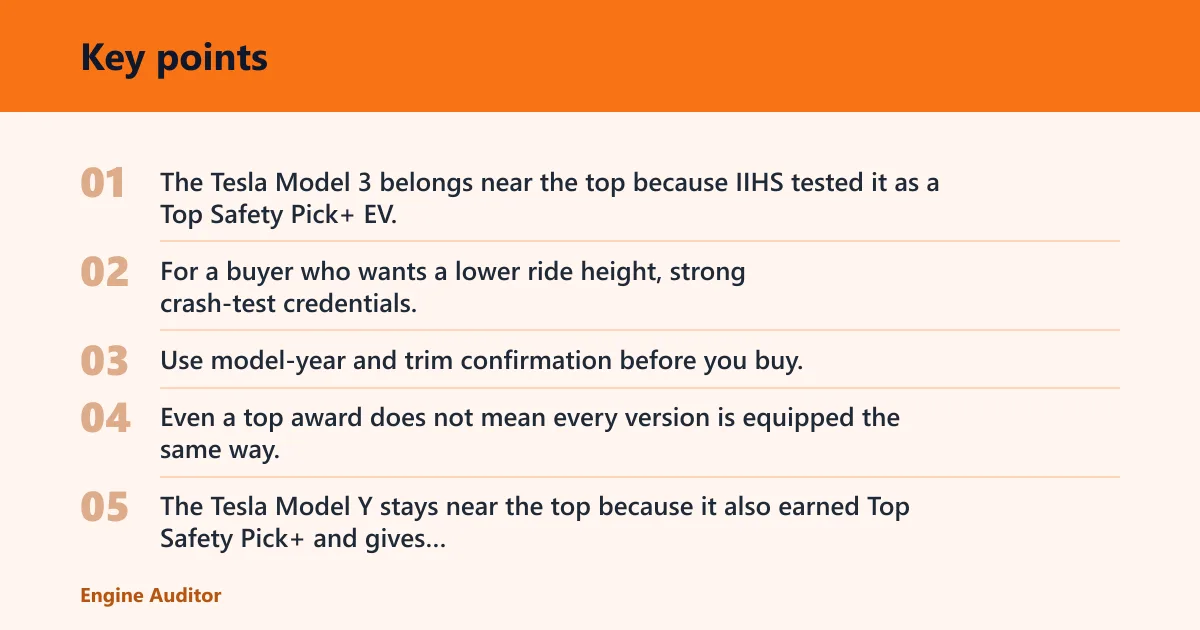
The Tesla Model 3 belongs near the top because IIHS tested it as a Top Safety Pick+ EV, which is the strongest award tier discussed here. For a buyer who wants a lower ride height, strong crash-test credentials, and a compact footprint, it is the cleanest first choice.
Use model-year and trim confirmation before you buy. Even a top award does not mean every version is equipped the same way, so the final decision should still check the exact headlights and crash-avoidance equipment on the window sticker.
Tesla Model Y
The Tesla Model Y stays near the top because it also earned Top Safety Pick+ and gives shoppers SUV utility without leaving the strongest award tier. If you need easier cargo loading or a higher seating position, it is the practical alternative to the Model 3.
The usual tradeoff is size. A taller vehicle can make child-seat loading and daily use easier, but the safest choice is still the one with the tested award, the right trim, and the features you actually receive on the car in front of you.
Hyundai Ioniq 5
The Hyundai Ioniq 5 earns its place because it is one of the electric models that reaches Top Safety Pick+ while also offering crossover practicality. For buyers who want EV packaging without chasing the most expensive badge in the group, it is an easy one to compare against the Tesla pair.
Picture a family deciding between a compact sedan and a crossover. If rear-seat access and cargo flexibility matter more than lower seating, the Ioniq 5 can be the better safety buy in practice, even though the crash-test award story is just as strong as the sedans.
Kia EV6
The Kia EV6 also earns Top Safety Pick+, so it belongs in the same safety tier as the Ioniq 5 and Tesla pair. Its value is not a separate safety score; it is the fact that it reaches the top level while giving shoppers another body style and trim mix to compare.
That matters because some buyers cross-shop on looks first. A vehicle can have the right badge and still be the wrong fit if the seating position, visibility, or cargo shape does not suit your use case.
Ford Mustang Mach-E
The Ford Mustang Mach-E is the car on this list that shows how close is not the same as equal. It earns Top Safety Pick, but it falls short of Top Safety Pick+ partly because of standard headlights, which makes it a strong choice only if you are willing to compare trim details carefully.
If you are choosing between this and a Top Safety Pick+ EV, the question is simple: do you want the better lighting and full award tier, or do you prefer the Mach-E’s shape and package? Safety shoppers should not assume the badge alone closes the case.
Do standard headlights affect IIHS safety awards?
Yes. Headlights can move a vehicle between IIHS award tiers, and that is one reason the Mustang Mach-E lands in Top Safety Pick rather than Top Safety Pick+. A car can score well in crash tests and still lose the higher award if its standard lighting does not meet the stronger threshold.
That is why headlights matter more than many shoppers expect. Night visibility, cut-off pattern, and standard equipment level change the practical meaning of an award, especially if you plan to drive on unlit roads or in heavy rain where lighting quality matters.
What to check before you buy
- Confirm the exact model year and body style.
- Check whether the trim keeps automatic emergency braking standard.
- Look for the current IIHS award tier for that exact version.
- Verify the headlight result, not just the crash-test score.
- Check the current NHTSA listing for the exact trim if you want the full federal rating picture.
Follow the vehicle manual for any safety system setup, and keep items out of airbag zones and the driver’s view. If you are comparing roof racks, hitch gear, child seats, or any load-bearing add-on, never exceed the vehicle’s rated roof, hitch, or tow limit and check local laws before you buy.
Why do some cars not have crash-test ratings?
Some vehicles are unrated because they were not tested, not sold in enough volume, or not covered for the exact model year or trim you are researching. Consumer Reports says nearly a half-million passenger cars and SUVs sold yearly have not been crash-test rated by the two main organizations, even though about 97 percent of new vehicles sold are rated by one or both. (Consumerreports)
That gap should change how you shop. If a vehicle is unrated and the seller cannot point to a current IIHS or NHTSA result for the exact model, you should keep looking unless there is a clear reason, such as a fresh redesign that has not yet been scheduled for testing.
When an unrated vehicle is a hard stop
If the car is a high-volume model and still has no public rating, that is a warning sign. If it is a low-volume specialty model, the absence may be less alarming, but you still need to treat the lack of data as a risk until a rating appears.
That is especially true for family use. A car that is only “probably safe” is not the same as a car with tested crash protection, good headlights, and standard automatic emergency braking.
How many NHTSA stars is considered safe?
NHTSA uses a five-star system, and five stars is the top score. For a practical buying screen, IIHS recommends looking for at least four NHTSA stars and a Good or Top Safety Pick recommendation, because the two systems do not measure exactly the same things.
Four stars is a useful floor, but five stars is the target if you want the strongest public federal result. NHTSA’s star rating also depends on the exact test set for the vehicle, which is why you should not treat one number as a substitute for the full listing.
How do I compare two safe cars beyond the rating badge?
Start with the exact model year and trim, then compare the headlights, standard automatic emergency braking, rear-seat protection, and any passenger-side caveats in the current award year. The better car is often the one with the same badge plus stronger standard equipment, not the one with the flashier trim name.
If two models both earn a top award, choose the one that better matches your life: sedan versus crossover, lower loading height versus more cargo room, and standard safety equipment versus add-on packages. The badge tells you the floor, but the trim tells you the actual deal.
Frequently asked questions
Which safety features matter most in a crash-tested car?
Automatic emergency braking matters most because it helps prevent or reduce front crashes, which is why both IIHS and Consumer Reports include it in their safety criteria. Headlights matter too, because they can change the award tier and affect real nighttime visibility. Strong rear-seat protection also deserves attention.
Products related to this article
Sponsored / affiliate links. As an Amazon Associate I earn from qualifying purchases. I may earn additional commission from eligible campaigns.