When to Repair a Heater Problem Now vs Wait Until Spring
Wait until spring only for minor comfort faults, such as weak heat from a cabin-side issue; repair at once if the windshield will not defrost, coolant is low, the temperature gauge climbs, or the cabin gets no heat at all. The wrong fault can turn poor visibility into a crash risk, or a small coolant leak into engine damage. This guide separates heater problems into can-wait and fix-now cases, with clear signs to check.
| Decision factor | When to Repair a Heater Problem Now | Wait Until Spring | Winner |
|---|---|---|---|
| Safety in freezing weather | Needed when defrost is weak, glass fogs fast, or cabin heat is gone. | Acceptable only when visibility stays clear and the fault is cabin-only. | When to Repair a Heater Problem Now |
| Engine protection | Needed for low coolant, overheating, a stuck-closed thermostat, or any leak. | Okay only when the engine temperature stays normal and there is no coolant loss. | When to Repair a Heater Problem Now |
| Cost of waiting | Higher if a leak grows, a heater core starts fogging windows, or overheating adds damage. | Lower when the fault is limited to airflow, a blend door, or another non-leak cabin issue. | Wait Until Spring |
| Best-fit use case | Daily drivers, highway trips, parked-street vehicles, and any car with visibility trouble. | Short trips in mild weather with stable gauge readings and no coolant smell or leak. | When to Repair a Heater Problem Now |
Can you wait until spring?
Yes, but only for comfort-only faults that do not affect coolant level, engine temperature, or windshield defrost. A weak blower, a blend door actuator problem, or one vent stuck on cold can often wait if the glass stays clear and the gauge stays normal. Anything tied to overheating, leaking coolant, or poor visibility belongs in the repair-now group.
Comfort-only faults
These faults mainly reduce cabin comfort. A blend door actuator can send cold air from one side or all vents even when the engine is hot, and a blower motor, fuse, or resistor fault can leave heat present but stop air from moving through the vents. Those problems are annoying, but they are not the same as a coolant leak or an overheating engine.
Safety-related faults
Defroster loss is different. If the windshield fogs or freezes and the defrost setting cannot clear it, driving becomes unsafe in winter even when the engine itself is fine. Weak heat plus fogged glass is a visibility problem first, a comfort problem second.
Engine-risk faults
Low coolant, a stuck-closed thermostat, or an active cooling system leak can raise engine risk quickly. Coolant also feeds the heater circuit, so a low level can cause no cabin heat and overheating at the same time. Those faults do not get a spring deadline.
What heater problems need immediate repair?
Any heater problem linked to overheating, warning lights, coolant loss, or lost defrost in freezing weather needs quick attention. The cabin may feel uncomfortable, but the larger issue is that the same fault can affect the engine or the driver’s view of the road. If the temperature gauge rises above normal or moves into the hot zone, stop driving before the repair gets larger.
Overheating or warning lights
A rising engine temperature gauge should change the priority at once. If the gauge climbs above normal, a check-engine light or temperature warning comes on, or steam appears, the car should not keep driving. A stuck-closed thermostat can trap heat in the engine, and low coolant can hide a bigger leak that gets worse under load.
Cooling system leaks
Leaks from a hose, radiator, water pump, or heater core belong in the repair-now group. Coolant loss can remove cabin heat, create overheating risk, and leave residue or a sweet odor inside the cabin if the heater core leaks. A small leak often becomes a larger one once the system heats and pressurizes.
Loss of defrost in freezing weather
If the defroster cannot clear the windshield, the car is generally not winter-safe even if it still moves normally. Fogged or icy glass can raise crash risk during stop-and-go traffic, lane changes, and dawn commutes. Fix the airflow or heat fault before relying on the car in freezing weather.
Why is the car blowing cold air?
Cold air from the vents can come from low coolant, a thermostat problem, or a blend door fault. Match the symptom to the subsystem and to the temperature gauge. Cold air with a hot engine does not rule out coolant problems; low coolant or poor coolant circulation can still leave the engine hot while the heater blows cold. Cold air with a cool gauge points toward warm-up trouble.
Low coolant
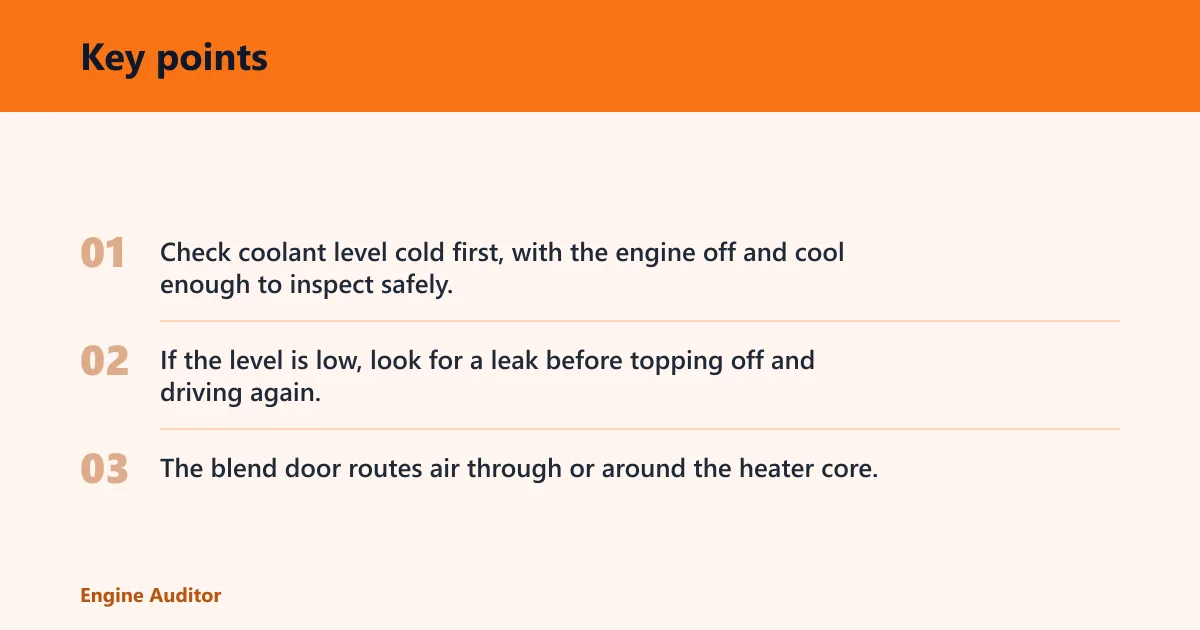
Check coolant level cold first, with the engine off and cool enough to inspect safely. Low coolant can stop cabin heat because the heater core has less hot fluid moving through it, and the same shortage can let the engine overheat. If the level is low, look for a leak before topping off and driving again.
Thermostat stuck open
A thermostat regulates engine warm-up. If it sticks open, the engine may warm slowly and the heater may stay weak for longer than normal, especially on short trips. That is a different pattern from overheating, which is more likely when a thermostat sticks closed.
Blend door actuator fault
The blend door routes air through or around the heater core. If the actuator fails, cold air can blow from one side of the cabin or from all vents even when the engine is hot and coolant level is normal. That fault is cabin-side and usually does not point to engine damage by itself.
Picture a commuter car that warms up on the gauge after 10 minutes, but the passenger-side vent stays cold while the driver-side vent gets warm. That pattern fits a blend door problem more than a coolant leak, because the engine is heating normally and the fault stays on the air-routing side.
What the symptoms point
Separate the symptom from the subsystem before you decide on timing. A clogged heater core, a failed blower motor, and a thermostat problem can all reduce heat, but they do not carry the same risk. The engine temperature gauge and the smell, fog, or airflow pattern tell you where to look next.
Heater core restriction or leak
The heater core transfers engine heat to cabin air. When it clogs, heat drops or disappears; when it leaks, coolant odor, damp carpet, or fogging windows may follow. A heater core leak is more urgent than a simple airflow problem because it can affect both visibility and coolant level.
Blower motor, fuse, or resistor fault
A bad blower motor, blown fuse, or failed resistor can stop air from coming out of the vents even though the heater core is producing heat. That can wait until spring if the defroster still clears the windshield within a few minutes and the engine runs at a normal temperature. It should move up the list if windshield clearing is slow, uneven, or fails.
Engine temperature gauge clues
The gauge tells you whether the heater fault is cabin-only or engine-related. Normal gauge readings usually point toward blower, blend door, or heater core restriction. An abnormally low warm-up reading can fit a stuck-open thermostat; an overheating reading or warning light means stop driving and repair now.
-
Check the coolant cold.
Open the reservoir only when the engine is cold and the level can be read safely. Never remove a pressurized radiator cap on a hot engine. If it is low, top it off only with the correct coolant mix for your vehicle, then look for a leak before assuming the heater is the only problem. -
Watch the temperature gauge.
Start the engine and note whether the gauge climbs into the normal range or keeps running hot or cold. A hot gauge plus weak heat points toward a coolant or thermostat problem; a normal gauge points more toward airflow or door control. -
Test the defroster.
Put the system on defrost and see whether the windshield clears within a few minutes. If it does not, the problem affects winter visibility and should be treated as urgent rather than cosmetic. -
Listen for airflow changes.
Switch fan speeds and vent modes. No airflow at any speed points toward a blower motor, fuse, or resistor fault, while changing airflow with no heat can point toward the blend door or heater core.
Heater urgency matrix
This matrix turns common symptoms into a timing decision. Match the symptom pair, not just the single complaint, because the same cold vent can be harmless in one case and urgent in another. The key split is between cabin-only faults and faults that threaten visibility or engine health.
| Symptom | Likely subsystem | Driveability risk | Engine-risk risk | Why the timing changes |
|---|---|---|---|---|
| Coolant level low and cabin heat weak | Cooling system leak, heater core, hose, radiator, water pump | High if defrost weak or fogging starts | High | Low coolant can remove cabin heat and raise overheating risk at the same time. |
| Temperature gauge climbs above normal | Thermostat stuck closed, leak, water pump, airflow issue | High | High | Overheating can damage the engine quickly, so this is a fix-now symptom. |
| Hot engine, but one side blows cold | Blend door actuator | Low to moderate | Low | The problem stays inside the HVAC door system if coolant level and gauge are normal. |
| Heat is available but no air comes out | Blower motor, fuse, resistor | Moderate to high in winter | Low | No airflow can make defrost fail even when the heater core works. |
| Sweet coolant smell and fogged windows | Heater core leak | High | Moderate to high | Fogging hurts visibility, and a leak can lower coolant fast enough to trigger overheating. |
| Slow warm-up, but gauge stays normal | Thermostat stuck open | Low to moderate | Low to moderate | This often waits briefly, but the car may stay weak on heat during short trips. |
Winter visibility and drivability
Winter driving risk is not only about cabin comfort. Fogged glass, icy inside windows, and weak defrost reduce the driver’s view, which matters more on short trips where the cabin never fully warms up. Highway driving adds risk because lane changes, merging, and headlight glare demand a clear windshield.
Fogged glass
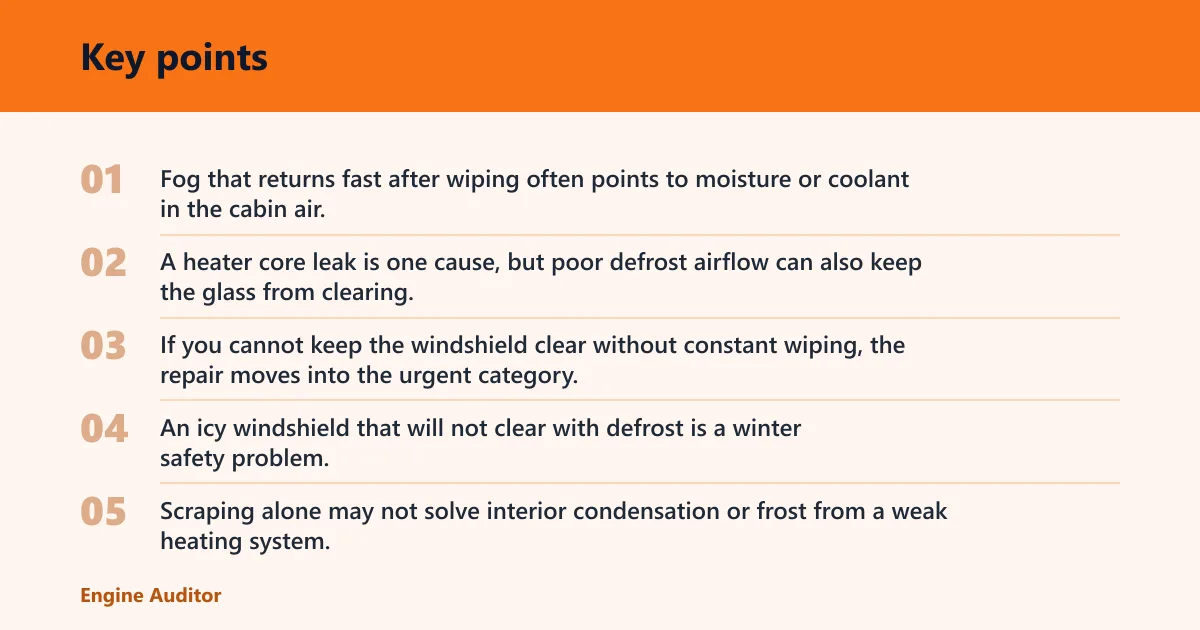
Fog that returns fast after wiping often points to moisture or coolant in the cabin air. A heater core leak is one cause, but poor defrost airflow can also keep the glass from clearing. If you cannot keep the windshield clear without constant wiping, the repair moves into the urgent category.
Icy windshield
An icy windshield that will not clear with defrost is a winter safety problem. Scraping alone may not solve interior condensation or frost from a weak heating system. A broken blower motor or failed defroster mode can turn a drivable car into one that should stay parked until repaired.
Short-trip and highway risk
Short-trip drivers notice weak heat most because the engine may never reach stable cabin comfort. Highway drivers face more danger when a fogging windshield steals forward vision at speed. Parked-street vehicles also need a working defroster because overnight frost and morning humidity can return every day.
Suppose a parked-street car has cold air at the vents, a normal temperature gauge, and a working blower, but the windshield fogs the moment two people get inside. That points toward a defrost or heater-core issue, and the visibility risk is enough to move the repair up from “later” to “soon.”
Choose When to Repair a Heater problem Now if…
Choose When to Repair a Heater Problem Now if coolant is low, the temperature gauge climbs, the engine warning light comes on, the defroster fails in freezing weather, or the windshield fogs in a way you cannot control. This is also the right pick if you smell coolant, see leaks, or notice overheating with weak heat.
Choose Wait Until Spring if the engine temperature stays normal, coolant level stays full, defrost still clears the windshield, and the problem is limited to comfort. That includes a blend door fault, a blower-only fault, or weak heat from a thermostat that is slow but not causing overheating.

Frequently asked questions
Can I wait until spring to fix my car heater?
Only if the fault is cabin-only and the windshield still clears. Weak heat from a blend door, blower motor, fuse, or resistor can often wait. If coolant is low, the gauge rises, or the glass fogs and stays fogged, do not wait.
When is a heater problem an emergency in winter?
It becomes an emergency when the temperature gauge climbs, warning lights appear, coolant is leaking, or the defroster stops clearing the windshield. Those signs point to engine risk or visibility risk, and both can make driving unsafe right away.
What heater problems can damage the engine if I ignore them?
Low coolant, a stuck-closed thermostat, and active cooling system leaks can all damage the engine if ignored. A heater core leak can also lower coolant enough to trigger overheating. These problems matter more than comfort because they can move from weak heat to engine damage.
Is no cabin heat dangerous for driving in freezing weather?
Yes, if it also means poor defrost or fogged glass. No cabin heat by itself may be a comfort issue, but no heat plus no windshield clearing is a visibility problem. In freezing weather, that can make normal driving unsafe long before the engine itself fails.
How do I know if low coolant is causing my heater problem?
Check the coolant level only when the engine is cold. If it is low and the heater output dropped at the same time, low coolant is a likely cause. Look for leaks, because topping off without fixing the source can leave you with the same problem again.
Can a broken blower motor wait until spring?
Sometimes, but only if the windshield still defrosts and the car remains safe to drive. A failed blower motor can mean no airflow even when heat is available, which makes winter driving harder. If it affects defrost, treat it as a repair-now problem.
Products related to this article
Sponsored / affiliate links. As an Amazon Associate I earn from qualifying purchases. I may earn additional commission from eligible campaigns.