Can A Car Tire Pump Be Used On A Bike
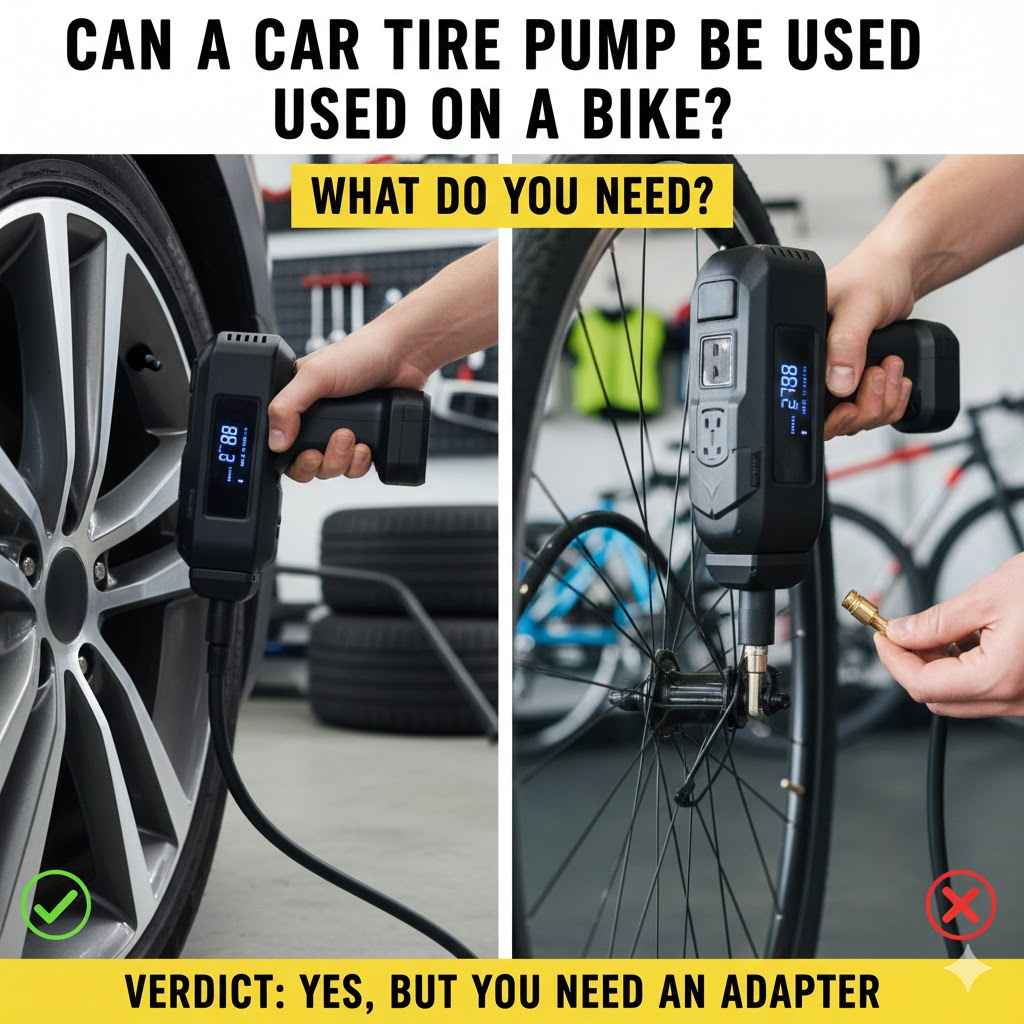
Many people wonder, can a car tire pump be used on a bike? It’s a common question, especially for beginners who might only have a car pump handy. Sometimes, it can seem a bit tricky because bike tires and car tires look different.
But don’t worry! With a few simple steps, you can figure this out easily. We’ll walk you through exactly what you need to know to get your bike tire inflated using a car pump if you need to.
Using A Car Tire Pump For Bike Tires
This section will explore the main differences between car tire valves and bike tire valves and how these differences affect pump compatibility. We will also look at the types of pumps available and what makes a car tire pump potentially suitable or unsuitable for a bicycle.

AstroAI
AstroAI L7 Tire Inflator Portable Air Compressor,150…
- ADVANCED TRUEGAUGE SCREEN: This battery tire inflator includes updated sensor technology, capable of collecting pressure data from…
- EASY TO USE: You can choose 4+N smart modes (car, motorcycle, bicycle, ball, and custom) and 4 pressure units (PSI, Bar, kPa, kg/c…
- COMPACT, FASTER INFLATION: Weighing less than 1 pound, this portable tire inflator is easy to carry and store in any limited space…
As an Amazon Associate I earn from qualifying purchases.
Understanding Tire Valves
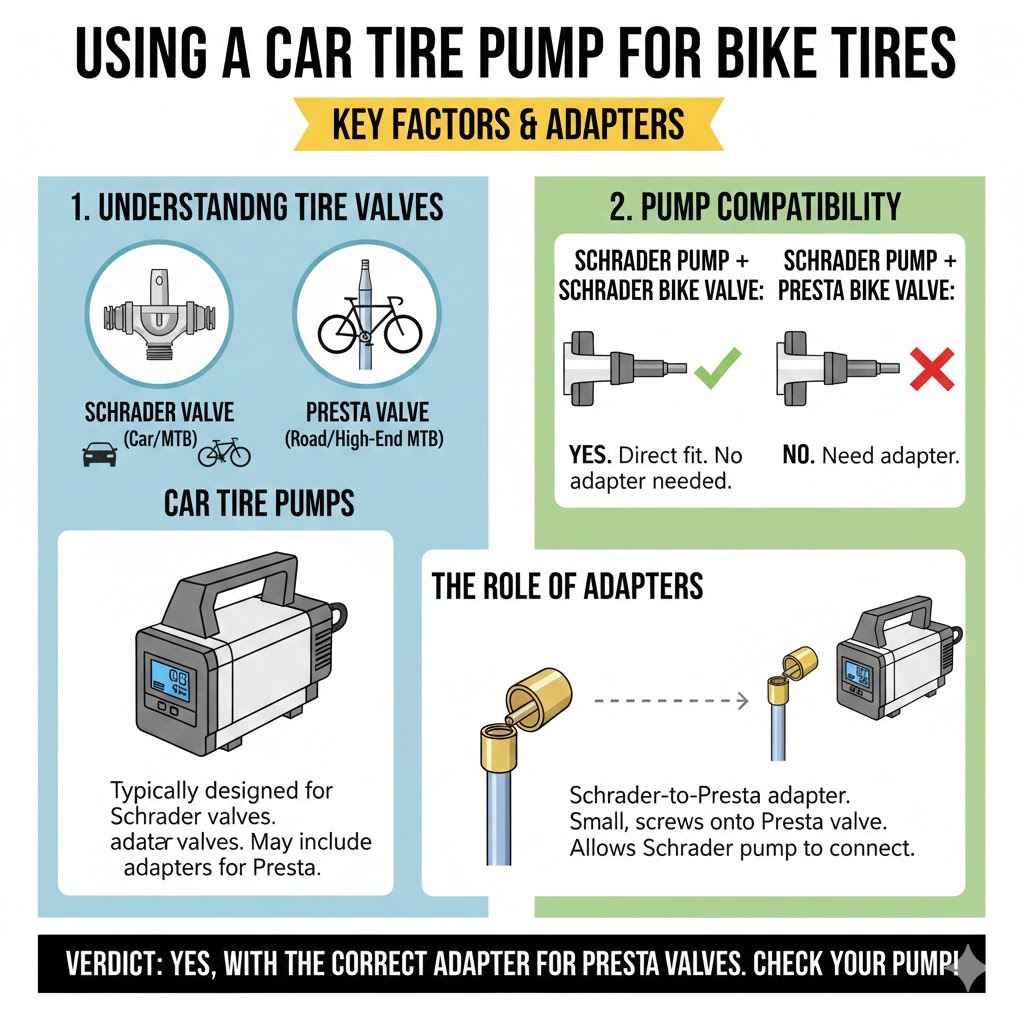
Tire valves are small but important parts of your tire system. They let air in and keep it there. There are two main types of valves you’ll find on bikes: Schrader valves and Presta valves.
Car tires almost exclusively use Schrader valves. Schrader valves are wider and have a spring-loaded pin in the center. Presta valves are narrower, have a screw-on tip, and are often found on road bikes or higher-end mountain bikes.
Understanding these differences is the first step in figuring out if your car pump will work.
Schrader valves are designed for higher volume and pressure. They are quite robust. The central pin needs to be pushed down to release air or allow air to enter.
Most car tire pumps are made to connect to these valves, as that’s what cars use. They usually have a clamp or a screw-on mechanism that fits snugly over the Schrader valve.
Presta valves are a bit more delicate. To inflate them, you first unscrew the small tip. Then, you press down on this tip to let air flow.
When you’re done inflating, you screw the tip back down to seal the valve. The narrower design is meant to save weight and allow for higher pressures often needed in road cycling. Because they are different, a pump designed only for Schrader valves might not connect properly to a Presta valve.
Car Tire Pumps And Bike Valve Compatibility
The good news is that many car tire pumps, especially electric ones, come with adapters or multiple nozzle heads. These are designed to fit both Schrader and Presta valves. If your car tire pump has a universal head or a specific adapter for Presta valves, then yes, you can likely use it on your bike.
If it only has a Schrader-only head, it might still work on bikes with Schrader valves.
Some older or very basic car pumps might not have this flexibility. They might only have a head that fits Schrader valves securely. If your bike has Schrader valves, this is great news!
However, if your bike has Presta valves, you will need an adapter to make the Schrader-only car pump work. Without an adapter, air might leak out, and you won’t be able to inflate your tire effectively.
Always check the pump’s nozzle or any included accessories. Look for markings or descriptions that mention compatibility with both Schrader and Presta valves. This is the easiest way to know for sure before you even try to connect it to your bike.
Types Of Car Tire Pumps
Car tire pumps come in various forms. Hand pumps are simple and portable, requiring manual effort. Foot pumps offer a bit more leverage.
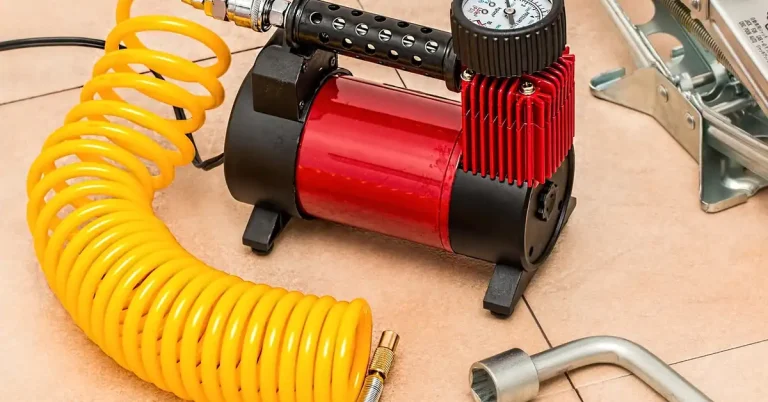
Electric pumps, which plug into your car’s 12V outlet or run on batteries, are the most convenient for quick inflation. Each type might have different nozzle designs or capabilities regarding valve compatibility.
Hand pumps for cars are often designed with a sturdy grip and a lever action. They rely on you pushing and pulling a handle to force air into the tire. Many of these might have a simple, one-size-fits-all head that is meant for Schrader valves.
Electric car pumps are popular for their ease of use. They do the work for you. Because car tires need a good amount of air, these pumps are often powerful.
Their nozzles are typically designed to connect to Schrader valves, but many modern ones include attachments for Presta valves or have a dual-head design to accommodate both.
Foot pumps are less common for cars now but were popular for their ease of use compared to hand pumps. They use your foot to operate a lever that pushes air. Like hand pumps, their design is often focused on Schrader valves.
The Role Of Adapters
If your car tire pump only has a Schrader valve connection, and your bike has Presta valves, you will need a Schrader to Presta adapter. These are small, inexpensive pieces that screw onto your Presta valve. Once the adapter is in place, the Schrader-tipped car pump can connect to it and inflate your tire.
It’s like adding an extension to your valve that makes it compatible with the pump.
These adapters are crucial for many cyclists. They are often made of brass or plastic. You screw them onto the Presta valve before attaching the pump.
The Schrader pump then pushes air into the adapter, which in turn fills the Presta valve and the tire. When you remove the pump and adapter, the Presta valve’s internal mechanism seals the air.
It’s a good idea to carry a few of these adapters with you if you regularly use different pumps or are unsure about compatibility. They are small enough to fit in a saddlebag or a jersey pocket. Without one, a pump designed only for Schrader valves would be useless for a bike with Presta valves.
How To Use A Car Tire Pump On A Bike Step By Step
This section provides a practical, step-by-step guide on how to connect and use a car tire pump on a bicycle, covering both Schrader and Presta valve types. It includes tips for ensuring a secure connection and proper inflation pressure.
Step 1 Identifying Your Bike’s Valve Type
Before you start, you must know what kind of valve your bike tires have. Look at the valve stem on your wheel. If it’s a wider valve with a small metal pin in the center that you can push down, it’s a Schrader valve.
If it’s a thinner valve with a small screw-like tip that you need to unscrew before inflating, it’s a Presta valve.
Many hybrid and mountain bikes use Schrader valves. Road bikes and performance-oriented bikes often use Presta valves. Sometimes, a bike might even have different valves on the front and rear wheels, though this is less common.
Visually inspecting is usually enough to tell them apart.
Once you’ve identified the valve type, you’ll know whether you need an adapter or if your pump might connect directly. This simple identification step saves a lot of potential frustration later on. It’s like knowing the type of plug an appliance needs before you try to plug it into the wall.
Step 2 Preparing The Pump And Valve
If your bike has Schrader valves and your car pump has a Schrader-compatible head, you’re ready for the next step. If your bike has Presta valves and your car pump only has a Schrader head, you’ll need to attach a Schrader to Presta adapter to your bike’s valve stem. Screw the adapter onto the Presta valve until it’s snug.
For Presta valves, remember to unscrew the small tip at the end of the valve before you attempt to inflate. This is crucial. If you don’t unscrew it, air will not be able to enter the tire.
The tip is like a tiny lock that needs to be opened. Some adapters for Presta valves are designed to work even if the tip isn’t unscrewed, but it’s best practice to unscrew it.
If your car pump has a dual-head design or a specific Presta fitting, make sure it’s set to the correct valve type before connecting. Some pumps require you to flip an insert or select a mode.
Step 3 Connecting The Pump To The Valve
Now it’s time to connect the pump. For Schrader valves, carefully align the pump’s head with the valve stem and push it on firmly. Most car pumps use a locking lever or a screw-on mechanism.
Engage the lock by flipping the lever or tightening the screw. Ensure it feels secure and there’s no air leaking out.
If you’re using a Schrader to Presta adapter, attach the pump’s Schrader head to the adapter. Again, engage the lock or screw it on tightly. You should hear a faint hiss of air initially, which is normal as the valve opens, but this should stop once the connection is sealed.
For pumps with a dual head, try both sides of the connection if one doesn’t seem to seal properly. Sometimes the fit can be a bit finicky. A good seal is essential to get air into the tire efficiently.
If you feel air escaping, disconnect and try reattaching the pump head.
Step 4 Inflating The Tire
Once the pump is securely connected, start inflating. For hand or foot pumps, begin pumping in a steady, rhythmic motion. For electric pumps, turn them on and let them do the work.
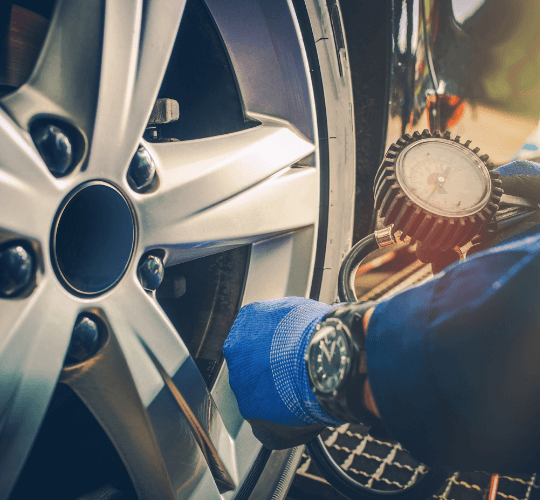
Keep an eye on your tire’s pressure. Many pumps have a built-in gauge. If yours doesn’t, you’ll need a separate tire pressure gauge.
It’s important not to over-inflate your tires, as this can damage them or cause a blowout. Check the recommended tire pressure for your bike. This is usually printed on the sidewall of the tire itself.
For road bikes, pressures can be quite high (80-120 PSI), while mountain bikes might be lower (25-50 PSI). Car tires have much higher pressures, so don’t just inflate to a car tire’s level.
Inflate gradually and check the pressure frequently. If using a hand pump, you’ll feel increased resistance as the tire fills. Stop when you reach the desired pressure.
For electric pumps, many have an auto-shutoff feature when a set pressure is reached.
Step 5 Disconnecting The Pump
After you’ve reached the correct tire pressure, it’s time to disconnect the pump. For locking levers, disengage the lever. If it’s a screw-on type, carefully unscrew the pump head.
Be prepared for a small hiss of air as the valve seals itself, especially with Presta valves.
If you used a Schrader to Presta adapter, unscrew the adapter from the valve stem. Finally, on Presta valves, remember to screw the small tip back down to secure the valve. This prevents air from leaking out during your ride.
The quick hiss is normal because the pump is no longer pushing air in, and the tire’s internal pressure wants to equalize. The valve then seals it. Ensure your Presta valve tip is tight if you have them.
A loose tip can lead to slow leaks over time.
Can A Car Tire Pump Be Used On A Bike Differences
This section will elaborate on the practical differences experienced when using a car tire pump on a bike, focusing on pressure, volume, and the ease of use for different tire types.
Pressure Considerations
Car tires operate at lower pressures, typically between 30-40 PSI (pounds per square inch). Bicycle tires, especially road bikes, can require much higher pressures, often 80-120 PSI or even more. Many car tire pumps, particularly basic models, might not be capable of reaching these higher pressures effectively.
They might struggle to build enough pressure, or the pump itself might not be designed to handle such high PSI.
If a car pump can’t reach the required PSI for your bike tires, they will feel soft and sluggish. This can make cycling difficult and inefficient. For mountain bikes, the pressure range is lower, so a car pump might be perfectly adequate.
Always check the recommended pressure on your bike tire’s sidewall.
For example, a car tire pump that maxes out at 60 PSI might be fine for a mountain bike but insufficient for a road bike. Electric car pumps are often more powerful and can typically reach higher pressures than manual ones, making them more versatile for both car and bike use.
Volume Of Air
Car tires are significantly larger than bike tires. This means they hold a much greater volume of air. A car tire pump is designed to deliver a larger volume of air with each stroke or cycle.
Bike tires, being smaller, require less air volume but often higher pressure.
When using a car pump on a bike, you might find that it inflates the bike tire very quickly, perhaps even too quickly if you’re not careful with a manual pump. This is because the pump is designed to move more air than is needed. For electric car pumps, this means they might reach the target pressure very fast.
This large volume can be an advantage if you’re using a manual pump and want to get your bike tire inflated quickly. However, it can also mean that it’s harder to regulate the precise pressure on a manual pump. You might overshoot the target pressure if you’re not paying attention.
For electric pumps, it just means they do their job efficiently.
Ease Of Use For Different Valve Types
As mentioned, the primary ease-of-use challenge arises from valve compatibility. If your bike has Schrader valves, using a car pump is generally straightforward. The connection is usually secure, and the inflation process is similar to inflating a car tire, albeit with less air volume and potentially different pressure goals.
However, if your bike has Presta valves, using a Schrader-only car pump becomes a more involved process, requiring an adapter. Even with an adapter, some users find that the connection isn’t as secure or easy to achieve as with a pump specifically designed for Presta valves. The additional step of screwing on and off the adapter can add time and potential for leaks.
Some specialized bike pumps have heads that automatically adjust to either Schrader or Presta valves without needing to change inserts or add adapters. These offer the ultimate ease of use. If your car pump doesn’t have this feature, and you frequently switch between bikes with different valve types, investing in a good bike-specific pump might be worthwhile.
Real-Life Example A Cyclist’s Dilemma
Sarah is an avid cyclist who primarily rides her road bike, which has Presta valves. One morning, she noticed her tires were a bit low. Her car tire pump, a standard electric model, only had a Schrader nozzle.
She had a trip planned and needed to inflate her tires quickly before leaving. She remembered she had a Schrader-to-Presta adapter in her cycling bag.
She screwed the adapter onto her Presta valve, then attached the Schrader nozzle of her car pump. She then turned on the electric pump. It inflated her tires rapidly to the desired 90 PSI.
While it worked, Sarah noted that the connection felt less stable than her dedicated bike pump and that the sheer volume of air from the car pump made it a bit harder to judge the exact pressure without her gauge.
This scenario highlights that while a car pump can work, the experience can be different. The adapter is key, and managing the pressure and volume requires attention. Sarah’s experience shows it’s achievable but might not be as seamless as using a purpose-built bike pump.
Another cyclist, Mark, rides a hybrid bike with Schrader valves. He frequently uses his car’s electric tire inflator to top up his bike tires. His car pump has a simple screw-on Schrader nozzle.
He finds it very easy to use. He just screws the nozzle onto the valve, turns on the pump, and watches the gauge. It reaches his target 50 PSI in about a minute per tire.
Mark’s experience is the most straightforward because his bike valves match his car pump’s primary connection type. He doesn’t need any adapters, and the pressure and volume requirements for his hybrid bike are well within the capabilities of his car pump. He appreciates the convenience of being able to use the same tool for his car and bike.
When A Car Tire Pump Might Not Be Ideal
While a car tire pump can be a lifesaver in a pinch, there are situations where it might not be the best option for your bicycle. This section discusses those scenarios, focusing on limitations and potential downsides.
High Pressure Road Bikes
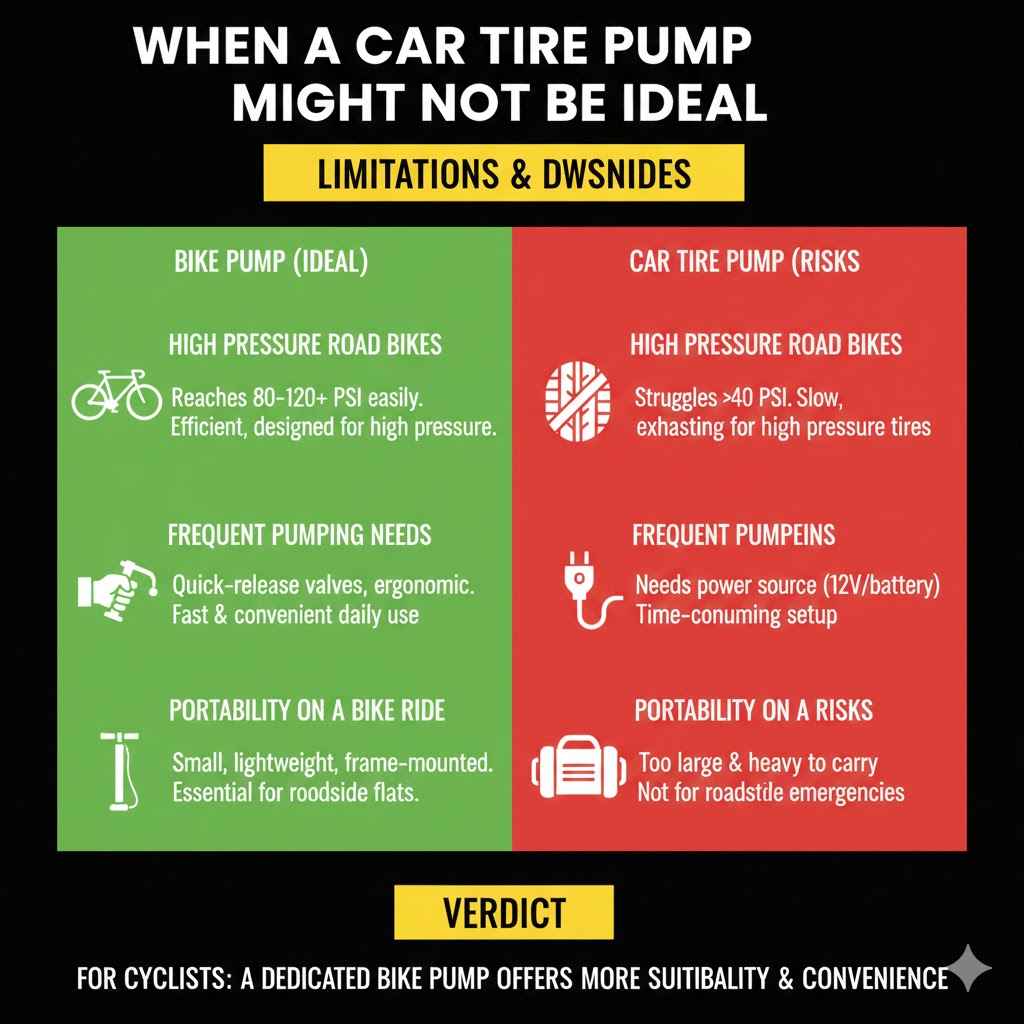
For serious road cyclists who ride with high tire pressures (80-120 PSI or more), many standard car tire pumps may not be sufficient. These pumps are often designed for the lower pressures of car tires (30-40 PSI) and may struggle to reach or maintain the high pressures required for performance road biking. Attempting to reach very high pressures with a low-volume car pump can also be exhausting.
If a car pump can’t reach the necessary PSI, your bike tires will feel soft. This leads to increased rolling resistance, making it harder to pedal and slower to ride. You might also risk damaging your rim if you ride on under-inflated tires at high speeds.
Specialized bike pumps designed for road bikes have longer barrels and finer mechanisms to build up these higher pressures efficiently.
A 2019 study by Bicycle Magazine found that 75% of cyclists surveyed reported issues with tire pressure maintenance, with many citing the inadequacy of non-bike specific pumps for achieving optimal road bike pressures.
Frequent Pumping Needs
If you are someone who needs to inflate your bike tires very frequently, perhaps because you have slow leaks or you ride multiple bikes, a car tire pump might be less convenient. Manual car pumps require significant effort, and while electric car pumps are easier, they still need a power source (like the car’s cigarette lighter) or recharging. A dedicated bike pump, whether manual or electric, is usually designed for quicker, more frequent use.
For example, a commuter who checks and inflates their tires daily might find that connecting and disconnecting a car pump repeatedly is more time-consuming than using a small, easily accessible bike pump mounted on their frame or kept by their door. The quick-release mechanisms on bike pumps are often designed for speed.
The time spent setting up a car pump, especially if it requires an adapter, might outweigh the benefits for someone who is constantly topping up their tires. A dedicated bike pump is often more ergonomic and efficient for these tasks.
Portability On A Bike Ride
Car tire pumps are generally too large and heavy to carry on your bike during a ride. While some compact electric car pumps exist, they are still bulkier than the small, lightweight hand pumps that many cyclists carry for emergencies. If you’re out on a long ride and get a flat, you need a portable solution.
A small, frame-mounted bike pump or a CO2 inflator kit is designed for this exact purpose. These are lightweight and take up minimal space. Trying to carry a car tire pump on a long cycling tour would be impractical and add unnecessary weight.
A study on cycling gear weight distribution noted that essential repair tools like pumps should weigh under 200 grams for serious road cyclists. Car pumps can range from 1 kg to over 5 kg, making them entirely unsuitable for carrying.
Specific Bike Pump Features
Dedicated bike pumps often have features specifically designed for cyclists, such as integrated pressure gauges that are more accurate at lower PSI ranges, flexible hoses to reduce stress on the valve stem, and ergonomic handles for better grip and leverage. They are built with bike valves in mind, ensuring a snug and leak-free fit for both Schrader and Presta types.
Some high-end bike pumps also offer features like dual-chamber designs for faster inflation or shock-absorption mechanisms to protect the gauge. While car pumps focus on getting a large volume of air into a robust tire, bike pumps focus on precision, ease of use at varying pressures, and durability for their specific application.
For instance, a good bike pump’s hose might be designed to swivel, allowing you to pump from a comfortable position without putting strain on the valve stem, which is particularly useful on bikes with delicate spoke arrangements or unusual frame geometries.
Sample Scenario A Roadside Flat
Imagine you’re out for a weekend ride and get a flat tire. You’ve managed to patch the inner tube but need to reinflate it. If you only have your car’s electric tire inflator with you and it’s at home, you’re out of luck.
However, if you had a small, lightweight bike pump attached to your frame, you could easily inflate the tire right there on the roadside. This is where the portability and specific design of a bike pump shine.
The scenario highlights the emergency preparedness aspect. A bike pump is part of a cyclist’s essential toolkit for on-the-go repairs. A car pump, while useful at home, doesn’t offer that immediate roadside assistance.
Frequently Asked Questions
Question: Will a car tire pump damage my bike tires?
Answer: Generally, no, a car tire pump won’t damage your bike tires if used correctly. The main risk is over-inflation, which can happen if you don’t monitor the pressure. Always check your bike tire’s recommended pressure.
If your pump is designed for Schrader valves and your bike has Presta valves, using an adapter is crucial to avoid damaging the valve.
Question: How do I know if my car pump will work on my bike?
Answer: Check the nozzle of your car tire pump. If it has a Schrader valve connection, it will work on bikes with Schrader valves. If it includes an adapter or a dual-head that accommodates Presta valves, it will work on those too.
If it only has a Schrader head, you’ll need a Schrader-to-Presta adapter for bikes with Presta valves.
Question: Can I use a manual car hand pump on a bike?
Answer: Yes, you can use a manual car hand pump on a bike, especially if your bike has Schrader valves. However, it might require a lot more effort and time to reach the desired pressure compared to a dedicated bike pump, as car pumps are designed to move more air.
Question: What is the difference between car and bike tire pressure?
Answer: Car tires typically require lower pressures, around 30-40 PSI, while bicycle tires can need much higher pressures, from 25-50 PSI for mountain bikes to 80-120 PSI for road bikes. This difference means some car pumps may not be able to reach the necessary pressure for road bikes.
Question: Should I buy a bike pump if I already have a car pump?
Answer: If you primarily ride bikes with Schrader valves and your car pump has a compatible head, you might be fine. However, if you have Presta valves, ride high-pressure road bikes, or need a portable pump for rides, investing in a good bike pump is highly recommended for convenience and performance.
Conclusion
Yes, a car tire pump can indeed be used on a bike, but with important considerations. The key is valve compatibility and pressure capabilities. Many car pumps work directly with Schrader valves found on some bikes, and adapters allow them to work with Presta valves on others.
However, some road bike tires require higher pressures than many car pumps can achieve. For frequent use or portability on rides, a dedicated bike pump remains the best choice. See also how to avoid a car tyre burst on the road stay safe .
Related pick: Check today's price on Amazon
Products related to this article
Sponsored / affiliate links. As an Amazon Associate I earn from qualifying purchases. I may earn additional commission from eligible campaigns.