Honda Civic Check Engine Light: Common Maintenance-related Causes
On a Honda Civic, a check engine light is often caused by a loose gas cap, worn spark plugs, or a faulty sensor. If it flashes, stop driving and diagnose it immediately. Ignoring the wrong warning can waste money on parts, raise fuel use, and turn a small fault into catalyst damage. This guide covers the common maintenance-related causes, how to verify them, and which symptoms mean you need deeper diagnosis.
What the Civic check engine light means
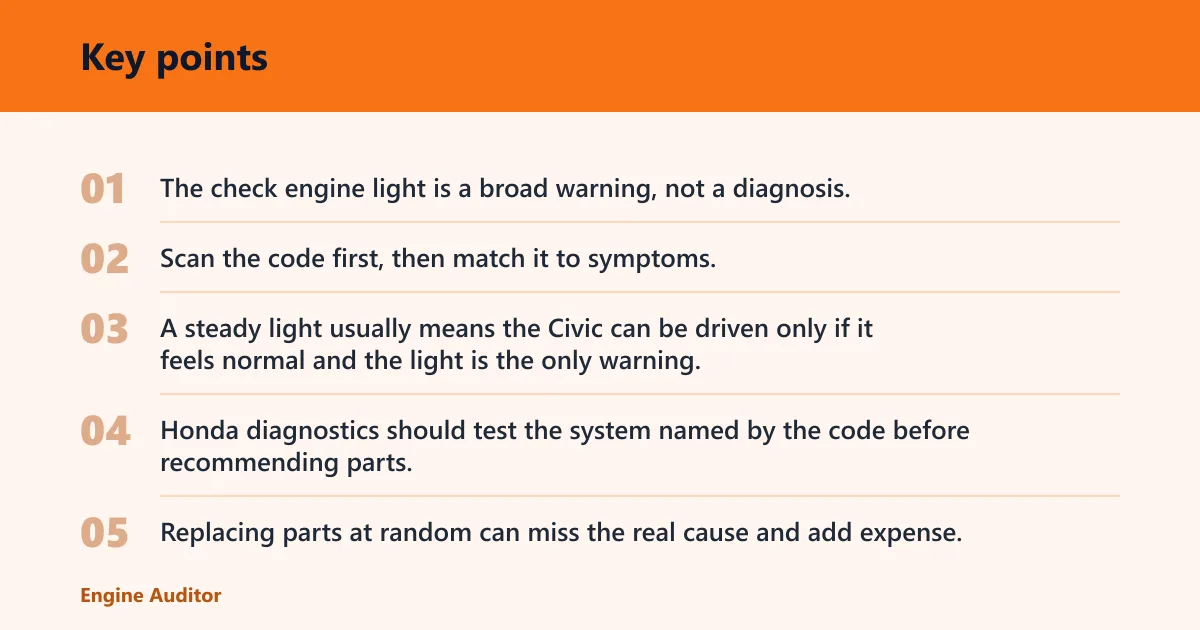


The check engine light is a broad warning, not a diagnosis. On a Civic, the first split is simple: a steady light often points to a problem that still needs attention soon, while a flashing light points to a more urgent misfire or similar fault that can harm the engine or catalytic converter. Scan the code first, then match it to symptoms.
Steady light versus flashing light
A steady light usually means the Civic can be driven only if it feels normal and the light is the only warning. A flashing light means the problem is active enough to raise immediate risk, especially if the engine shakes, stumbles, or loses power. That is the point to stop guessing.
Why you should scan the code first
Honda diagnostics should test the system named by the code before recommending parts. That matters because a P0301 points toward cylinder 1 misfire checks, while a P0171 points toward a different kind of diagnostic check. Replacing parts at random can miss the real cause and add expense.
How driveability symptoms change urgency
If the Civic starts hard, idles rough, hesitates on acceleration, or shudders at cruise, treat the light as more than a routine reminder. A misfire from ignition or fuel delivery can start as a maintenance issue and become a catalyst problem if it is ignored.
Picture a Civic that runs fine on the way home, then starts idling rough at the next stoplight. That is not a “wait and see” pattern. The code may still be maintenance-related, but the symptom has changed the urgency.
Does your Civic need maintenance or diagnosis?
Some Civic warning lights are tied to routine service, and some point to a fault that needs diagnosis. The Maintenance Minder and the check engine light are separate systems. If the car runs normally and the light is steady, start with codes, fluid checks, and service history; if it runs badly or the light flashes, move to diagnosis first.
Where the maintenance minder fits
Honda replaced fixed mileage intervals with the Maintenance Minder system. Oil life can show 15% as a warning, 5% as due now, and 0% as overdue. Main and sub-codes tell you which service items are due, including brake fluid or transmission fluid, but that is separate from a check engine light.
When a shop scan beats guesswork
If the Civic has a steady light plus rough idle, repeated misfires, or reduced power, a scan tool is the better first move. The same is true after recent service if the light appeared right after an oil change, fuel fill-up, or filter replacement. That pattern can separate a service mistake from a deeper fault fast.
Civic CEL triage table
| Symptom | Likely maintenance cause | Likely code family | Quick owner check | Safe to drive? | Next best action | Urgency |
|---|---|---|---|---|---|---|
| Steady light, no drivability change | Loose gas cap or EVAP seal issue | P0440, P0442, P0455, P0456 | Check cap seal, tighten until it clicks, inspect filler neck | Usually yes for short trips if the car runs normally | Reseat the cap, then scan and verify the EVAP system before replacing parts | Low to moderate; scan soon |
| Rough idle, stumble under load | Worn spark plugs | P0300, P0301-P0304 | Review plug age and interval; note misfire counts if scanned | Only if the light is steady and the stumble is mild | Inspect plugs first, then confirm whether the misfire is cylinder-specific or random | Moderate to high |
| Rough idle, intermittent bucking | Failing ignition coils | P0300, P0301-P0304 | Look for coil-age history, wet plug wells, or swapped-cylinder misfire | Not ideal if the misfire is active | Trace the misfire to the affected cylinder before replacing multiple coils | High if misfire is active |
| Lazy response, lower fuel economy | Dirty air filter or MAF contamination | P0171, P0101, P0172 | Inspect filter restriction and air duct contamination | Usually yes if there is no rough running | Verify intake restriction, then check fuel trims and sensor readings for the real fault | Low to moderate |
| Oil smell, idle flare, trim-related complaints | PCV valve issue | P0171, P0507, lean trim codes | Check PCV age, hose condition, and idle behavior | Usually yes for brief use if the engine runs smoothly | Confirm crankcase ventilation before chasing lean codes or idle complaints | Moderate |
| Oil light concern, no CEL at first, then drivability complaint | Low or degraded oil; 1.5L turbo fuel dilution | Indirectly P0300 family, some lean or efficiency codes | Check dipstick level and oil smell; review oil life and service interval | No if oil is very low or the engine runs poorly | Correct the oil level first, then determine whether the complaint is maintenance-related or a separate fault | Moderate to high |
| Shudder or whine during acceleration | CVT fluid overdue or wrong fluid | Transmission-related complaint codes, sometimes none | Confirm HCF-2 only and service history | Use caution; avoid hard acceleration | Verify the correct fluid and service history before assuming an internal transmission failure | Moderate |
| Light after recent refueling, fuel smell, no drivability change | EVAP or gas-cap issue | P0440, P0441, P0455, P0456 | Check cap seal, neck, and whether the cap was left loose | Usually yes if the engine feels normal | Check for a loose cap first, then inspect the EVAP system if the code returns | Low unless the light flashes or the car runs poorly |
What maintenance items can trigger a Civic check engine light?
Several routine Civic upkeep items can set a code family that looks like a major failure at first glance. Spark plugs, coils, filters, PCV parts, oil condition, and EVAP seals are the main maintenance-related suspects. The key is to connect the symptom to the most likely code family before replacing parts.
Spark plugs and misfire codes
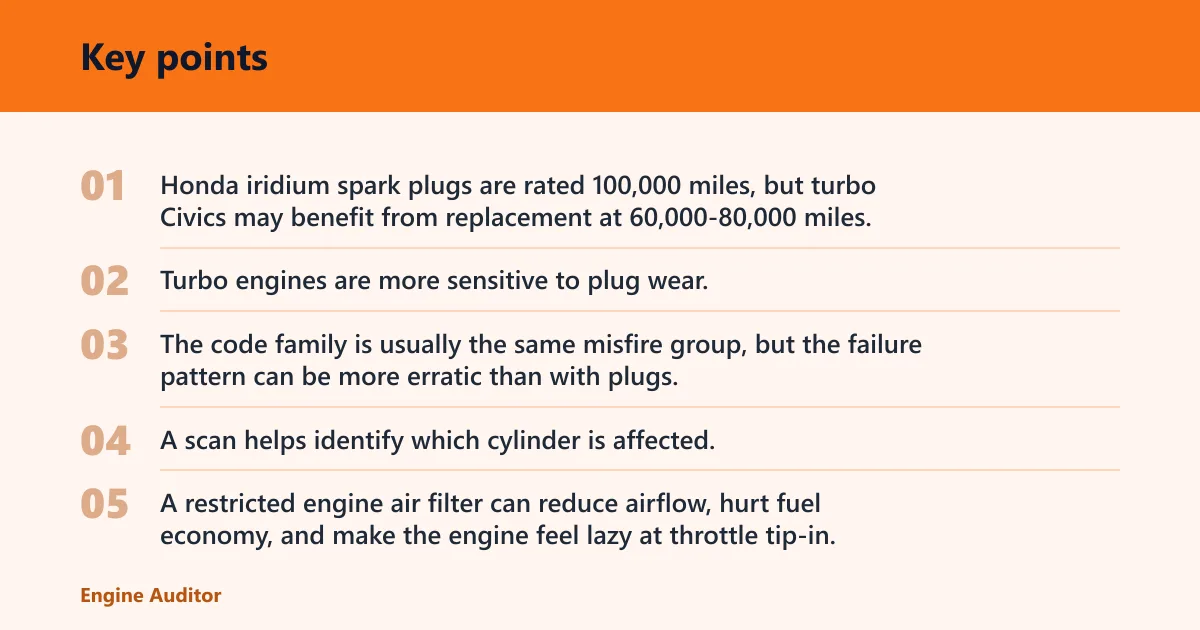
Honda iridium spark plugs are rated 100,000 miles, but turbo Civics may benefit from replacement at 60,000-80,000 miles. Worn plugs can trigger P0300 random misfire or a cylinder-specific misfire code, often with rough idle, hesitation, or a stumble when merging. Turbo engines are more sensitive to plug wear.
Ignition coils and rough idle
Failing ignition coils often show up as a rough idle, a stumble under load, or an intermittent misfire that gets worse when the engine is warm. The code family is usually the same misfire group, but the failure pattern can be more erratic than with plugs. A scan helps identify which cylinder is affected.
Air filter, MAF contamination, and PCV issues
A restricted engine air filter can reduce airflow, hurt fuel economy, and make the engine feel lazy at throttle tip-in. A dirty mass airflow sensor can add P0101-type complaints. PCV problems can contribute to unstable idle, oil vapor buildup, or lean-trim codes when crankcase ventilation is not working as expected.
Suppose a Civic has a steady light, a slightly uneven idle, and a dirty air filter that looks overdue at the next service. Replacing the filter may help airflow, but the code still needs to be read. A clogged filter and a sensor fault can appear together.
Oil level, oil condition, and 1.5L turbo fuel dilution
Oil life is not the same as oil level. Low oil can contribute to noise, poor lubrication, or variable valve timing complaints, but it does not directly explain every check engine light. The 1.5L turbo Civic has a known fuel dilution issue, so oil can thin out or smell like fuel before the maintenance minder catches up.
EVAP and gas-cap faults
Loose gas caps and EVAP leaks are among the most common maintenance-adjacent causes of a Civic check engine light. These faults often create a steady light without drivability complaints. After refueling, a loose cap can trigger P0455 or P0456-type evaporative leak codes and the car may still run normally while needing attention.
How do you read Honda Maintenance Minder codes?
The Maintenance Minder tells you what service is due, not why the check engine light is on. Oil life percentage is the first number to watch. At 15%, Honda issues a warning; at 5%, the vehicle must be serviced immediately; at 0%, service is past due. Main and sub-codes point to the specific maintenance item.
Oil life percentage and due-now thresholds
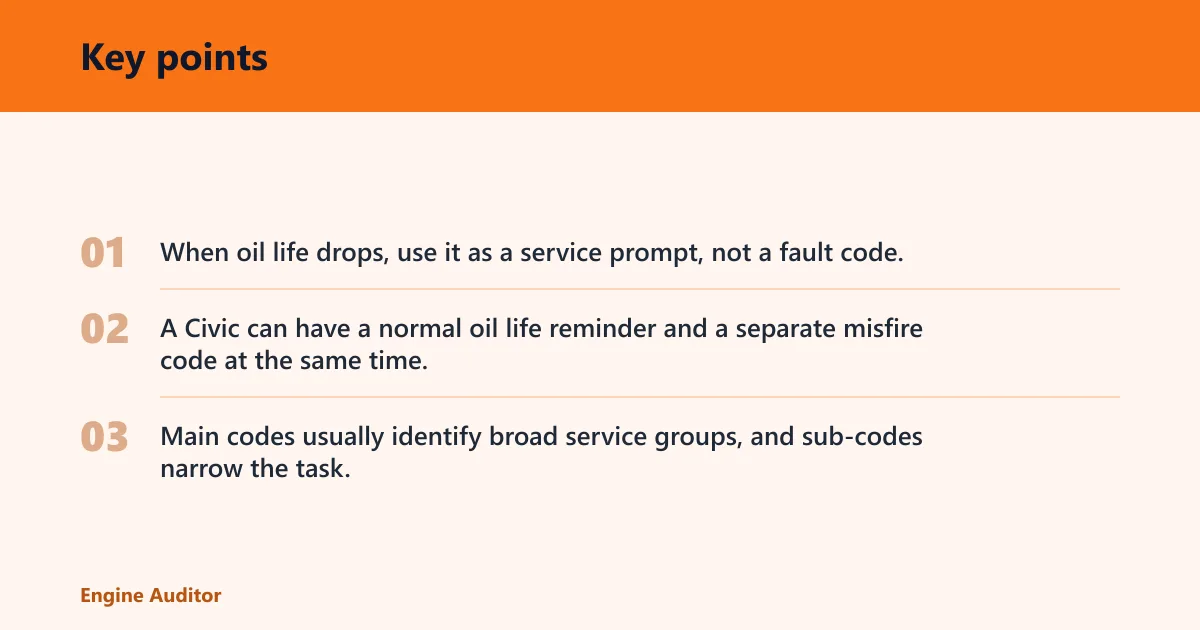
When oil life drops, use it as a service prompt, not a fault code. It tells you when maintenance is due, while the CEL tells you that the engine control system saw an abnormal reading. A Civic can have a normal oil life reminder and a separate misfire code at the same time.
Main codes and sub-codes
Main codes usually identify broad service groups, and sub-codes narrow the task. That can include oil, filters, brake fluid, or transmission service. It is useful for planning upkeep, but it does not replace a scan when the CEL is on.
Why brake fluid and transmission fluid matter here
Brake fluid is not a check engine light cause, but it belongs in the service conversation because Honda includes it in maintenance planning. Transmission fluid matters too. Honda CVT fluid service is recommended every 25,000-30,000 miles in severe service, and Honda CVTs require HCF-2 fluid only. Shudder or whine should not be ignored.
Can you keep driving with a Civic check engine light?
A steady light may be lower urgency if the Civic drives normally, but it still needs a scan. If the engine shakes, hesitates, loses power, or the light flashes, the answer changes fast. That is no longer a simple maintenance reminder. It is a fault that can damage other parts if you keep driving.
When a steady light is usually lower urgency
If the car starts normally, accelerates normally, and the light is steady, it is often reasonable to drive only as needed until the code is read. A gas-cap leak, sensor drift, or overdue plug set can wait a short time. That said, the scan still belongs on the to-do list.
When rough running changes the answer
Rough idle, hard starting, stumbling under load, or fuel smell raises the urgency. Those symptoms can point to active misfire, fuel delivery trouble, or an air metering problem. If the car is shaking, do not treat it as routine maintenance.
Why a flashing light needs immediate attention
A flashing check engine light signals a more urgent problem than a steady one. It often means active misfire severe enough to threaten the catalytic converter. Stop driving if possible, because continued operation can turn a plug, coil, or injector issue into a more expensive repair.
How maintenance history affects catalytic converter and oxygen sensor codes
Misfires can damage the catalytic converter if they are ignored, and that can lead to P0420 or P0430 after the original issue is fixed or partly fixed. Oxygen sensor codes can also appear after a long misfire period because the exhaust mixture the sensors see has been abnormal. Inspect the cause first, not the sensor alone.
Why misfires can damage the converter
When fuel is left unburned, it can overheat the converter. That is why a misfire code should not be postponed. Fixing plugs, coils, or a fuel delivery fault early can prevent a second round of codes later.
What to inspect after the original issue is fixed
After a misfire repair, clear history only after the underlying issue is corrected and the engine runs cleanly. Then watch for a return of catalyst-efficiency codes, fuel trim problems, or new exhaust sensor complaints. If those come back, the original fault may not have been the whole story.
How to triage a Civic check engine light
- Check the light behavior. Decide first whether the light is steady or flashing. A flashing light means the problem is urgent and the car should not be driven farther than necessary.
- Read the codes. Use an OBD-II scan tool or have a parts store or shop read the stored codes. Write down the exact code number and any freeze-frame data if available.
- Inspect the easy maintenance items. Check the gas cap, dipstick level, air filter, and recent service records. This is where many Civic maintenance-related lights start.
- Match symptoms to the code family. Rough idle and stumble point toward misfire codes. Poor fuel economy and lazy response point more toward air, sensor, or EVAP issues.
- Escalate if the engine runs poorly. If the car shakes, stalls, or flashes the light, move to diagnosis immediately. That is the point where catalyst damage becomes a real risk.
Frequently asked questions
Why is my Honda Civic check engine light on after an oil change?
An oil change can expose a loose oil cap, low or overfilled oil, or a disconnected connector near the air box or intake. If the light started right after service, inspect what was opened or moved first. A fresh service does not guarantee the new warning is related to the oil itself.
Can low oil cause the check engine light on a Honda Civic?
Low oil can contribute to drivability issues, timing or valve-train problems, and warning lights tied to those faults, but it is not a direct cause of every Civic check engine light. Check the dipstick first, then scan the code. Do not confuse oil level with the maintenance minder.
Is it safe to drive with a steady check engine light on my Civic?
If the light is steady and the Civic drives normally, short trips to a repair shop are often reasonable. If the engine runs rough, lacks power, or the light starts flashing, stop driving. The urgency changes with symptoms, not just the light itself.
Can spark plugs or ignition coils turn on the check engine light?
Yes. Worn spark plugs and failing ignition coils can trigger misfire codes, rough idle, and stumble under load.
Can a dirty air filter or fuel dilution cause a Honda Civic check engine light?
A dirty air filter can contribute to airflow problems, lower fuel economy, and sensor-related codes. Fuel dilution is a known issue on the 1.5L turbo Civic and can confuse drivability diagnosis if the oil is thin or contaminated. Check both the filter and the oil condition, then scan the code.
Products related to this article
Sponsored / affiliate links. As an Amazon Associate I earn from qualifying purchases. I may earn additional commission from eligible campaigns.
 OBD2 Scanner Diagnostic Tool - Check Engine Light Code Scanner Tool with Reset, DTC, Data Stream, I/M Readiness, Car & Truck Scan Tool for All Vehicles Since 1996, escaner automotriz
 OBD2 Scanner Diagnostic Tool - Check Engine Light Code Reader, Reset Function, Data Stream, I/M Readiness, Full Features, Modes 6 & 8, for All 1996+ Vehicles, Automotriz Scanner