How to Adjust Steering Wheel Position on a Can-Am X3
Check the wheel on level ground first: if the Can-Am X3 tracks straight but the wheel is off-center, the wheel is usually clocked on the splines; if it pulls or the wheel changes with steering travel, check toe and rack centering before loosening anything. Skip that diagnosis and you can hide a toe error, keep the steering off-center, and wear tires fast. This guide separates a spline-clocked wheel from a rack or toe problem, then gives the correct fix for each.
What is actually off?


A crooked wheel on a Can-Am Maverick X3 can come from the wheel on the shaft, the steering rack being off-center, or front toe. The fix depends on which one moved. Start with the tires pointed straight ahead, the vehicle on level ground, and the steering at its natural straight-ahead point.
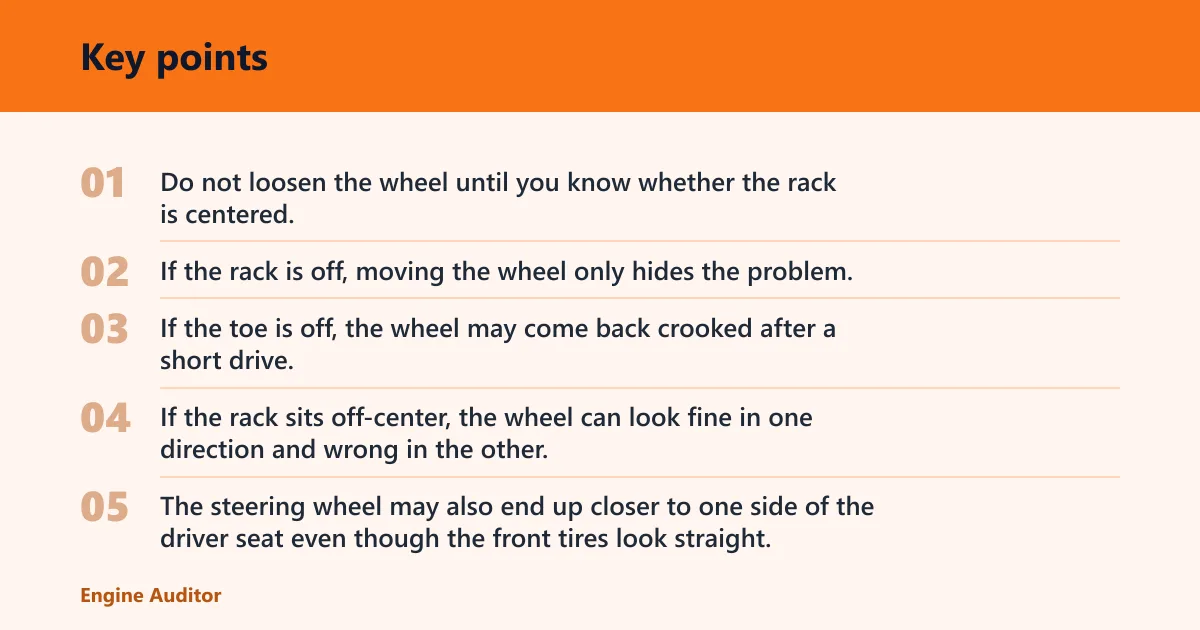
Do not loosen the wheel until you know whether the rack is centered. If the rack is off, moving the wheel only hides the problem. If the toe is off, the wheel may come back crooked after a short drive.
Why a straight wheel can still hide a bad rack center
If the rack sits off-center, the wheel can look fine in one direction and wrong in the other. The steering wheel may also end up closer to one side of the driver seat even though the front tires look straight. That usually points to uneven left-right steering travel, not a bad wheel clock.
Why a crooked wheel can follow a toe change
Toe changes alter where the vehicle wants to travel with the wheel held straight. If someone adjusted tie rods without re-centering the rack, the steering wheel can drift off-center even though the UTV drives straight. A crooked wheel after a lift or tire change often points here first.
When the wheel itself is the real problem
If the wheel was removed, replaced, or installed with an aftermarket hub or adapter, the spline clocking may be wrong. That is the kind of situation where steering-wheel repositioning is appropriate. It should be the last thing you change, after you confirm the rack is centered and the toe is acceptable.
What you’ll need
- Socket and wrench set for the steering wheel retention hardware
- Trim tool or small pick for any center cap or fastener access cover
- Paint marker or tape for marking current wheel position
- Measuring tape or ruler for tie-rod and toe reference checks
- Straight edge or two equal-length references for comparing front wheel angle
- Torque wrench for reassembly, using the service manual torque spec
- Steering wheel puller if the wheel is stuck on the shaft
- Replacement hardware only if the service manual calls for one-time-use fasteners
Follow the vehicle manual for steering work, and check local laws if you plan to drive on public roads. Never work under a vehicle held only by a jack, and keep tools clear of the driver’s view while testing.
Steering wheel diagnostic checklist
| Branch | Confirming symptom | Adjustment to make | Order of operations | Recheck after short drive |
|---|---|---|---|---|
| Wheel spline misclocked | Vehicle tracks straight, rack travel feels even, but the wheel sits off-center in a steady line | Move the steering wheel on the spline or correct the hub/adapter clocking only after confirming the rack is centered. | Confirm straight-ahead tires, verify rack center, then remove and re-index the wheel | Wheel stays centered on a flat road and no new pull appears |
| Rack not centered | Left and right steering travel feel different, or the wheel recenters only partway | Center the rack with tie-rod length balance, then set the wheel | Set rack center first, then lock the wheel position, then road test | Wheel remains centered through both left and right turns |
| Toe or alignment incorrect | Vehicle pulls, tires point slightly in or out, or the wheel changes after a previous toe change | Adjust toe at the tie rods; do not use the wheel to hide the error | Measure toe, correct it evenly, re-center the rack, then verify wheel position | Steering stays centered and the vehicle tracks without a drift |
How do you tell if the wheel is misclocked?
A misclocked wheel is most likely when the X3 drives straight, the steering rack feels balanced left to right, and the wheel alone sits crooked. The key check is whether the front tires are straight ahead while the wheel is not. If the wheel was removed, replaced, or fitted to a different hub, clocking becomes more likely.
- Park on level ground. Point the front tires straight ahead and stop with the wheel in its natural centered feel. Mark the current wheel position before loosening anything.
- Check the wheel history. Look for a recent wheel swap, steering wheel puller use, hub or adapter change, or other work that could change spline clocking. If the wheel was never off, look harder at rack center and toe.
- Verify the shaft interface. Confirm the hub or adapter matches the shaft spline and offset needs for your model. If the adapter clocking is wrong, the wheel can sit crooked even when the rack is centered.
For example, the X3 may track straight after a tire rotation, but the wheel may sit about 20 to 30 degrees left. That pattern usually points to clocking or a prior toe correction that was not finished, not to a bad steering wheel itself.
How do you know the rack is off center?
A rack off center usually shows up as uneven steering travel. One side may have more lock than the other, or the wheel may sit wrong even after you straighten the tires. On an X3, the rack should be the baseline, because toe and wheel position both depend on it.
- Measure both steering directions. Turn the wheel full left, then full right, and compare how much travel each side has. Unequal travel may suggest the rack is not centered.
- Compare tie-rod length. Check whether one tie rod is much longer than the other. Large left-right imbalance is a clue that the rack was shifted to hide a toe issue.
- Re-center before wheel work. Bring the rack to its middle position, then set the wheel on the shaft. Do not use the wheel to compensate for a crooked rack.
Picture a machine that drives straight only when the wheel sits a quarter-turn left. If the steering travel is longer on one side, the wheel move is a bandage. The rack center needs to come first.
How do I adjust the steering wheel position on a Can-Am X3?
On a Can-Am X3, steering-wheel repositioning means changing the wheel’s spline clocking on the shaft. That is only the right fix after you confirm the rack is centered and the toe is acceptable. If the wheel is stubborn, use a proper puller rather than prying on the shaft or column parts.
- Expose the retention hardware. Remove the center cover or any trim needed to reach the wheel fastener. Keep track of every washer, spacer, and clocking mark.
- Mark the current position. Scribe or tape the wheel, hub, and shaft so you can return to the starting point if needed. This matters if the wheel has an indexed spline pattern.
- Remove the wheel cleanly. Loosen the retention hardware, then use a steering wheel puller if the wheel is stuck. Use the puller bolt pattern that matches the wheel or hub, and do not force the shaft.
- Re-index the wheel. Move the wheel one spline or the required clocking amount, then reinstall it squarely. If the hub or adapter has offset options, choose the setting that matches the centered rack.
- Tighten to manual spec. Reinstall the fastener with the torque value from the service manual. Generic torque numbers are not a safe substitute for steering parts.
Follow the vehicle manual for steering work, and check local laws if you plan to use the machine on public roads. Never exceed the vehicle’s rated limits, and keep tools out of the driver’s view during the test drive.
What if the wheel is still off after alignment?
If the wheel recenters after a ride and then drifts back, something is still moving. That often means the toe was set without the rack centered, a tie rod is not balanced side to side, or a lift kit and tire change altered the front geometry enough to need another alignment. Do not keep rotating the wheel to chase the symptom.
- Recheck toe first. Confirm the front wheels still point straight ahead with the steering held at center. If the toe changed again, correct the tie rods before touching the wheel.
- Inspect lift changes. If the X3 has a lift kit, different tires, or new wheels, assume the steering center may have shifted. Those changes can move toe enough to bring the wheel back off-center.
- Stop if travel stays uneven. If steering effort or travel still differs left to right, return to rack centering instead of moving the wheel again. A repeated wheel correction can hide the real problem.
A common first-timer mistake is to move the wheel after every test ride. That works once if the wheel was truly misclocked. It fails fast if the rack or toe is still wrong.
Common mistakes to avoid
- Using spoke angle as the only steering-center reference. Wheel designs vary, so tire direction and rack center matter more.
- Moving the wheel before checking rack center. That can hide an uneven steering setup.
- Adjusting toe with the wheel held off-center. The result often comes back crooked after the first drive.
- Guessing at torque values. Use the service manual for the exact fastener spec on your model year.
- Forcing a stuck wheel off the shaft. Use a steering wheel puller that fits the bolt pattern.
If the wheel sits crooked after a lift, a tire change, or prior DIY toe work, treat that as an alignment or rack clue first. The wheel is often the last part to move, not the first part to blame.
Frequently asked questions
Can-Am X3 steering wheel is not centered after alignment, what do I do?
Check whether the rack was centered during the alignment. If steering travel is uneven or the tie rods are mismatched, return to rack center and toe first. A wheel move comes after that, not before it.
How do I center my Can-Am X3 steering wheel without affecting toe?
Do not change the tie rods if toe is already correct. Leave the front wheels straight, center the rack, then move the wheel on the shaft to match. Recheck on a short road test to confirm the wheel stays centered.
Does a Can-Am X3 need an alignment after steering wheel adjustment?
Not always. If the wheel was the only thing moved and the rack and toe were already correct, a full alignment may not be needed. If the wheel was off because of toe or rack position, recheck alignment before you call the job done.
Can I adjust the steering wheel on a Can-Am Maverick X3 myself?
Yes, if you can confirm the rack is centered and you can remove the wheel without damaging the shaft. Use the correct puller if needed, match any hub or adapter to the shaft spline, and follow the service manual for reassembly torque.
Will adjusting the steering wheel fix a pull on my Can-Am X3?
No. A pull usually points to toe, tire, or rack-center issues, not the wheel alone. If the machine pulls on a straight road, correct the front-end geometry first and use the wheel position only as the final centering step.
Products related to this article
Sponsored / affiliate links. As an Amazon Associate I earn from qualifying purchases. I may earn additional commission from eligible campaigns.