Best Cars for New Parents on a Budget: Affordable Family Picks
For new parents on a budget, a Honda CR-V is a strong used-family-car option. It combines a roomy cabin and generous cargo space with maintenance costs that stay manageable for many shoppers and fuel efficiency that helps keep weekly driving costs down, so it can handle car seats, groceries, and road-trip luggage without the payment pressure of a larger SUV or minivan.
Toyota Camry vs. RAV4 vs. honda Odyssey for new parents
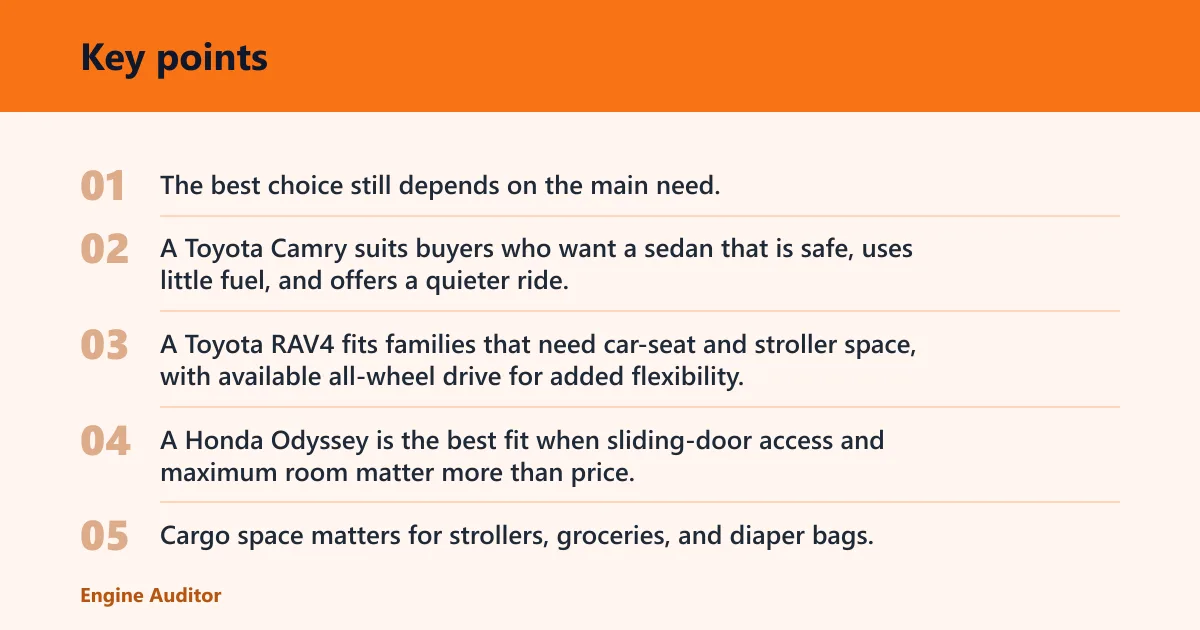
The best choice still depends on the main need. A Toyota Camry suits buyers who want a sedan that is safe, uses little fuel, and offers a quieter ride. A Toyota RAV4 fits families that need car-seat and stroller space, with available all-wheel drive for added flexibility. A Honda Odyssey is the best fit when sliding-door access and maximum room matter more than price.
New parent buyer matrix
| Use case | Body style | Minimum cargo threshold | Rear-seat priority | Ideal budget ceiling |
|---|---|---|---|---|
| Newborn only | Sedan or compact SUV | Infant seat, diaper bag, folded stroller | Wide rear door opening and easy LATCH access | Tight budget |
| One rear-facing seat | Compact SUV | Car seat plus small stroller and groceries | Enough legroom for front-seat clearance | Tight to mid budget |
| Two kids | Midsize SUV or minivan | Two seats, double stroller, weekly shopping | Rear bench width and easy buckle access | Mid budget |
| Frequent road trips | Midsize SUV or minivan | Stroller, luggage, cooler, diaper gear | Second-row comfort and cargo flexibility | Mid to higher budget |
| Tight city parking | Sedan or compact SUV | Folded stroller and a few bags | Easy door swing in narrow spaces | Tight budget |
| Snow or poor weather | Compact or midsize SUV | Room for winter gear and child seats | Confident access in slush and snow | Mid budget |
Safety belongs near the top of the list. Cargo space matters for strollers, groceries, and diaper bags. Used vehicles often cost less up front, and fuel economy matters for daily school runs later on. Reliability and low maintenance are the ideal, because surprise repairs hit a family budget harder than a slightly older cabin ever will.
How much should new parents spend on a family car?
A sensible budget is the one that keeps the payment manageable after child-care, insurance, and repairs. A used family car usually makes the most sense because it spreads the cost out and avoids the fastest depreciation. The goal is simple: keep enough cash available for tires, brakes, and the first round of child-gear purchases.
Budget bands that make sense
- Tight budget: prioritize a sedan or compact SUV with good cargo access and a clean history.
- Mid budget: aim for a compact or midsize SUV if you need stroller room and a rear-facing seat.
- Stretch budget: look at a minivan if you expect two kids or frequent long trips.
Used family car financing matters because the interest rate can change the monthly payment more than the sticker price does. Compare loan offers side by side, check trade-in value on its own, and ask for the vehicle history report before you sign. Low maintenance costs matter too; a cheap payment is less helpful if repairs are constant.
Honda CR-V
The Honda CR-V is the best overall fit for many new parents because it blends a roomy cabin, maintenance costs that stay reasonable for a used SUV, fuel efficiency, and generous cargo space. On used models, backup camera, lane assist, and adaptive cruise control may be available, which helps if you want extra driver support without moving up to a larger vehicle.
It works best for families that need school bags, groceries, and road-trip luggage to fit without a fight. It is also one of the stronger answers when a rear-facing seat is going behind the passenger seat, because the cabin usually leaves more usable space than many compact cars.
The downside is that it can still feel smaller than a minivan once two child seats and a stroller are on board. If you plan for three children or lots of weekend gear, the CR-V may become a compromise rather than the final answer.
Toyota Camry
The Toyota Camry is the budget sedan pick for parents who want a safe sedan choice, great fuel economy, and a comfortable interior. It also has a quiet ride, which matters on long drives when a sleeping baby turns highway noise into a bigger issue than most shoppers expect.
Used models can bring touchscreen infotainment and advanced safety systems, depending on trim and model year. That makes it a practical way to get family-friendly tech without moving into SUV pricing or SUV fuel use.
The tradeoff is space. A Camry can handle one baby well, but rear-facing seats eat into front-legroom faster than many buyers expect. If the stroller is full-size and the family grows quickly, the sedan can feel like the cheapest choice that becomes tight the soonest.
Toyota RAV4
The Toyota RAV4 is a versatile SUV for parents who want interior space for car seats and strollers without jumping to a large vehicle. Available all-wheel drive helps in poor weather, and stronger crash-test ratings are part of its appeal when safety stays high on the list.
It makes sense for families who want a little more room than a sedan, but not the size or parking penalty of a minivan. The rear doors and taller ride height also make loading a child seat easier than in many low sedans, especially when you are buckling in a newborn with one hand and a diaper bag with the other.
The downside is price. RAV4s often cost more than smaller crossovers with similar age and mileage, so the budget can stretch quickly if you chase all-wheel drive and desirable safety features at the same time.
Other used family cars to compare
These models can solve a narrower problem better than the top three. The Hyundai Santa Fe is useful when you want feature-rich used models, heated seats, spacious cargo areas, a quiet interior, and a lower upfront cost. The Kia Sorento fits larger families with six- or seven-seat layouts and easy handling.
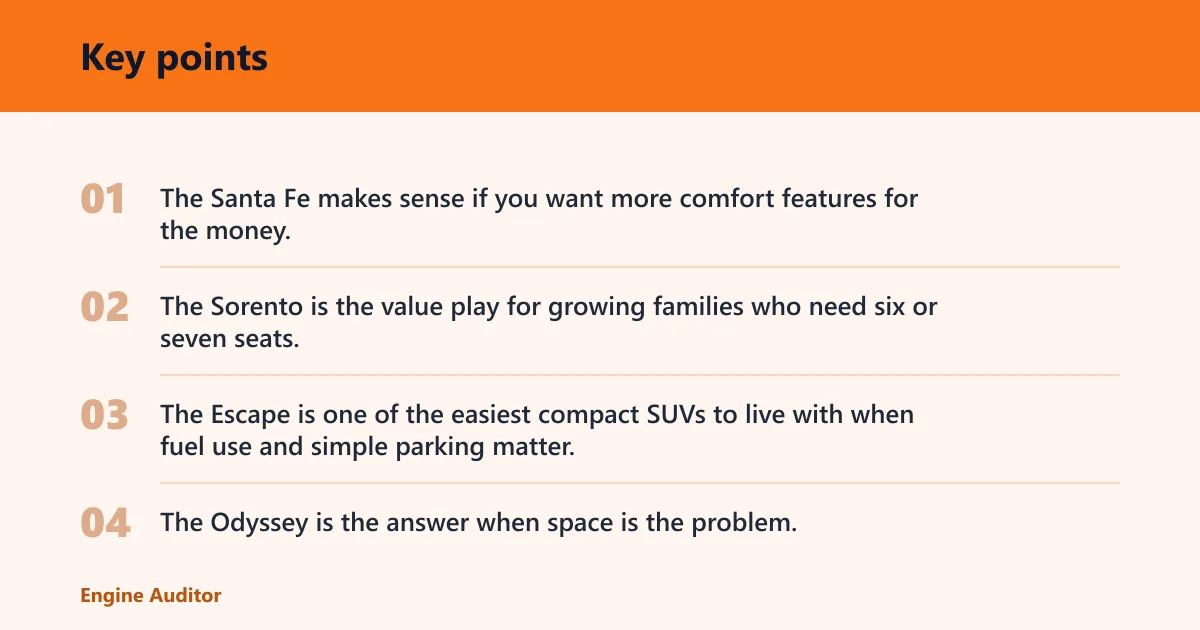
The Ford Escape is the compact SUV choice for fuel efficiency, easy handling, interior room, remote start on some used models, and touchscreen displays. The Honda Odyssey is the strongest answer for sheer people-moving space, with sliding doors, massive interior room, and multiple seating configurations.
Hyundai Santa Fe
The Santa Fe makes sense if you want more comfort features for the money. Heated seats in older used models and a quiet interior can make winter errands and longer drives easier, while the spacious cargo area helps with strollers and shopping bags.
Its downside is size and cost balance. It gives more room than a small crossover, but buyers paying for extra equipment may find that the monthly payment starts to look less “budget” than expected. It is best when comfort matters as much as space.
Kia Sorento
The Sorento is the value play for growing families who need six or seven seats. It is family-friendly inside and easier to handle than many larger three-row SUVs, so it works for buyers who think they may need another seat soon but do not want to jump straight to a minivan.
The limit is third-row usefulness. In many families, that row becomes occasional seating rather than everyday space, so buyers should check whether the cargo area still works once all seats are in place.
Ford Escape
The Escape is one of the easiest compact SUVs to live with when fuel use and simple parking matter. It is fuel-efficient and easy to handle, with enough interior room for a small family and some used models offering remote start and touchscreen displays.
It is a strong fit for newborn-only or one-child households. The main drawback is cargo depth. Once a stroller grows larger or a second child arrives, the Escape can start to feel like the smallest SUV that still looks practical on paper.
Honda Odyssey
The Odyssey is the answer when space is the problem. Sliding doors, large interior room, and multiple seating configurations can make it easier to load car seats, stack baby gear, and move through school-run chaos without constant seat gymnastics.
It is also the best family vehicle for buyers who know they want more children. The downside is simple: a minivan usually costs more in size, parking space, and image than a sedan or compact SUV, so it only makes sense when the extra room will get used.
How to choose a used family car
Start with the newborn pain point, not the badge. If loading a rear-facing seat matters most, focus on rear-door opening, rear-seat width, and LATCH access. If stroller space matters most, check cargo shape with the third row folded or with the child seat installed. If daily commuting dominates, fuel economy and low maintenance rise fast.
Say your stroller folds flat but still leaves almost no room for groceries in the cargo area. In that case, a compact SUV may be enough for newborn-only life, but it can become frustrating once diaper bags, a cooler, and a second child’s gear start stacking up.
Suppose the family is parked on a narrow street and the rear door barely opens wide enough to buckle a car seat. That is the kind of detail that makes a sedan or a compact SUV feel different on paper than in daily use, even when both are “budget-friendly.”
-
Check the rear seat first. Open the rear doors fully and see whether you can reach the lower anchors and buckle the seat without twisting. Follow the vehicle and child-seat manuals, keep items out of airbag zones and the driver’s view, and check local laws.
-
Measure your cargo routine. Bring the stroller you plan to use and see whether it fits with groceries or a diaper bag at the same time. If it only fits after a seat is folded, decide whether that tradeoff works for your daily routine.
-
Review ownership costs. Ask about maintenance history, tire age, brake wear, and fuel use. A vehicle that is cheap to buy can still cost more over time if parts are expensive or service is overdue.
-
Read the vehicle history report. Check for prior damage, title issues, and regular maintenance records before you negotiate. Compare loan offers from more than one lender, because the rate can change the payment enough to alter the entire budget.
-
Take a careful test drive. Focus on visibility, braking, steering, parking, and how easy it is to load a child seat. Follow the owner’s manual for any inspection or setup steps, and never work under a vehicle held only by a jack.
Frequently asked questions
What is the best car for new parents on a budget?
The Honda CR-V is the strongest all-around budget pick for many new parents because it combines room, cargo space, fuel efficiency, and relatively low upkeep. If the family wants a sedan, the Toyota Camry is the safer bet. If two kids are likely soon, the Honda Odyssey becomes more sensible.
Should new parents buy a sedan, SUV, or minivan?
Buy a sedan if you want the lowest fuel use and the easiest parking. Buy a compact or midsize SUV if you need more room for a car seat and stroller. Buy a minivan if sliding doors, wide access, and long-term family space matter more than image or size.
Which used family cars are cheapest to maintain?
The Honda CR-V and Toyota Camry are the safest places to start when low maintenance matters. Both have a reputation for keeping service simple compared with larger, more complicated family vehicles. Still, maintenance costs vary by model year, mileage, and how well the previous owner kept up with service.
What cars fit a stroller and car seat without being huge?
The Toyota RAV4, Honda CR-V, Hyundai Santa Fe, and Ford Escape are the best place to look if you want stroller space without moving to a full-size vehicle. The Camry can work with a smaller stroller, but it usually gives up cargo flexibility sooner than a compact SUV.
What should new parents check before buying a used car?
Check the vehicle history report, the rear-seat fit for a child seat, the cargo area with your stroller, and the maintenance records. Then test-drive it on streets and highways, and look at financing, trade-in value, and expected upkeep together. A cheap car is only cheap if it stays dependable.
Products related to this article
Sponsored / affiliate links. As an Amazon Associate I earn from qualifying purchases. I may earn additional commission from eligible campaigns.