Best Cars for Insurance Savings: Lower-cost Models to Compare
The cheapest cars to insure are usually base-trim compact sedans and small SUVs with moderate power, strong safety ratings, and inexpensive bodywork to repair; start with models like the Toyota Corolla, Honda Civic, Subaru Crosstrek, Mazda3, and Honda HR-V. A bad trim choice can add hundreds a year, especially with turbo engines, larger wheels, or costly headlights. This guide compares models by the insurance drivers that matter most and shows how trim, safety tech, and repair costs change the bill.
What makes a car cheaper to insure?
Insurance groups and the parts that feed them do most of the work. Lower insurance groups are usually cheaper, and lower bands are commonly priced more favorably because insurers weigh engine size, repair cost, value, safety, and theft risk when they set prices. Location, parking, mileage, age, and claims history still matter too.
Insurance groups and what they measure
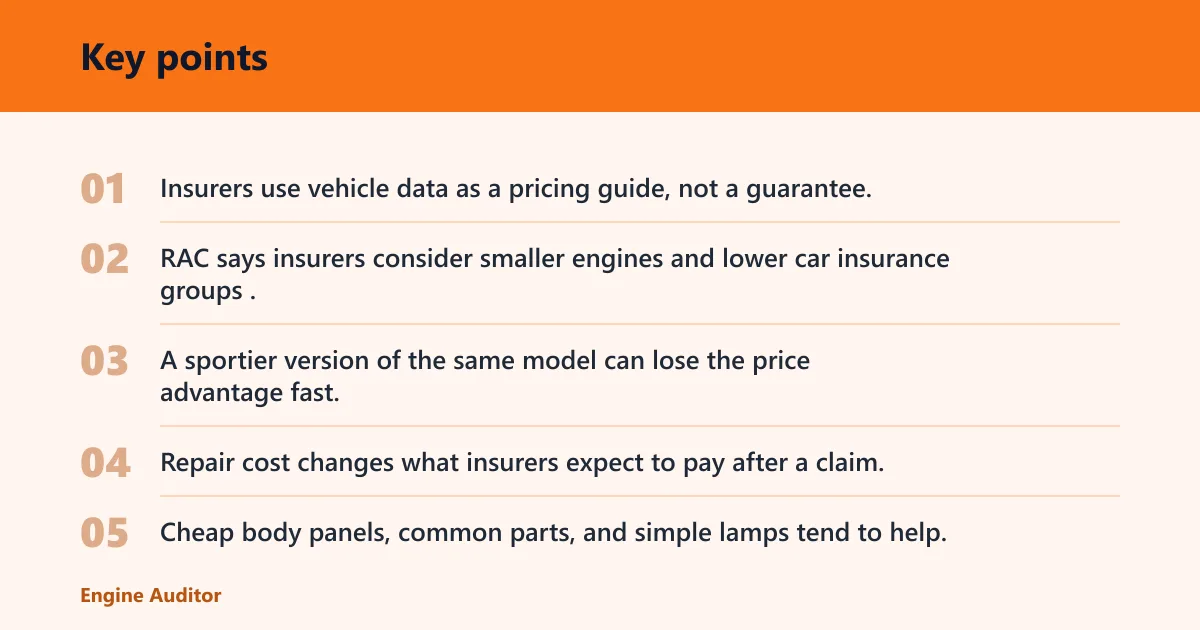
Insurers use vehicle data as a pricing guide, not a guarantee. The same badge can sit in very different groups depending on engine output, body style, wheels, headlights, drivetrain, and even options packs. That is why a base car and a higher trim can land in different premium bands.
RAC says insurers consider smaller engines and lower car insurance groups. That generally helps city cars and modest compact models, but only when the trim stays modest. A sportier version of the same model can lose the price advantage fast.
Why repair costs and theft risk matter
Repair cost changes what insurers expect to pay after a claim. Cheap body panels, common parts, and simple lamps tend to help. Cars commonly targeted by thieves cost more to insure, and the place where the car is kept matters because insurers use local crime statistics in pricing.
Security equipment can help. Immobilisers, alarms, and tracking systems all matter, and overnight parking in a locked garage or secure compound can reduce risk compared with leaving a car on the street.
How safety tech can affect premiums
Autonomous emergency braking can help reduce costs because it lowers the chance or severity of a low-speed crash. That does not erase other risks, though. A car with expensive sensors, cameras, or radar can still be costly to repair after a bump, especially on a higher trim.
Best cars for lower premiums
Uswitch says small hatchbacks typically have the lowest car insurance premiums, based on models with at least 2,000 quotes and social-use policies only. The lowest-cost nameplates in that sample were the Dacia Sandero, Hyundai i10, Fiat 500, Kia Picanto, and Skoda Fabia. They are not identical, and trim still matters.
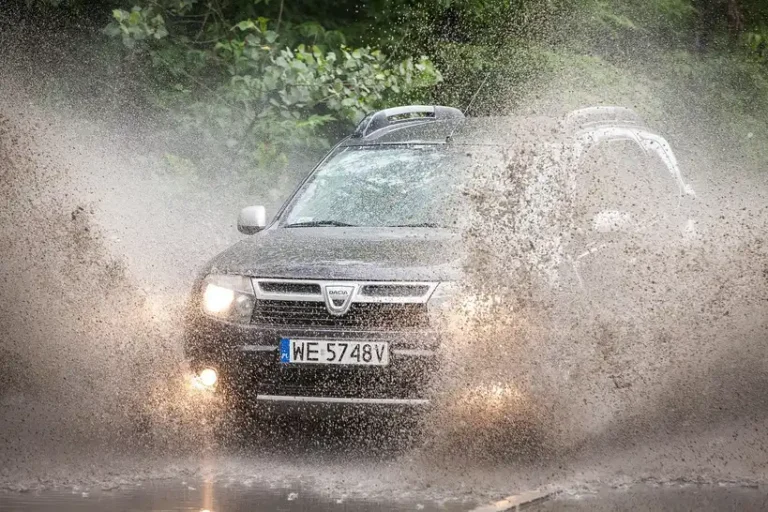
Dacia Sandero
The Dacia Sandero came out cheapest in the Uswitch sample at £299.74 a year. Its modest engine options and relatively low repair costs help keep premiums down. For many buyers, the appeal is simple: low purchase price, low running cost, and a clear insurance advantage if you stay away from higher-spec versions.
Watch out for larger wheels, extra equipment, or a more powerful trim if you compare a Sandero. Those changes can raise repair cost and group position even if the badge stays the same.
Hyundai i10
The Hyundai i10 was second on the Uswitch list at £307.92. It is a typical small hatchback and often fits the bill for younger drivers because it is easy to park and has modest power. That said, premium features can still shift the price upward if you move beyond the simplest versions.
Watch out for higher-spec infotainment, parking packs, and larger wheels on upper trims. Those features can affect repair bills and may move the car out of the lowest insurance band.
Fiat 500
The Fiat 500 averaged £326.88 a year in the Uswitch rankings. It is frequently recommended for new drivers because it is small, simple to park, and available with modest engines. The cheapest versions tend to fit the low-insurance brief better than styling-led trims.
Watch out for turbo engines and sport-themed trims. They can change the insurance outcome even when the shape of the car looks nearly the same.
Kia Picanto
The Kia Picanto averaged £327.82 a year in the Uswitch rankings. It is another small hatchback that appeals to younger drivers and to buyers who want a cheap-to-run city car. Repair costs and engine size matter here just as much as the badge.
Watch out for higher-output engine choices and trim bundles with more expensive exterior parts. A Picanto can stay low-cost, but only if you compare like with like.
Skoda Fabia
The Skoda Fabia appears in cheapest-cars lists because it often combines small-engine options with a lower-cost repair profile. It can suit buyers who need more practicality than a tiny city car without moving into a much pricier insurance bracket. Trim choice changes the result.
Watch out for larger alloy wheels and higher-powered versions. A practical hatchback can turn less practical for insurance if the spec climbs quickly.
Car insurance comparison table
| Model | Typical insurance group band | Engine size / power | Repair-cost risk | Theft-risk profile | Safety tech | Likely buyer type | Watch out for higher trims |
|---|---|---|---|---|---|---|---|
| Dacia Sandero | 1 to 10 | Modest petrol engines | Low | Usually lower than popular hatchbacks | AEB on some trims, basic driver aids | Budget buyer, first-time owner | High-spec wheels and more powerful versions can lift costs |
| Hyundai i10 | 1 to 10 | Small petrol engines | Low to moderate | Generally low | AEB on some trims, parking aids | Young driver, city commuter | Upper trims with larger wheels can raise repair bills |
| Fiat 500 | 1 to 10 | Small petrol engines | Moderate | Can be a theft target in some areas | Some trims add AEB and parking sensors | New driver, urban buyer | Turbo or sport trims can lose the low-premium advantage |
| Kia Picanto | 1 to 10 | Small petrol engines | Low to moderate | Usually lower | AEB on selected trims | Young driver, small-car shopper | Trim upgrades can add cost through extra equipment |
| Skoda Fabia | 2 to 10 | Small to modest petrol engines | Low | Usually moderate | AEB on many versions | Practical hatchback buyer | Higher-powered engines and larger wheels can push premiums up |
| Renault Captur | 5 to 15 | Small turbo petrol or hybrid options | Moderate | Moderate | AEB, lane support, parking aids | Small-SUV buyer | Top trims often add costly sensors and larger wheels |
| Honda CR-V | 10 to 20 | Moderate petrol or hybrid engines | Moderate to high | Moderate | AEB and broader active safety on many trims | Family buyer needing space | Four-wheel drive and premium trim lines can increase the price |
| Ford Kuga | 10 to 20 | Moderate petrol, hybrid, or plug-in hybrid | Moderate to high | Moderate | AEB, driver assists, parking aids | Family buyer, crossover shopper | Higher-output versions and larger wheel options can cost more to insure |
| Volkswagen Tiguan | 10 to 20 | Moderate engines across the range | Moderate to high | Moderate | Strong safety kit on many trims | Buyer wanting a larger SUV | R-Line and high-spec versions usually move away from the cheapest quote set |
| Honda Civic | 5 to 15 | Small to moderate engines | Moderate | Moderate | AEB and other driver aids on many versions | Buyer wanting a compact car with space | Sport trims and turbo variants can raise the premium |
Which cars are cheapest for young drivers?
For younger drivers, the cheapest options are usually smaller-engine cars in lower insurance groups, because insurers price in higher claim risk for new or less experienced drivers. Uswitch highlights the Hyundai i10, Kia Picanto, Citroën C1, and Fiat 500 for younger drivers, but the trim and engine still decide the final quote.
For a 19-year-old comparing two similar hatchbacks, the lower-cost choice is often the one with the smaller engine, the simpler wheel package, and the least expensive headlights or body panels. That can matter more than the badge itself.
Why insurers price young drivers differently
Younger drivers often pay more because insurers commonly see them as a higher claims risk. That is why a car that looks cheap on paper can still carry a strong premium if the driver profile is poor. Lower groups help, but they are only one piece of the price.
Models that often stay in lower groups
Hyundai i10, Kia Picanto, Fiat 500, Dacia Sandero, and Skoda Fabia are common starting points because they tend to sit in lower groups on simpler versions. Uswitch also says the smaller-engine route is the better route for younger drivers.
Trim choices that can push the price up
A common first-timer mistake is picking a sporty-looking trim because it seems like a small step up. Bigger wheels, more power, and cosmetic packages can move the quote in the wrong direction. A basic car with ordinary steel or smaller alloy wheels is often the better comparison point.
Do small cars always cost less to insure?
No. Small cars are often cheaper to insure, but they are not automatically cheaper. Trim, engine output, theft risk, and repair cost can change the answer. A small model with a turbo engine or expensive parts can cost more than a larger but simpler car.
When a small car stays cheap
A small car tends to stay cheap when it has a modest engine, a low repair cost profile, and ordinary safety equipment. That is the pattern behind the Dacia Sandero, Hyundai i10, Fiat 500, and Kia Picanto in the Uswitch sample.
When a bigger model can still be competitive
Some compact SUVs and family SUVs appear in lower-premium samples because they are sold in sensible trims with strong safety tech and moderate power. The Renault Captur, Honda CR-V, Ford Kuga, and Volkswagen Tiguan all appear in the sourced examples with usable premiums, even though they are larger than city cars.
Say your shortlist includes a small hatchback and a compact SUV with the same annual mileage. If the SUV has a simpler engine and the hatchback has a higher-spec turbo trim, the SUV can quote lower than expected. The badge size alone does not set the price.
Why performance trims change the answer
Performance versions often carry higher groups because insurers expect costlier claims. Bigger brakes, more power, larger wheels, and pricier body parts all feed into the number. That is why the base model and the hot version should never be treated as the same insurance choice.
How to compare insurance before you buy
Compare quotes before you commit, and compare the exact trim, engine, and transmission you plan to buy. Uswitch’s sample used only models with at least 2,000 quotes and social use only, which is a useful reminder that quote quality depends on matching the right version of the car to the right driver profile.
-
List the exact trim. Write down engine, gearbox, wheel size, fuel type, and any safety pack. A quote for a base model is not a quote for a higher trim, even when the badge is the same.
-
Check the insurance group. Use the group as a first filter, not the final answer. Lower groups are usually cheaper, but repair cost, theft risk, and driver profile can still move the premium.
-
Compare two or three versions. Look at the base car, the next trim up, and the engine you actually want. This shows whether the extras are worth the insurance jump.
-
Ask about security and parking. Tell the insurer where the car sleeps overnight, whether it has an immobiliser, alarm, or tracker, and how often it is parked on the street. That information can change the quote materially.
-
Check total ownership cost. Add insurance to fuel, repairs, tyres, and depreciation. A cheap-to-insure car is useful, but only if the rest of the ownership stack still makes sense.
Suppose a buyer wants a practical family SUV and narrows the list to a Renault Captur and a Ford Kuga. The Captur’s smaller footprint may help on insurance, but the Kuga can still be competitive in some trims and quote sets. The deciding factor is the exact version, not the body style alone.
Frequently asked questions
What cars are cheapest to insure?
The cheapest cars to insure are usually small hatchbacks and compact models with modest engines, low repair costs, and good safety equipment. In the Uswitch sample, the Dacia Sandero, Hyundai i10, Fiat 500, Kia Picanto, and Skoda Fabia were among the lowest-cost options. Trim choice still matters.
Which cars are cheapest to insure for young drivers?
Young drivers usually do best with smaller engines and lower insurance groups. Uswitch highlights the Hyundai i10, Kia Picanto, Citroën C1, and Fiat 500 for that reason. A basic trim usually helps more than a styling pack or bigger wheel package, which can raise the premium quickly.
Are SUVs expensive to insure?
Not always. SUVs often cost more because they can be pricier to repair, but some compact and family models still land in lower-premium samples. The Renault Captur, Honda CR-V, Ford Kuga, and Volkswagen Tiguan all appear in the sourced examples, which shows that size alone does not decide the quote.
How can I compare insurance before buying a car?
Compare exact trims, engines, and gearboxes before you sign anything. Check the insurance group, then ask for quotes using your real parking, mileage, and driver details. Add repair cost, theft risk, and depreciation to the comparison so you do not save on insurance and lose money elsewhere.
Which car model has the lowest insurance in the UK?
In the Uswitch sample, the Dacia Sandero had the lowest average annual premium at £299.74. That does not mean every Sandero trim is the cheapest possible choice, and it does not guarantee the lowest quote for every driver. The exact version and driver profile still matter.
What are the cheapest cars to insure by age group?
Younger drivers generally do best with small hatchbacks and smaller engines, especially lower-group models such as the Hyundai i10, Kia Picanto, Fiat 500, and Dacia Sandero. Older drivers can still benefit from those cars, but family-friendly models like the Renault Captur or Honda CR-V may also quote competitively depending on use.
Products related to this article
Sponsored / affiliate links. As an Amazon Associate I earn from qualifying purchases. I may earn additional commission from eligible campaigns.