How Often Should You Pump Car Tires for Best Performance?
How often you should pump your car tires is a question every driver asks, and the answer directly impacts your safety, fuel economy, and tire lifespan. This post covers the exact frequency, the factors that change it, and the best practices to keep your tires performing at their peak.
Simply put, you should check and adjust your tire pressure at least once a month and before any long road trip. Seasonal temperature shifts and normal air leakage mean you cannot rely on a single inflation to last more than four weeks.
Key Takeaways
- Check tire pressure monthly and before long trips to maintain optimal performance and safety.
- Seasonal temperature changes cause air to contract and expand, requiring pressure adjustments every time the weather shifts significantly.
- Proper inflation can improve fuel economy by up to 3% and extend tire life by thousands of miles.
- Use a reliable digital gauge and always check tires when they are cold for the most accurate reading.
Why Regular Tire Pumping Matters for Safety and Savings
Tire pressure is not a set-it-and-forget-it item. It naturally drops about 1-2 PSI (pounds per square inch) per month due to permeation through the rubber. Temperature drops of 10°F reduce pressure by 1 PSI.

WOLFBOX
WOLFBOX 150PSI Heavy Duty Tire Inflator Portable…
- 45LPM Dual-Cylinder Fast Inflation: Fully charged, the upgraded 45LPM dual-cylinder tire inflator can inflate a car tire (195/65R1…
- 3×4000mAh Battery for Multiple Inflations per Charge: Powered by a 3×4000mAh (44.4Wh) battery pack and a 150 PSI maximum pressure,…
- USB-C Dual Quick Charge & LED Light: The inflator features a USB-C two-way fast charging port. Using a 45W charger, the inflator c…
As an Amazon Associate I earn from qualifying purchases.
These small losses add up quickly.
Underinflated tires create more rolling resistance, which forces your engine to work harder. The National Highway Traffic Safety Administration (NHTSA) reports that underinflated tires contribute to over 600 fatalities and 30,000 injuries annually in the US alone.
- Safety risk: Low pressure causes poor handling, longer braking distances, and increased risk of blowouts.
- Fuel waste: Each PSI drop below the recommended level reduces fuel economy by roughly 0.2%.
- Uneven wear: Underinflation wears the outer edges faster; overinflation wears the center tread.
- Reduced tire life: Proper inflation can add 5,000 to 10,000 miles to your tire lifespan based on data from Tire Rack.
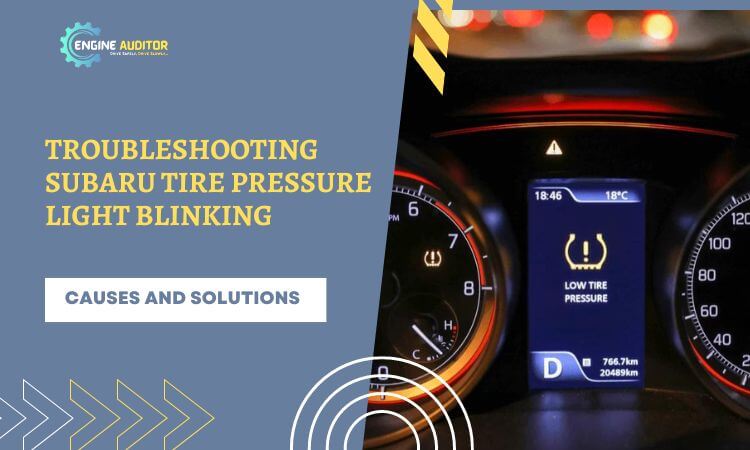
- TPMS limitations: The Tire Pressure Monitoring System (TPMS) typically alerts you only when pressure is 25% below the recommended level, which is already too low for optimal performance.
The bottom line is that keeping your tires properly inflated is one of the simplest and most effective maintenance tasks you can do. It directly affects your control on the road and your wallet at the pump.
How Often Should You Pump Car Tires? The Exact Schedule
Automotive experts from AAA and Consumer Reports consistently recommend a monthly check schedule. This is the sweet spot that catches the natural pressure loss before it becomes a problem.
In addition to monthly checks, you should inflate your tires whenever you notice the TPMS light is on, before a long trip, or after a significant temperature swing. Waiting longer than four weeks means your tires could be running several PSI below the target.
| Scenario | Recommended Action | Frequency |
|---|---|---|
| Normal daily driving | Check and adjust pressure | Every 4 weeks |
| Seasonal temperature change (+/- 10°F) | Recheck and adjust | At the start of each season |
| Before a road trip (over 100 miles) | Fill to recommended PSI | Before every trip |
| TPMS warning light is on | Check immediately and inflate | As soon as possible |
| After a puncture repair | Recheck pressure after 24 hours | Once post-repair |
This table gives you a clear, actionable schedule. The key insight is that monthly checking is your baseline safety net.
Pro Tip: Download a tire pressure tracking app on your phone. Log your PSI readings each time you check. After three months, you will see the natural loss pattern, which helps you predict when you will need to add air again.
How Temperature and Altitude Affect Your Tire Pressure
Temperature is the biggest external factor affecting tire pressure. For every 10°F drop in ambient temperature, your tire pressure drops by about 1 PSI. This is a direct result of the ideal gas law, which teaches that gas volume changes with temperature.
Altitude also plays a role. Driving from sea level to a mountain pass at 10,000 feet can cause tire pressure to increase by 1-2 PSI due to the lower external atmospheric pressure. Conversely, descending will make the pressure seem lower than you started with.
- Cold weather: In winter, pressure drops significantly. Check more frequently, as a 30°F drop can reduce pressure by 3 PSI.
- Hot weather: Summer heat increases pressure. Do not let air out because the pressure will drop again when the tires cool down.
- Driving heat: Tires heat up during driving, increasing pressure by 4-6 PSI. Always measure when tires are cold (car stationary for 3+ hours).
- Rapid climbs: Mountain driving causes temporary pressure increases. It is safe as long as you stay within the tire’s maximum sidewall rating.
- Garage vs. outside: If you check in a warm garage and drive into freezing temperatures, the pressure will drop quickly. Compensate by inflating to the recommended cold PSI.
What Is the Correct Tire Pressure for Your Car?
The correct pressure for your vehicle is not printed on the tire itself. The tire sidewall lists the maximum pressure the tire can handle, not the recommended pressure for your car. The manufacturer’s recommendation is what you need to follow.
Vehicle manufacturers determine the optimal pressure based on a balance of ride comfort, handling, load capacity, and fuel efficiency. This value is determined through extensive testing with the specific tires and suspension system on your car.
- Check the driver’s door jamb: There is a sticker inside the driver’s side door that lists the recommended PSI for front and rear tires. This is the most accurate source.
- Check the owner’s manual: The manual will list the recommended pressure for different load conditions and tire sizes.
- Check the glove box: Some manufacturers place a pressure sticker inside the glove box or fuel filler door.
- Ignore the sidewall number: The number on the tire is the maximum safe pressure, not the recommendation. Your car’s pressure is usually 30-35 PSI for most passenger vehicles.
- Use the same pressure on all four: Unless your car specifies different pressures for front and rear (common in high-performance or heavy-load situations), use the same PSI on all tires.
Warning: Never exceed the maximum pressure listed on the tire sidewall. Overinflating to extremes can cause the tire to burst, especially at high speeds or in hot weather. Always stay within the vehicle manufacturer’s recommended range, not the tire’s maximum.
How to Check and Pump Your Tires Correctly
Checking tire pressure is a simple five-minute job that anyone can do. The key is doing it correctly to get an accurate reading. Follow this step-by-step process for best results.
Always check your tires when they are cold, meaning the car has been parked for at least three hours or driven less than a mile at low speed. A hot tire reading will be artificially high and could lead you to under-inflate.
- Remove the valve cap: Unscrew the small cap on the tire’s valve stem. Keep it somewhere safe, like your pocket.
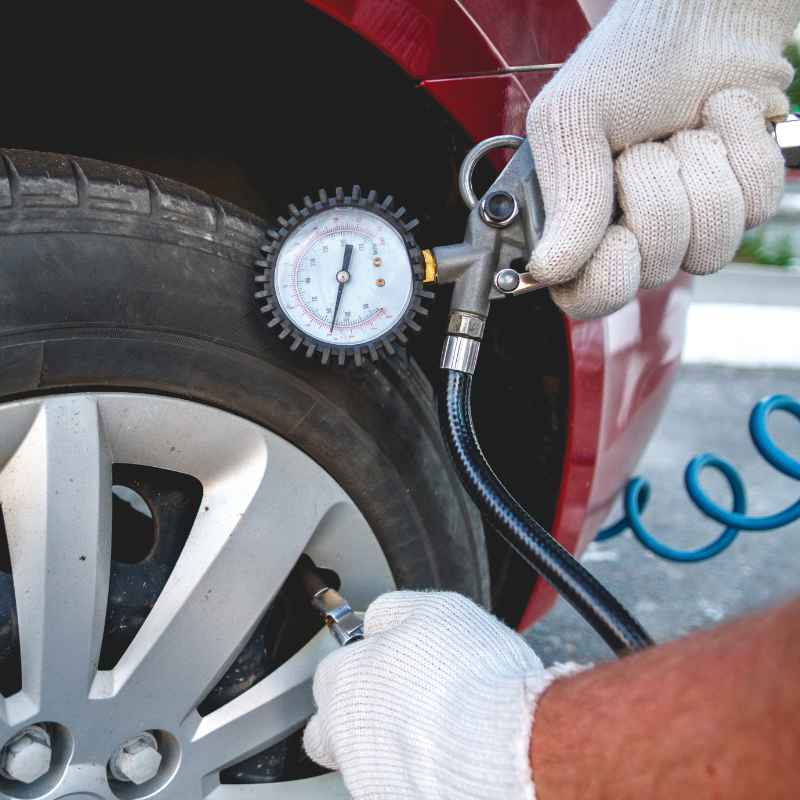
- Press the gauge firmly: Place the tire pressure gauge over the valve stem and press down hard to get a tight seal. You should hear a brief hiss of air, but if it continues hissing, you have a bad seal.
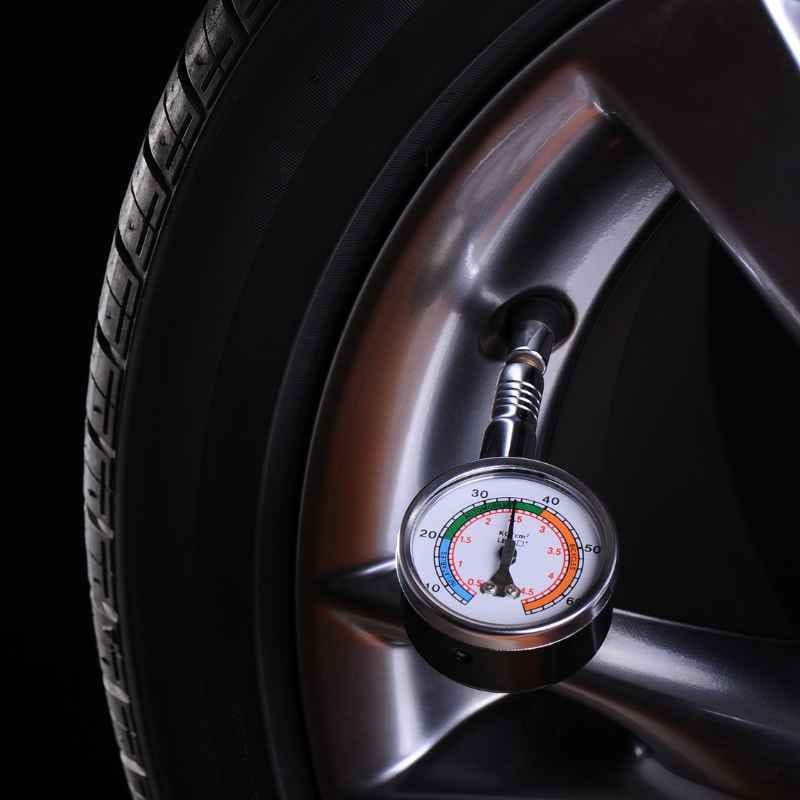
- Read the gauge: A digital gauge will show the PSI number. A stick-type gauge will have a small ruler that pops out. Read the number at the base of the ruler.
- Compare to the recommended PSI: Check your car’s recommended pressure (usually 32-38 PSI for most sedans and SUVs).
- Add air if needed: Use an air compressor at a gas station or a portable pump. Add air in short bursts, checking the pressure after each burst. Do not overfill.
- Check pressure again: After adding air, recheck the pressure to confirm you hit the target. Replace the valve cap securely.
| Tire Type | Typical Recommended PSI (Cold) | Typical Max PSI (Sidewall) |
|---|---|---|
| Passenger car (sedan, hatchback) | 32 – 35 | 44 – 51 |
| SUV / Crossover | 35 – 38 | 44 – 51 |
| Light truck (pickup) | 35 – 45 | 51 – 65 |
| High-performance / sports car | 30 – 36 | 44 – 51 |
This table shows typical ranges, but always verify with your vehicle’s specific sticker. The variations are based on vehicle weight, tire size, and intended use.
Important: For the most accurate fill, consider using a portable 12V compressor with a built-in digital gauge. Gas station compressors are often inaccurate and can be off by 2-4 PSI. A quality portable unit costs between $25 and $50 and lasts for years.
Common Mistakes When Pumping Car Tires
Even experienced drivers make these common errors. Avoiding them will keep your tire pressure at the correct level and ensure you are getting the performance boost you expect.
The biggest mistake is checking pressure after driving. The friction of the road heats up the air inside the tire, causing the pressure reading to be significantly higher than the actual cold pressure. If you set the pressure to the recommended level when the tire is hot, you will actually be under-inflated by 4-6 PSI once the tire cools down.
- Checking after driving: Always check cold. A hot reading of 38 PSI might actually be 32 PSI cold, leading to dangerous underinflation.
- Overfilling to the sidewall max: That number is the maximum, not the target. Inflating to 44 PSI if your car needs 32 PSI will cause a harsh ride and rapid center tread wear.
- Forgetting the spare tire: Your spare tire also loses pressure over time. Check it every few months, especially before a long trip. Many spares need 60 PSI.
- Using the wrong gauge: Stick gauges are cheap but less accurate. Digital gauges are more reliable. Avoid the pencil-type gauges available at dollar stores.
- Ignoring seasonal changes: As winter approaches, your tires will lose pressure. You will need to add air every 2-3 weeks during the first cold snap.
Warning: Do not use the “eyeball test” to determine if your tires are low. Radial tires can look fine even when underinflated by 10 PSI. A visual check is not reliable. Always use a gauge.
How Tire Pressure Affects Fuel Economy and Tire Wear
The connection between tire pressure and fuel economy is well-documented by the U.S. Department of Energy. They state that proper tire pressure can improve gas mileage by 0.6% on average and up to 3% in some cases.
For a car that consumes $1,200 in fuel annually, that is a potential saving of $36 per year.
Tire wear is also directly tied to pressure. Underinflation accelerates wear on the outer edges of the tread, while overinflation accelerates wear in the center. Proper inflation ensures even contact with the road, maximizing the tire’s usable life.
- Fuel savings: Lower rolling resistance means the engine uses less energy to move the car. Every 1 PSI below the recommendation reduces fuel economy by 0.1% in general, but more at highway speeds.
- Tread life extension: Tires properly inflated last 10,000 to 15,000 miles longer than those that are consistently 10 PSI low, based on data from the Rubber Manufacturers Association.
- Reduced emissions: Better fuel economy means less CO2 emitted per mile. Proper tire pressure reduces your vehicle’s carbon footprint.
- Improved handling: Correct pressure gives you the proper contact patch for cornering stability and braking performance.
- Reduced blowout risk: Underinflated tires generate more heat, which is the primary cause of high-speed blowouts, especially in summer.
Overall, the cost of a few minutes each month is vastly outweighed by the financial and safety benefits. It is one of the highest-ROI maintenance tasks you can do for your car.
How Does Pumping Tires Differ for Electric Vehicles?
Electric vehicles (EVs) have different tire requirements than gasoline cars. Because EVs are generally 20-30% heavier than their gas counterparts due to the battery pack, manufacturers often recommend higher tire pressures to support the additional weight.
Typical EV tire pressures range from 38 to 45 PSI, compared to 32-35 PSI for a similar-sized gas car. This higher pressure reduces rolling resistance, which is critical for maximizing the car’s driving range. However, it also means you need to be more vigilant about checking pressure, as even small drops in PSI can noticeably affect range.
- Check more frequently: EV owners should ideally check pressure every two weeks, as the higher pressure and heavier load accelerate air loss.
- Monitor on the dashboard: Most EVs have a live tire pressure display showing each tire’s PSI. Use this feature proactively, not just when a warning appears.
- Expect stiffer ride: The higher recommended pressure for EVs means a firmer ride, but it is necessary for safe handling and range optimization.
- Use dedicated EV tires: If you replace your tires, look for tires specifically designed for electric vehicles. They have reinforced sidewalls and lower rolling resistance compounds.
Tip for EV Owners: The recommended pressure for your EV is almost always on the driver’s door jamb sticker. Do not follow general online advice that says EVs run at 45 PSI. Some models like the Tesla Model 3 recommend 42 PSI, while the Chevrolet Bolt recommends 38 PSI. Check your specific car.
What Tools You Need for Accurate Tire Pressure Maintenance
You do not need expensive equipment to maintain proper tire pressure, but having the right tools makes the job faster, easier, and more accurate. Investing in a few simple items will pay for themselves in saved fuel and extended tire life.
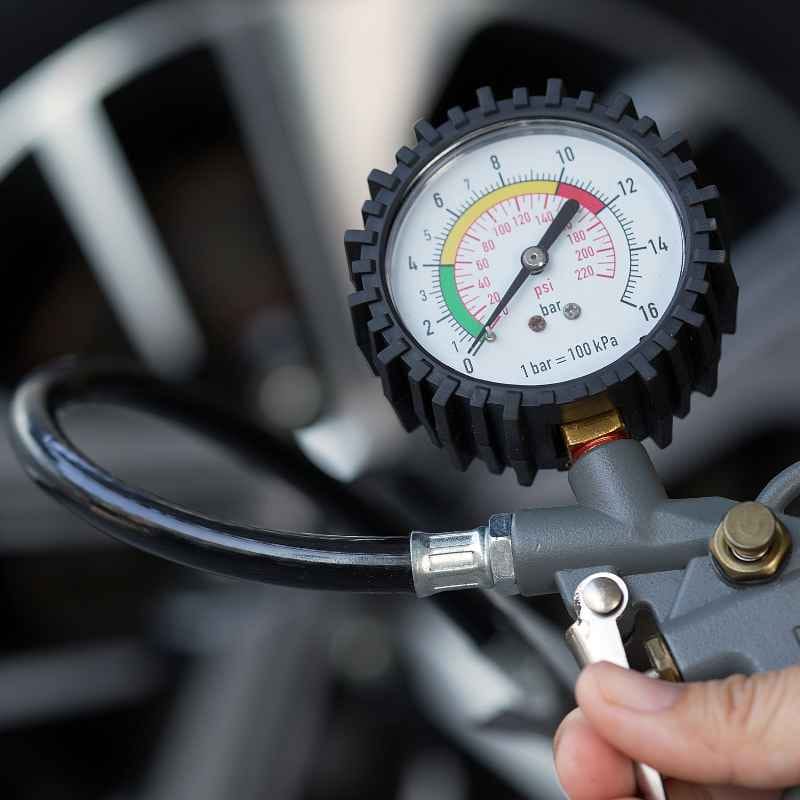
The most important tool is a high-quality tire pressure gauge. You can choose between digital, dial, or stick types. Digital gauges are generally the most accurate and easiest to read.
Dial gauges are reliable but require a bit more skill to read precisely. Stick gauges are cheap but often inaccurate and can break easily.
| Tool | Best Feature | Approx. Cost | Recommendation |
|---|---|---|---|
| Digital gauge | Easy to read, high accuracy (+/- 1%) | $10 – $30 | Best buy for most drivers |
| Dial gauge | Durable, professional-grade accuracy | $15 – $40 | Great for heavy use |
| Stick gauge | Very cheap, compact | $3 – $8 | Avoid if possible |
| 12V portable compressor | Fill tires anywhere, built-in gauge | $25 – $70 | Highly recommended |
| Valve cap tool | Removes stubborn caps | $2 – $5 | Nice to have |
A good gauge and a portable compressor cover you for nearly every situation. With these two tools, you can check and fill your tires at home without relying on gas station equipment.
Frequently Asked Questions
Is it bad to drive with low tire pressure?
Yes, it is dangerous. Driving with low tire pressure increases the risk of a blowout, reduces fuel economy, and causes uneven tread wear. The National Highway Traffic Safety Administration recommends pulling over and checking your tire pressure if the TPMS light comes on.
Can I pump my tires when they are hot?
You can, but you should not use the hot reading as your target. If you must add air on the road, fill the tire to 4-6 PSI above the recommended cold pressure. Once the tire cools down, recheck and adjust to the correct level.
How often should I replace my tire pressure gauge?
Digital gauges should be replaced every 1-2 years if you use them frequently. They lose calibration over time. Dial gauges can last 3-5 years.
Stick gauges should be replaced after about one year of regular use.
Does nitrogen inflation mean I never have to check pressure?
No. Nitrogen molecules are larger than oxygen molecules, so they escape more slowly, but they still escape. Nitrogen-filled tires lose pressure at about half the rate of regular air, but they still need checking every 2-3 months instead of monthly.
What is the best time of day to check tire pressure?
The best time is early morning on a day you have not driven yet. The tires will be cold from sitting overnight, giving you the most accurate baseline reading. Avoid checking in the middle of the day after driving to work.
Final Thoughts
Checking your tire pressure once a month is a simple habit that pays off in safety, fuel savings, and extending your tire life. Seasonal temperature changes and normal air loss mean you cannot ignore this task for more than four weeks. Invest in a quality digital gauge and a portable air compressor, and make pressure checks a regular part of your vehicle care routine.
Your car, your wallet, and the road will all thank you.
See also car tire won’t come off try these proven simple fixes. See also how to make car tyres black again easy diy methods .
Related pick: Check today's price on Amazon