Why Does My Honda Civic Keep Dying? Here’s What’s Wrong
If your Honda Civic keeps dying, you’re likely dealing with a frustrating and inconvenient issue that many owners face. This post breaks down the most common reasons for a Honda Civic dying unexpectedly and how to fix them.
Simply put, a Honda Civic that keeps dying is usually caused by a faulty battery, failing alternator, bad fuel pump, or ignition system problems. The issue may also stem from a parasitic drain or sensor malfunction. A systematic diagnosis is essential to identify the exact cause.
Key Takeaways
- Honda Civic keeps dying most often due to battery, alternator, or fuel system issues.
- Start diagnosis with a battery voltage test and alternator check.
- Parasitic battery drain is a common hidden cause of repeated stalling.
- Ignition problems (coils, plugs) and sensor failures can also cause stalling.
- Professional diagnosis with an OBD-II scanner can pinpoint sensor-related faults.
Common Causes of a Honda Civic That Keeps Dying
A Honda Civic that stalls repeatedly usually points to one of a handful of systems. The most frequent culprits involve the battery, alternator, fuel delivery, or ignition. A less common but tricky cause is a parasitic drain that slowly kills the battery overnight.
Understanding the pattern of failure helps narrow down the issue. Does the car die while driving, at idle, or after sitting? Each scenario suggests a different root cause.
- Battery failure – old age, corrosion, or internal short
- Alternator malfunction – not charging the battery properly
- Fuel pump or filter – insufficient fuel pressure
- Ignition coils or spark plugs – misfires leading to stall
- Parasitic battery drain – a component drawing power with the engine off
- Faulty sensors – MAF, crankshaft position, or throttle position sensor
Warning: If your Civic dies suddenly while driving, it could indicate a failing alternator or fuel pump. Pull over safely and have the vehicle towed if needed.
According to data from the American Automobile Association (AAA), battery-related issues account for about 25% of roadside assistance calls. The average lifespan of a car battery is 3–5 years, and many Honda Civic owners report original batteries failing around 4 years.
How to Diagnose Why Your Honda Civic Keeps Dying
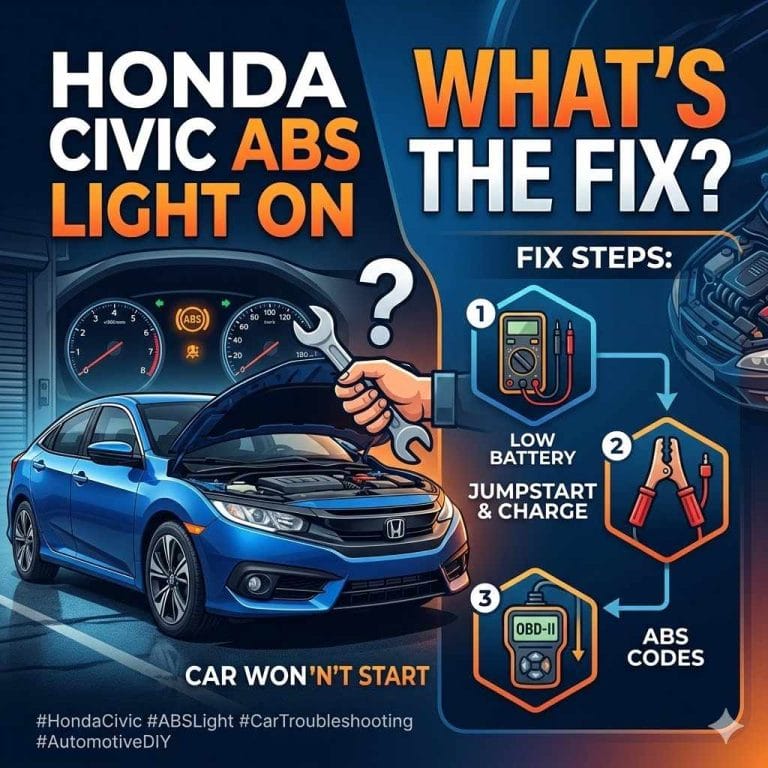
Start with simple checks before moving to complex components. A multimeter, a set of basic tools, and an OBD-II scanner are your best friends.
Follow these steps in order to avoid wasting time on the wrong part.
- Check battery voltage – with engine off, voltage should be 12.4–12.7V. With engine running, 13.7–14.7V.
- Test the alternator – turn on headlights and blower; if voltage drops below 13V, alternator likely failing.
- Inspect battery terminals and cables – clean any white/green corrosion, tighten loose connections.
- Scan for trouble codes – use an OBD-II reader to check for stored codes related to fuel, ignition, or sensors.
- Perform a fuel pressure test – a fuel pressure gauge will tell you if the pump or filter is weak.
- Check for parasitic draw – with everything off, disconnect negative battery cable and place multimeter in series; draw over 50mA indicates a drain.
- Inspect ignition components – look for cracked spark plug insulators, oil in spark plug wells, or damaged coil boots.
Tip: Many auto parts stores offer free battery and alternator testing. Take advantage of this before buying parts.
A systematic approach prevents replacing parts that aren’t broken. For example, a new battery won’t fix a bad alternator, and a new fuel pump won’t solve a parasitic drain.
Battery Problems: The Most Common Reason Your Honda Civic Keeps Dying
The battery is the most likely cause when a Honda Civic keeps dying, especially after sitting overnight. A weak battery may still start the car but fail to hold a charge, leading to stalling at low speeds or after short trips.
Signs of battery trouble include slow cranking, dim headlights, and a clicking sound when turning the key. Corroded terminals or loose connections can mimic a dead battery even when the battery itself is good.
| Battery Voltage Reading | What It Means |
|---|---|
| 12.6V – 12.7V | Fully charged, healthy |
| 12.4V – 12.5V | 75% charged, acceptable |
| 12.2V – 12.3V | 50% charged, needs recharge |
| Below 12.0V | Battery is discharged or failing |
If your battery is more than three years old and you live in a hot climate, consider replacing it preventively. Extreme heat accelerates battery degradation.
Important: Always disconnect the negative terminal first when removing the battery. Reconnect the positive first to prevent shorts.
Alternator Failure: When the Battery Isn’t Charging
If your Honda Civic dies while driving or shortly after starting, the alternator may be failing. The alternator charges the battery while the engine runs; when it stops working, the battery supplies power until it drains completely.
Symptoms include dimming headlights, a battery warning light on the dash, and a whining noise from the alternator. A quick test: with the engine running, measure battery voltage again. It should be between 13.7V and 14.7V.
- Voltage below 13V with engine running = alternator not charging
- Voltage above 15V = overcharging, can damage battery and electronics
- Alternator bearings can seize, causing belt squeal or smoke
- Modern Honda Civics often have variable-output alternators; check with a load test
According to a study by the National Institute for Automotive Service Excellence (ASE), alternator failure is the second most common cause of vehicle breakdowns after battery issues. Replacing an alternator is a more involved job than swapping a battery, but many DIYers can do it with basic tools.
Fuel System Issues: Pump, Filter, and Injectors
A lean fuel condition can cause a Honda Civic keeps dying under load or during acceleration. The fuel pump may be weak, the filter clogged, or the injectors dirty. When the engine demands more fuel, pressure drops and the engine stalls.
Listen for a buzzing sound from the rear of the car when turning the key to the “on” position. If you don’t hear the fuel pump prime for a few seconds, it may be failing. A fuel pressure test (typically 40–60 psi for most Civics) confirms the issue.
| Fuel Pressure Reading | Likely Cause |
|---|---|
| Below 40 psi | Weak fuel pump or clogged filter |
| Drops under load | Fuel pump strainer or filter restriction |
| No pressure at all | Dead fuel pump, blown fuse, or relay failure |
A failing fuel pump should be replaced as soon as possible. Driving with a weak pump can cause the engine to run lean, potentially damaging the catalytic converter over time.
Ignition System: Spark Plugs, Coils, and Wires
An intermittent spark can make a Honda Civic keeps dying, especially under load or in wet conditions. Worn spark plugs, failing ignition coils, or damaged wires can cause misfires that lead to stalling.
Honda Civic models from the 2000s onward often use individual coil-on-plug (COP) systems. Moisture or oil in the spark plug wells is a common issue, particularly after valve cover gasket leaks.
- Check engine light flashing or steady – codes P0300–P0304 indicate misfires
- Rough idle – engine shakes or runs unevenly
- Stalling during rain – moisture seeping into coil boots
- Loss of power – cylinder misfires reduce acceleration
- Increased fuel consumption – unburned fuel from misfire
According to a report by the Automotive Aftermarket Suppliers Association (AASA), iridium spark plugs last up to 100,000 miles in many modern Hondas. Still, if you’re experiencing stalling and haven’t changed plugs in 60,000 miles, they’re a prime suspect.
Parasitic Battery Drain: Finding the Hidden Culprit
If your Honda Civic starts fine but dies after sitting for a day or two, a parasitic drain is likely. A component like the interior lights, glove box light, or an aftermarket stereo draws power even when the car is off.
Modern Civics have many modules that stay awake for a short time after shutdown (the BCM, radio, security system). But if the current draw exceeds 50 milliamps (0.05A) after 30 minutes, you have a drain.
- Disconnect the negative battery cable.
- Set your multimeter to DC amps (10A setting initially).
- Connect the positive lead to the negative battery post and the negative lead to the disconnected cable.
- Wait 30 minutes for modules to go to sleep (door closed, key out).
- Read the current. Normal is 20–50 mA. If higher, start pulling fuses one by one.
- When the current drops significantly, that circuit is the culprit.
Warning: Never start the engine with the multimeter in current mode. Always switch to voltage mode or disconnect the meter before cranking.
Common sources of parasitic drain on Honda Civics include the blower motor resistor, the audio unit, or a faulty door lock actuator. Some aftermarket alarm systems also cause persistent draw.
Sensor Malfunctions: MAF, Crank, and Throttle Position
Faulty sensors can send incorrect signals to the ECU, causing the engine to stall or hesitate. The mass airflow (MAF) sensor, crankshaft position sensor, and throttle position sensor are common failures in older Civics.
A dirty MAF sensor can cause the engine to run lean and stall at idle. Cleaning it with MAF cleaner often resolves the issue. A failing crankshaft position sensor may cause intermittent stalling without warning, often without a check engine light initially.
- MAF sensor – clean with dedicated spray (do not use carb cleaner)
- Crankshaft position sensor – prevents engine from detecting rotation; car may start but then die
- Throttle position sensor – erratic idle, stalling when coming to a stop
- Coolant temperature sensor – wrong reading can affect fuel mixture
- Oxygen sensor – can cause lean/rich condition leading to stalling
Using an OBD-II scanner to check live data can reveal sensor values that are out of range. For example, a MAF reading of less than 2 g/s at idle on a 1.8L engine indicates a problem.
Frequently Asked Questions
Why does my Honda Civic die while driving?
This often points to a failing alternator, fuel pump, or ignition system. If the battery warning light comes on just before stalling, suspect the alternator. If it sputters before dying, check fuel pressure.
Can a bad battery cause a Honda Civic to stall?
Yes, a weak or dying battery can cause the engine to stall, especially at low RPM or when electrical loads are high. The battery on its own doesn’t power the ignition while running, but voltage dips can confuse sensors and the ECU.
How much does it cost to fix a Honda Civic that keeps dying?
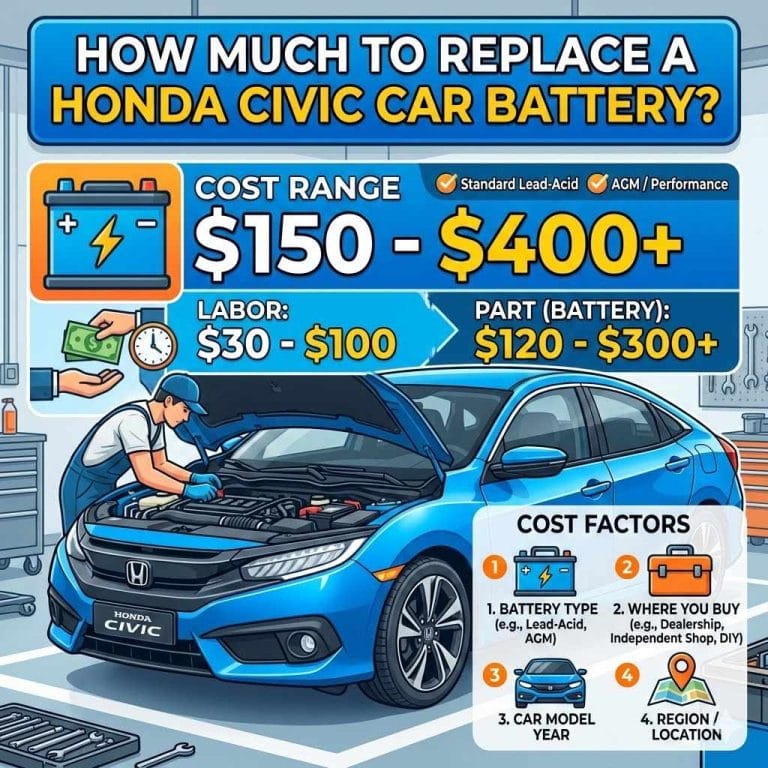
Cost depends on the cause: a new battery costs $100–$200, an alternator $300–$600 (parts and labor), fuel pump $400–$700, and ignition coil $150–$300 per coil. Diagnostic fees at a shop run $100–$150.
How do I know if my Honda Civic alternator is bad?
Check the battery voltage with the engine running; if it’s below 13V, the alternator isn’t charging. Other signs include dim headlights, a growling noise from the alternator, and a battery warning light.
Can a parasitic drain damage my Honda Civic battery?
Yes, repeated deep discharges caused by a parasitic drain will significantly shorten the battery’s lifespan. Over time, the battery may no longer hold a charge and require replacement.
Final Thoughts
Diagnosing why your Honda Civic keeps dying doesn’t have to be overwhelming. Start with the battery and alternator, move to fuel and ignition, and then check for parasitic drains or sensor issues. With a systematic approach and basic tools, you can pinpoint the problem and get back on the road.
If you’re not comfortable with electrical testing, a trusted mechanic can run a proper diagnosis quickly.