What Happens When Electric Car Runs Out of Power: Essential Guide
When you drive an electric car, you enjoy a quiet ride, clean air, and low running costs. But there’s one worry that many drivers share: what happens if your electric car runs out of power? Unlike gasoline vehicles, you can’t just walk to a gas station and fill a can. Running out of power, or “range anxiety,” is a real concern, especially for new electric vehicle (EV) owners.
This article will guide you through everything that happens when your electric car battery reaches zero, what you should do, and how to avoid getting stranded. We’ll also compare electric cars to gas vehicles, explain rescue options, and answer common questions. By the end, you’ll have a clear understanding and feel more confident about driving electric.
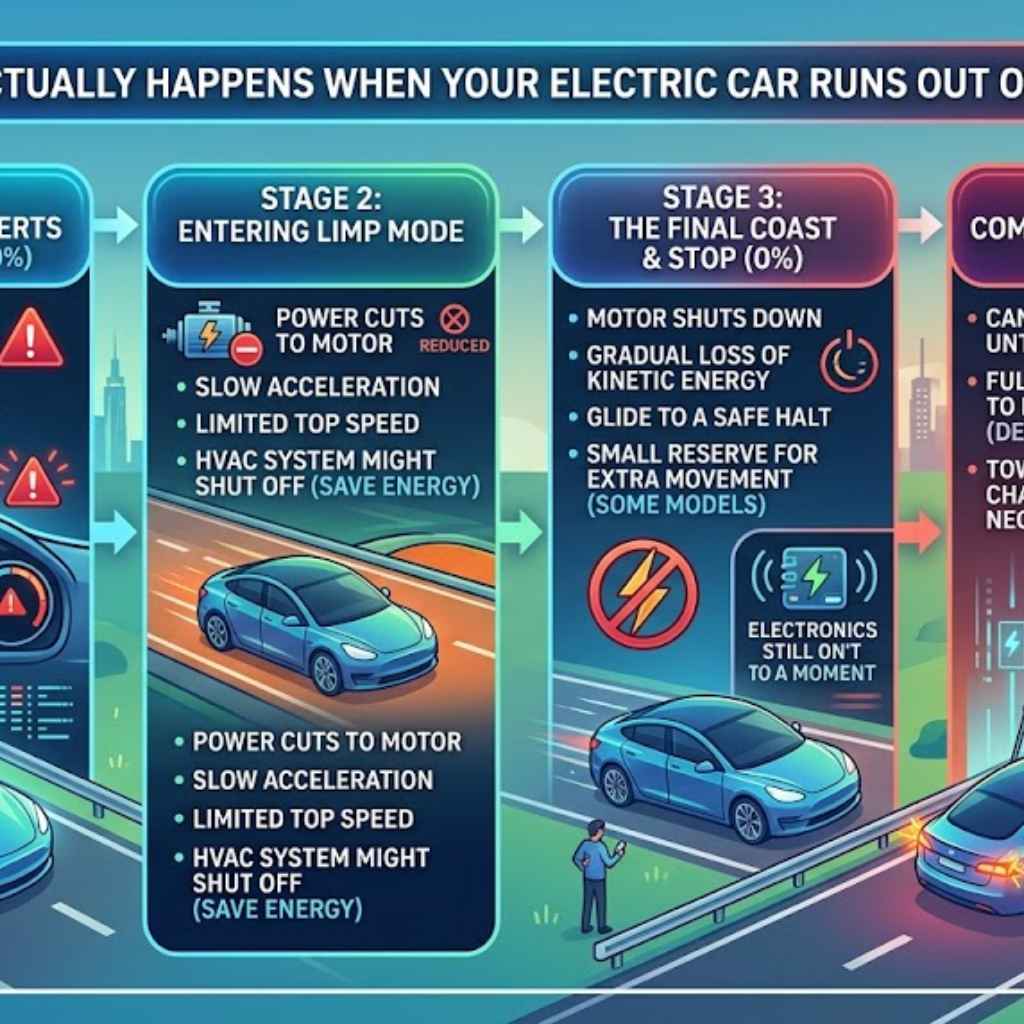
What Actually Happens When Your Electric Car Runs Out Of Power
When an electric car battery runs out, the experience is different from a gasoline car. You won’t see your engine sputter or hear strange noises. Instead, you’ll notice a gradual loss of performance.
First, the car’s display will alert you when the battery is low, often with several warnings as you approach zero. Many EVs show the remaining state of charge in both percentage and estimated kilometers or miles.
As you near the end, most electric cars enter a “limp mode.” In this mode, the car reduces power to the motor to save energy. Acceleration becomes slow, air conditioning or heating might switch off, and top speed is limited. The idea is to help you reach a charging point if possible.
If you continue driving, eventually, the car will come to a stop. Unlike a gas car, it doesn’t stutter or shake. The motor just shuts down, and you glide to a halt—usually safely, as the car gives you enough warning.
Some models even have a small reserve that allows a little extra movement at very low speed.
After the car stops, you won’t be able to drive again until you recharge the battery. The electronics may still work for a short time, but eventually, even those will shut down to protect the battery from deep discharge.
Immediate Steps To Take When An Ev Runs Out Of Power
If your electric car stops because the battery is empty, here’s what you should do:
- Stay Calm and Safe: Move your car to the side of the road if possible. Use your remaining momentum to steer out of traffic.
- Turn on Hazard Lights: Alert other drivers that you are stopped. This is important for your safety.
- Check Your Location: Use your phone or the car’s navigation to find out where you are. This will help when you call for help.
- Call for Assistance: Contact your roadside assistance provider. Many services now offer mobile charging or towing for electric cars.
- Wait Inside if Safe: If you’re on a busy road or highway, stay inside the car with seatbelts on until help arrives. If you’re in a safe area, you can wait outside.
- Inform Others: If you’re blocking traffic or in a dangerous spot, let authorities know.
A non-obvious tip: If your car has a small 12-volt battery (which powers electronics), try not to use the radio or lights unnecessarily while waiting. This battery is also drained during a full power loss, and if it dies, remote unlocking and some safety features may stop working.
How Electric Cars Warn Drivers About Low Battery
Modern electric cars are designed to prevent you from running out of power. They use several methods to warn you:
- Dashboard Alerts: The car’s display will show warnings when the battery drops below a certain level—often at 20%, 10%, and 5%.
- Navigation Prompts: Some EVs suggest the nearest charging stations automatically when your range is low.
- Reduced Performance: The car may limit speed, turn off climate control, or dim lights to conserve power.
- Mobile App Alerts: Many car apps send notifications to your phone when the battery is low.
A beginner might not realize that the car’s estimated range is just an estimate. Driving uphill, using the heater, or driving fast can reduce range quickly. Always leave a buffer, especially on unfamiliar routes.
Comparison: Electric Car Vs. Gasoline Car When Out Of Power
Understanding the difference helps you prepare better. Here’s a comparison:
| Aspect | Electric Car | Gasoline Car |
|---|---|---|
| Warning System | Multiple digital warnings, range estimate | Low fuel light, analog gauge |
| Performance Before Stop | Reduced speed, “limp mode” | Engine sputters, may stall suddenly |
| Restarting | Needs to be recharged | Can add a small amount of fuel to continue |
| Rescue Options | Mobile charger (rare), towing | Can walk with a fuel can |
| System Shutdown | Electronics may stay on briefly, then shut down | Electrical system may still work |
The key takeaway: running out of power in an electric car means you need a charging solution, not just a small refill.
What To Do: Charging And Rescue Options
If your electric car is out of power, you have a few rescue options:
Mobile Charging Services
Some roadside assistance companies now have mobile chargers. These are vans with large batteries or generators that can give your car enough charge to reach the nearest station. It’s still rare, but becoming more common in cities.
Towing To A Charging Station
If a mobile charger isn’t available, your car will need to be towed. Electric cars require flatbed towing to avoid damage to the motors. Make sure the towing company knows how to handle EVs.
Portable Chargers
Some EV owners carry a portable charger (also called a “granny charger”) that can plug into a standard outlet. If you’re near a building with power, you might be able to charge slowly. However, this method is very slow—about 5-10 km of range per hour.
Charging From Another Ev
A few new models allow vehicle-to-vehicle (V2V) charging, where one EV can give power to another. This is still rare and requires special equipment.
Emergency Power Banks
The idea of a “power bank” for cars is popular, but practical options are limited. Large battery packs are heavy and expensive. Still, some companies are working on solutions for emergency backup charging.
A practical tip: Always check your car’s manual for specific instructions. Some vehicles can be damaged if towed incorrectly or left with a dead battery for too long.
Impact On Car Systems And Battery Health
Running your electric car battery to zero has effects beyond just being stranded. Here’s what happens:
- Battery Protection: Most EVs have software to protect the battery. The system may shut down before the battery is truly empty, leaving a small reserve to prevent damage.
- 12-Volt System: The car’s 12-volt battery runs electronics like lights, locks, and airbags. If you leave the car without charging for too long, this battery can also die, making it harder to unlock or move the car.
- Long-Term Battery Health: Regularly running to zero can shorten battery life. Lithium-ion batteries last longer if you keep them between 20% and 80% charge. Deep discharges cause stress and reduce total capacity over time.
A non-obvious insight: If you leave your EV with a dead battery for days, the car may go into a “deep sleep” mode, making it harder for service technicians to restart. Always arrange charging as soon as possible.
Legal And Safety Concerns
Stopping on the road can bring up legal issues and safety risks:
- Blocking Traffic: If your car stops in a dangerous spot, you could be fined for blocking a lane or causing a hazard.
- Pedestrian Safety: Walking along highways to find help is dangerous and sometimes illegal.
- Insurance Implications: Some policies may not cover rescue costs if you are found negligent (for example, ignoring multiple low battery warnings).
- Emergency Services: In some cases, police may need to be called to direct traffic or help you move the car.
Always put safety first—use hazard lights, stay with your vehicle if safe, and follow local laws.
How To Avoid Running Out Of Power
The best solution is prevention. Here’s how to avoid being stranded:
- Plan Your Route: Use apps or the car’s system to find charging stations along your route. Leave a buffer for unexpected detours.
- Check Weather and Terrain: Cold weather, steep hills, and fast driving all reduce range.
- Monitor Range, Not Just Percentage: Estimated range changes based on your driving style and conditions. Watch this, not just the battery percent.
- Charge When You Can: Don’t always wait until you’re nearly empty. Top up when you stop for coffee or shopping.
- Get to Know Your Car: Each model is different. Learn how your car behaves at low charge and how accurate its predictions are.
An expert tip: Try a “practice run.” Drive until you reach 10% or 5% to see how your car warns you and how fast the remaining range drops. Do this near home, not on a long trip.
Technology Improvements And The Future
Electric car technology is improving quickly. Here’s what’s coming:
- Better Range: Newer batteries offer 400 km or more per charge, reducing range anxiety.
- More Charging Stations: Networks are expanding, with thousands of fast chargers being added each year.
- Faster Charging: Some cars can add 100 km of range in 10-15 minutes at ultra-fast stations.
- Smarter Navigation: Cars can automatically route you to chargers, check if they are available, and adjust route for traffic or weather.
- Reserve Power Features: Some brands are adding “emergency reserve” modes, which save a small amount of energy for emergencies.
A growing number of smartphone apps and car systems can help you plan trips, monitor charging, and even pay for charging automatically.
Real-world Stories: What Drivers Experience
Hearing from actual drivers gives a better sense of what happens:
- A driver in Norway ran out of power on a mountain road. The car entered limp mode, slowed to 10 km/h, and he was able to reach a rest stop before stopping completely.
- In the US, a family’s EV stopped on a rural road. They used the car’s app to call for roadside assistance, which sent a flatbed tow to the nearest fast charger.
- A London commuter underestimated cold weather’s effect and ran out on the highway. Police helped push the car to a safe spot and arranged a mobile charging van.
These stories show that while running out of power is stressful, it is rarely dangerous if you follow safety rules.
Common Myths About Running Out Of Power
Many people worry about electric cars based on myths. Here’s the truth:
- Myth: “The car will stop suddenly and I’ll be stranded in traffic.”
*Fact:* Modern EVs give clear warnings and enter limp mode. You have time to find a safe place.
- Myth: “You can’t tow an electric car.”
*Fact:* EVs must be towed on a flatbed, but towing is possible and safe when done correctly.
- Myth: “You can recharge from a regular outlet anywhere.”
*Fact:* Charging from a normal plug is very slow—sometimes not practical in emergencies.
- Myth: “Batteries are damaged every time you run out of power.”
*Fact:* Occasional deep discharge is safe, but frequent emptying reduces battery life.
- Myth: “You can’t open or move the car if the battery is dead.”
*Fact:* Most cars have backup ways to unlock doors, but the 12-volt system must still have some power.
Understanding the real risks helps you avoid unnecessary stress.
How Range Estimations Work In Electric Cars
The “estimated range” shown in your car is a prediction, not a guarantee. It’s based on:
- Recent Driving: If you were driving fast, your range drops faster.
- Weather Conditions: Cold reduces battery performance.
- Use of Accessories: Heaters, air conditioning, and lights all use energy.
- Elevation: Climbing hills uses more power, but you regain some going downhill.
Some cars have eco-modes that adjust range predictions for better accuracy. Learn how your car’s system works to avoid surprises.
What Happens If You Leave An Ev With A Dead Battery
Leaving your electric car with a dead battery for a long time can cause more problems:
- Battery Damage: Extended deep discharge can permanently reduce battery capacity.
- 12-Volt Battery Drain: If the small battery dies, you may not be able to unlock the car or shift it into neutral for towing.
- Software Issues: Some cars may need to be “jump-started” by a technician, which can take time and cost money.
If your car runs out of power, arrange to charge it as soon as possible. Avoid leaving it in a dead state for days or weeks.
Insurance And Warranty Considerations
Running out of power doesn’t usually void your car’s warranty, but repeated deep discharges might affect battery warranty claims. Some insurance policies include roadside assistance for electric cars, but it’s important to check the details. Coverage for towing, mobile charging, or even hotel stays while you wait can vary by provider and region.
If you’re shopping for insurance, look for policies that mention electric vehicle support. Some companies offer special plans for EV owners.
Cost Of Running Out Of Power
While running out of power once is not expensive, the rescue can cost money:
- Towing Fees: Depending on distance and provider, towing can be $100–$300 or more.
- Mobile Charging Fees: If available, these services may charge a premium.
- Lost Time: Waiting for rescue can take hours, especially in remote areas.
- Battery Health Costs: Frequent deep discharge can reduce battery life, which is costly to replace.
If you plan well, you can avoid these costs.
How Automakers Are Helping Drivers Avoid Power Loss
Car companies are adding features to prevent drivers from running out of power:
- Better Alerts: More frequent and clearer warnings.
- Integrated Apps: Real-time charging station info, navigation with live range prediction.
- Trip Planning Tools: Tools that suggest when and where to charge on long trips.
- Remote Monitoring: Apps that let you check battery status from anywhere.
- Over-the-Air Updates: Some cars update their software to improve range predictions or add new features.
For example, Tesla’s navigation system automatically routes you via their Supercharger network and warns if conditions change. Nissan, Hyundai, and other brands are adding similar features.
Electric Car Models And Low-battery Performance
Different electric cars handle low battery situations in different ways. Here’s a quick look at a few popular models:
| Model | Limp Mode | Low-Battery Warnings | Unique Features |
|---|---|---|---|
| Tesla Model 3 | Yes, reduced power and speed | 20%, 10%, 5%, “zero” km left | Navigation auto-routes to chargers |
| Nissan Leaf | Yes, limits acceleration | Multiple, plus audible alert | Eco mode for extra range |
| Hyundai Kona EV | Yes, “turtle mode” icon | At 8% and below | Detailed energy use display |
| Chevrolet Bolt | Yes, reduced power | Visual and sound warnings | Owner app alerts |
| BMW i3 | Yes, speed limited | Range drops to “–” | Optional gasoline range extender |
Knowing your model’s behavior helps you respond correctly.

Frequently Asked Questions
What Should I Do If My Electric Car Runs Out Of Power On The Highway?
Stay calm and steer to a safe spot if possible. Turn on hazard lights, stay in the car if it’s dangerous to exit, and call your roadside assistance provider. Give your exact location and wait for help. Never try to cross a busy highway on foot.
Will Running Out Of Power Damage My Electric Car’s Battery?
Most cars have software that prevents the battery from being truly empty, but frequent deep discharge can reduce battery life over time. Try to avoid letting your battery reach zero whenever possible.
Can A Regular Tow Truck Move My Electric Car?
Electric cars must be towed on a flatbed truck to avoid damaging the motor or drivetrain. Tell the towing company that your car is an EV and check your car’s manual for special instructions.
How Can I Charge My Electric Car If It Runs Out Far From A Charging Station?
You may need a mobile charging service, which is becoming more common in cities. Some EVs can use a portable charger plugged into a standard outlet, but charging is slow. Towing to the nearest station is often the best solution.
Is There A Quick Way To Refill An Electric Car Like With Gasoline?
Not really. Charging takes longer than filling a gas tank, even at fast chargers. The fastest stations can add about 100 km of range in 10–15 minutes, but you can’t carry a “can of electricity. ” Planning ahead is the best way to avoid problems.
If you want to learn more about how batteries work in electric vehicles, you can check this Wikipedia article on electric vehicle batteries.
Driving an electric car is different, but with good planning and an understanding of what to do if you run out of power, it’s easy to avoid trouble. With technology improving and charging networks growing, range anxiety is becoming a thing of the past.