
Sometimes your car dashboard lights up with a warning, and then your car just won’t go anywhere. This can be pretty confusing, especially if you’re not a car expert. The problem of the Honda Civic ABS Light On and Car Won’t Start happening together can seem tricky, but it’s often something you can figure out with a little help.
Don’t worry, we’re going to walk through it step by step, making it simple to understand. Let’s get your car running again.
Understanding Honda Civic ABS Light On and Car Won’t Start
When the ABS warning light on your Honda Civic stays on, and then your car refuses to start, it’s a sign that something isn’t right with your braking system or related electronics. The Anti-lock Braking System (ABS) is a critical safety feature. It prevents your wheels from locking up during hard braking, allowing you to maintain steering control.
When the ABS light is on, it indicates a fault within this system. This fault can sometimes be linked to other electronic issues that prevent the car from starting, creating a frustrating situation for drivers.
The ABS system uses sensors at each wheel to monitor their rotation speed. These sensors send information to the ABS control module. If a sensor fails or sends incorrect data, the ABS light will illuminate.
However, the ABS system is interconnected with other vehicle electronics, including the immobilizer system, which is designed to prevent the car from starting without the correct key. A problem in the ABS circuit could potentially interfere with the immobilizer, leading to the no-start condition. This makes the Honda Civic ABS Light On and Car Won’t Start a common point of confusion.
Diagnosing this issue requires looking at several potential culprits. It’s not always as simple as just one broken part. The electrical connections, the sensors themselves, the ABS control module, and even the battery can play a role.
Understanding how these components work together is key to finding the solution. We will break down these parts and explore the most likely reasons for this specific problem.
What is the ABS System and Why Does Its Light Turn On
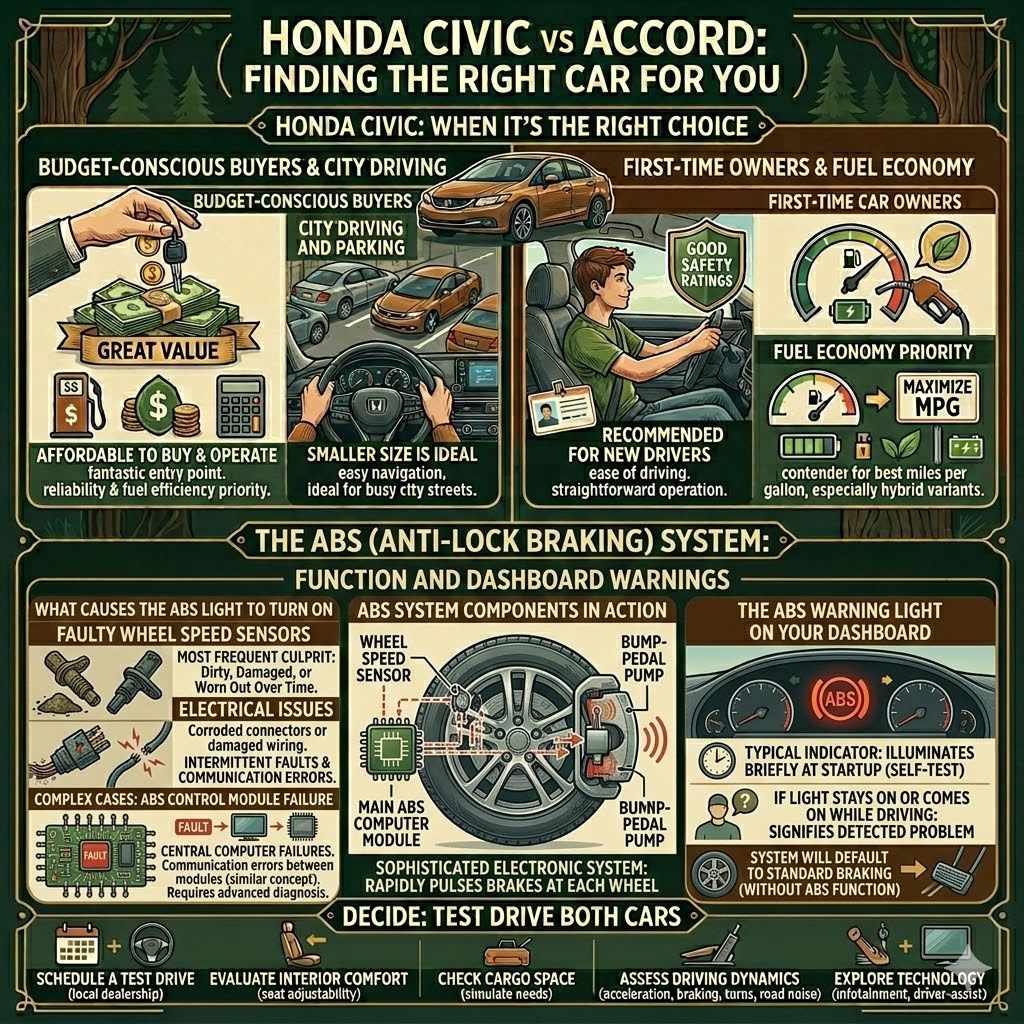
The Anti-lock Braking System, or ABS, is a sophisticated electronic system built into modern vehicles to enhance safety during braking. Its primary function is to prevent the wheels from locking up and skidding when a driver applies the brakes forcefully. When you slam on the brakes, the ABS system rapidly pulses the brakes at each wheel, allowing them to keep rotating.
This controlled pulsing helps the driver maintain steering control even during emergency stops, significantly reducing the risk of accidents.
The ABS light on your dashboard serves as an indicator for this system’s status. Typically, this light will illuminate briefly when you start your car as a self-test. If it stays on after the engine has started, or if it comes on while driving, it signifies that the ABS control module has detected a problem.
This problem could be with one of the wheel speed sensors, the ABS pump, the ABS control module itself, or the wiring that connects these components. The system will usually default to a standard braking mode, but without ABS functionality.
Several factors can cause the ABS light to come on. The most frequent culprits are faulty wheel speed sensors. These sensors can get dirty, damaged, or simply wear out over time.
Electrical issues, such as corroded connectors or damaged wiring, are also common. Sometimes, low brake fluid levels can trigger the ABS light, although this is less common for ABS-specific warnings. In more complex cases, the ABS control module, the central computer for the system, might have failed.
How ABS Relates to the Car Not Starting
It might seem strange that a problem with your braking system could prevent your car from starting. However, modern vehicles have complex electronic systems that are highly interconnected. The ABS control module, while primarily responsible for braking, communicates with other important electronic control units (ECUs) in your car.
One of these critical systems is the immobilizer system, which is designed to prevent the car from being stolen.
The immobilizer system requires a specific signal from a transponder chip in your key to allow the engine to start. If there’s an electrical fault within the ABS system, especially one that causes a short circuit or a communication error, it can sometimes interfere with the immobilizer’s ability to receive the correct signal or to communicate with the engine control unit (ECU). This interference can lead the car’s security system to believe an unauthorized attempt is being made to start the vehicle, thereby disabling the starter motor or fuel pump.
This is why the Honda Civic ABS Light On and Car Won’t Start is a specific issue that points towards a potential electronic communication problem. It’s not just a coincidence; the two symptoms are often linked by a common electronic or electrical malfunction. The car’s computer sees a critical error in the ABS and, as a safety measure or due to cascading electrical failure, prevents the engine from firing up.
Identifying the exact point of this interference is the key to solving the problem.
Common Causes for the ABS Light and No-Start Condition
Several specific issues can trigger both the ABS light and the inability to start your Honda Civic. Understanding these common causes helps in diagnosing the problem more efficiently. Often, the issue lies with the vehicle’s electrical system, which links various components together.
A failure in one area can cascade and affect others, leading to multiple warning lights and system malfunctions.
One of the most frequent reasons is a faulty wheel speed sensor. Each wheel has a sensor that tells the ABS module how fast that wheel is spinning. If one of these sensors is damaged, dirty, or its wiring is frayed, the ABS module receives incorrect or no information.
This fault will illuminate the ABS light. In some car models, a faulty wheel speed sensor can also send incorrect signals that confuse the engine control unit or immobilizer system, leading to a no-start situation.
Corroded or damaged wiring and connectors are another significant cause. The ABS system and its sensors are connected by a network of wires. Exposure to moisture, road salt, or physical damage can cause these connections to corrode or break.
A poor electrical connection can disrupt signals, triggering the ABS light and potentially preventing the car from starting by interrupting power or communication to critical systems like the immobilizer. This is especially common in areas with harsh weather conditions.
The ABS control module itself can also fail. This unit is essentially the brain of the ABS system. If it malfunctions due to water intrusion, electrical surge, or internal component failure, it can cause widespread issues.
A failing control module may send erroneous signals or fail to communicate with other ECUs, leading to the ABS light and, crucially, the car’s inability to start.
Finally, a weak or failing battery can sometimes manifest as ABS issues and starting problems. While not directly related to the ABS sensors, a low battery can cause erratic behavior in electronic systems. Insufficient voltage can prevent the ABS module from functioning correctly or communicating properly, and it will also directly prevent the engine from cranking over.
Therefore, a battery check is always a good first step.
Step-by-Step Diagnosis and Troubleshooting Guide
When your Honda Civic’s ABS light is on and the car won’t start, it’s time to go through a systematic diagnostic process. Don’t be intimidated; we’ll break it down into manageable steps. The goal is to isolate the problem to a specific component or system.
This methodical approach will save you time and potentially money by avoiding unnecessary part replacements.
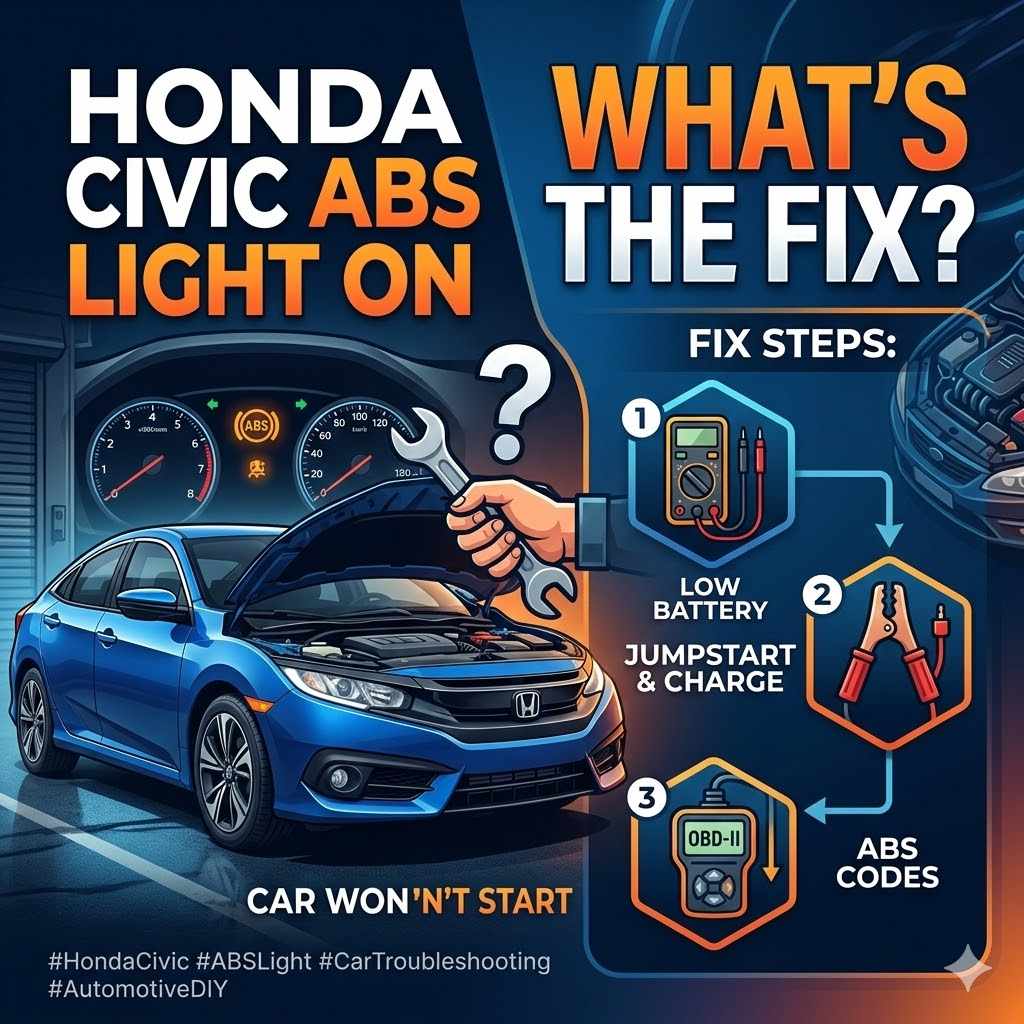
The first and simplest step is to check the battery. A weak battery is a common cause of many electrical gremlins in cars. Ensure the battery terminals are clean and tight.
If you suspect the battery might be the issue, you can try jump-starting the car or having the battery tested at an auto parts store. A healthy battery should provide around 12.6 volts when fully charged.
Next, inspect the ABS wheel speed sensors and their wiring. These sensors are usually located near the wheel hub. Look for any visible damage, such as cracks, loose connections, or debris covering the sensor.
Gently clean any dirt or corrosion you find around the sensors and connectors. Ensure the wiring is securely attached and not frayed or broken. This inspection requires getting under the car, so safety is paramount.
If visual inspection doesn’t reveal obvious issues, it’s time to consider using an OBD-II scanner. This diagnostic tool plugs into a port usually found under the dashboard. It can read error codes stored in the car’s computer.
Look for codes related to the ABS system (often starting with ‘C’ or ‘U’ codes) and any immobilizer or communication codes. The specific codes will give you a much clearer idea of where the problem lies. You can often find these codes explained online.
If you find specific ABS codes, like those indicating a particular wheel speed sensor failure, you can then focus your efforts on that component. If the codes point to a communication issue between modules, it could be a wiring problem, a failing module, or even an issue with the immobilizer system itself. For issues that are difficult to pinpoint, or if you’re uncomfortable working with car electronics, it’s best to consult a qualified mechanic.
Checking the Battery and Terminals
The battery is the heart of your car’s electrical system. If it’s weak or its connections are poor, many electronic systems can malfunction. This is why checking the battery is always the first step when troubleshooting starting issues and strange dashboard lights.
First, locate your car battery. It’s usually under the hood, but in some vehicles, it might be in the trunk or under a seat. Make sure the car is turned off and the parking brake is engaged.
Open the hood and identify the battery. You’ll see two terminals, usually marked with a ‘+’ for positive and a ‘-‘ for negative.
Next, inspect the terminals. Look for any signs of corrosion, which often appears as a white or bluish powdery substance. Corrosion can prevent electricity from flowing properly.
If you see corrosion, you’ll need to clean it. You can do this with a wire brush and a mixture of baking soda and water. Be careful not to get this mixture into the battery itself.
After cleaning, ensure the battery cables are securely tightened onto the terminals. Loose cables are a very common cause of starting problems. If the cables feel wobbly, tighten the clamps with a wrench.
A good connection is essential for consistent power delivery to all the car’s systems, including the starter and the ABS module.
If your battery is old (typically 3-5 years), it might just be failing. You can have it tested at most auto parts stores for free. They can tell you if it’s holding a charge and starting power adequately.
A simple voltage check with a multimeter can also give you a good indication. A healthy, fully charged battery should read around 12.6 volts.
Inspecting ABS Wheel Speed Sensors and Wiring
The wheel speed sensors are crucial components of the ABS system. Their job is to report the rotational speed of each wheel to the ABS control module. If a sensor is faulty, dirty, or its wiring is damaged, the ABS light will come on, and in some cases, it can affect other vehicle systems, including starting.
You’ll need to get your car safely elevated, either on a car lift or sturdy jack stands, to access the wheel speed sensors. They are typically located near the brake rotor or hub assembly on each wheel. Visually inspect each sensor.
Look for any obvious signs of damage, such as cracks in the plastic housing or a broken sensor wire.
Dirt and debris can sometimes accumulate on the sensor or its magnetic pickup ring, interfering with its signal. Gently clean the area around the sensor with a soft brush and some brake cleaner. Be careful not to damage the sensor itself during cleaning.
Next, examine the wiring that connects each sensor to the main ABS harness. Look for any signs of fraying, cuts, or corrosion on the wires or the connectors. If a connector is loose, try to reconnect it firmly.
Water and road salt can cause significant corrosion over time, especially in areas prone to harsh weather. Check for any signs of rodent damage to the wiring as well.
If you find a damaged sensor or wiring, this is likely your culprit. Replacing a wheel speed sensor is often a DIY-friendly job for those with some mechanical experience. The wiring may need to be repaired or replaced, which can be more complex.
If you’re unsure, consult a professional mechanic.
Using an OBD-II Scanner for Diagnostic Codes
An On-Board Diagnostics (OBD-II) scanner is an invaluable tool for modern car troubleshooting. When your Honda Civic’s ABS light is on and it won’t start, an OBD-II scanner can help pinpoint the problem by retrieving diagnostic trouble codes (DTCs) stored in the car’s computer.
First, locate the OBD-II port in your vehicle. It’s usually found under the dashboard, near the steering column. Plug the scanner into this port.
Turn the ignition key to the ‘ON’ position (without starting the engine) to power up the scanner and allow it to communicate with the car’s computer systems.
Follow the scanner’s instructions to read the codes. You’ll likely see a series of letters and numbers, such as “C1234” or “P0401.” Codes starting with ‘C’ usually relate to the chassis systems, which include the ABS. Codes starting with ‘P’ are for the powertrain (engine and transmission).
Codes starting with ‘B’ relate to the body systems, and ‘U’ codes are for network communication issues.
Once you have the codes, you can look them up online or in the scanner’s manual. Websites like OBD-Codes.com or forums dedicated to Honda Civics can provide detailed explanations of what each code means. For instance, a code like “C0022” might indicate an issue with the front left wheel speed sensor circuit.
Pay close attention to any codes related to the immobilizer system or communication errors between modules, as these can directly explain why the car won’t start. If you find multiple codes, address the most critical ones first, often those that are directly related to engine start or safety systems like ABS. If the codes are unclear or point to complex issues, it might be time to seek professional help from a mechanic.
Common Honda Civic ABS Light On and Car Won’t Start Scenarios
Let’s look at some typical situations that lead to the Honda Civic ABS light being on and the car refusing to start. These scenarios help illustrate how different components can cause this combined problem.
Scenario 1: A driver experiences a rough patch of road, and shortly after, the ABS light illuminates. The next time they try to start the car, it just clicks or doesn’t crank at all. This could point to a wheel speed sensor that was jolted loose or damaged by the rough terrain.
The disruption in the sensor’s signal triggers the ABS light, and in some models, this fault can prevent the immobilizer from recognizing the key, thus preventing the car from starting.
Scenario 2: After washing the car or driving through a deep puddle, the ABS light comes on. Then, the car won’t start. This suggests that water has entered a critical electrical connector, likely for the ABS system or a related module.
The moisture creates a short circuit or corrodes the connections, leading to the ABS warning and an interference with the starting system. Drying out the affected components might solve the issue.
Scenario 3: A car has been sitting for a long time, and when the owner tries to start it, the ABS light is on, and it won’t start. This could be due to a weak or dead battery that can no longer power all the electronic systems adequately. A low battery voltage can cause the ABS module to misbehave and also prevent the starter motor from engaging.
Even if the battery seems okay, a parasitic drain could be depleting it.
Scenario 4: The owner notices the ABS light has been intermittently on for a while. One day, the car just won’t turn over. This intermittent issue might have been a sign of a failing ABS control module or a loose connection that was eventually aggravated to the point of complete failure.
When the module’s communication completely breaks down, it can lock out the starting system.
Example Case Study: The Corroded Connector
A 2012 Honda Civic owner reported that their ABS light was on, and the car would not start. They had recently driven through heavy rain and a few minor floods. They decided to check the wiring harness connected to the ABS module, which is usually located near the master cylinder or firewall.
Upon careful inspection of the ABS module’s main electrical connector, they found significant green corrosion on several pins. This corrosion was the result of moisture ingress. The corroded pins were preventing proper electrical signals from passing through the connector to and from the ABS module, and also to other connected ECUs involved in the starting process.
The repair involved disconnecting the battery, carefully cleaning the corroded pins on both the module and the harness connector using electrical contact cleaner and a small brush, and then reconnecting them securely. After reassembling everything and reconnecting the battery, they turned the key. The ABS light went off, and the car started up immediately.
The key takeaway was that even minor water exposure could cause corrosion that impacted multiple systems.
Sample Troubleshooting Scenario
Let’s imagine you are facing the Honda Civic ABS Light On and Car Won’t Start problem. Here’s how you might approach it:
- Initial Check: Try starting the car again. Does it crank? Does it make any noise at all? Note any sounds or lack thereof. Check if interior lights or headlights are dim, which points to a weak battery.
- Battery Test: Inspect battery terminals for corrosion and tightness. If you have a multimeter, check the battery voltage. If it’s below 12 volts, the battery is likely the problem. If you don’t have a multimeter, attempt a jump start.
- Scan for Codes: If the battery seems okay or jump-starting doesn’t work, use an OBD-II scanner. Plug it in and retrieve any DTCs. Look for codes related to ABS sensors, ABS module, or immobilizer system.
- Wheel Speed Sensor Inspection: If codes point to a specific wheel speed sensor or its circuit, visually inspect that sensor and its wiring for damage or debris.
- Wiring Harness Check: If codes indicate a communication issue or if no specific sensor codes appear, check the main wiring harness connections, particularly those leading to the ABS module. Look for corrosion or loose connections.
- Professional Diagnosis: If you are unable to identify the problem after these steps, or if the issue seems complex (e.g., faulty ABS module, immobilizer fault), it is time to take the car to a trusted mechanic. They have specialized tools and expertise to diagnose and repair these issues.
Possible Solutions and Repairs
Once you’ve identified the cause of the Honda Civic ABS Light On and Car Won’t Start, you can move on to the appropriate solutions. The fix will depend entirely on what the diagnosis reveals.
For battery-related issues, the solution is straightforward. If the battery is weak, it needs to be replaced. If the terminals are corroded, they need to be cleaned and tightened.
A simple jump-start might get you going temporarily, but a failing battery requires replacement to ensure reliable starting and proper operation of all vehicle electronics.
If a wheel speed sensor is faulty, it will need to be
Damaged or corroded wiring requires repair or replacement. This might involve splicing in new wire sections, repairing connectors, or sometimes replacing entire sections of the harness. This can be a more complex job that may require professional attention, especially if the damage is extensive or in a hard-to-reach area.
Electrical contact cleaner is a vital tool for cleaning corroded connectors.
If the ABS control module is determined to be faulty, it will need to be
Sometimes, the problem is not with the ABS itself but with the immobilizer system. If an ABS fault is causing interference with the immobilizer, fixing the ABS issue might resolve the starting problem. However, if the immobilizer has its own fault, it will require separate diagnosis and repair, which often involves key programming or other electronic diagnostics.
Replacing a Faulty Wheel Speed Sensor
Replacing a wheel speed sensor is a common repair that can resolve ABS warning lights. The process involves accessing the sensor, disconnecting it, removing it, and installing a new one.
Tools you’ll likely need include a socket set, a wrench, possibly a torque wrench, and safety equipment like gloves and eye protection. You’ll also need the correct replacement sensor for your specific Honda Civic model.
First, ensure the car is safely supported on jack stands. Locate the faulty sensor, which is usually near the brake caliper or hub. You’ll see a wire running from it; follow this wire to its connector.
Unplug the connector. Then, you’ll typically find the sensor held in place by one or two bolts. Remove these bolts.
Carefully pull the old sensor out. It might be stuck, so a gentle wiggle or tap might be needed. Clean the mounting area on the hub before installing the new sensor.
Insert the new sensor and secure it with the bolts. Make sure to tighten them to the manufacturer’s specified torque if using a torque wrench.
Reconnect the electrical connector. Once everything is reassembled and the car is safely lowered, start the engine. The ABS light should now be off.
If it remains on, or if you encountered other issues, it’s advisable to have the system scanned for codes again.
When to Seek Professional Mechanic Help
While many car issues can be diagnosed and fixed at home, some problems require the expertise and specialized equipment that only a professional mechanic possesses. The Honda Civic ABS Light On and Car Won’t Start scenario is one of those times when professional help might be necessary.
If you’ve gone through the basic troubleshooting steps – checking the battery, visually inspecting sensors and wiring, and scanning for codes – and you’re still unsure about the cause, it’s time to consult a mechanic. Complex electrical issues, such as intermittent faults, communication errors between modules, or problems with the ABS control module or immobilizer system, are best left to professionals.
Mechanics have access to advanced diagnostic software that can provide more in-depth data and pinpoint specific system failures. They also have the tools and knowledge to safely handle components like ABS modules, which can be sensitive to improper handling. Additionally, if the repair involves specialized programming or calibration, a professional mechanic is essential.
Don’t hesitate to seek help if you feel overwhelmed or uncomfortable with any part of the diagnostic or repair process. Safety is paramount, and ensuring the repair is done correctly is crucial for your car’s reliability and your safety on the road. A qualified mechanic can quickly identify the root cause and perform the necessary repairs, saving you time, frustration, and potentially more costly mistakes.

Conclusion
When your Honda Civic ABS light stays on and the car won’t start, it’s usually an electrical or electronic issue. We’ve covered how faulty sensors, wiring problems, or control module failures can cause this. Checking the battery and cleaning connections are good starting points.
Using an OBD-II scanner can reveal specific trouble codes. Often, fixing a damaged sensor or repairing corroded wiring resolves the problem. If you’re unsure, a professional mechanic is the best resource for these complex systems.
Frequently Asked Questions
Question: Can a dead battery cause the ABS light to come on and the car not to start
Answer: Yes, a weak or dead battery can cause various electronic systems to malfunction, including the ABS system. Low voltage can lead to the ABS light illuminating and also prevent the engine from having enough power to crank and start.
Question: How do I know if my ABS wheel speed sensor is bad
Answer: A bad ABS wheel speed sensor typically causes the ABS warning light to illuminate on your dashboard. Diagnostic trouble codes read with an OBD-II scanner will often point to a specific sensor’s circuit or performance issue.
Question: Should I try driving my car with the ABS light on
Answer: While the car might still drive, it’s generally not recommended to drive extensively with the ABS light on. Your anti-lock braking system will not be functioning, which can be dangerous during emergency braking. It’s best to get the issue diagnosed and repaired promptly.
Question: How much does it typically cost to fix an ABS light issue
Answer: The cost can vary widely depending on the cause. Replacing a wheel speed sensor might cost between $150-$400, while replacing an ABS control module can range from $500-$1500 or more, including labor and programming.
Question: Is it possible for a simple fuse to cause both the ABS light and no-start issue
Answer: While a blown fuse can cause a single system to fail, it’s less common for one fuse to directly cause both the ABS light to be on and the car to refuse to start simultaneously, unless it’s a major fuse that powers multiple critical circuits.
Final Thoughts
The Honda Civic ABS light on and car won’t start scenario points to interconnected electronic issues. By systematically checking the battery, sensors, and wiring, or using a scanner, you can often pinpoint the problem. Addressing faulty components like sensors or damaged wires typically resolves the dual symptoms, restoring both braking safety and starting capability to your vehicle.