
Have you ever wondered about all the different lights on your car and why they are there? It’s a common question, especially for people new to driving or car care. Sometimes, it feels like there are too many buttons and functions to remember!
But don’t worry, understanding your car’s lights is simpler than it seems. This guide will walk you through everything you need to know, step by step. We’ll cover the basics and make sure you feel confident about using them correctly.
The Essential Role of Your Car’s Lights
Your car’s lights are vital safety features. They do more than just make your car visible; they help you see the road ahead and communicate your intentions to other drivers. This section explains the fundamental reasons why these lights exist and how they contribute to safer travels for everyone.
Understanding their purpose is the first step to using them effectively, ensuring you and others stay safe, especially in poor visibility conditions or at night.
Headlights Illuminating Your Path
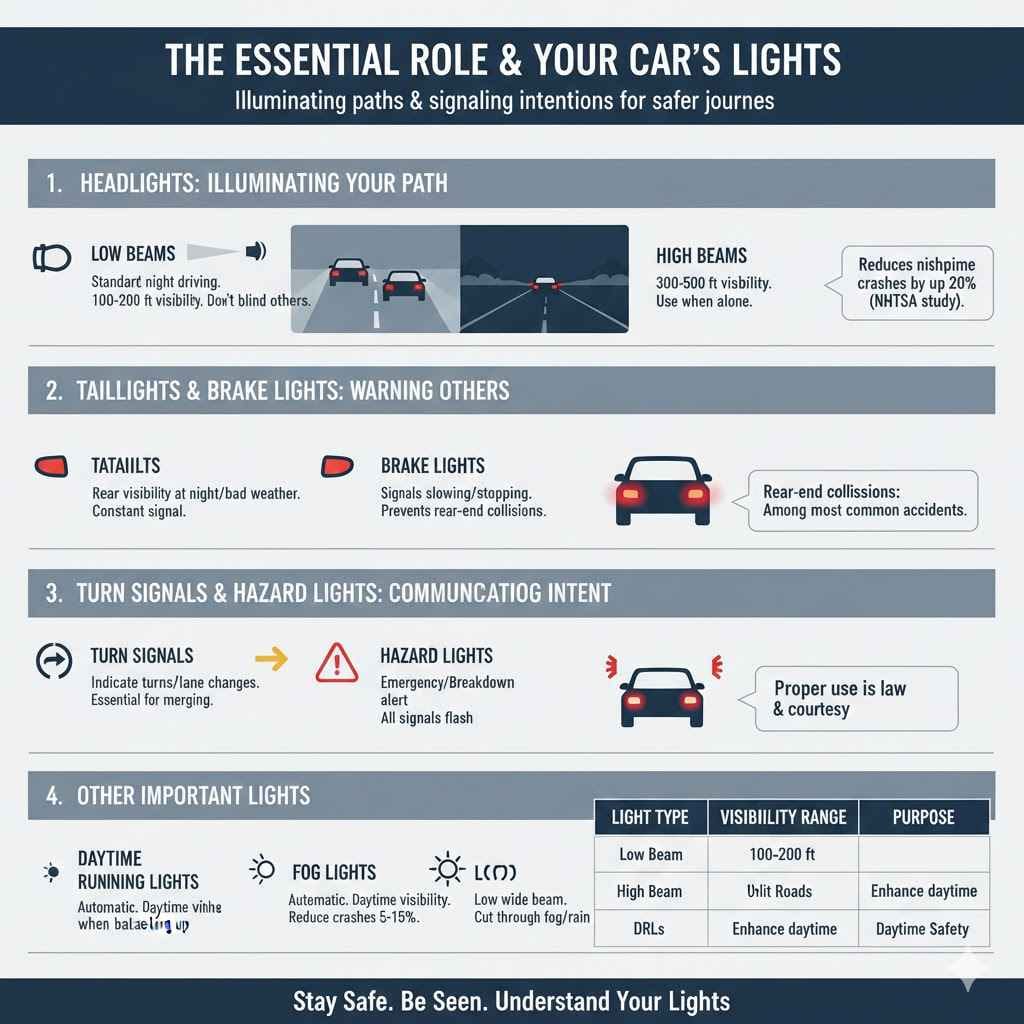
Headlights are probably the most obvious lights on your car. Their primary function is to light up the road in front of you, allowing you to see obstacles, road signs, and turns when it’s dark or visibility is low. They are essential for driving at night or in conditions like fog, rain, or snow.
Properly aimed and functioning headlights can significantly reduce the risk of accidents by providing ample warning of hazards.
- Low Beams: These are your standard headlights for normal nighttime driving. They illuminate the road ahead without blinding oncoming drivers. They are designed to provide sufficient light to see about 100 to 200 feet. Using low beams is crucial when you see another vehicle approaching or when you are following another car.
- High Beams: High beams are more powerful and shine further down the road, typically 300 to 500 feet. They are meant for driving in unlit rural areas or on highways with no other traffic. It is a legal requirement and a matter of courtesy to switch back to low beams when you encounter oncoming traffic or when following another vehicle.
The difference in illumination between low and high beams is substantial. Low beams are designed for general visibility without causing glare, while high beams are for maximum visibility in specific, low-traffic situations. Many modern cars also feature automatic high beams that adjust based on the surrounding light and traffic conditions, adding another layer of safety and convenience.
A study by the National Highway Traffic Safety Administration (NHTSA) found that adequate headlights can reduce nighttime crashes by up to 20%. This highlights the direct impact that functional and correctly used headlights have on road safety.
Taillights and Brake Lights Warning Others
Taillights and brake lights are equally important for safety. They ensure that other drivers can see your vehicle from behind. This is especially critical at night, during bad weather, or when you are stopped.
These lights serve as constant signals of your presence and as clear indicators of your actions.
- Taillights: These are the red lights at the rear of your vehicle that are always on when your headlights or parking lights are activated. They make your car visible to drivers approaching from behind, allowing them to judge your distance and speed.
- Brake Lights: These are brighter red lights that illuminate when you press the brake pedal. Their purpose is to signal to drivers behind you that you are slowing down or stopping. This is a critical communication tool that prevents rear-end collisions.
The color and brightness of brake lights are standardized to ensure they are easily distinguishable. A malfunctioning brake light can be dangerous, as it removes a key signal that other drivers rely on. Many vehicles now use LED brake lights, which illuminate much faster than traditional bulbs, providing a crucial fraction of a second’s warning time to following drivers.
Statistics show that rear-end collisions are among the most common types of car accidents. The clear signaling provided by functioning brake lights is a primary factor in reducing their occurrence. When your brake lights are working correctly, you are actively contributing to the safety of everyone on the road.
Turn Signals and Hazard Lights Communicating Intent
Turn signals and hazard lights are your car’s communication devices for specific maneuvers. They tell other drivers what you plan to do next, allowing them to react accordingly and avoid potential conflicts. Proper use of these signals is a fundamental aspect of defensive driving and courteous road behavior.
- Turn Signals (Indicators): These are the flashing amber or red lights, usually at the front and rear corners of your car, that indicate your intention to turn left or right. You should activate your turn signal well in advance of making the turn, giving other drivers time to adjust.
- Hazard Lights (Emergency Flashers): These are the red flashing lights that activate all turn signals simultaneously. They are used to alert other drivers to a hazard, such as a breakdown, a stopped vehicle in the travel lane, or when you need to pull over in an emergency.
Using turn signals is not just polite; it’s often a legal requirement. Failing to signal can lead to confusion and accidents. Hazard lights are reserved for genuine emergencies; using them unnecessarily can desensitize other drivers to their important warning signal.
For example, if you are merging into traffic on a highway, your turn signal is crucial for letting other drivers know you intend to change lanes. In situations where you must stop unexpectedly on the side of a busy road, turning on your hazard lights immediately alerts approaching vehicles to your presence and the potential danger.
Other Important Car Lights
Beyond the main lights, your car has several other important lights that serve specific functions, often related to visibility, safety, and vehicle operation. Understanding these lesser-known lights can help you maintain your car and drive more safely.
- Parking Lights: These are the front white and rear red lights that are less bright than headlights and taillights. They are used when parking on a street at night where headlights are not needed but some visibility is still required. They also act as a warning to other drivers if you are parked in a less visible area.
- Reverse Lights: These white lights illuminate at the rear of your car when you shift into reverse. They serve two main purposes: to illuminate your path when backing up and to signal to others that you are moving backward.
- Daytime Running Lights (DRLs): Many modern cars are equipped with DRLs, which are lights that stay on automatically when the engine is running. They are typically less bright than low beams and are designed to make your vehicle more visible to others during daylight hours, reducing the risk of daytime collisions.
- Fog Lights: These are typically located below the main headlights and are designed to cut through fog, mist, or heavy rain. They emit a wide, flat beam that stays close to the ground, illuminating the road surface without reflecting back into the driver’s eyes from the dense moisture.
Fog lights can be particularly useful in adverse weather conditions where standard headlights might be less effective due to light scattering off the water droplets. Using them judiciously, only when needed, ensures they provide the maximum benefit without causing unnecessary glare.
Here’s a look at the visibility ranges for different lights:
| Light Type | Typical Visibility Range | Purpose |
|---|---|---|
| Low Beam Headlights | 100-200 feet | Standard nighttime illumination, avoid glare |
| High Beam Headlights | 300-500 feet | Maximizing visibility on unlit roads |
| Taillights | Visible from behind | Make vehicle presence known |
| Brake Lights | Visible from behind | Signal stopping or slowing |
| DRLs | Enhance daytime visibility | Increase conspicuity to others |
The statistics regarding DRLs are compelling. Research indicates that DRLs can reduce daytime crashes involving vehicles by approximately 5-15%. This demonstrates their effectiveness in improving road safety during daylight hours, a time when many drivers might not expect potential hazards.
Understanding the Mechanics and Technology
Behind every light on your car is a system designed for reliability and safety. This section explores the technology that powers these lights, from traditional bulbs to modern LEDs, and how they are controlled. Knowing a bit about the mechanics can help you appreciate their function and understand basic troubleshooting.
Traditional Halogen Bulbs
Halogen bulbs are a common type of headlight and taillight bulb. They work by passing an electric current through a tungsten filament enclosed in a glass bulb filled with halogen gas. This process heats the filament, causing it to glow and produce light.
Halogen bulbs are relatively inexpensive and have been a standard for many years.
The halogen gas inside the bulb helps to redeposit evaporated tungsten back onto the filament. This process, known as the halogen cycle, extends the life of the filament compared to older incandescent bulbs. However, the filament can still break under vibration or if the bulb is handled improperly when hot.
A significant characteristic of halogen bulbs is their warmth. They produce a yellowish light, which can sometimes be less effective at penetrating fog or rain compared to brighter, whiter lights. Despite this, they remain a reliable and widely available lighting solution.
The Rise of LED Technology
Light Emitting Diodes (LEDs) are now a dominant force in automotive lighting. LEDs are semiconductor devices that emit light when an electric current passes through them. They offer numerous advantages over traditional bulbs, including much longer lifespans, lower energy consumption, and brighter, more focused light.
LEDs also provide an almost instant on-off capability, which is particularly beneficial for brake lights. This instant illumination gives following drivers more time to react, potentially preventing accidents. Furthermore, LEDs generate less heat, contributing to greater efficiency and reduced strain on the vehicle’s electrical system.
The light produced by LEDs is typically whiter and can be tuned to various color temperatures, offering improved visibility and clarity for drivers. Their compact size also allows for more flexible and aerodynamic vehicle designs. Many modern luxury and performance vehicles, as well as an increasing number of mainstream models, feature full LED lighting systems.
An interesting statistic is that LEDs can last up to 25 times longer than traditional halogen bulbs. This means fewer replacements and less maintenance over the vehicle’s lifetime, making them a more sustainable and cost-effective option in the long run.
Understanding Your Car’s Lighting Controls
Your car’s dashboard houses the controls for its lighting system. Familiarizing yourself with these controls is essential for proper operation. Most modern cars have a steering column stalk or a panel near the dashboard for managing your lights.
Typically, you will find a dial or lever that allows you to select between off, parking lights, automatic (if equipped), and headlights. The headlight control often has positions for low beams and high beams, with a separate switch or a push/pull function on the stalk to toggle between them. Some systems also include controls for fog lights and hazard lights.
Automatic headlight systems are becoming increasingly common. These systems use sensors to detect ambient light levels and will automatically turn your headlights on when it gets dark and off when it becomes light. This feature adds a layer of convenience and ensures your lights are on when needed without manual intervention.
Here’s a simple breakdown of common control symbols:
- Headlight Symbol: Usually a stylized beam of light pointing forward.
- Green Headlight Icon: Often indicates low beams are active.
- Blue Headlight Icon: Typically signifies high beams are engaged.
- “Auto” Setting: For automatic headlight operation.
- “A” inside a circle: Common symbol for automatic headlights.
- Hazard Light Symbol: A red triangle, often found on the dashboard.
It’s important to know that using your headlights correctly is a fundamental aspect of road safety. For instance, driving on unlit roads without headlights is incredibly dangerous, reducing your reaction time significantly. In a simulated driving test, drivers using headlights during dusk conditions were found to react to obstacles 1.5 seconds faster than those without.
This small time difference can be the key to avoiding an accident.
Common Issues and Maintenance Tips
Like any part of your car, lights can experience issues. Regular maintenance and awareness of common problems can keep your car’s lighting system in top shape, ensuring your safety and the safety of others. Addressing small issues promptly can prevent larger, more costly repairs down the line.
Dealing with Burned-Out Bulbs
The most common lighting issue is a burned-out bulb. Whether it’s a headlight, taillight, brake light, or turn signal, a failed bulb needs to be replaced. The process for replacing bulbs varies greatly depending on the car model and the specific light fixture.
Many modern cars have designed their lighting systems for easier access to bulbs. However, on some vehicles, replacing a headlight bulb might require removing other components. It’s always a good idea to consult your car’s owner’s manual for specific instructions.
If you are uncomfortable performing the replacement yourself, a mechanic can do it quickly.
It’s often recommended to replace bulbs in pairs. For instance, if one headlight bulb burns out, it’s wise to replace the other one at the same time. This is because bulbs have a similar lifespan, and the other bulb may be close to burning out as well.
Replacing them together ensures consistent brightness and color for both lights.
Maintaining Fog Lights and DRLs
Fog lights and Daytime Running Lights (DRLs) require their own attention. Fog lights, in particular, can be exposed to road debris and moisture, which can affect their performance. It’s good practice to periodically check that they are clear and functioning correctly.
DRLs are designed to be maintenance-free for the most part, as they are usually integrated into the headlight or marker light assemblies. However, their brightness and aim can still be affected by issues with the vehicle’s electrical system or the light fixture itself. If you notice your DRLs are dim or not working, it’s worth getting them checked.
When using fog lights, remember they are for specific conditions. Using them on clear nights can be distracting to other drivers and may even be illegal in some areas. Their intended purpose is to improve visibility in adverse weather by providing a lower, wider beam.
Ensuring Proper Aiming and Brightness
The aiming of your headlights is critical for safe driving. If headlights are aimed too low, they won’t illuminate the road sufficiently. If they are aimed too high, they can blind oncoming drivers and reduce your visibility of the road immediately in front of you.
Most vehicles have adjustment screws near the headlight assembly that allow for aiming adjustments. This is a task that can be done at home with proper tools and a flat surface, or it can be performed by a mechanic during routine service. Some states have vehicle inspection requirements that include checking headlight aim.
Brightness is also important. While LEDs are generally brighter than halogens, a dirty lens or a failing bulb can reduce light output. Keeping headlight lenses clean with a polishing kit can restore clarity and brightness.
If you have a car with older technology, and the bulbs seem dimmer than they used to, it might be time for a replacement, even if they haven’t completely burned out.
A properly aimed headlight system can increase the effective range of your low beams by up to 100 feet. This extended visibility allows you to react to hazards much sooner. For example, if a deer jumps onto the road 200 feet away, with properly aimed headlights, you might have an extra 2-3 seconds to brake compared to poorly aimed lights.
Troubleshooting Common Indicator Lights
Your car’s dashboard has various warning lights, and some relate to the lighting system. For instance, a warning light might illuminate if a taillight or brake light has failed, or if there’s an issue with the automatic headlight system. These lights are designed to alert you to potential problems.
If you see a warning light related to your lights, it’s important not to ignore it. Consult your owner’s manual to understand what the specific light means. Often, it indicates a bulb that needs replacing or a sensor that might be malfunctioning.
Addressing these issues promptly ensures your car’s safety features remain fully operational.
Consider this scenario: you press the brake pedal, and a dashboard light comes on indicating a brake light failure. This is a critical alert. Without functioning brake lights, other drivers might not know you are slowing down, significantly increasing the risk of a rear-end collision.
Acting quickly to replace the faulty bulb is paramount.
What Is the Purpose of Your Car’s Lights? In Practice
Putting all this knowledge into practice is what truly matters. This section focuses on how understanding the purpose of your car’s lights translates into safer driving habits and better vehicle maintenance. Applying these principles makes you a more confident and responsible driver.
Night Driving Safety
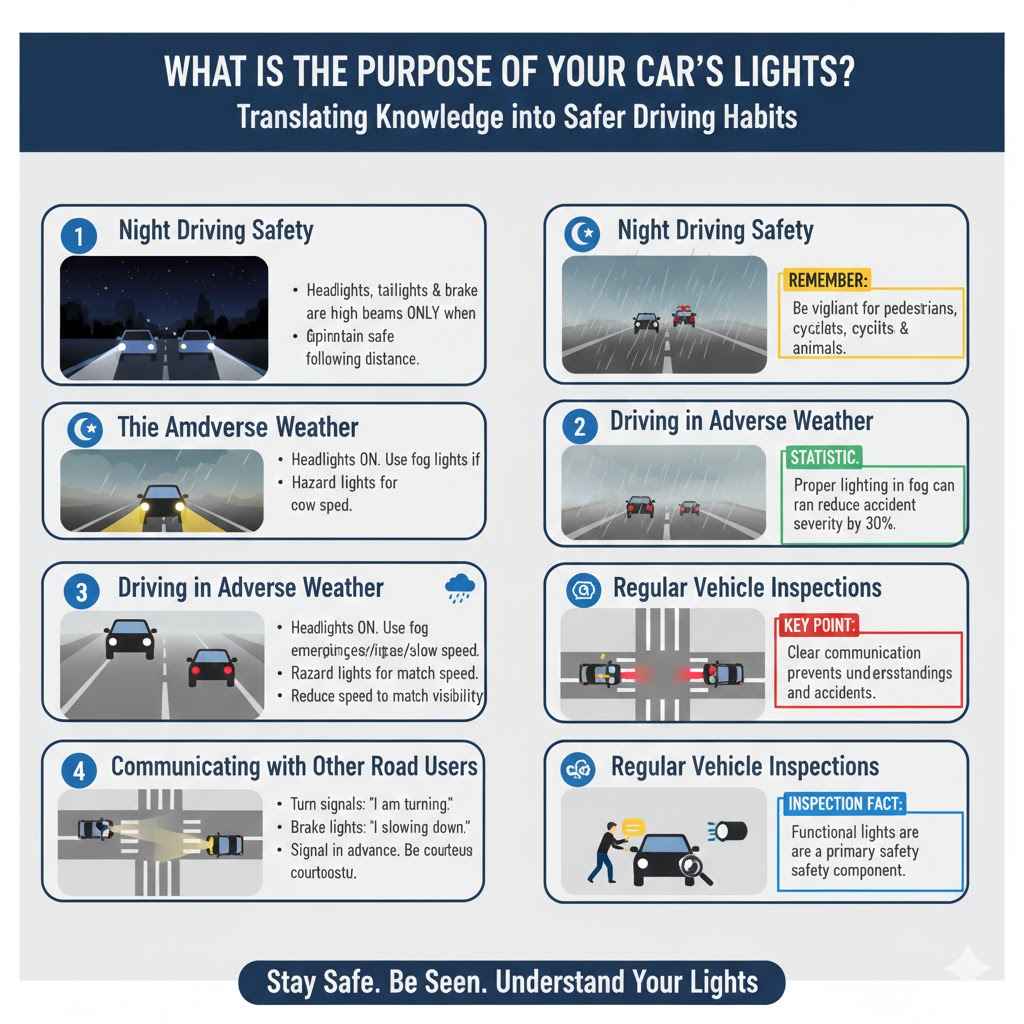
Night driving presents unique challenges due to reduced visibility. Your headlights, taillights, and brake lights are your primary tools for navigating safely in the dark. Always ensure your headlights are on when visibility is low, and use high beams only when appropriate.
When driving at night, be extra vigilant for pedestrians, cyclists, and animals that may be harder to see. Your headlights help you spot them from a distance, but your reactions are still key. Also, be aware of other drivers’ lights; if an oncoming car has bright headlights, it’s a sign they may be using high beams, and you should switch to low beams.
A good practice is to maintain a safe following distance from the vehicle in front of you. This gives you more time to react if they brake suddenly, and your brake lights will signal your own intentions clearly.
Driving in Adverse Weather
Rain, fog, snow, and even dust storms drastically reduce visibility. In these conditions, using your lights correctly is not just about seeing; it’s about being seen. Always turn on your headlights, and consider using your fog lights if your vehicle is equipped with them and visibility is severely impaired.
Hazard lights should be used if you need to stop or are driving at a significantly reduced speed due to weather. This alerts other drivers to slow down and exercise caution. Remember that even with fog lights, visibility can still be limited, so reducing your speed is crucial.
For example, during a dense fog advisory, driving at the posted speed limit with only headlights on can be extremely dangerous. Using fog lights, if available, and significantly reducing speed to match your visibility range is a much safer approach. Statistics show that using appropriate lighting in fog can reduce the severity of accidents by up to 30%.
Communicating with Other Road Users
Your car’s lights are a language. Turn signals say “I am turning.” Brake lights say “I am slowing down.” Hazard lights say “There is a problem, be careful.” Using these signals effectively is crucial for preventing misunderstandings and accidents.
A common scenario: you are at an intersection, and a car approaches with its left turn signal flashing. You know that car intends to turn left and you should proceed straight if you have a green light, or yield if you are turning right. This clear communication prevents confusion and potential collisions.
Always signal your intentions in advance, especially when changing lanes or turning. This courtesy gives other drivers the time they need to adjust their driving, making the road safer for everyone.
Regular Vehicle Inspections
Making it a habit to check your car’s lights regularly is a simple yet effective maintenance practice. Before you start driving, a quick walk-around can reveal a burned-out bulb or a dirty lens. This can be part of your pre-drive routine.
When you get your car serviced, always ask the mechanic to check your lights, including aiming and brightness. Many vehicle inspections, whether for registration or just routine maintenance, will include a check of the lighting system. Ensuring all lights are functioning correctly is a key part of keeping your vehicle roadworthy and safe.
Consider a scenario where your state requires annual safety inspections. One of the first things inspectors check is your vehicle’s lighting system. This is because functional lights are considered a primary safety component.
Failing to have all lights working correctly can result in your vehicle failing inspection, preventing you from registering it.
Frequently Asked Questions
Question: What is the most important purpose of car lights
Answer: The most important purpose of car lights is to ensure safety by allowing drivers to see the road ahead and by making the vehicle visible to other road users, especially during nighttime or in poor visibility conditions.
Question: Do daytime running lights use a lot of power
Answer: No, daytime running lights (DRLs) use very little power, especially if they are LED-based, which are highly energy-efficient.
Question: When should I use my hazard lights
Answer: You should use your hazard lights to indicate a problem, such as a vehicle breakdown, when stopped in a dangerous location, or when driving at a significantly reduced speed due to emergency conditions.
Question: Can I drive with one headlight out
Answer: It is generally unsafe and often illegal to drive with one headlight out, as it significantly reduces your visibility and makes your vehicle less visible to others.
Question: How often should I check my car’s lights
Answer: It’s a good idea to check your car’s lights at least once a month, or before long trips, to ensure all bulbs are working correctly and lenses are clean.
Conclusion
Your car’s lights are more than just illuminating bulbs; they are critical safety devices. They help you see, help others see you, and communicate your intentions on the road. By understanding the purpose of each light and performing simple checks, you enhance your safety and the safety of everyone around you.