
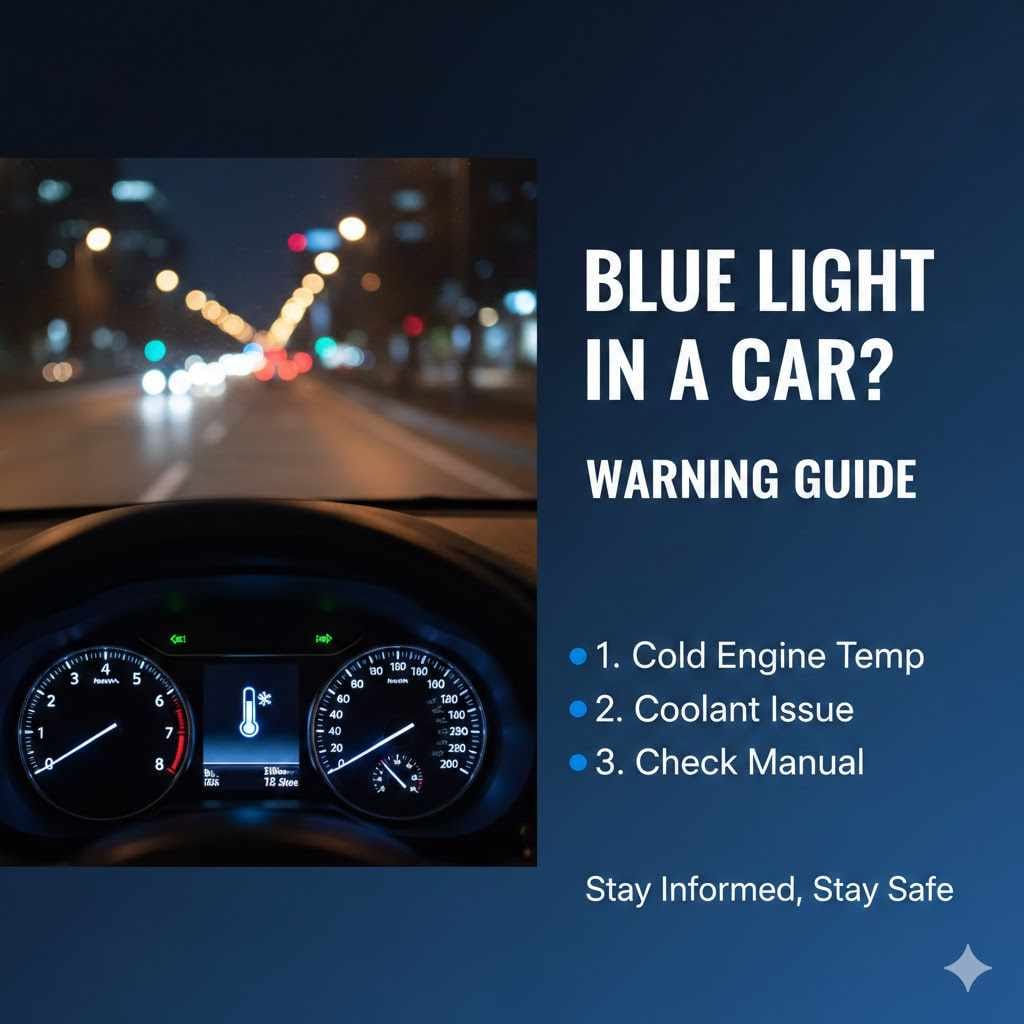
Seeing a blue light on your car’s dashboard can be confusing, especially if you’re new to driving. It’s not always a clear sign of trouble, but it’s good to know what it means. Many drivers wonder, What Does Blue Light Mean in a Car?
Warning Guide is a common question that pops up. Don’t worry; this guide will break it down simply. We’ll go step-by-step to help you understand these lights and what to do.
Understanding Blue Light Meanings In Your Car
The blue light on your car’s dashboard is a crucial indicator, though its meaning can vary. It’s not always a serious alert, but it’s always important to pay attention. This section will explore the most common reasons for a blue light to appear.
We will cover what this light typically signifies and why it’s important to recognize it.
The High-Beam Headlight Indicator
One of the most frequent meanings of a blue light on your dashboard is that your high-beam headlights are on. This is a standard symbol found in most vehicles. When you see this blue icon, usually shaped like a headlight with lines pointing forward, it tells you that your bright headlights are active.
These lights are designed for driving in the dark on unlit roads and help you see much farther ahead. However, it’s important to remember to switch them off when other cars are approaching or when you are driving in fog or heavy rain. Using high beams inappropriately can blind other drivers and is a safety hazard.
The high-beam indicator is typically blue to distinguish it from other warning lights. Its simplicity makes it easily recognizable. When you activate your high beams, this light illuminates.
Conversely, when you switch them off, the light will turn off. Understanding this basic function is the first step in deciphering your car’s dashboard signals.
Consider this scenario: You are driving on a dark country road late at night. You want to improve your visibility, so you switch on your high-beam headlights. Immediately, the blue light on your dashboard appears.
This is a confirmation that your high beams are on, and you can now see further down the road. As you approach an oncoming car, you remember to switch back to your low beams, and the blue light disappears from your dashboard.
Why is the high-beam indicator usually blue?
The color choice for indicator lights in cars is not random. Manufacturers often use specific colors to convey different types of information. Blue and green lights are generally used for informational purposes, indicating that a system is active or functioning correctly.
Red lights, on the other hand, usually signal a warning that requires immediate attention. Yellow or amber lights typically suggest a caution or a condition that needs to be checked soon. For the high-beam indicator, blue is chosen because it represents the bright, forward-facing nature of the lights without signaling a problem.
It’s a simple status indicator.
Other Less Common Blue Light Meanings
While the high-beam indicator is the most common, there are a few other instances where a blue light might appear. These are less frequent and can depend on the specific make and model of your car. It’s always best to consult your car’s owner’s manual for the most accurate information.
Some vehicles might use a blue light to indicate that a specific safety feature is active, such as advanced cruise control or lane-keeping assist. These are often sophisticated driver-assistance systems. When these systems are engaged, a blue light might illuminate to confirm their operation.
This helps the driver know that the car is actively assisting them. For example, if your car has adaptive cruise control and it’s active, you might see a blue symbol on your dashboard indicating this.
In rare cases, a blue light could be part of a more complex system. For instance, some hybrid or electric vehicles might use blue indicators for their power systems or charging status. These are specific to those types of vehicles.
If you are unsure, the owner’s manual is your best resource for demystifying any dashboard light.
Examples of less common blue lights
One example could be a blue snowflake symbol. This often appears on cars with climate control systems or in colder regions. It indicates that the outside temperature has dropped to a point where there might be icy conditions.
This is a warning about potential hazards on the road due to ice. Another possibility is a blue light related to a specific vehicle system that is functioning normally but has a unique indicator. For example, some cars may have a blue light that indicates the adaptive front lighting system is active, which helps to illuminate curves as you turn.
Here’s a quick look at what different colored lights might mean in general:
| Color | General Meaning | Example |
|---|---|---|
| Blue | Informational or System Active | High-beam headlights, specific driver assistance |
| Green | System Active or Operational | Turn signals, cruise control engaged |
| Yellow/Amber | Caution or Needs Attention | Low fuel, check engine light (less severe) |
| Red | Warning or Serious Issue | Brake system failure, engine overheating |
What To Do When You See a Blue Light
Seeing any light on your dashboard can cause a moment of concern. However, with a blue light, it’s often a straightforward matter of awareness rather than immediate panic. The key is to understand what the light is telling you and act accordingly.
This section focuses on the practical steps you should take when a blue light appears on your car’s dashboard. We’ll guide you through assessing the situation and making sure you drive safely.
Identify the Specific Blue Light Symbol
The first and most important step is to look closely at the dashboard and identify the exact symbol associated with the blue light. Most modern cars have a collection of icons that illuminate. Your car’s manual will have a diagram of the dashboard, showing each symbol and its meaning.
Take a moment to find this section in your owner’s manual. It’s like a secret decoder ring for your car.
For instance, if the blue light looks like a headlight with lines, you know it’s your high beams. If it’s a different shape, like a steering wheel with lines, it might indicate a driver-assist feature. The shape and context are crucial.
If you’re driving and see the blue light, try to recall what action you just performed, such as turning on your headlights or engaging a specific driving mode. This will often give you a clue.
Many cars also have a small digital display that can provide text-based information when a light comes on. Check this display for any messages. Sometimes, the car will tell you directly, like “High Beams On.” This makes identification much simpler.
Common blue light symbols and their meanings
- High-Beam Headlights: Typically a blue circle with lines pointing forward, indicating your bright headlights are active.
- Adaptive Front-Lighting System (AFS): May appear as a blue headlight symbol with curved lines, showing the system that adjusts headlights to your steering is active.
- Fog Lights (Front): In some vehicles, front fog lights might have a blue indicator, especially if they are integrated with the headlight system.
- Specific Driver Assistance Systems: Symbols vary widely but might be a blue steering wheel, a car with lines, or a blue radar wave, indicating features like lane keeping assist or adaptive cruise control are engaged.
Each of these symbols tells a different story. The high-beam symbol is for visibility. The AFS symbol is about improving vision around corners.
Driver assistance symbols are about the car helping you maintain speed or stay in your lane. Knowing the symbol is key to knowing what to do.
Consult Your Owner’s Manual
Your car’s owner’s manual is the ultimate authority on what every single light and symbol means. It’s designed specifically for your vehicle’s dashboard. If you see a blue light and aren’t sure what it means, pulling over safely and consulting the manual is the best course of action.
Most manuals are organized by section, with a dedicated part for dashboard lights and indicators.
Locate the section on dashboard warning lights. You’ll usually find an illustration of the dashboard with all the possible symbols labeled. Find the blue symbol you’re seeing, and it will clearly state its purpose.
This step is non-negotiable for complete understanding. It’s better to be sure than to guess, especially when it comes to your car’s functions.
If you don’t have a physical copy of your owner’s manual, don’t worry. Most manufacturers provide digital versions on their websites. You can often download a PDF version to your phone or tablet.
Keep this digital copy handy for easy access. It’s a wealth of information that can save you time and worry.
Where to find your owner’s manual
You can usually find your owner’s manual in a few places:
- Glove Compartment: This is the most common place for the physical manual.
- Manufacturer’s Website: Search for your car’s make and model on the official website. Look for a “Owners” or “Support” section.
- Online Automotive Forums: Sometimes, other owners share digital copies if you cannot find it elsewhere.
Having your owner’s manual readily available empowers you to understand your vehicle better. It’s a tool for safe driving and proper car maintenance.
When to Seek Professional Help
While most blue lights are simple indicators, there are rare occasions when a blue light might signal a more technical issue. If the blue light is accompanied by other warning lights, unusual noises, or a change in the car’s performance, it’s time to seek professional help. Don’t ignore these signs.
For example, if the blue high-beam indicator stays on even when the headlights are off, or if another blue light appears that isn’t explained in the manual, it could indicate an electrical problem. A malfunctioning sensor or a wiring issue could be the cause. These problems often require specialized tools and knowledge to diagnose and fix correctly.
A qualified mechanic will be able to identify the root cause and perform the necessary repairs.
Remember, your car’s safety systems are complex. If you suspect something is wrong, it’s always better to err on the side of caution. A visit to your mechanic can prevent minor issues from becoming major, expensive repairs down the line.
They can also confirm if a particular blue light is indeed functioning as expected or if there’s an underlying fault.
Signs that indicate a need for a mechanic
- Persistent Blue Light: The blue light remains on when it should not be. For example, the high beam indicator stays on with low beams.
- Multiple Warning Lights: The blue light appears along with red or yellow warning lights.
- Change in Performance: The car behaves unusually, such as making strange noises, losing power, or having steering issues.
- Unexplained Blue Light: The blue light appears, and you cannot find any explanation for it in your owner’s manual.
These situations warrant a visit to a professional mechanic. They have the expertise to diagnose and fix any underlying issues.
The Importance of Knowing Your Car’s Lights
Understanding what the lights on your dashboard mean is a fundamental part of being a responsible driver. It’s not just about knowing when something is wrong; it’s also about knowing when everything is working as it should. This knowledge contributes significantly to your safety and the safety of others on the road.
Let’s explore why this is so important and how it enhances your driving experience.
Ensuring Road Safety
The primary reason for understanding your car’s dashboard lights is to ensure road safety. Lights are your car’s way of communicating with you. A blue light indicating high beams means you need to be mindful of oncoming traffic.
If it were a red light, like a brake system warning, it would signal an immediate need to stop and address a potentially dangerous situation. Prompt recognition and response to these signals can prevent accidents.
For example, if you accidentally leave your high beams on while driving in a city, the blue indicator reminds you to switch them off. This prevents blinding other drivers, which could lead to them losing control of their vehicle. This simple act of awareness, prompted by the blue light, directly contributes to safer roads for everyone.
Consider the scenario where a driver is on a highway at night and sees a red brake warning light. If they ignore it because they don’t understand its seriousness, they could be driving with compromised brakes. This is a high-risk situation.
Conversely, recognizing a blue high-beam light and switching it off is a low-risk action that has a high safety benefit.
Statistics on driver awareness
While specific statistics for blue light awareness are rare, general driver awareness of warning lights is crucial. A study by the National Highway Traffic Safety Administration (NHTSA) found that driver distraction, which includes not paying attention to dashboard signals, is a contributing factor in many accidents. While not directly about blue lights, it highlights the importance of being attentive to all vehicle indicators.
A survey conducted by AAA showed that a significant percentage of drivers admitted to not knowing the meaning of all the dashboard warning lights in their vehicle. This gap in knowledge can lead to delayed responses to critical issues.
Maintaining Your Vehicle
Dashboard lights are not just about immediate safety; they are also key to proactive vehicle maintenance. While a blue light often signifies a system is active, if it behaves unexpectedly or persists when it shouldn’t, it could point to an underlying issue that, if left unaddressed, could lead to more significant problems and costly repairs. Regular checks and understanding these indicators help in maintaining your vehicle’s health.
For instance, if the blue indicator for a driver-assist system remains on constantly, even when the system is off, it might suggest a fault in that system’s electronics. Addressing this early could prevent it from affecting other parts of the car’s electrical system or failing when you need it most. It’s like noticing a small leak in your roof; fixing it early prevents extensive water damage.
Think of it this way: your car is a complex machine. The dashboard lights are its communication system. By learning to listen to what these lights are saying, you can catch minor issues before they escalate into major repairs.
This saves you money in the long run and ensures your car remains reliable.
Proactive maintenance benefits
- Reduced Repair Costs: Catching small issues early prevents them from becoming expensive problems.
- Increased Vehicle Lifespan: Proper maintenance ensures your car lasts longer.
- Improved Reliability: Your car is less likely to break down unexpectedly.
- Better Resale Value: A well-maintained car with a documented service history fetches a higher price when you decide to sell it.
Paying attention to all dashboard lights, including the blue ones, is a wise investment in your vehicle.
Improving Your Driving Experience
Knowing what your car is telling you through its lights can significantly improve your overall driving experience. When you understand your dashboard, you feel more in control and less anxious. This confidence allows you to focus on the road and enjoy your journey, rather than wondering about a mysterious light.
Imagine driving on a long road trip. You see the blue high-beam indicator light up. You immediately know it’s your high beams and check if you need to dim them.
This quick, confident action prevents potential issues with other drivers and keeps your focus on the road ahead. You can relax knowing you’re managing your car’s functions correctly.
Understanding your car also means you can utilize its features more effectively. If a blue light indicates a driver-assist system is active, you can trust that system to help you, making your drive easier and potentially safer. It transforms driving from a passive activity to an interactive one where you are in tune with your vehicle.
Scenarios where light knowledge helps
- Night Driving Safety: You’re driving at night and see the blue high-beam indicator. You correctly dim your lights for oncoming traffic, ensuring everyone’s safety and avoiding a glare problem.
- Utilizing Features: You’re on the highway and a blue light illuminates, indicating adaptive cruise control is active. You understand this system will help maintain your speed and distance, allowing you to relax your focus slightly while remaining attentive.
- Peace of Mind: You see a blue light on startup, and you recognize it as the high-beam indicator, which then turns off as expected. This confirms your car is functioning normally, giving you peace of mind.
Frequently Asked Questions
Question: What does a blue light mean on a car dashboard in general?
Answer: In most cars, a blue dashboard light is informational. It typically indicates that a system is active or functioning correctly, such as your high-beam headlights. It’s not usually a warning of a problem.
Question: Is a blue light on my car dashboard a cause for alarm?
Answer: Generally, no. Blue lights are usually indicators that something is on or active, like high beams. However, if it appears unexpectedly or with other warning lights, it’s wise to check your owner’s manual.
Question: What is the most common blue light meaning in a car?
Answer: The most common blue light on a car dashboard signifies that the high-beam headlights are switched on. This is a standard symbol across many vehicle makes and models.
Question: Can a blue light indicate a serious problem with my car?
Answer: While rare, a blue light could be part of a more complex system alert. If it’s accompanied by other warning lights, unusual noises, or performance issues, consult your owner’s manual or a mechanic.
Question: How do I know for sure what a specific blue light means in my car?
Answer: The best way to know for sure is to consult your car’s owner’s manual. It will have a detailed guide to all dashboard symbols and their meanings for your specific vehicle.
Summary
Understanding what blue lights mean in your car is simple. Most often, it means your high-beam headlights are on. Always check your owner’s manual for exact meanings.
Knowing these symbols helps keep you safe and your car running well. Pay attention to your dashboard; it’s your car talking to you.