
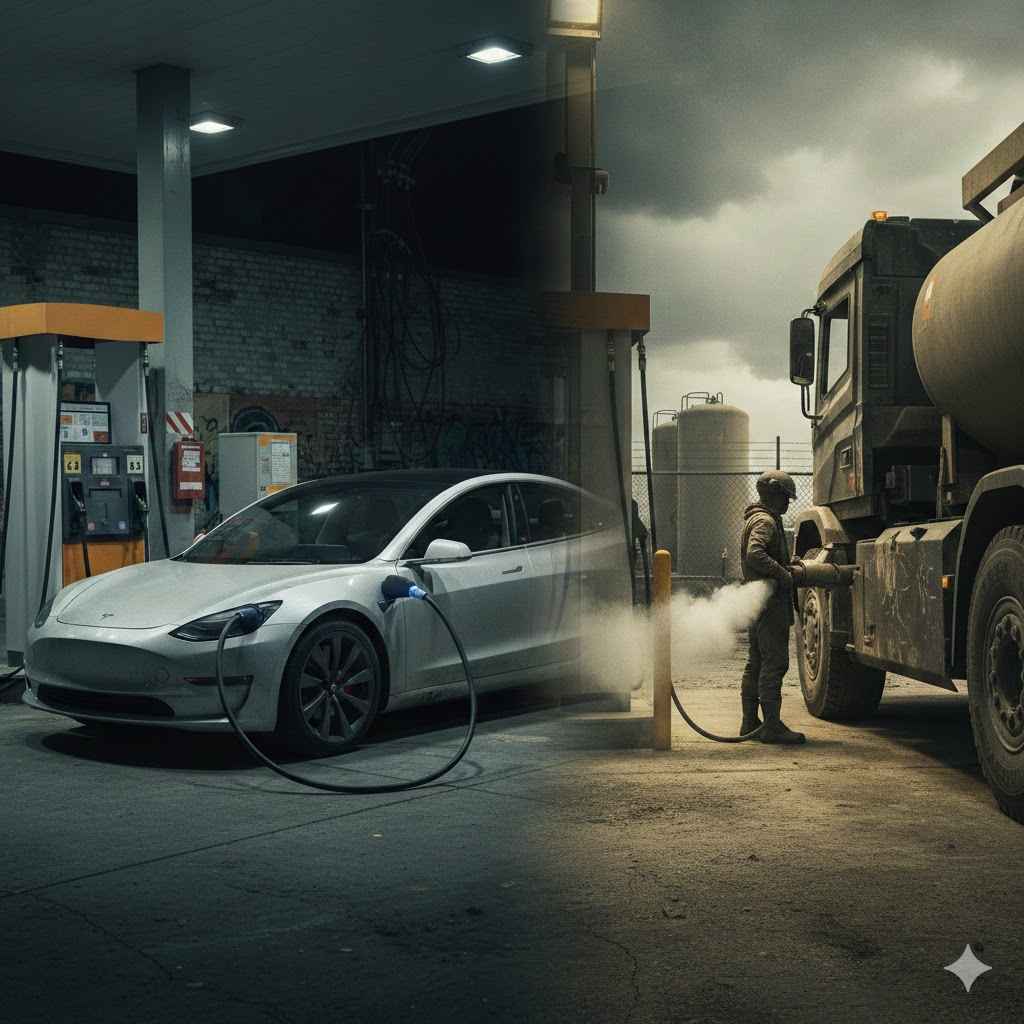
For most drivers, buying an electric car (EV) today is the proven and practical choice. EVs have a wide variety of models and a large, growing charging network. Hydrogen cars show future promise but are not ready for the average driver due to extremely limited car choices and a near-nonexistent fueling infrastructure.
Thinking about a new car? It feels like the future is here, but it’s a bit confusing. You hear about electric cars everywhere, but then someone mentions hydrogen cars. It’s easy to feel stuck. Should you buy an electric car now? Or is something better just around the corner? It’s a big decision, and you want to get it right.
Don’t worry. This is a common question, and you are not alone in asking it. We are going to break it down in simple, clear terms. We will look at what these cars are, how they work in the real world, and what makes sense for you right now. By the end, you’ll have the confidence to make the best choice for your needs.
What’s the Big Difference? Electric vs. Hydrogen Cars Explained Simply
Before we compare, let’s quickly understand what we’re talking about. Both types of cars use electric motors to turn the wheels, which is why they are so quiet and smooth. The real difference is where they get their electricity from. It’s like having two different kinds of batteries.
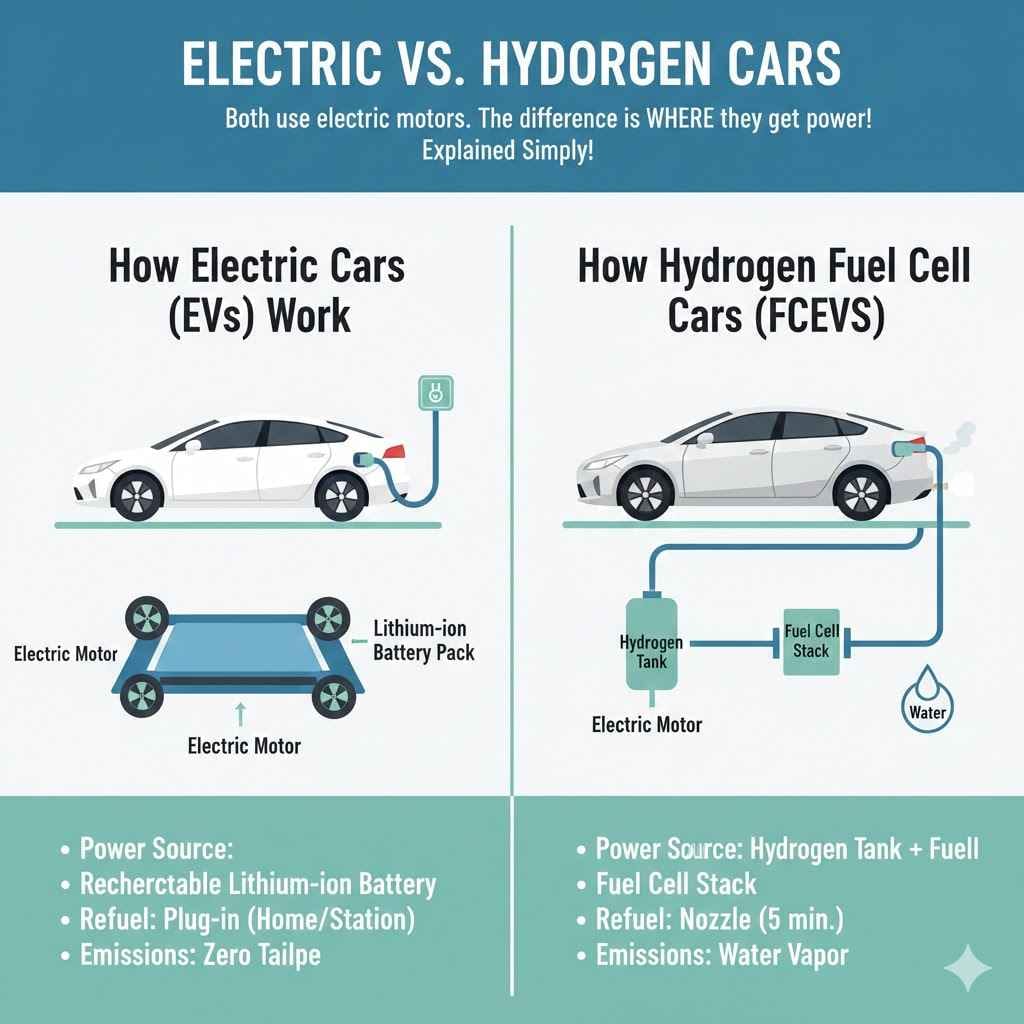
How Electric Cars (EVs) Work
An electric car is actually very simple. Think of it like your smartphone. It has a very big battery pack that you charge by plugging it in. This battery stores electricity and sends it to an electric motor (or motors) that makes the car go. That’s it! There’s no engine, no oil, and no exhaust pipe.
- The Power Source: A large, rechargeable lithium-ion battery pack, usually located in the floor of the car.
- How You “Refuel”: You plug it into an outlet at home or a public charging station. It’s like charging your phone, but on a bigger scale.
- What Comes Out: Nothing. EVs have zero tailpipe emissions.
How Hydrogen Fuel Cell Cars (FCEVs) Work
A hydrogen car, or Fuel Cell Electric Vehicle (FCEV), is a bit more complex. It’s also an electric car because it uses an electric motor. However, it doesn’t store electricity in a big battery. Instead, it makes its own electricity on the go.
It does this using a “fuel cell.” You fill a tank with hydrogen gas. Inside the fuel cell, the hydrogen mixes with oxygen from the air. This chemical reaction creates two things: electricity to power the motor and water. The water then drips out of the tailpipe.
- The Power Source: A tank of compressed hydrogen gas and a fuel cell stack.
- How You “Refuel”: You go to a special hydrogen refueling station and fill the tank with a nozzle, much like you would with gasoline. It only takes about five minutes.
- What Comes Out: Just water vapor.
The Real-World Comparison: What Matters to You Today
Understanding the technology is one thing, but living with the car is what really counts. Let’s look at the key factors that affect your daily driving life and your wallet. This is where the choice becomes much clearer.
Availability: Can You Even Buy One?
This is perhaps the biggest and most immediate difference. Your ability to buy one of these cars depends heavily on where you live and what your options are.
Electric Cars (EVs): They are everywhere. Nearly every major car brand sells at least one EV, and many offer several models. Whether you want a small hatchback, a family SUV, a luxury sedan, or even a pickup truck, there is an EV for you. You can walk into most dealerships today and test drive one. The used EV market is also growing rapidly, providing more affordable options.
Hydrogen Cars (FCEVs): The options are extremely limited. As of now, there are only two main models available in the U.S.: the Toyota Mirai and the Hyundai Nexo. More importantly, you can generally only buy or lease them in California, because that’s the only state with a handful of public hydrogen stations.
Fueling and Charging: Keeping Your Car Going
This is where your daily habits come into play. How you power up your car is fundamentally different between the two.
EV Charging: The biggest advantage of an EV is home charging. Over 80% of EV charging happens overnight at home. You plug in when you get home from work and wake up to a “full tank” every morning. It’s convenient and cheap. For long road trips, you use public DC fast chargers, which can add hundreds of miles of range in 20-40 minutes. The network of these chargers is growing every day. You can easily find stations using apps or your car’s navigation system. The U.S. Department of Energy’s Alternative Fuels Data Center provides a great map of public stations.
Hydrogen Refueling: Refueling an FCEV is quick, taking only about five minutes—just like a gas car. This is a great benefit. However, the huge problem is finding a station. There are fewer than 60 public hydrogen stations in all of North America, with almost all of them clustered in California. If you don’t live very close to one of these few stations, owning a hydrogen car is simply not possible.
| Feature | Electric Cars (EVs) | Hydrogen Cars (FCEVs) |
|---|---|---|
| Where to “Fill Up”? | At home, work, or public charging stations (malls, highways, etc.) | Only at specialized hydrogen refueling stations. |
| Time to “Fill Up” | 20-60 minutes at a fast charger; 8+ hours at home. | About 5 minutes. |
| Station Availability | Over 50,000 public station locations across the U.S. and growing. | Fewer than 60 stations, almost all in California. |
| Convenience | Extremely high for daily use (home charging); requires planning for road trips. | Extremely low; only practical if you live and work next to a station. |
Cost: What’s the Price Tag?
For most of us, the budget is a major factor. This includes both the initial price to buy the car and the ongoing costs to run it.
Purchase Price: EVs come in a wide range of prices. While some high-end models are expensive, there are now many affordable options that compete directly with gas cars. Plus, new and used EVs can be eligible for federal tax credits and state rebates, which can lower the price significantly.
FCEVs are generally expensive. With only two models, there is no competition to drive prices down. The technology is also complex and costly to produce. While manufacturers sometimes offer incentives or special lease deals, the upfront cost is typically higher than a comparable EV.
Running Costs: This is a big win for EVs. On a per-mile basis, charging an EV with electricity from your home is much cheaper than buying gasoline. Maintenance is also simpler and cheaper. EVs don’t need oil changes, spark plugs, or exhaust systems, saving you time and money. For FCEVs, the story is different. The cost of hydrogen fuel can be very high, often costing more per mile than gasoline. Maintenance can also be an issue, as it requires specialized technicians who are hard to find.
Looking at the Future: Will Hydrogen Catch Up?
Many people ask about waiting for hydrogen because it seems like a promising future technology. But how realistic is that future for personal cars? Let’s look at the challenges and where each technology is headed.
The “Chicken and Egg” Problem for Hydrogen
Hydrogen’s biggest obstacle is a classic dilemma. Companies don’t want to build expensive hydrogen refueling stations if there are no cars to use them. And car buyers won’t purchase hydrogen cars if there’s nowhere to refuel them. This has stalled the growth of hydrogen infrastructure for years, and it’s a very difficult problem to solve on a national scale.
Building a hydrogen network is also incredibly expensive. It requires producing the hydrogen, transporting it (either as a liquid or gas), and storing it safely at high pressure at the station. Building out a network comparable to today’s gas stations or EV chargers would require trillions of dollars of investment.
Where Hydrogen Might Shine
While hydrogen might not be the future for our daily driver cars, it shows great promise in other areas. Its quick refueling time and energy density make it a strong candidate for heavy-duty transportation. Think about long-haul semi-trucks, city buses, ships, and even airplanes. For these applications, where vehicles run on fixed routes and need to refuel quickly to stay in service, hydrogen makes a lot of sense. Many experts believe this is where hydrogen technology will truly find its place, as detailed in reports from organizations like the U.S. Department of Energy.
The Massive Momentum Behind Electric Cars
In contrast to hydrogen, the momentum for electric cars is undeniable. Every major automaker in the world is investing billions of dollars into developing new EV models and building battery factories. Governments and private companies are spending billions more to build out the charging infrastructure along highways and in communities. Battery technology is also improving at a rapid pace, leading to longer ranges, faster charging times, and lower costs. This massive global effort means EVs are not just a trend; they are the clear direction the entire automotive industry is moving for personal vehicles.
Pros and Cons: A Simple Breakdown
To make things even easier, let’s just list the good and the bad for each option based on today’s reality.
Electric Cars (EVs): The Good and The Bad
- Pros:
- You can charge conveniently at home every night.
- The public charging network is large and growing fast.
- There are dozens of models to choose from in every size and price range.
- Running costs are low (cheap electricity, less maintenance).
- They offer a quiet, smooth, and powerful driving experience.
- Zero tailpipe emissions are great for air quality in our communities.
- Cons:
- Long road trips require some planning around charging stops.
- Charging is still slower than filling a gas tank.
- Battery performance can be reduced in very cold weather.
- Replacing a battery pack out of warranty can be expensive (though they are designed to last for many years).
Hydrogen Cars (FCEVs): The Good and The Bad
Pros:
Refueling is very fast, taking only about five minutes.
They often have a longer driving range than some comparable EVs.
The only emission is water, which is clean.
They provide a quiet and smooth ride, like an EV.
Cons:
There is virtually no refueling infrastructure outside of California.
There are only a couple of models to choose from.
The cars themselves are expensive to buy.
Hydrogen fuel is very expensive, often more than gasoline.
Producing “green” hydrogen is energy-intensive and costly.
| Factor | The Clear Winner Today | Why It Wins |
|---|---|---|
| Car Availability | Electric Cars (EVs) | Dozens of models from almost every brand vs. only two FCEV models in one state. |
| Fueling Convenience | Electric Cars (EVs) | You can charge at home. The public network has tens of thousands of stations. |
| Cost to Buy | Electric Cars (EVs) | Wide range of prices and models, plus tax credits make them more accessible. |
| Cost to Run | Electric Cars (EVs) | Electricity is much cheaper than hydrogen fuel, and maintenance costs are lower. |
| Future Proofing | Electric Cars (EVs) | The entire auto industry and government are investing heavily in the EV ecosystem. |
The Final Verdict: What Should You Do Right Now?
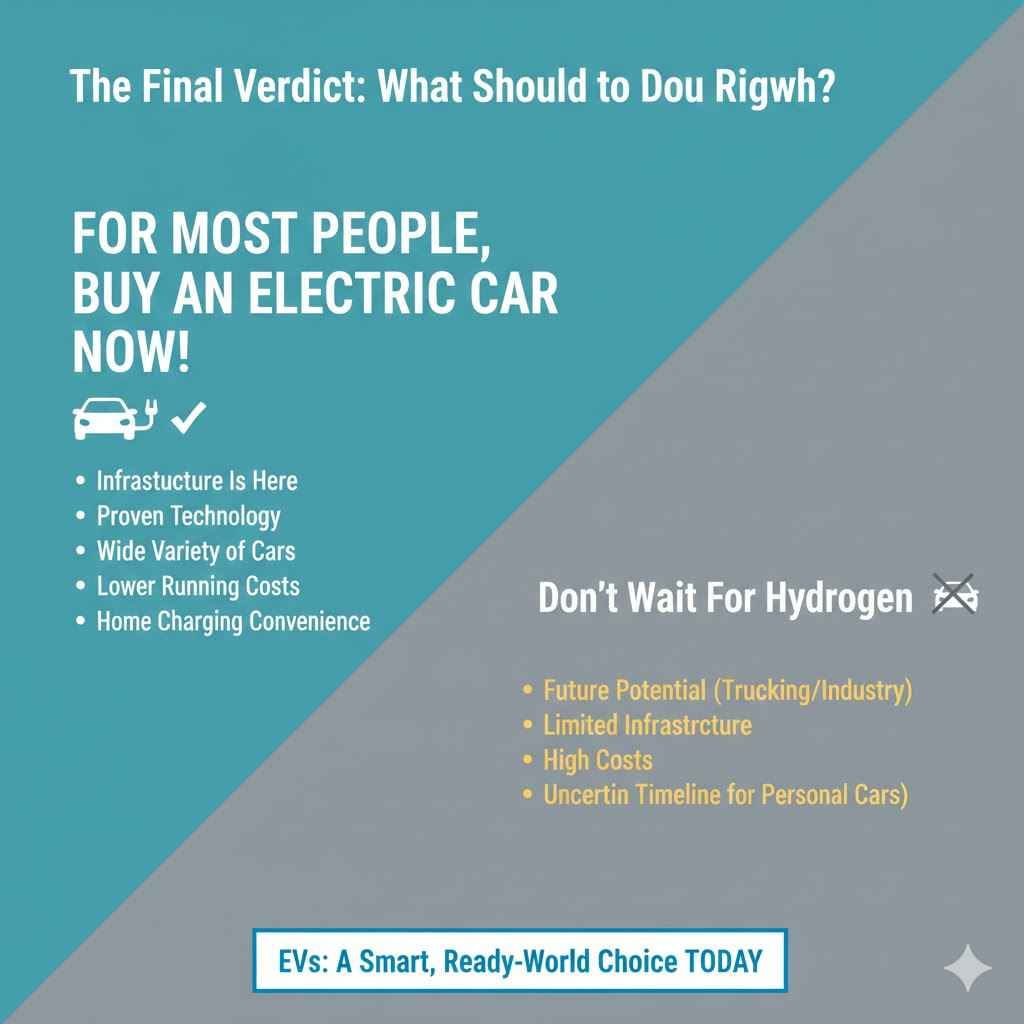
After looking at all the facts, the answer is clear and simple: for the vast majority of people, buying an electric car is the right choice. Waiting for hydrogen is not a practical strategy if you need a car in the next decade.
The world of electric cars is here now. The infrastructure is in place, the technology is proven, and the variety of cars available meets nearly every need and budget. You can enjoy the benefits of cheaper running costs, a quieter ride, and the incredible convenience of home charging today. EVs are a smart, reliable, and established choice.
Hydrogen technology is fascinating, and it will likely play an important role in a clean energy future, especially for trucking and industry. But for personal cars, it remains a distant and uncertain dream. The immense challenges of cost and infrastructure mean it is not something you should wait for. Choosing an EV is a decision you can make with confidence, knowing you are getting a great vehicle that is ready for the real world right now.
Frequently Asked Questions (FAQ)
1. Isn’t hydrogen cleaner than electric?
Not necessarily. While a hydrogen car only emits water, producing the hydrogen fuel can be dirty. Most hydrogen today is made from natural gas, which creates carbon emissions. “Green” hydrogen made with renewable energy is very clean but also very expensive and rare. EVs powered by a grid that includes renewable energy sources like wind and solar are also very clean, and the grid is getting cleaner every year.
2. How long do EV batteries last?
EV batteries are designed to last the life of the car. Manufacturers typically offer a warranty for 8 years or 100,000 miles, guaranteeing the battery will retain a high percentage of its original capacity (usually 70%). Most batteries last much longer than that with only gradual, minimal range loss over time.
3. Is it hard to find a charger for an electric car?
For daily driving, it’s not hard at all since most charging is done at home. For road trips, it’s getting easier every day. There are many apps (like PlugShare or A Better Routeplanner) and in-car navigation systems that show you exactly where chargers are, if they are available, and how fast they charge. Major highways are now well-covered.
4. Are hydrogen cars safe?
Yes. Hydrogen cars have been rigorously tested and must meet the same strict safety standards as regular gasoline cars. The hydrogen fuel tanks are incredibly strong, made from carbon fiber, and have undergone extensive crash, fire, and ballistics testing to ensure they are safe.
5. Will my electric bill go up a lot with an EV?
Your electric bill will go up, but you will no longer be paying for gasoline. For most people, the increase in their electricity bill is much less than what they used to spend on gas each month. Many utility companies also offer special lower rates for charging your EV during off-peak hours, like overnight, which can save you even more money.
6. What happens if I run out of charge in an EV?
This is a common fear, but it’s very rare in practice. Your car gives you many warnings when the battery is low, just like a gas car’s fuel light. It will suggest nearby charging stations. If you do run out, you can’t just bring it a can of electricity. You would need to call a tow truck to take you to the nearest charger, similar to running out of gas far from a gas station.
7. Why is hydrogen fuel so expensive?
Hydrogen is expensive because of the complex and energy-intensive process required to produce, compress, and transport it. The low number of stations also means there is no economy of scale to help bring the price down for consumers. Currently, filling up a hydrogen car can cost two to three times more than filling up a comparable gas car.