
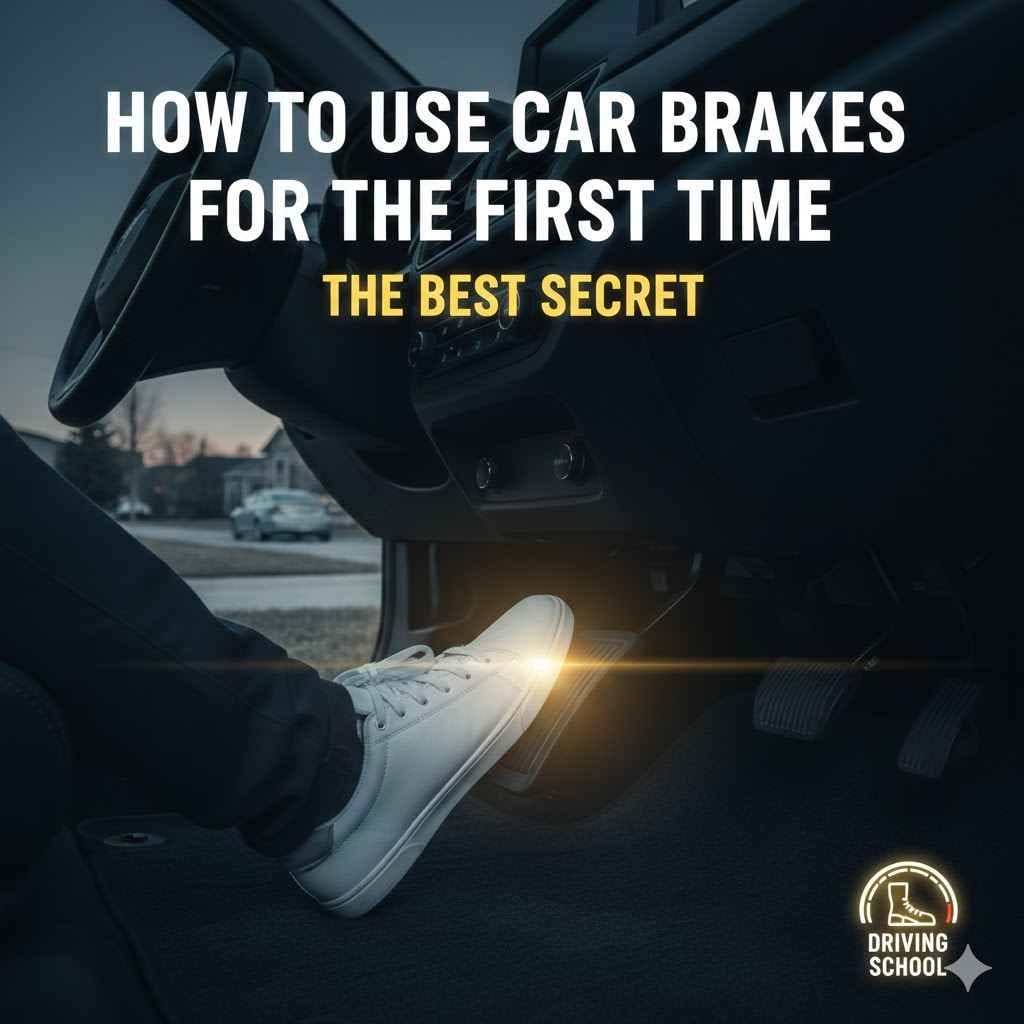
To use car brakes for the first time, the secret is gentle, progressive pressure. Place the ball of your right foot on the center of the brake pedal and smoothly press down. Think of it like squeezing a sponge, not stomping a bug. This technique ensures a smooth, controlled stop and quickly builds driving confidence.
Getting behind the wheel for the first time is exciting! It is also a little nerve-wracking. You have a lot to think about. One of the biggest worries for new drivers is using the brakes. Will you stop too fast? Or not fast enough? It feels like a big mystery.
Don’t worry, you are not alone. Every single driver has felt this way. The good news is that braking is a simple skill. Once you learn the one big secret, it will feel natural and easy. This guide will walk you through everything, step-by-step. We will show you the best way to use your brakes for a smooth, safe ride every time.
Before You Even Start the Car: Getting Comfortable
Confidence starts before you even turn the key. The first step to great braking is making sure you are set up for success. Your car should feel like an extension of you, and that begins with your position in the driver’s seat. Let’s get you settled in.
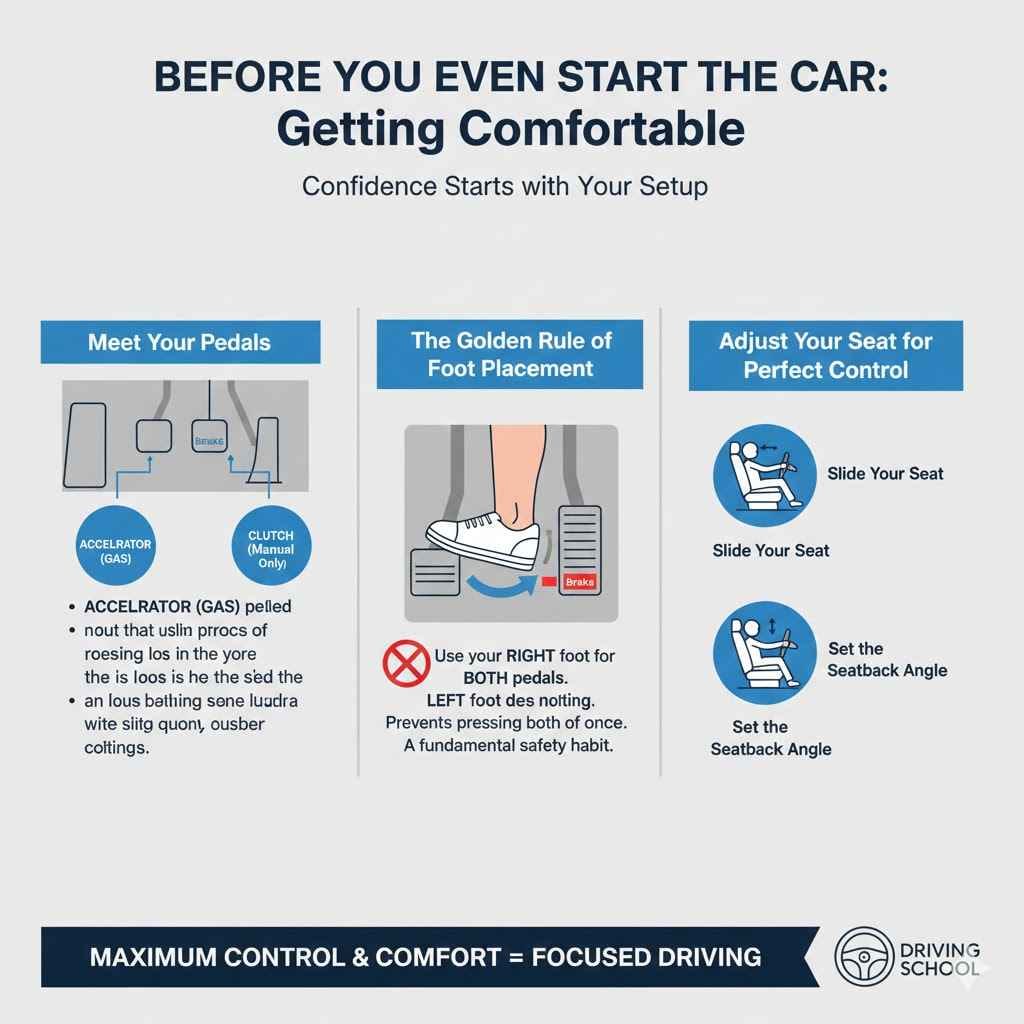
Meet Your Pedals
Look down at your feet. You will see two or three pedals. It’s very important to know which one is which without looking. In most cars around the world, the layout is standard.
- Accelerator (Gas): This is the pedal on the far right. It makes the car go faster.
- Brake: This is the pedal in the middle (or to the left of the gas in an automatic). It is usually wider than the gas pedal. This is your stopping pedal.
- Clutch: If you are driving a manual transmission (stick shift), this pedal is on the far left. You use it to change gears. If you are in an automatic, you will not have this pedal.
For automatic cars, which most beginners learn on, you only need to worry about two pedals: the brake and the gas.
The Golden Rule of Foot Placement
This is one of the most important rules of driving: Use your right foot for BOTH the gas and the brake. Your left foot should do nothing. It can rest on the floor or on the “dead pedal,” a patch of reinforced floor to the far left.
Why is this so important? Using one foot prevents you from accidentally pressing both pedals at the same time. It trains your brain and your foot to know that when your foot is on the gas, it cannot be on the brake, and vice versa. It is a fundamental safety habit.
Adjust Your Seat for Perfect Control
You cannot control the pedals properly if you are not sitting correctly. An incorrect seat position can make braking jerky and uncomfortable.
- Slide Your Seat Forward or Back: Sit down and press the brake pedal all the way to the floor. Your knee should still have a slight bend in it. If your leg is completely straight, you are too far back. If your knee is bent sharply, you are too close.
- Adjust Seat Height: Raise or lower your seat so you have a clear view over the steering wheel and dashboard. You should be able to see the road clearly without straining.
- Set the Seatback Angle: Sit with your back and shoulders flat against the seat. Your back should be mostly upright, not reclined like you are on a lounge chair. Extend your arms; your wrists should rest on top of the steering wheel without you having to lean forward.
Taking a minute to get your seat right makes a world of difference. It gives you maximum control and comfort, which helps you stay relaxed and focused.
The “Secret” to Perfect Braking: Progressive Pressure
Okay, here it is. The single most important concept for smooth, safe braking. It’s not about how hard you press the pedal; it’s about how you press it. The secret is progressive pressure.
Imagine you are squeezing a tube of toothpaste. You don’t just smash it in the middle. You start gently at the end and slowly increase the pressure to get a nice, even stream. Your car’s brakes work the same way.
The brake pedal is not an on/off switch. It is a dimmer switch. The more you press, the more braking force is applied. Stomping on the brake pedal is like flipping a light switch from off to on—it’s sudden and jarring. Progressive pressure is like slowly turning the dimmer up—it’s smooth, controlled, and comfortable for you and your passengers.
Let’s Practice: Your First Time Applying the Brakes (Engine Off)
You can build muscle memory without even moving the car. This is a safe, zero-pressure way to get a feel for the brake pedal.
- Get Situated: Sit in your properly adjusted driver’s seat. Make sure the car is in Park (P) and the engine is off.
- Find the Brake: Without looking, use your right foot to find the wide brake pedal.
- Place Your Foot: Position the ball of your right foot (the area just behind your toes) on the center of the pedal. Your heel should be resting on the car floor.
- Press Gently: Slowly press the brake pedal down. Feel the resistance. It will feel firm. Notice how far it travels before it gets really tight.
- Press a Bit Harder: Release the pedal and press it again, this time a little firmer. Pay attention to how the pedal feels under your foot.
- Release Smoothly: Let your foot come off the pedal in a controlled, smooth motion. Don’t just let it snap back up.
- Repeat: Do this 10 to 15 times. Press, release. Press, release. This simple exercise teaches your foot exactly where the brake pedal is and how it feels.
This may seem silly, but it is incredibly effective. You are training your body to act without thinking, which is exactly what you need when you are driving.
Your First Real Stop: A Step-by-Step Guide in a Safe Place
Now it’s time to put it all together. The key here is to choose a safe, stress-free environment. An empty parking lot, a quiet industrial park on a weekend, or a long, empty rural road are perfect spots. Do not try this in traffic for the first time.
Step 1: Get Ready
With your foot firmly on the brake, start the car. Put the car into Drive (D).
Step 2: Move Forward Slowly
Take a deep breath. Look around to make sure your path is clear. Slowly and smoothly lift your foot off the brake pedal. In an automatic car, this will cause the car to start moving forward on its own, a process called “creeping.” You don’t even need to touch the gas pedal yet. Let the car creep forward to about walking speed.
Step 3: Prepare to Brake
As the car moves, pivot your right foot so it is hovering directly over the brake pedal. Your heel stays on the floor—you just move your toes from the gas area to the brake area.
Step 4: Apply Gentle, Progressive Pressure
Now, put the secret into action. Lightly press down on the brake pedal with the ball of your foot. You should immediately feel the car start to slow down. Don’t jab at it; just apply light, steady pressure.
Step 5: Increase Pressure Smoothly
As the car slows, gradually and smoothly increase the pressure on the pedal. Keep adding a little more pressure until the car comes to a complete, gentle stop. The goal is to stop without any lurch or jerk.
Step 6: Hold and Release
Once stopped, keep your foot on the brake to hold the car in place. When you are ready to move again, simply release the brake slowly. Repeat this process—creeping forward and braking to a smooth stop—ten or twenty times. This practice is the foundation of confident driving.
Understanding Different Braking Situations
Of course, you won’t always be braking in an empty parking lot. Different situations on the road call for slight adjustments in your technique. The core principle of progressive pressure always applies, but here is how you adapt it.
| Braking Scenario | Best Technique | Why It Works |
|---|---|---|
| Normal Stop (Stop Sign, Red Light) | Start braking early with light pressure, then gradually increase it for a smooth stop right at the line. | This gives you plenty of time, keeps your passengers comfortable, and is gentle on your car’s brakes. |
| Sudden or Emergency Stop | Apply firm, strong, and continuous pressure quickly. Do not pump the brakes. Trust your car’s ABS. | This engages the Anti-lock Braking System (ABS) to prevent skidding and helps you stop in the shortest possible distance. |
| Braking in Rain or Snow | Double your following distance. Brake much earlier and more gently than you would in dry conditions. | Wet or icy roads drastically reduce traction. Early, gentle braking prevents your wheels from locking up and skidding. |
| Going Down a Steep Hill | Shift to a lower gear (L, 2, or 3) to let the engine help slow you down. Apply the brakes in short, firm presses instead of holding them down continuously. | Constantly “riding” your brakes downhill can cause them to overheat and fail. This is called “brake fade.” Using the engine and intermittent braking keeps them cool. |
What is ABS and Why You Shouldn’t Pump the Brakes
You may have heard someone say you should “pump the brakes” if you start to skid. This is old advice for very old cars. Virtually every modern car is equipped with an Anti-lock Braking System (ABS).
ABS is a safety feature that automatically pumps the brakes for you, but it does so incredibly fast—many times per second. This prevents your wheels from locking up and skidding during a hard stop, allowing you to maintain steering control. For more information on this amazing technology, you can visit the National Highway Traffic Safety Administration (NHTSA) website.
When ABS is working, you will feel a rapid pulsing or vibrating in the brake pedal, and you might hear a grinding or buzzing sound. This is completely normal! It means the system is doing its job.
The most important thing to remember in an emergency stop with a modern car is:
- Press Firmly: Push the brake pedal down hard.
- Hold It Down: Keep constant pressure on the pedal. Do not lift your foot.
- Steer: Keep your eyes up and steer around the obstacle.
Do not pump the brakes. Let the car’s computer do the work for you.
Common Mistakes First-Time Drivers Make (And How to Avoid Them)
Every new driver makes a few mistakes. Knowing what they are ahead of time can help you avoid them.
- Mistake 1: Stomping the Brake. This is the most common mistake. It leads to jerky, uncomfortable stops and can startle other drivers.
Solution: Remember the secret! Practice progressive pressure until it becomes second nature.
- Mistake 2: Braking Too Late. Waiting until the last second to brake causes panic and hard stops.
Solution: Always look far down the road, not just at the car in front of you. This helps you anticipate when you need to slow down, so you can start braking early and gently.
- Mistake 3: Using the Left Foot for Braking. In an automatic car, this is a dangerous habit that can lead to confusion and accidents.
Solution: Train yourself from day one to tuck your left foot away. The right foot is for gas and brake. Period.
- Mistake 4: Riding the Brakes. This means resting your foot on the brake pedal while driving.
Solution: Make a conscious effort to keep your foot off the brake pedal unless you are actively slowing down. Riding the brakes not only wears them out prematurely but also keeps your brake lights on, which can confuse the driver behind you.
Getting to Know Your Brakes: What Do Those Noises Mean?
Your brakes will often tell you when something is wrong. Learning to listen to your car is a great skill for any driver. Here are a few common sounds and what they might mean.
| Sound | What It Likely Means | What You Should Do |
|---|---|---|
| High-Pitched Squeal or Screech | This is often the sound of the brake pad wear indicator. It’s a small piece of metal designed to make this noise when your brake pads are getting thin. | This is a warning. You should schedule an appointment to have your brakes inspected and likely replaced soon. |
| Deep, Loud Grinding Noise | This is a very serious sign. It usually means your brake pads are completely gone, and now metal is grinding against metal. | Stop driving as soon as it is safe to do so. Continuing to drive can cause severe, expensive damage to your braking system. Get your car to a mechanic immediately. |
| Clicking Noise When Braking | This could be a number of things, from a loose brake pad to a piece of debris caught in the caliper. | While not usually an emergency, you should have it checked out by a professional to ensure everything is secure. |
Final Tips for Building Braking Confidence
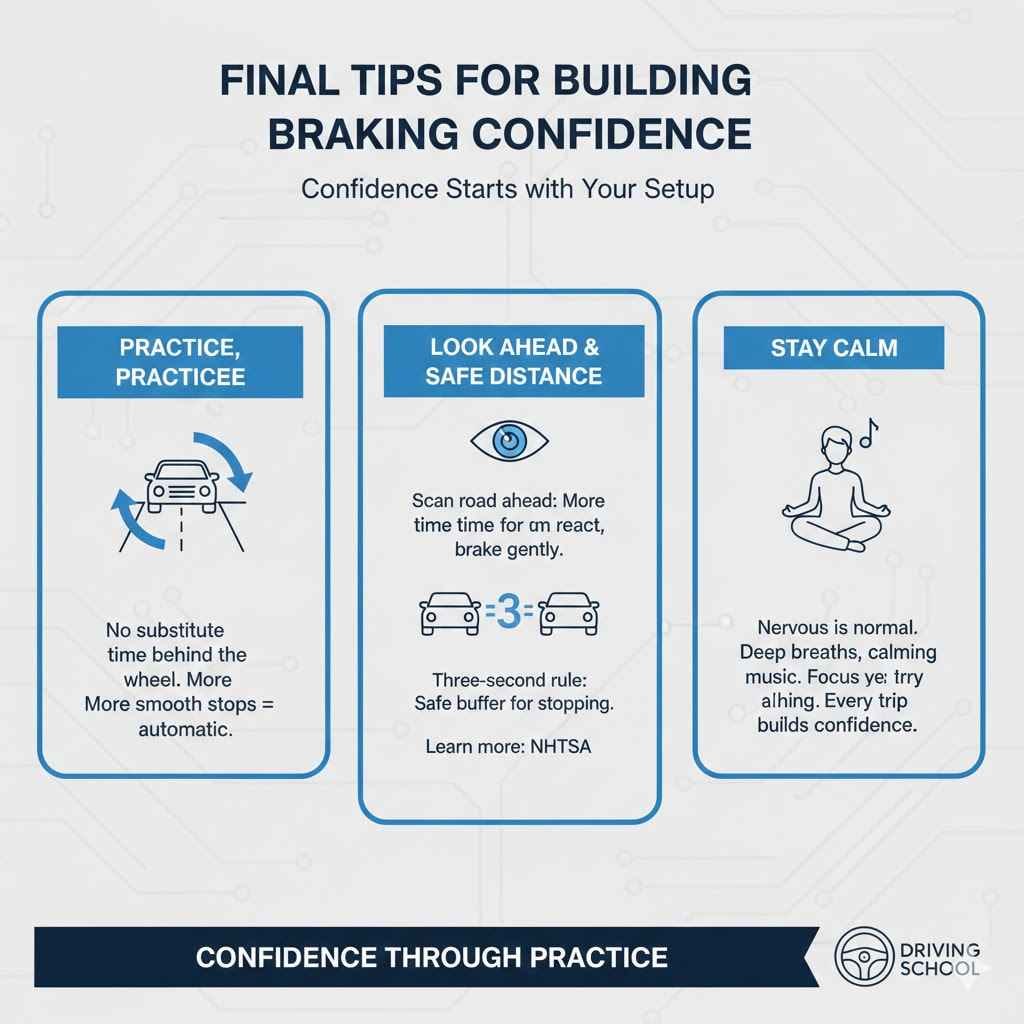
Mastering the brakes is all about building confidence through practice. Here are a few final thoughts to help you on your journey.
- Practice, Practice, Practice: There is no substitute for time behind the wheel. The more you practice smooth stops in a safe area, the more automatic it will become.
- Look Ahead: Good drivers are always scanning the road ahead. This gives you more time to react, and more time means you can brake more gently.
- Keep a Safe Distance: Follow the “three-second rule.” When the car in front of you passes a fixed object (like a sign), it should take you at least three seconds to reach that same object. This gives you a safe buffer for stopping. You can learn more about safe following distances from driver education resources like your local DMV.
- Stay Calm: Feeling nervous is normal. Take deep breaths, put on some calming music, and focus on one thing at a time. Every trip you take will make you a more confident driver.
Frequently Asked Questions (FAQ)
Which foot do you use to brake?
Always use your right foot for both the brake pedal and the accelerator (gas) pedal. Your left foot should rest on the floor or the dead pedal to the far left. This is a critical safety habit for driving an automatic car.
What’s the difference between the brake and gas pedal?
The accelerator (gas) pedal is on the right and makes the car go. The brake pedal is to the left of the gas and makes the car slow down and stop. The brake pedal is also typically wider than the gas pedal.
Why does my car stop so suddenly when I brake?
This usually happens when you press the brake pedal too hard and too fast. The key is to apply gentle, progressive pressure. Start with light pressure and smoothly add more until you come to a gentle stop. Practice this in an empty parking lot to get a better feel for it.
Is it bad to press the brake and gas at the same time?
Yes, it is very bad. It confuses the car, causes excessive wear on your brakes and transmission, and can be dangerous. This is why it’s essential to only use your right foot for both pedals, making it impossible to press both at once.
How do I know if I’m pressing the brake too hard?
You’ll know you’re braking too hard if your stops are jerky and throw you and your passengers forward. A good stop should be so smooth that you barely feel the car come to a complete halt. If your coffee is sloshing out of its cup, you’re braking too hard!
What is engine braking?
Engine braking is the process of using your engine to help slow the car down, typically by shifting to a lower gear. This is most useful when going down long, steep hills, as it helps prevent your brakes from overheating.
When should I get my brakes checked?
You should have your brakes inspected by a professional mechanic at least once a year. You should also get them checked immediately if you hear any grinding or squealing noises, if the brake pedal feels “spongy” or soft, or if your car pulls to one side when you brake.
You’ve Got This!
Learning to use your car’s brakes is a huge step toward becoming a safe and confident driver. It can feel strange at first, but remember the secret: progressive pressure. Be smooth, be gentle, and be patient with yourself.
Every time you get in the car and practice, you are building a skill that will last a lifetime. So find that empty parking lot, get a feel for the pedal, and practice those smooth stops. Before you know it, braking will be as natural as breathing. Welcome to the road—you’re going to do great.