
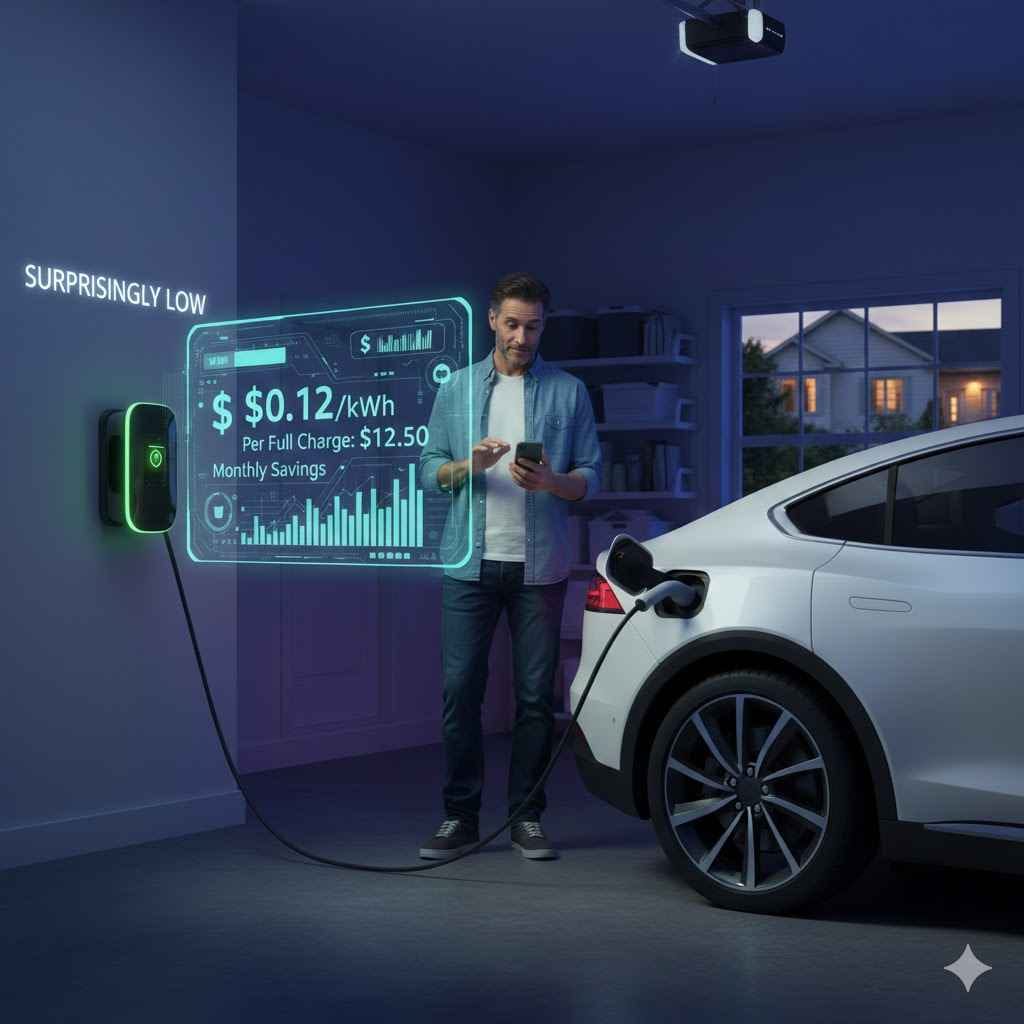
Charging an electric car at home typically costs between $5 and $20 for a full charge, making it significantly cheaper than gasoline. Your exact cost depends on your local electricity rate (cents per kilowatt-hour) and your car’s battery size. Most drivers save hundreds, or even thousands, of dollars per year by charging at home.
Thinking about an electric car? You’re probably wondering about charging. One of the biggest questions people have is about the cost. Will your electric bill shoot through the roof? The good news is, charging at home is easier and much more affordable than you might think. It’s nothing like a weekly trip to the gas station.
Forget confusing charts and technical jargon. We are going to break it down in simple terms. This guide will walk you through exactly how to figure out your charging cost, what factors change the price, and how you can save even more money. You’ll see just how simple it is to power your car right from your own home.
Welcome! I’m Dustin Hall, and my goal is to make car care simple for everyone. If you’re looking into electric vehicles (EVs), you’re making a smart move. But the idea of charging at home can feel like a big unknown. Let’s clear up the confusion together and show you how charging your car at home is one of the best perks of owning an EV.
Understanding the Basics of EV Charging Costs
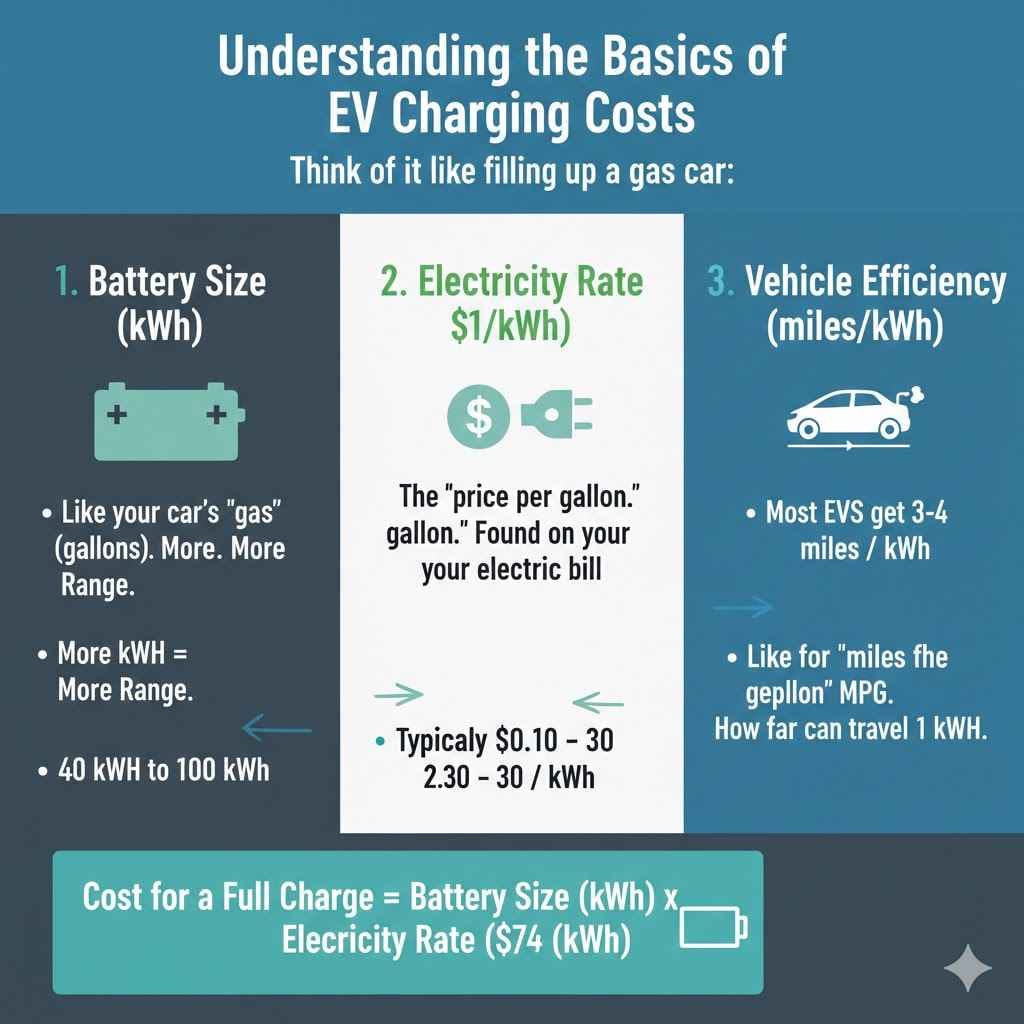
Before we get into the numbers, let’s cover three simple terms. Once you understand these, calculating your cost will be a piece of cake.
Think of it like filling up a gas car:
- Battery Size (kWh): This is like your car’s “gas tank.” Instead of gallons, it’s measured in kilowatt-hours (kWh). A bigger battery holds more energy and gives you more range, just like a bigger gas tank. Most modern EVs have batteries ranging from 40 kWh to 100 kWh.
- Electricity Rate ($/kWh): This is the “price per gallon.” It’s what your utility company charges you for one kilowatt-hour of electricity. You can find this price on your monthly electric bill. It’s usually listed in cents per kWh.
- Vehicle Efficiency (miles/kWh): This is like your “miles per gallon” (MPG). It tells you how many miles your car can travel on one kWh of energy. Most EVs get between 3 to 4 miles per kWh.
That’s it! The two most important things for figuring out your cost for a full charge are your battery size and your electricity rate.
The Simple Formula to Calculate Your Charging Cost
Ready for some simple math? I promise it’s easy. Here is the magic formula to find out how much a full “fill-up” will cost you at home.
The Formula:
(Your Car's Battery Size in kWh) x (Your Electricity Rate in $/kWh) = Cost for a Full Charge
Let’s walk through an example. Imagine:
- You have an EV with a 65 kWh battery.
- Your electric company charges you $0.15 per kWh.
Here’s the calculation:
65 kWh x $0.15/kWh = $9.75
That’s it! A full charge from empty to full would cost you less than ten dollars. For most EVs, that amount of energy will give you over 200 miles of range. Compare that to the cost of filling a gas tank!
How to Find Your Electricity Rate
Finding your electricity rate is simple. Grab your latest utility bill. Look for a line item that shows “Supply” or “Generation” charges. You should see a price listed as cents or dollars per kWh. For example, it might say 14.5 cents/kWh or $0.145/kWh. That’s the number you need for our formula. If you can’t find it, just call your utility company or check their website.
Let’s Break Down the Numbers: Real-World Examples
Seeing the costs for popular cars can make it even clearer. Let’s look at a few examples using the U.S. national average electricity rate, which is around $0.17 per kWh. Keep in mind your rate might be higher or lower.
| Electric Vehicle Model | Approx. Battery Size (kWh) | Approx. Range (miles) | Estimated Cost for a Full Charge (at $0.17/kWh) |
|---|---|---|---|
| Tesla Model 3 (Standard Range) | 60 kWh | 272 miles | $10.20 |
| Ford Mustang Mach-E (Standard Range) | 70 kWh | 250 miles | $11.90 |
| Chevrolet Bolt EV | 65 kWh | 259 miles | $11.05 |
| Hyundai Ioniq 5 (Standard Range) | 58 kWh | 220 miles | $9.86 |
| Rivian R1T (Standard Pack) | 105 kWh | 270 miles | $17.85 |
As you can see, even for a large electric truck like the Rivian, the cost to “fill up” is dramatically less than a tank of gas. For most daily commutes, you’ll only be topping off a small portion of the battery, making your daily cost just a dollar or two.
What Factors Can Change Your Home Charging Costs?
While our formula is a great starting point, a few things can make your actual costs vary. It’s helpful to know what they are so you can be the smartest EV owner on the block.
1. Your Location (It Matters a Lot!)
Where you live is the single biggest factor. Electricity rates are very different from state to state. For example, states like Washington and Idaho have very low rates, while states like California and Hawaii have much higher rates. You can see a full breakdown of average electricity prices by state from the U.S. Energy Information Administration (EIA). Knowing your local rate is key to getting an accurate cost estimate.
2. Time of Day You Charge
Many utility companies offer special rate plans called “Time-of-Use” (TOU) plans. With a TOU plan, electricity costs more during “peak” hours (usually late afternoon and early evening when everyone is using a lot of power) and costs much less during “off-peak” hours (like late at night).
- On-Peak Hours: Highest price. Avoid charging during this time if you can.
- Off-Peak Hours: Lowest price. This is the best time to charge your EV!
By scheduling your car to charge overnight, you could cut your charging costs by 50% or more. Most EVs and home chargers let you set a schedule easily from an app.
3. The Type of Charger You Use
At home, you have two main charging options: Level 1 and Level 2.
- Level 1 Charging: Uses a standard 120-volt wall outlet, the same one you use for a lamp or a toaster. It’s very slow, adding only 3-5 miles of range per hour.
- Level 2 Charging: Uses a 240-volt outlet, like the one for an electric dryer. It’s much faster, adding 20-60 miles of range per hour. This is what most EV owners install in their garage.
While both deliver the same amount of energy eventually, Level 2 chargers are slightly more efficient. That means less energy is wasted as heat during the charging process. The difference in cost per charge is tiny, but the convenience of a faster charge is huge.
4. The Season
Believe it or not, the weather can affect your charging costs. In the winter, cold temperatures can make your EV’s battery less efficient. This means two things:
- Your car might use a little more energy to travel the same distance.
- The battery may use some energy to heat itself during charging.
This means you might need to charge a bit more often in the winter, which can slightly increase your overall monthly cost. It’s usually not a huge difference, but it’s good to be aware of.
Level 1 vs. Level 2 Charging: Does It Affect Cost?
We touched on this, but let’s dive a little deeper. Many new EV owners wonder if they need to spend money on a special charger. The answer depends on your driving habits.
A Level 1 charger comes with your car for free. You can just plug it into any wall outlet. If you only drive 20-30 miles a day, a Level 1 charger might be all you need. You can plug it in when you get home, and it will be topped off by the next morning.
A Level 2 charger requires professional installation, which can cost anywhere from $500 to $2,000. However, the benefits are significant. It charges your car 5-10 times faster, ensuring you always have a full battery when you need it. It also gives you the flexibility to get a quick boost of range if you have an unexpected trip.
Here’s a simple breakdown:
| Feature | Level 1 Charger | Level 2 Charger |
|---|---|---|
| Voltage | 120-Volt (Standard Outlet) | 240-Volt (Dryer Outlet) |
| Charging Speed | Very Slow (3-5 miles of range per hour) | Fast (20-60 miles of range per hour) |
| Installation Cost | $0 (Included with car) | $500 – $2,000+ |
| Best For | Low-mileage drivers, plug-in hybrids, or those who can’t install a Level 2. | Most EV owners, anyone who wants convenience and faster charging. |
While the upfront cost of installing a Level 2 charger is a factor, it doesn’t significantly change your ongoing cost per kWh. The real value is in the speed and convenience.
How to Save Even More Money on Home EV Charging
Charging at home is already cheap, but who doesn’t like saving more money? Here are a few simple tips to lower your costs even further.
Charge During Off-Peak Hours: This is the biggest money-saver. Call your utility provider and ask about Time-of-Use (TOU) plans. If they offer one, sign up! Then, use your car’s settings or your charger’s app to schedule all your charging sessions for the middle of the night when electricity is cheapest.
Set a Charging Limit for Daily Driving: Your EV’s battery is happiest when it’s not kept at 100% all the time. For daily driving, most manufacturers recommend setting your charging limit to 80% or 90%. This is better for long-term battery health and saves you a little money by not packing in those last few, slower-to-charge electrons every night. Save the 100% charge for long road trips.
Precondition Your Car While Plugged In: On a cold morning or a hot afternoon, you can set your car to warm up or cool down the cabin before you unplug. When you do this while the car is still plugged in, it uses power from the wall instead of your battery. This means you start your trip with more range.
Look for Utility Rebates and Incentives: Many electric companies want to encourage EV adoption. They may offer a rebate on the purchase of a Level 2 charger or even give you a credit on your bill just for owning an EV. Check your utility’s website for any special programs.
Avoid Draining Your Battery to Empty: Just like you shouldn’t keep your battery at 100%, you should also try to avoid running it down to near zero regularly. Batteries charge most efficiently in the middle of their range. Plugging in each night to top off what you used during the day is a great habit.
Is Charging at Home Really Cheaper Than Gas?
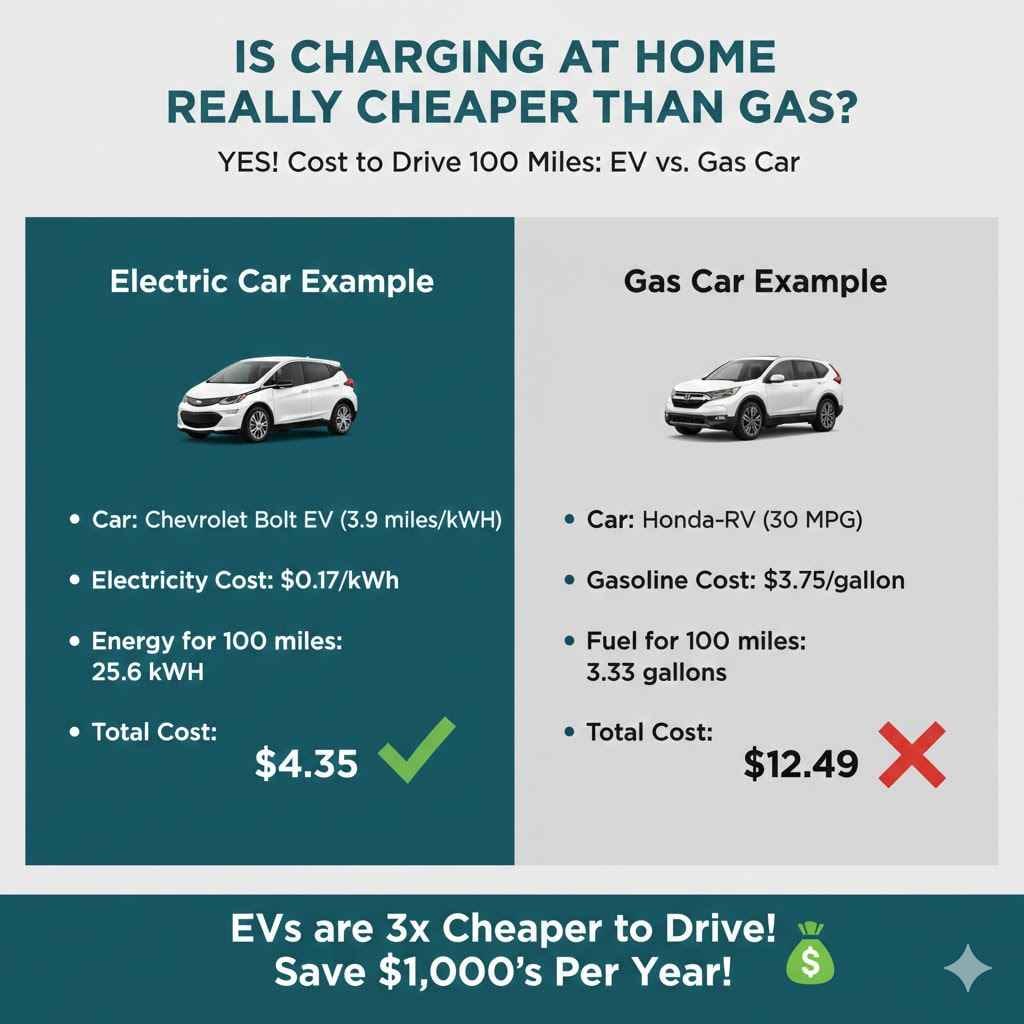
Yes, and it’s not even close! Let’s do a final, direct comparison. We’ll calculate the cost to drive 100 miles in a typical EV versus a typical gas car.
Electric Car Example:
- Car: A Chevrolet Bolt EV (gets about 3.9 miles/kWh).
- Electricity Cost: $0.17 per kWh.
- Energy Needed for 100 miles: 100 miles / 3.9 miles/kWh = 25.6 kWh.
- Total Cost: 25.6 kWh x $0.17/kWh = $4.35.
Gas Car Example:
- Car: A Honda CR-V (gets about 30 miles per gallon).
- Gasoline Cost: $3.75 per gallon.
- Fuel Needed for 100 miles: 100 miles / 30 MPG = 3.33 gallons.
- Total Cost: 3.33 gallons x $3.75/gallon = $12.49.
In this scenario, driving 100 miles in the electric car is nearly three times cheaper than in the gas car. If you drive 1,000 miles a month, that’s a savings of over $80 every single month, or nearly $1,000 a year! The savings are real, and they add up fast.
Frequently Asked Questions About Home EV Charging Costs
How much will my electricity bill go up with an EV?
It depends on how much you drive. If you drive an average of 1,000 miles per month, you can expect your bill to increase by about $30 to $60, depending on your electricity rate. While your electric bill will go up, your spending on gasoline will drop to zero, resulting in significant overall savings.
Is it worth installing a Level 2 charger at home?
For most people, yes. While you can get by with a Level 1 charger, the convenience and speed of a Level 2 charger make EV ownership much more enjoyable. It ensures your car is always ready to go with a full charge and gives you peace of mind.
Can I just use a regular outlet to charge my car?
Yes, absolutely. This is called Level 1 charging, and it works perfectly fine. It’s very slow, so it’s best for people who don’t drive long distances daily. If you drive 40 miles or less per day, you can likely replenish that range by charging overnight with a regular outlet.
How do I find my exact electricity rate?
The best place to look is on your monthly bill from your electric utility company. It’s usually listed in a “details” or “supply charges” section, shown in cents per kilowatt-hour (kWh). If you can’t find it, check their website or give them a call.
Is it cheaper to charge at home or at a public station?
Charging at home is almost always the cheapest option. Public Level 2 chargers are often more expensive than home electricity, and DC Fast Chargers (the very fast ones you use on road trips) are the most expensive, sometimes costing as much as or more than gasoline per mile.
Does charging an EV take a long time at home?
With a Level 1 charger, a full charge can take over 24 hours. However, with a Level 2 charger, most EVs can be fully charged overnight in 6-10 hours. Since most people just top off the battery each night instead of charging from empty, it’s usually done in just a few hours while you sleep.
Does my car’s battery size affect the cost of a full charge?
Yes. A car with a larger battery (like a 100 kWh battery) will cost more for a single full charge than a car with a smaller battery (like a 50 kWh battery), just like a bigger gas tank costs more to fill. However, the larger battery will also give you more range.
You’ve Got This: The Power Is in Your Hands
Figuring out how much an electric car costs to charge at home can seem complicated at first, but as you’ve seen, it’s surprisingly simple. All you need is your car’s battery size and your home’s electricity rate. For just a few dollars, you can wake up every morning with a “full tank,” ready to go.
Charging at home is not only convenient but also one of the biggest financial benefits of switching to an electric car. You’ll save a remarkable amount of money compared to buying gasoline, all while enjoying a quieter, smoother ride. So go ahead, look up your electricity rate and do the math for yourself. You might be surprised at just how affordable your driving future can be.