
Charging an electric car in the UK can cost anywhere from £5 for a full charge at home on a special nighttime tariff to over £50 using a public rapid charger. The key difference is where and when you charge, with home charging being significantly cheaper than public networks.
Thinking about switching to an electric car? It’s an exciting idea! But one big question probably keeps popping into your head: how much will it actually cost to charge? It feels like a complicated puzzle with lots of different prices and charger types. You might worry about surprise bills or hidden costs.
Don’t worry, it’s much simpler than it looks. We’re here to break it all down for you, step by step. This guide will show you exactly what to expect, from cheap overnight charging at home to quick top-ups on the motorway. We’ll give you the real numbers so you can feel confident about your running costs. Let’s uncover the shocking truth about EV charging costs together.
The Simple Answer: It All Depends on Where You Plug In
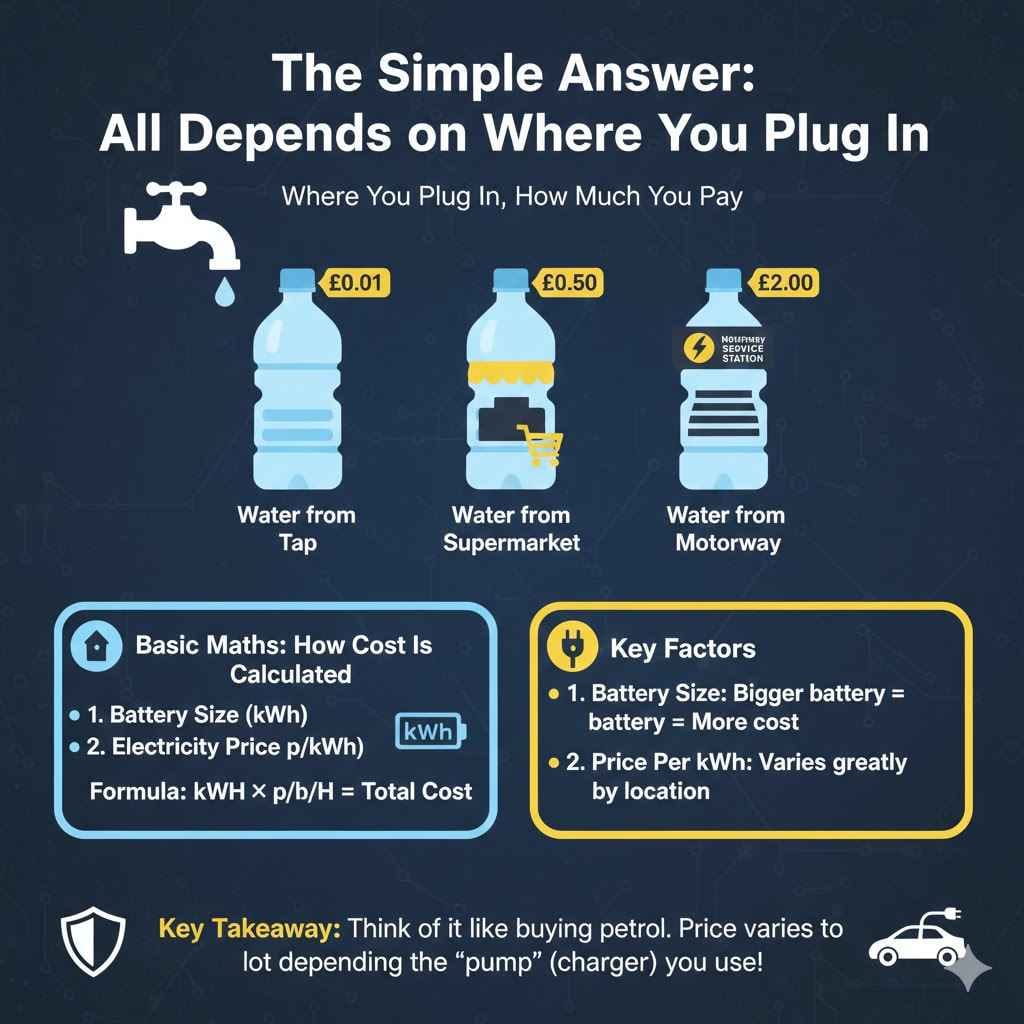
The cost of charging an electric car isn’t one single price. It’s a bit like buying a drink. A bottle of water from your tap is nearly free. The same bottle from a supermarket costs a little more. And that same bottle from a motorway service station? You’ll pay a lot more for the convenience.
Electric car charging works the same way. The price is based on two simple things:
- The size of your car’s battery (measured in kilowatt-hours, or kWh). Think of this like the size of your petrol tank. A bigger battery holds more energy and costs more to fill.
- The price of electricity where you charge (measured in pence per kWh). This is like the price of a litre of petrol, and it changes depending on where you plug in.
So, the basic maths is: Battery Size (kWh) × Electricity Price (p/kWh) = Total Cost to Charge.
Let’s look at the different “pumps” you can use and see how the price changes.
Charging at Home: Your Secret Weapon for Cheap Miles
For most electric car owners, around 80% of charging happens right at home. This is by far the cheapest, easiest, and most convenient way to keep your car topped up. You plug in overnight, just like your phone, and wake up to a full “tank” every morning.
Understanding Your Home Electricity Tariff
The price you pay for home charging depends entirely on your electricity plan, or “tariff.” There are two main types to know about.
1. Standard Variable Tariffs (SVT): This is the default plan most people are on. The price per kWh is set by the government’s energy regulator, Ofgem, and can change every few months. Right now, it’s around 27p per kWh. It’s a reliable price, but not the cheapest for an EV.
2. EV-Specific Tariffs: These are game-changers. Energy suppliers offer special plans for electric car owners with super cheap electricity during “off-peak” hours, usually overnight (e.g., from midnight to 5 am). During these hours, the price can drop to as low as 7.5p per kWh. This is where the huge savings are.
Let’s Do the Math: A Real-World Example
Seeing the numbers side-by-side makes the difference crystal clear. Let’s take a popular electric car, like a Volkswagen ID.3 with a 58kWh battery, and see how much a full charge (from 0% to 100%) costs on both types of tariffs.
| Tariff Type | Price per kWh | Cost for a Full 58kWh Charge | Approximate Cost per Mile |
|---|---|---|---|
| Standard Tariff | 27p | £15.66 | ~6p |
| Off-Peak EV Tariff | 7.5p | £4.35 | ~1.7p |
As you can see, the difference is huge! Just by switching to an EV tariff and charging overnight, you could pay less than a third of the price. That £4.35 charge will give you over 250 miles of range. To go that same distance in a petrol car getting 45 MPG, you’d spend over £30. The savings add up incredibly fast.
What About the Charger Installation Cost?
To get the best charging speeds and safety at home, you’ll want a dedicated home charger, often called a wallbox. This is a one-off cost, typically ranging from £800 to £1,200 for supply and installation. While that sounds like a lot, it pays for itself quickly with the money you save on fuel. Plus, if you live in a flat or rent your property, you may be eligible for a government grant to help with the cost through the EV chargepoint grant scheme.
Public Charging: Convenience When You’re on the Road
What happens when you’re far from home and need a top-up? That’s where the public charging network comes in. It’s growing fast across the UK, with chargers at supermarkets, retail parks, town centres, and motorway service stations. But this convenience comes at a higher price.
The Different Types of Public Chargers
Public chargers are not all the same. They are grouped by how quickly they can charge your car. Think of them as a trickle, a tap, or a fire hose.
- Slow Chargers (3-7kW): These are often found in long-stay car parks or workplaces. They add about 10-20 miles of range per hour. Sometimes they are free to use, which is a great bonus!
- Fast Chargers (7-22kW): You’ll find these at supermarkets, gyms, and cinemas. They are perfect for adding a good amount of range while you’re busy for an hour or two, typically giving 25-80 miles of range per hour.
- Rapid & Ultra-Rapid Chargers (50kW+): These are the motorway heroes. They are designed to get you back on the road quickly, adding 100-200 miles of range in as little as 20-30 minutes. They are the most expensive type of charger.
Public Charging Costs: A Wide Spectrum
The price for public charging varies a lot between different network providers (like Gridserve, BP Pulse, Ionity, and Pod Point) and the speed of the charger. Unlike at home, you can’t shop around for a better tariff. You pay the price shown on the machine.
Here’s a rough idea of what to expect:
- Slow/Fast Chargers: Prices range from 30p to 60p per kWh.
- Rapid/Ultra-Rapid Chargers: Prices are usually higher, from 65p to 85p per kWh.
Some networks offer a monthly subscription. You pay a small fee and get a lower price per kWh, which can be worthwhile if you use public chargers often.
Let’s Do the Math Again: Public Charging Example
Let’s use our same 58kWh Volkswagen ID.3 to see how the costs compare when charging in public. For this example, we’ll calculate the cost to add about 80% charge, as you rarely charge to 100% on a rapid charger to save time and protect the battery.
| Charger Type | Average Price per kWh | Cost for an 80% Charge (~46kWh) | Approximate Time to Add 80% Charge |
|---|---|---|---|
| Fast Charger (22kW) | 45p | £20.70 | 2-3 Hours |
| Rapid Charger (50kW) | 79p | £36.34 | 45-60 Minutes |
| Ultra-Rapid Charger (150kW+) | 79p | £36.34 | 20-30 Minutes |
The numbers are shocking in a different way here. A single rapid charge on the motorway can cost more than eight times as much as charging overnight at home! This is why public charging is best for long trips and occasional top-ups, not for everyday use.
Other Factors That Affect Your Charging Cost and Range
Just like with a petrol car, several things can affect how much energy your EV uses and, therefore, how much it costs to run.
- The Weather: Cold temperatures can be a big shock for new EV owners. Batteries are less efficient in the cold, so your car’s range can drop by 10-30% in the winter. Using the heater also uses a lot of energy.
- Your Driving Style: Driving smoothly and avoiding harsh acceleration and braking will save a lot of energy. Most EVs have regenerative braking, which puts a little bit of power back into the battery when you slow down.
- Tyre Pressure: Just like in any car, under-inflated tyres create more resistance and use more energy. Check your pressures regularly.
- Charging Losses: Not all the electricity from the plug makes it into your battery. A small amount (usually around 10%) is lost as heat during the charging process. This is normal, but it’s good to be aware of.
Top Tips to Keep Your EV Charging Costs Down
You have a lot of control over how much you spend on charging. By being smart, you can keep your running costs incredibly low. Here are the best ways to save money:
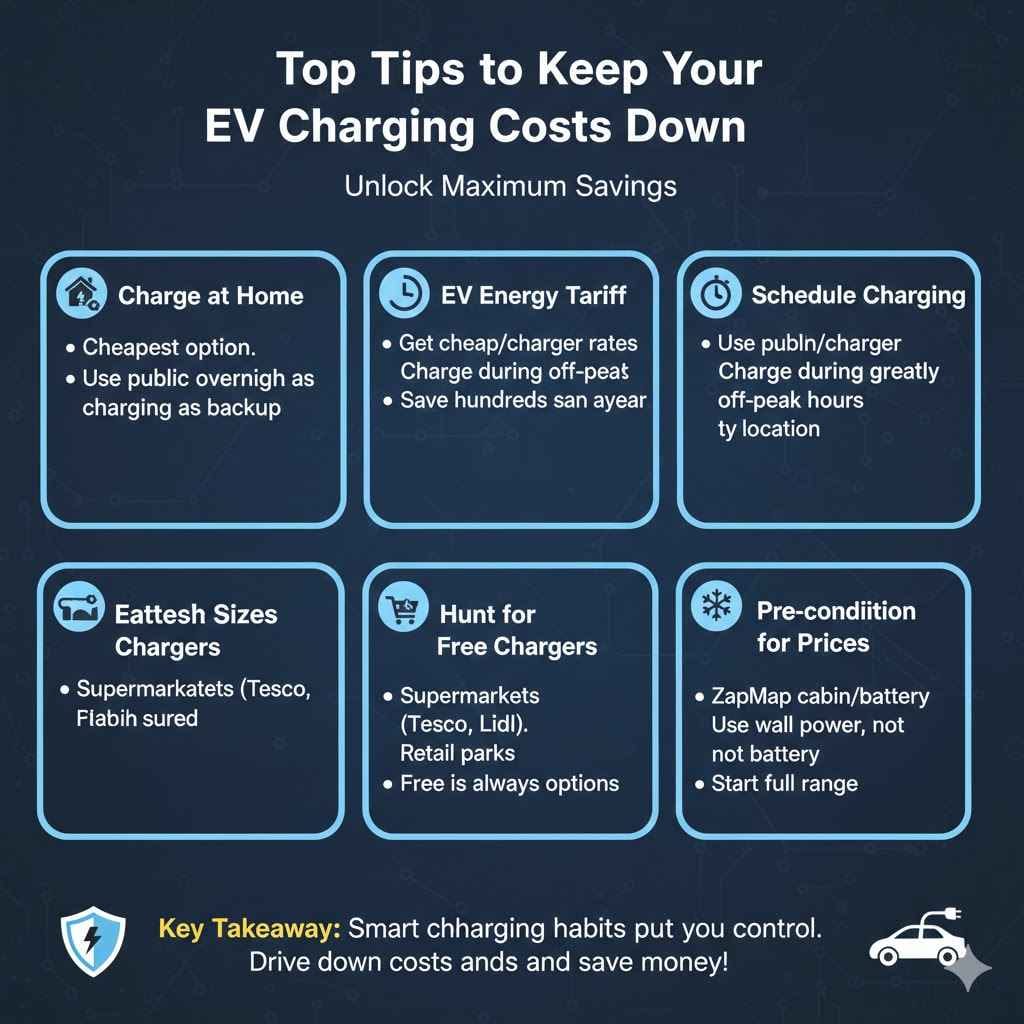
Charge at Home as Much as Possible: This is the number one rule. Home charging is always the cheapest option. Treat public chargers as a backup for long journeys.
Switch to an EV-Specific Energy Tariff: If you can, get a tariff with cheap overnight electricity. This single change can save you hundreds of pounds a year.
Schedule Your Charging: Use the timer in your car or home charger to make sure it only charges during those cheap off-peak hours. Set it and forget it!
Hunt for Free Chargers: Many supermarkets (like Tesco and Lidl) and retail parks offer free charging for customers. It might be slow, but free electricity is always a win!
Use Apps to Find the Best Prices: Apps like Zap-Map and PlugShare not only show you where chargers are but also their live status and cost. You can filter by price to find the cheapest option near you.
Pre-condition Your Car: On a cold morning, use your car’s app to warm up the cabin and battery while it’s still plugged in. This uses power from the wall, not your battery, so you start your journey with a full range.
Avoid Overstay Fees: Some public chargers have “idling fees.” If you leave your car plugged in after it has finished charging, you could be charged a penalty per minute. Move your car as soon as it’s done.
FAQ: Your EV Charging Questions Answered
Is it really cheaper to charge an EV than to buy petrol?
Yes, absolutely. Even if you only used expensive rapid chargers, the cost per mile would be similar to an efficient petrol car. If you charge at home on an off-peak tariff, the cost per mile is a tiny fraction of petrol, saving the average driver over £1,000 per year.
How long does it take to charge an electric car?
It depends on the car’s battery size and the charger’s speed. A full charge at home on a 7kW wallbox typically takes 6-12 hours (perfect for overnight). A rapid charger on the motorway can add 80% charge in just 20-40 minutes.
Can I use any public charger for my car?
Almost all modern EVs and public chargers in the UK and Europe use the same “Type 2” connector for slow/fast charging and “CCS” connector for rapid charging. So, you can be confident that you’ll be able to plug into most public chargers. The main exception is the Nissan Leaf, which uses a different rapid charging plug called CHAdeMO, but these are still widely available.
Do I need a special charger at home?
While you can charge an EV using a standard 3-pin wall socket, it is extremely slow (taking over 24 hours for a full charge) and not recommended for regular use. A dedicated 7kW wallbox is much faster, safer, and more efficient. It is the best solution for home charging.
Is it safe to charge my car in the rain?
Yes, it is completely safe. Electric cars and chargers are designed to be used in all weather conditions. The charging equipment is weatherproof, and there are multiple safety systems in place to prevent any risk of electric shock.
How do I pay for public charging?
Payment methods vary. Most now accept contactless payment with a credit or debit card. Others require you to use a specific smartphone app for that network or an RFID card. It’s a good idea to download the apps for a few of the major networks before a long trip.
What is an ‘idling’ or ‘overstay’ fee?
This is a fee some networks charge if you leave your car connected to the charger after it has finished charging. It’s designed to stop people from blocking chargers that other drivers need. Your car’s app or the charging provider’s app will usually notify you when your charge is nearly complete.
Conclusion: The Shocking Verdict on EV Charging Costs
So, how much does it cost to charge an electric car in the UK? The shocking answer is that it can be both incredibly cheap and surprisingly expensive. The power is truly in your hands.
If you rely solely on convenient but costly public rapid chargers, your running costs could be similar to an efficient petrol car. But if you embrace home charging and switch to an off-peak electricity tariff, you will unlock the biggest superpower of owning an EV: running your car for just pennies per mile.
The transition to electric driving is about more than just a new car; it’s about a new way of thinking about fuel. By planning your charging and using the right tools, you can leave the unpredictable prices at the petrol station behind for good and enjoy a smoother, quieter, and much cheaper drive.