
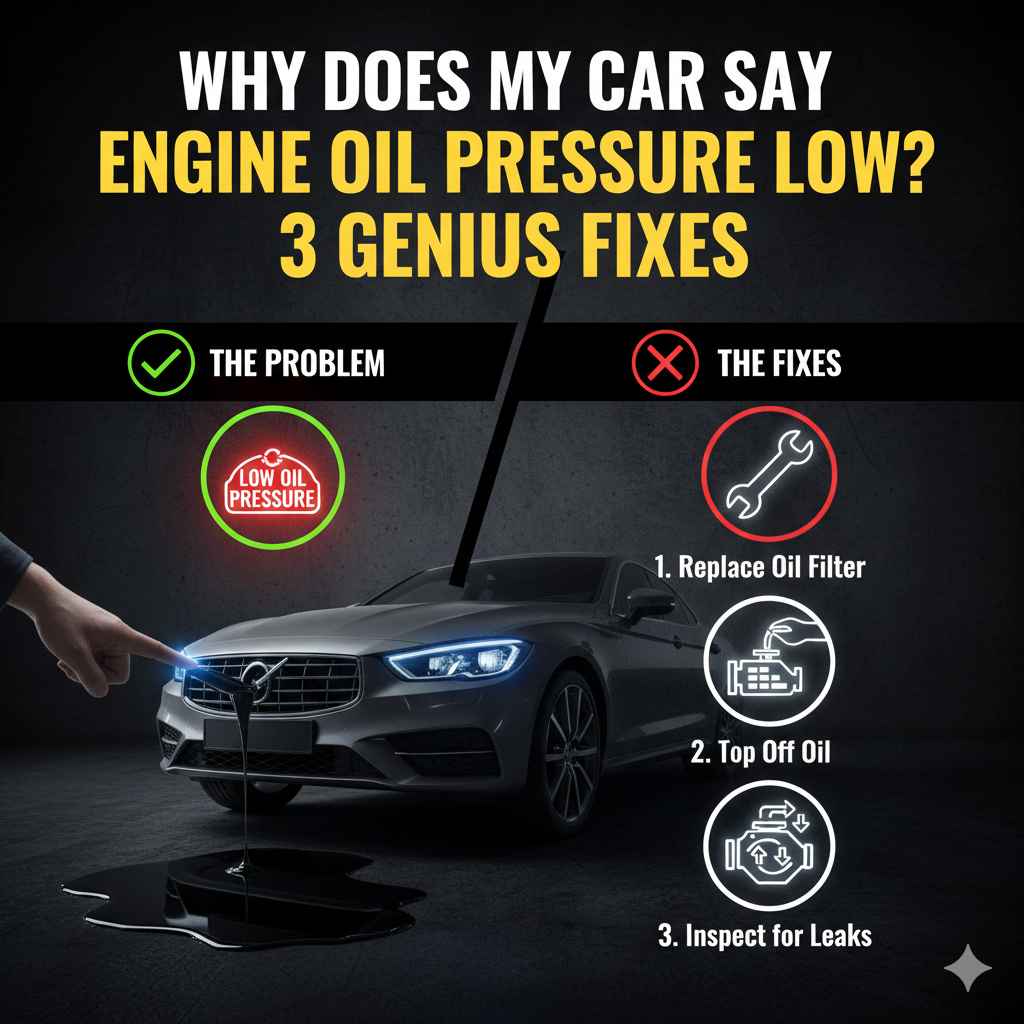
A low engine oil pressure warning often means your car’s oil level is critically low, and you should stop driving immediately. The most common causes are a simple lack of oil, a faulty oil pressure sensor giving a false reading, or a more serious internal engine problem like a failing oil pump.
That little red or orange oil can symbol on your dashboard is one of the most serious warnings your car can give you. Seeing “Engine Oil Pressure Low” flash to life can send a wave of panic through any driver. It feels complicated, expensive, and frankly, a little scary. But don’t worry. I’m Dustin, and I’m here to walk you through this problem step-by-step. More often than not, the fix is easier than you think.
Think of your car’s engine oil like the blood in your body. It lubricates all the moving parts, cleans away gunk, and helps keep things cool. Oil pressure is the force that pushes that oil through all the tiny passages inside your engine. When that pressure drops, vital parts can grind against each other, causing catastrophic damage in a matter of minutes. That’s why this warning is so urgent.
But before you start imagining a huge repair bill, let’s take a deep breath. We’re going to tackle this together, starting with the simplest and most common solutions. I’ll show you exactly what to do, what to look for, and how to make a smart decision to keep your car safe and reliable. Let’s get you back on the road with confidence.
What To Do Immediately When the Oil Pressure Light Comes On
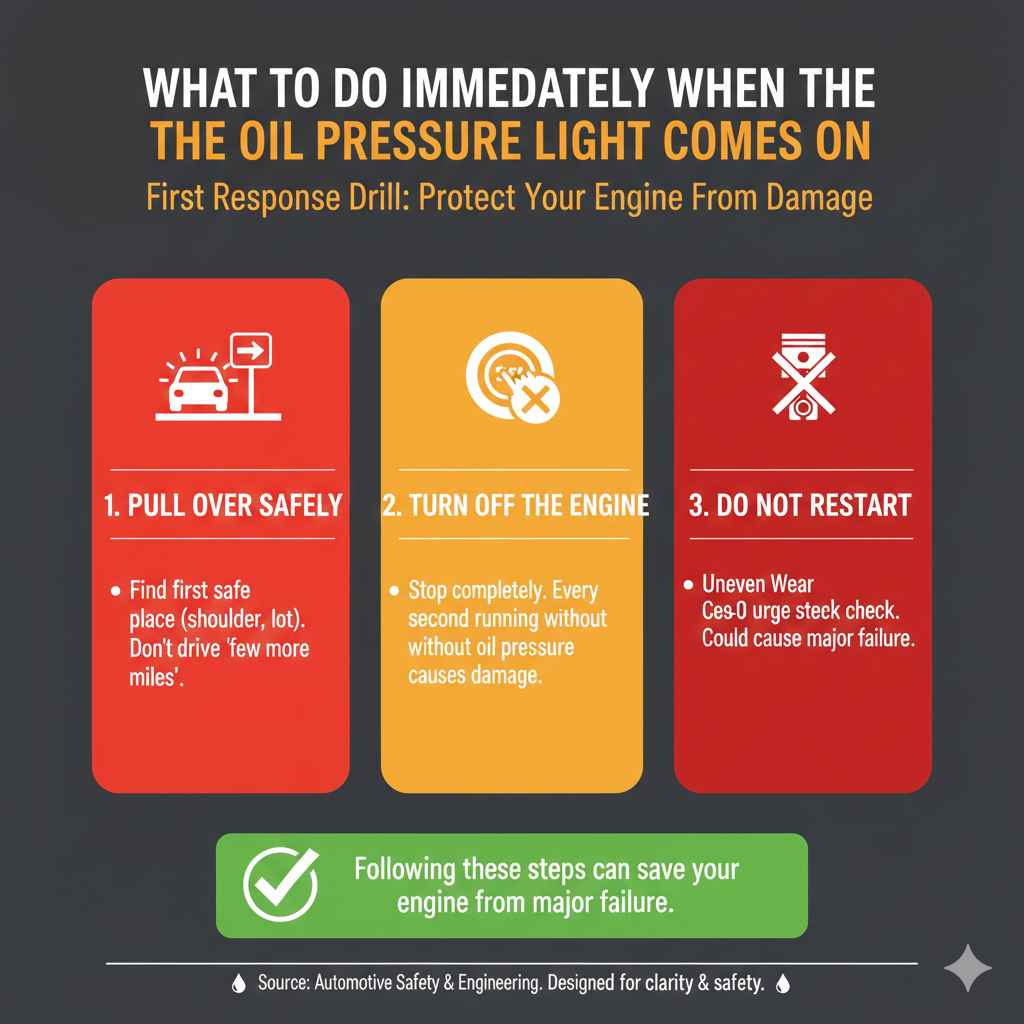
Before we dive into the fixes, you need to know the first-response drill. This is non-negotiable and the single most important thing you can do to protect your engine from expensive damage.
- Pull Over Safely: As soon as you see the light, find the first safe place to pull over. This means a shoulder, a side street, or a parking lot. Do not continue driving to your destination, even if it’s “just a few more miles.”
- Turn Off the Engine: Once you are safely stopped, turn off the engine completely. Every second the engine runs without proper oil pressure, it is damaging itself.
- Do Not Restart the Engine: Resist the urge to see if the light “goes away.” Restarting the engine could be the final straw that causes a major failure.
Following these three steps can be the difference between a simple fix and needing a whole new engine. Now that your car is safely stopped, we can investigate the cause.
The Easiest Fix — Check Your Engine Oil Level
Nine times out of ten, the “Engine Oil Pressure Low” light is simply telling you the truth: your engine is dangerously low on oil. This can happen from a slow leak you didn’t notice or because the engine is naturally burning a small amount of oil between changes. This is the best-case scenario because it’s a problem you can fix yourself in minutes.
How to Check Your Engine Oil Like a Pro
Checking your oil is a fundamental car care skill. If you’ve never done it before, don’t feel intimidated. It’s as easy as checking the air in your tires.
What you’ll need:
- A clean, lint-free rag or paper towel
- A funnel (optional, but highly recommended)
- The correct type of engine oil for your car (check your owner’s manual!)
Here are the steps:
- Park on Level Ground: For an accurate reading, your car must be on a flat surface. A sloped driveway will give you a false reading.
- Let the Engine Cool: Wait at least 10-15 minutes after turning the engine off. This allows the oil to drain back down into the oil pan at the bottom of the engine.
- Locate the Dipstick: Open the hood and find the oil dipstick. It usually has a brightly colored handle (often yellow or orange) and may have an oil can symbol on it.
- Pull and Wipe: Pull the dipstick all the way out. Use your rag to wipe it completely clean from the handle to the tip.
- Dip and Read: Push the clean dipstick all the way back into its tube. Make sure it goes in fully. Now, pull it out again and look at the tip.
- Check the Level: The end of the dipstick will have markings. There might be two small holes, two lines, or a cross-hatched area. The oil level should be somewhere between the “Full” and “Add” marks. If there is no oil on the dipstick at all, or if it’s below the “Add” mark, your oil level is critically low. This is almost certainly the cause of your warning light.
How to Add Engine Oil Safely
If the level is low, it’s time to add some oil. This is just as easy, but you need to be careful not to add too much.
- Find the Oil Cap: Look for a large cap on top of the engine, usually with the same oil can symbol or the word “OIL” printed on it.
- Unscrew the Cap: Turn the cap counter-clockwise to remove it. Place it somewhere clean where it won’t get dirty.
- Add Oil Slowly: If you have a funnel, place it in the opening. Add about half a quart (or half a liter) of the correct oil for your car. Don’t just dump the whole bottle in!
- Wait and Re-Check: Wait a minute or two for the oil to settle into the pan. Then, use the dipstick again to check the level.
- Repeat if Needed: Continue adding a little oil at a time and re-checking the dipstick until the level is at or just below the “Full” mark. Do not overfill the engine. Too much oil can be just as bad as too little.
Once the oil level is correct, you can safely restart your engine. The warning light should go off within a few seconds. If it does, you’ve just saved yourself a tow and a trip to the mechanic! However, you still need to figure out why the oil was low. Keep a close eye on the oil level over the next few weeks to see if you have a leak.
The Common Culprit — A Faulty Oil Pressure Sensor
What if you check your oil and the level is perfectly fine? If the dipstick shows the oil is right at the “Full” mark, you might be dealing with a faulty sensor. This is another very common and relatively inexpensive problem.
What is an Oil Pressure Sensor?
The oil pressure sensor (or sending unit) is a small electronic device that screws into the engine block. Its only job is to measure the pressure of the oil and send that information to your car’s computer, which then controls the warning light on your dash.
Like any electronic part, these sensors can fail over time. They can get clogged with sludge, the internal wiring can break, or the connection can become loose. When this happens, it can send a false signal, telling your dashboard there’s a problem when there isn’t one.
Symptoms of a Bad Oil Pressure Sensor
A failing sensor often behaves differently than a true low-pressure situation. Here are some classic signs:
- Flickering Light: The oil pressure light might flicker on and off randomly, especially at idle or when you first start the car.
- Warning at Idle Only: The light may come on when you’re stopped at a red light but go away as soon as you press the gas and the engine RPMs increase.
- Gauge Acting Erratically: If your car has a physical oil pressure gauge, it might bounce around wildly or drop to zero and then jump back up to normal.
- Light On, Engine Sounds Fine: If the light is on but your engine sounds perfectly normal (no new clattering, knocking, or grinding noises), a bad sensor is a strong possibility. A true low-pressure situation is almost always accompanied by scary new engine noises.
This table can help you tell the difference:
| Symptom | Likely Cause: True Low Oil Pressure | Likely Cause: Faulty Sensor |
|---|---|---|
| Warning Light Behavior | Stays on solid and consistently. | Flickers, comes on at idle, or acts erratically. |
| Engine Noise | Loud ticking, clattering, or grinding noises. | Engine sounds completely normal. |
| Oil Dipstick Reading | Oil level is below the “Add” mark. | Oil level is full and correct. |
| Other Warning Lights | The “Check Engine” light may also come on. | Usually, only the oil light is on. |
What to Do About a Bad Sensor
Replacing an oil pressure sensor is a manageable DIY job for some, but it can be tricky depending on its location. If you’re not comfortable working on your engine, this is a quick and affordable job for any trusted mechanic. They can also perform a manual pressure test to confirm the sensor is the problem before replacing it.
Even if you suspect a bad sensor, it’s still best to limit your driving until it’s confirmed. It’s not worth risking your engine on a guess. Towing the car to a shop is the safest bet.
The Serious Issue — Mechanical Engine Problems
This is the scenario we all hope to avoid. If your oil level is full and you’ve ruled out a bad sensor, the “Engine Oil Pressure Low” warning could be pointing to a serious mechanical failure inside the engine. This is rare, especially on a well-maintained car, but it’s critical to recognize the signs.
The Heart of the System: The Oil Pump
The oil pump is a mechanical gear that is driven by the engine. Its sole purpose is to suck oil from the oil pan and pump it under pressure throughout the engine. If this pump fails, the pressure disappears, and the engine starves for lubrication.
Signs of a failing oil pump include:
- A consistent low oil pressure warning at all engine speeds.
- A loud whining or whirring noise coming from the engine.
- A noticeable increase in engine temperature.
Replacing an oil pump is a major, labor-intensive repair that is not a beginner DIY job. If you suspect this is the issue, your car needs to be towed to a professional mechanic immediately.
The Clogged Arteries: Sludge and Blockages
Another mechanical issue is an internal blockage. Over many thousands of miles, if oil changes are neglected, the oil can break down and form a thick, tar-like substance called sludge. This sludge can clog the “pickup tube,” which is the straw the oil pump uses to suck up oil from the pan. It can also clog the small passages that deliver oil to vital components.
The engine can be full of oil, and the pump can be working perfectly, but if the pickup tube is blocked, no pressure can be built. This is a direct result of poor maintenance. The only solution is often a major engine cleaning or teardown, which is very expensive.
Fix Difficulty and Cost Comparison
Here’s a quick look at how these three fixes stack up in terms of difficulty and cost.
| Problem | DIY Difficulty | Estimated Cost (DIY) | Estimated Cost (Mechanic) |
|---|---|---|---|
| Low Oil Level | Very Easy | $10 – $20 for a quart of oil | N/A (This is a self-fix) |
| Faulty Oil Sensor | Easy to Moderate | $20 – $75 for the part | $100 – $250 |
| Failing Oil Pump / Sludge | Very Difficult (Pro-Level) | Not recommended for DIY | $500 – $2,000+ |
Prevention is the Best Medicine: How to Avoid Low Oil Pressure Problems
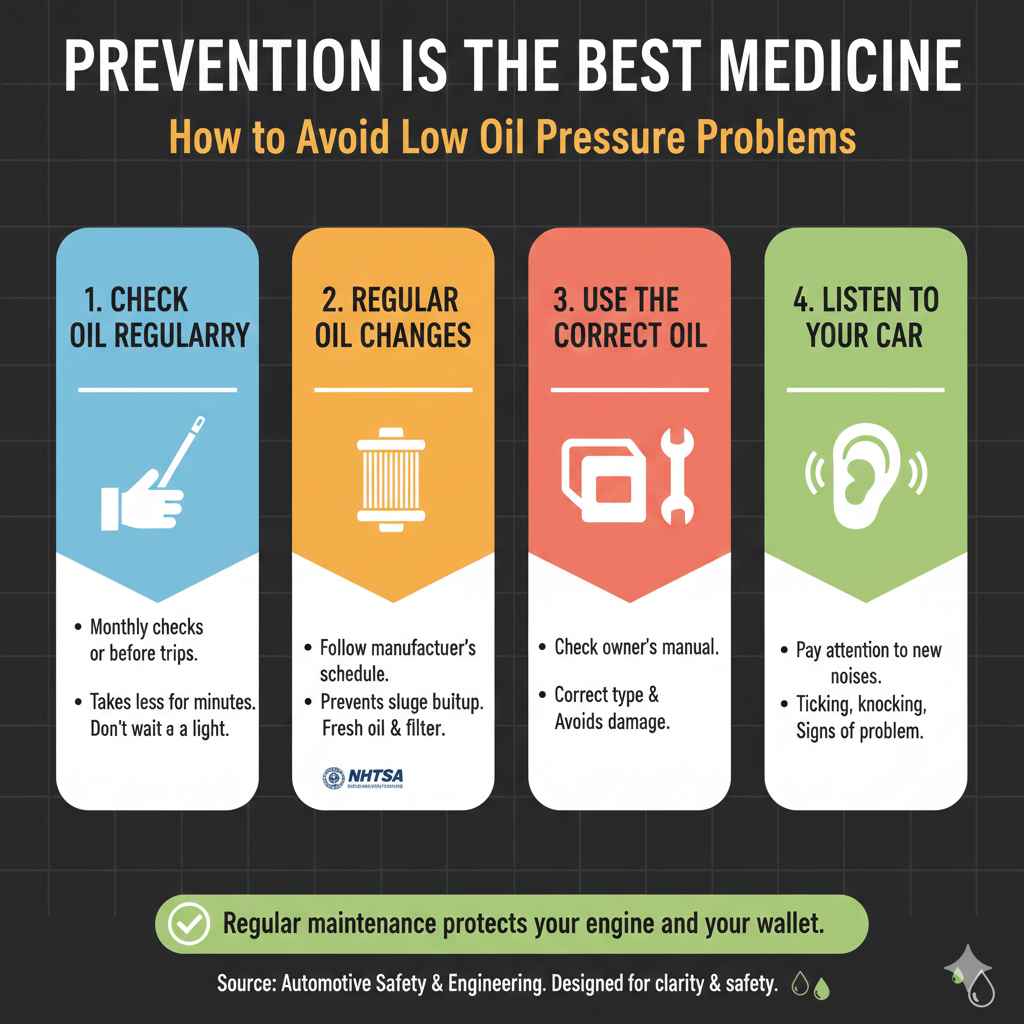
You can avoid nearly all of these issues with one simple habit: regular maintenance. Keeping up with your car’s service schedule is the most effective way to protect your engine and your wallet.
- Check Your Oil Regularly: Don’t wait for the warning light. Make it a habit to check your oil level at least once a month, or before any long road trip. It takes less than two minutes.
- Get Regular Oil Changes: This is the most important maintenance you can perform. Follow the manufacturer’s recommended interval (usually found in your owner’s manual). Fresh oil and a new filter keep sludge from forming and ensure your engine is properly protected. The National Highway Traffic Safety Administration (NHTSA) emphasizes that regular vehicle maintenance is key to safety and reliability.
- Use the Correct Oil: Using the wrong type or weight of oil can lead to low pressure and long-term damage. Your owner’s manual will specify exactly what your engine needs. Don’t guess!
- Listen to Your Car: Pay attention to new noises. A healthy engine has a consistent, smooth sound. Ticking, knocking, or whining are signs that something is wrong.
Frequently Asked Questions (FAQ)
1. Can I drive my car with the low oil pressure light on?
No, you should never drive with the low oil pressure light on. Pull over and turn off the engine as soon as it is safe to do so. Driving for even a few minutes can cause severe, irreversible engine damage that could cost thousands of dollars to repair.
2. My oil light comes on at idle but goes off when I drive. Is it safe?
While this is a classic symptom of a bad oil pressure sensor, you should not assume it’s safe to drive. It could also be a sign of worn engine bearings or a failing oil pump that can’t generate enough pressure at low RPMs. Have it checked by a professional immediately.
3. How do I know what kind of oil my car needs?
The best place to find this information is in your vehicle’s owner’s manual. It will specify the required viscosity (like 5W-30) and the certification standard (like API SN). If you don’t have the manual, you can usually find this information online or at any auto parts store.
4. What’s the difference between the oil pressure light and the “check engine” light?
The oil pressure light (usually a red or orange oil can symbol) is a specific warning about the engine’s lubrication system and is extremely urgent. The “check engine” light is a more general warning that can indicate hundreds of different potential issues, from a loose gas cap to a serious transmission problem.
5. I overfilled my engine with oil. What should I do?
Overfilling the engine can be harmful. The crankshaft can whip the oil into a foam, which doesn’t lubricate properly and can cause overheating. If you’ve only added a little too much, it may not be a major issue. But if the level is significantly over the “Full” mark, you should not start the engine. You will need to drain some oil out, which may require a tow to a mechanic if you’re not comfortable doing it yourself.
6. Can a cheap oil filter cause low oil pressure?
Yes, absolutely. A low-quality or incorrect oil filter can become clogged or have a faulty anti-drainback valve, both of which can restrict oil flow and cause a drop in pressure. Always use a high-quality filter that meets your car’s specifications.
Conclusion: Your Next Steps to a Healthy Engine
Seeing the “Engine Oil Pressure Low” light can be stressful, but now you’re armed with the knowledge to handle it calmly and correctly. Remember the most important rule: pull over and turn the engine off immediately. From there, your investigation is simple. Start with the easiest and most common fix by checking the dipstick.
If the oil level is low, topping it off will likely solve your problem and get you back on your way. If the oil level is full, you can look for the signs of a faulty sensor. And in the rare case that it’s something more serious, you now know the importance of getting your car to a professional right away.
Car care is all about confidence, and by understanding how your car’s lubrication system works, you’ve taken a huge step toward becoming a more empowered and knowledgeable car owner. Regular checks and timely maintenance are your best defense, ensuring your engine runs smoothly for many years and miles to come.