
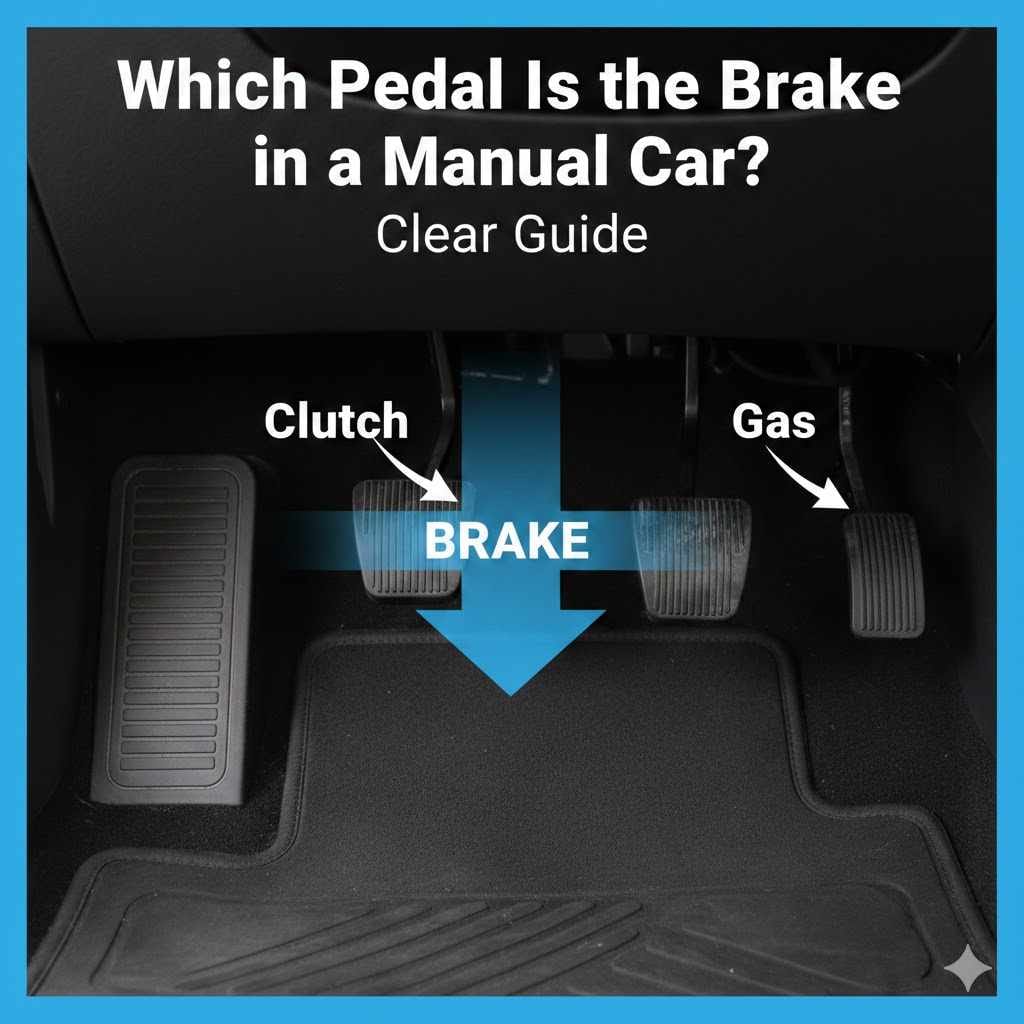
Learning to drive a car with a manual transmission can feel a bit tricky at first. One common question new drivers have is, Which Pedal Is the Brake in a Manual Car? Clear Guide, because they are used to automatics.
It’s totally normal to get a little confused when you see three pedals instead of two. This guide will make it super simple. We’ll walk through it step by step so you know exactly which pedal does what, and you’ll be driving with confidence soon.
Understanding Manual Car Pedals
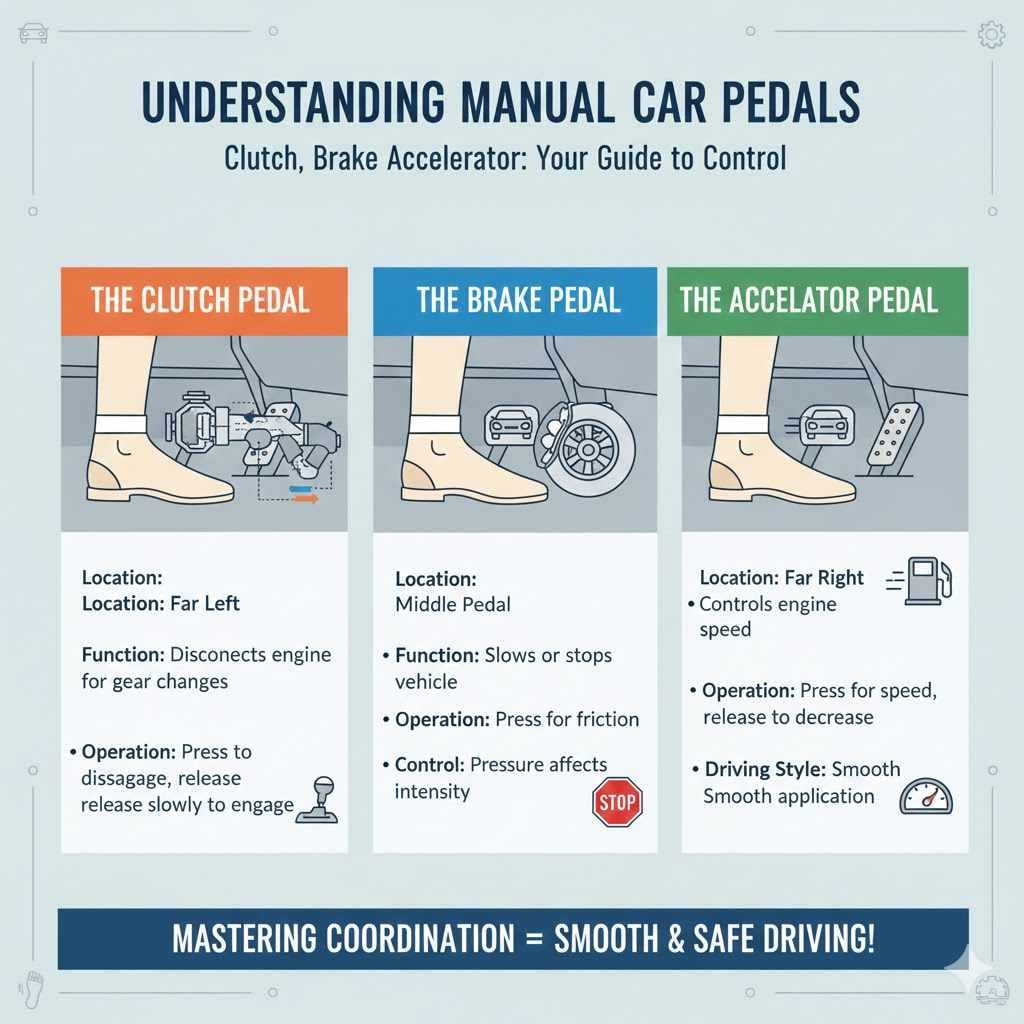
Cars with manual transmissions have three pedals that control the car’s speed and power. These pedals are the clutch, the brake, and the accelerator. Knowing what each pedal does is key to driving smoothly and safely.
This section will explain the purpose of each pedal and how they work together. We’ll break down each one so you can easily remember their functions.
The Clutch Pedal
The clutch pedal is the pedal on the far left in a manual car. Its main job is to disconnect the engine from the transmission. When you press this pedal, you can change gears.
When you let it out slowly, you reconnect the engine to the transmission, allowing power to go to the wheels. This allows for smooth gear changes and starting from a stop.
Think of the clutch like a switch. When it’s pressed, the engine is in neutral relative to the wheels. When it’s released, the engine’s power flows to the wheels through the gearbox.
Mastering the clutch is often the hardest part of learning to drive a manual. It takes practice to get the feel for when to press and release it, especially when starting on a hill.
Here are some key points about the clutch pedal:
Location: It’s always the leftmost pedal.Function:
Disconnects the engine from the wheels to allow gear changes.
Operation: Press down to disengage, release slowly to engage.Importance: Essential for shifting gears and starting smoothly.
Learning Curve: Requires practice to master the engagement point.Feel: Often described as a “bite point” where the engine starts to connect.
The Brake Pedal
The brake pedal is located in the middle of the three pedals. This is the pedal you use to slow down or stop the car. When you press the brake pedal, it activates the car’s braking system, which applies pressure to the wheels to create friction and reduce speed.
This pedal functions the same way as the brake pedal in an automatic car.
It’s crucial to know that the brake pedal is your primary control for stopping. Unlike the clutch, which needs careful coordination, the brake pedal is straightforward. Press it to brake; release it to stop braking.
The harder you press, the faster the car slows down. In emergency situations, pressing the brake pedal firmly and quickly is essential for maximum stopping power.
Key aspects of the brake pedal:
Location: It’s the middle pedal.Function: To slow down or stop the vehicle.
Operation: Press to activate brakes, release to disengage.Control: The amount of pressure determines the braking intensity.
Similarity to Automatics: Works exactly like the brake in an automatic car.Safety: Your most important safety pedal for avoiding hazards.
The Accelerator Pedal
The accelerator pedal, also known as the gas pedal, is on the far right. This pedal controls the engine’s speed. Pressing it down increases the amount of fuel and air going into the engine, making the engine work harder and therefore increasing the car’s speed.
Releasing the pedal reduces engine power and slows the car down.
Like the brake pedal, the accelerator is similar in function to that in an automatic transmission. You press it to go faster and ease off to slow down. The amount you press it directly affects how quickly you accelerate.
Smoothly applying and releasing the accelerator is important for fuel efficiency and a comfortable ride for passengers.
Understanding the accelerator pedal:
Location: It’s the rightmost pedal.Function: Controls engine speed and thus the car’s acceleration.
Operation: Press to increase speed, release to decrease speed.Influence: Affects how quickly the car gains momentum.
Driving Style: Smooth application leads to a comfortable ride.Economy: Gentle acceleration saves fuel.
Putting It All Together Which Pedal Is the Brake in a Manual Car Clear Guide
Now that you know what each pedal does, let’s focus on the specific question: Which pedal is the brake in a manual car? The answer is straightforward. The brake pedal is the one in the middle.
It’s the same pedal you would use in an automatic car. You do not need to use the clutch when applying the brakes, unless you are coming to a complete stop and intend to shift into neutral or a lower gear.
The critical part for beginners is to remember that the middle pedal is always the brake. Your right foot will typically operate both the brake and the accelerator. This means you’ll move your foot between these two pedals.
It’s essential to practice this foot movement so it becomes second nature. Think of it as a dance your right foot does between the brake and gas.
Here’s a simple breakdown for easy recall:
Leftmost pedal: Clutch (for shifting gears).Middle pedal: Brake (for slowing down and stopping).
Rightmost pedal: Accelerator (for going faster).Your Right Foot: Operates both the brake and accelerator pedals.
Braking: Press the middle pedal with your right foot.No Clutch Needed: For most braking, the clutch pedal stays untouched.
How to Use the Brake Pedal When Driving
Using the brake pedal in a manual car is very similar to using it in an automatic. When you need to slow down or stop, simply lift your right foot off the accelerator and press the middle pedal with your right foot. The amount of pressure you apply will determine how quickly the car decelerates.
For gentle slowing, use light pressure. For a quick stop, press firmly.
When you are coming to a complete stop, it is often recommended to press the clutch pedal down with your left foot just before the car stops completely. This prevents the engine from stalling. However, if the car is already moving at a low speed or rolling to a stop, you might not need to press the clutch.
The key is to listen to the engine and feel how the car is responding.
Steps for braking:
Identify the middle pedal (the brake).
Lift your right foot from the accelerator pedal.
Gently or firmly press the brake pedal with your right foot.
If coming to a complete stop, consider pressing the clutch pedal with your left foot as the car nears standstill.
Common Scenarios and How to Brake
Let’s look at a few everyday situations where you’ll need to use the brake pedal. Imagine you’re driving down a street and see a red traffic light ahead. You’ll lift your foot off the accelerator and press the brake pedal to slow down and stop the car before the line.
As you get close to stopping, you might press the clutch to keep the engine running.
Another scenario is encountering traffic. If cars ahead start slowing down, you’ll do the same. You’ll ease off the gas and gently apply the brake pedal.
If a pedestrian suddenly walks into the road, you’ll need to react quickly. Lift your foot from the gas and press the brake pedal hard to stop the car as quickly as possible. In these moments, knowing which pedal is the brake is instinctive and vital for safety.
Examples of braking in action:
Approaching a stop sign: Release accelerator, press brake pedal. As you stop, press clutch to avoid stalling.
Slowing down for a turn: Ease off accelerator, lightly apply brake pedal. Shift to a lower gear if needed after pressing the clutch.
Emergency stop: Lift foot from accelerator immediately, stomp on the brake pedal. Press the clutch pedal simultaneously if possible to avoid stalling and maximize braking force.
When to Use the Clutch with the Brake
You primarily use the clutch when you need to change gears. This includes shifting from a stop into first gear, or shifting to higher gears as you speed up. You also use the clutch when shifting down to a lower gear to prepare for slowing or accelerating.
The clutch is used in conjunction with the brake when you are coming to a complete stop and want to keep the engine running. Just before the car comes to a standstill, press the clutch pedal all the way down. This disengages the engine from the transmission, preventing the engine from stalling.
If you forget to press the clutch as you stop, the engine will likely sputter and die.
Here’s when they work together:
Coming to a complete stop from a moving speed.The clutch is pressed just before the car stops to prevent engine stall.
Engine braking down a steep hill.You might downshift and use the clutch as you brake to control speed.
When the engine is about to stall.Pressing the clutch can save the engine from shutting off.
The Role of the Middle Pedal
The middle pedal in a manual car is unequivocally the brake pedal. Its design and placement are consistent across almost all manual vehicles. This consistency is intentional to simplify the driving experience and ensure safety.
Drivers can rely on the middle pedal being the one responsible for decelerating and stopping the vehicle, just as they would in an automatic.
It’s important to distinguish it from the other pedals. The clutch on the left is solely for managing the engine’s connection to the wheels, enabling gear changes. The accelerator on the right is purely for controlling speed by managing engine power.
The brake, in the middle, is the universal command to slow or halt the vehicle’s motion. Focusing on this middle pedal for braking is fundamental.
Key functions of the middle pedal:
Primary function: To apply the brakes and slow the car.Secondary function: Used in conjunction with the clutch for smooth stops.
Consistency: Always the middle pedal in manual vehicles.Safety: Essential for controlling vehicle speed and avoiding collisions.
Driver Control: Allows precise adjustments to speed.Interplay: Works independently or with the clutch depending on the situation.
Brake vs. Clutch Pedal Coordination
Coordinating the brake and clutch pedals is a skill that develops with practice. When you are driving and need to stop, you will typically use your right foot for the brake. As the car slows down, you will also need to press the clutch with your left foot to prevent the engine from stalling, especially if you are coming to a full stop.
The timing of this is what makes it a skill.
For smooth stops, you’ll press the brake pedal first to start slowing down. Then, as the speed drops, you’ll press the clutch pedal. This prevents the engine from being forced to slow down too much by the wheels, which would cause it to stall.
Think of it as a sequence: brake, then clutch, as you get slower. Many new drivers tend to press both at once, which can lead to jerky stops.
Here’s how they coordinate:
Start braking with your right foot on the brake pedal.
As the car slows, move your left foot to the clutch pedal.
Press the clutch pedal down completely as you come to a near stop.
Release the brake pedal once the car is stopped (or keep it pressed if on a hill).
Pedal Placement Variations
While the standard layout for manual cars is clutch, brake, accelerator from left to right, some older or specialized vehicles might have slight variations. However, these are rare. The vast majority of modern manual cars follow this established pattern.
It’s crucial to always confirm the pedal layout in any new vehicle you drive, especially if it’s unfamiliar.
For example, some race cars might have different pedal configurations for driver comfort or performance reasons. But for everyday passenger cars, the left-to-right order of clutch, brake, and accelerator is almost universal. This standardization helps drivers transition between different manual vehicles more easily.
If you’re learning, your instructor will likely emphasize this common layout.
A Quick Visual Guide to Pedals
Imagine sitting in the driver’s seat. Your feet are in front of you. On the far left is the clutch.
In the middle is the brake. On the right is the accelerator. It’s a simple straight line of three pedals.
Think of it as L-M-R: Left is clutch, Middle is brake, Right is accelerator.
When you need to stop, focus on that middle pedal. When you need to go faster, focus on the right pedal. And when you need to change gears, use that left pedal.
It’s about assigning your feet to their specific jobs. Your right foot will do most of the work, moving between the brake and accelerator. Your left foot has one main task: the clutch.
Visualizing the pedals:
Left: Clutch PedalMiddle: Brake Pedal
Right: Accelerator PedalRight Foot: Operates brake and accelerator.
Left Foot: Operates clutch.Simple Order: Clutch, Brake, Accelerator (left to right).
Safety and Best Practices
Knowing Which Pedal Is the Brake in a Manual Car? Clear Guide is essential for safe driving. The brake pedal is your primary tool for controlling your speed and stopping the vehicle.
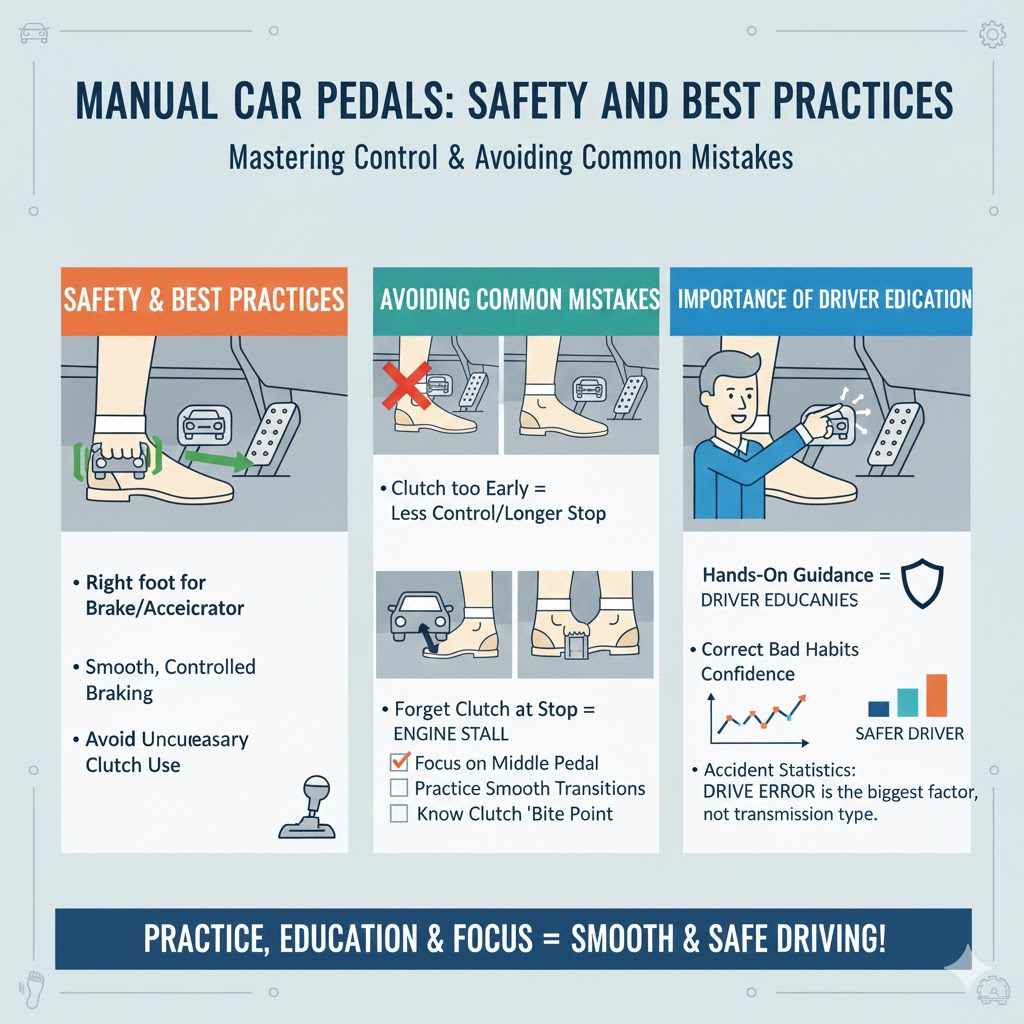
Always ensure your right foot is positioned to comfortably reach both the brake and accelerator pedals. This allows for quick reactions in various driving situations.
Never press the clutch pedal unnecessarily when braking. While it’s needed for coming to a complete stop, using it while simply slowing down can make you lose engine braking, making it harder to control your speed. Focus on smooth, controlled braking using the middle pedal.
Practicing these techniques in a safe, open area will build your confidence and skills.
Avoiding Common Mistakes
One common mistake beginners make is confusing the clutch and brake pedals, especially when in a hurry. Another is pressing the clutch too early when braking, which can lead to longer stopping distances or a loss of control. It’s also common to forget to press the clutch when coming to a full stop, which will cause the engine to stall.
To avoid these, practice makes perfect. Get familiar with the feel of each pedal. Pay attention to the car’s response when you press them.
When slowing down, try to only use the brake pedal until you are very close to stopping, then press the clutch. This will help you develop better pedal control and understanding.
Tips for avoiding errors:
Focus on the middle pedal for braking.Avoid pressing the clutch unless you are stopping completely or changing gears.
Practice smooth transitions between brake and accelerator.Listen to the engine and feel the car’s response.
Develop a consistent braking routine.Know when to press the clutch just before you stop.
The Importance of Driver Education
Proper driver education is invaluable for anyone learning to drive a manual car. An experienced instructor can provide hands-on guidance and correct bad habits before they become ingrained. They will teach you the nuances of clutch control, smooth gear changes, and effective braking techniques.
This hands-on experience is critical for building confidence and competence.
Beyond just knowing which pedal is which, driver education covers vital safety aspects. This includes understanding how to react to different road conditions, defensive driving techniques, and how to handle emergencies. Investing in good driver education will not only help you master driving a manual but also make you a safer and more responsible driver overall.
Statistics on Manual vs. Automatic Transmission Accidents
While the number of manual transmissions on the road has decreased, understanding accident statistics can still be informative. Some studies suggest that drivers of manual transmissions may have a slightly lower accident rate in certain scenarios, possibly due to a more engaged driving style. However, this is a complex correlation influenced by many factors, including driver experience and demographics.
For instance, a report from the National Highway Traffic Safety Administration (NHTSA) in the US often shows that while automatics are more common, accident rates are not solely tied to transmission type. Driver error, speed, and distraction are far more significant factors. The key takeaway is that safe driving practices are paramount, regardless of the transmission type.
Frequently Asked Questions
Question: Which pedal is the brake in a manual car
Answer: The brake pedal is the middle pedal in a manual car. It is operated by your right foot.
Question: Do I need to use the clutch when braking
Answer: You generally only need to use the clutch with the brake when you are coming to a complete stop to prevent the engine from stalling. For slowing down, the brake pedal alone is usually sufficient.
Question: What is the pedal on the far left in a manual car
Answer: The pedal on the far left in a manual car is the clutch pedal. It is used for changing gears.
Question: Can I use my left foot for the brake
Answer: While some drivers might have a preference, the standard and recommended way to drive a manual car is to use your right foot for both the brake and accelerator pedals, and your left foot for the clutch.
Question: How do I stop the car safely in a manual
Answer: To stop safely, you will use the middle brake pedal with your right foot to slow down. As you approach a complete stop, press the clutch pedal down with your left foot to prevent the engine from stalling.
Wrap Up
Learning Which Pedal Is the Brake in a Manual Car? Clear Guide is a fundamental step. Remember, it is the middle pedal, operated by your right foot.
This pedal functions just like in an automatic car. Practice makes perfect, so focus on smooth pedal control and coordination. You’ve got this!