
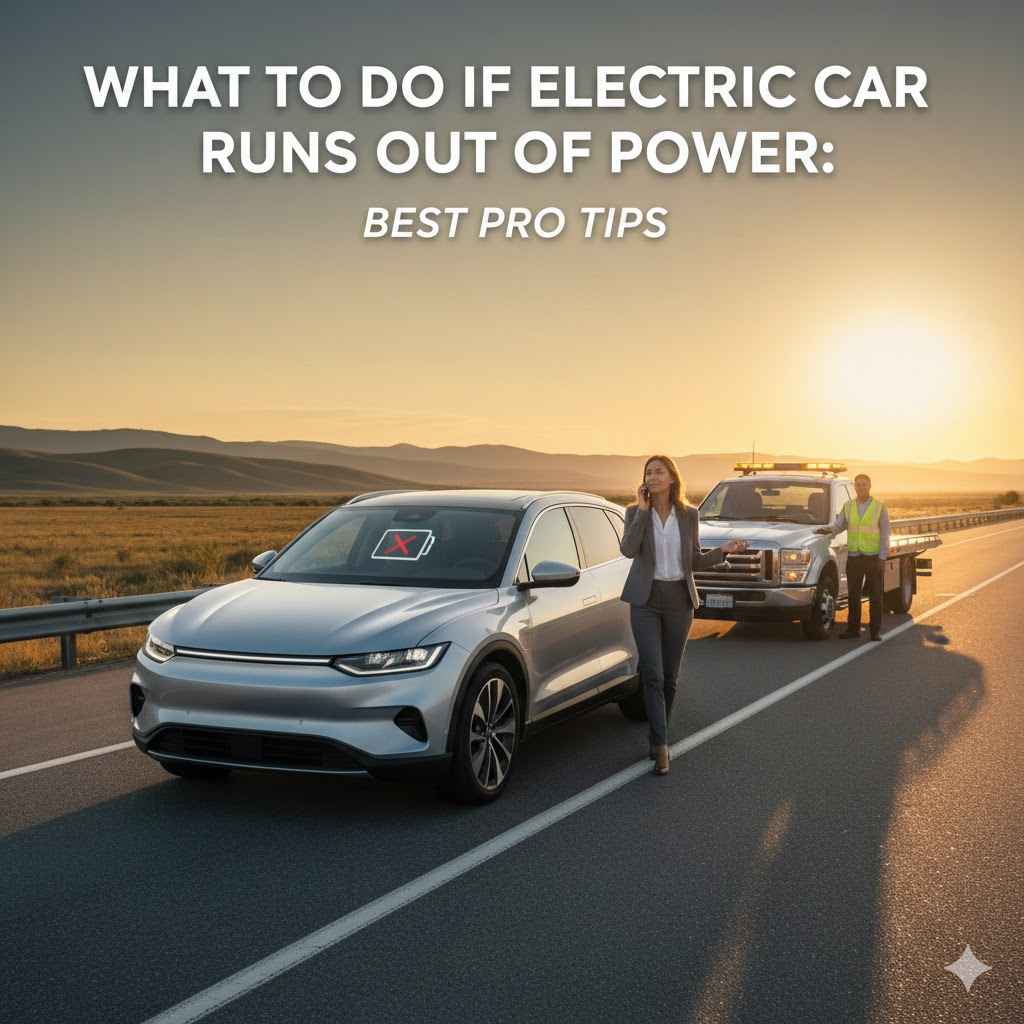
If your electric car runs out of power, immediately pull over to a safe location and turn on your hazard lights. Your best option is to call a roadside assistance service that specializes in EVs. They can provide a mobile charge to give you enough range to reach a station or safely tow your vehicle on a flatbed truck.
What To Do If Your Electric Car Runs Out Of Power: Best Pro Tips
There’s a feeling every new electric car driver knows well. You glance at your dashboard, and the battery percentage seems to be dropping faster than you expected. Your mind starts racing. “Will I make it?” This fear, often called “range anxiety,” is completely normal. It’s one of the biggest worries for people thinking about switching to an electric vehicle (EV).
But what if the worst happens? What if you actually run out of power? Don’t worry. It’s not the sudden, dramatic shutdown you might imagine. Modern electric cars are designed to help you handle this situation safely. In this guide, I’ll walk you through exactly what happens, the simple steps to take, and how to prevent it from happening again. You’ll see that it’s a manageable problem, not a catastrophe.
The First Signs: Your Car Will Tell You What’s Happening
Your electric car won’t just die without warning. It’s actually quite chatty when its battery gets low. Long before you’re stranded, your car will give you clear signals that it’s time to find a charger. Learning to recognize these signs is the first step to staying in control.
Low Battery Warnings and Alerts
Just like a smartphone, your EV will start notifying you when its battery level drops to a certain point. This usually happens around the 10-15% mark. You can expect to see:
- Dashboard Icons: A battery icon, often in yellow or red, will light up on your display.
- Audible Chimes: Many cars will play a distinct sound to get your attention.
- On-Screen Messages: A message will likely pop up on your central screen, telling you the battery is low and that you should charge soon.
- Navigation Prompts: Your car’s built-in navigation system will often automatically suggest nearby charging stations.
These warnings are your cue to take action. Don’t ignore them and hope for the best. Start planning your route to the nearest charger as soon as you see them.
Entering “Turtle Mode” or Limp Mode
If you continue to drive after the initial warnings, your car will eventually enter a low-power conservation mode to protect the battery and stretch the remaining energy as far as possible. This is commonly known as “Turtle Mode” (some cars even display a turtle icon!) or “Limp Mode.”
When this happens, you’ll notice a few things:
- Reduced Power: Your car’s acceleration will become much slower. It will feel sluggish, especially when trying to get up to speed.
- Limited Top Speed: The car will cap your maximum speed, often to around 20-30 mph. This is a safety feature to ensure you have enough power for essential functions like steering and brakes.
- Climate Control Disabled: To save energy, the car will likely turn off power-hungry features like air conditioning and heating.
Turtle Mode is your car’s final, urgent message: “Find a safe place to stop NOW.” It’s not designed to get you another 10 miles to a charging station. It’s designed to give you just enough control to pull off the highway and get out of traffic safely.
Step-by-Step Guide: What to Do When You’re Out of Power
Okay, so the warnings have come and gone, and your car is now coasting to a stop. Your heart might be pounding, but I promise, you can handle this. Follow these steps calmly and methodically.
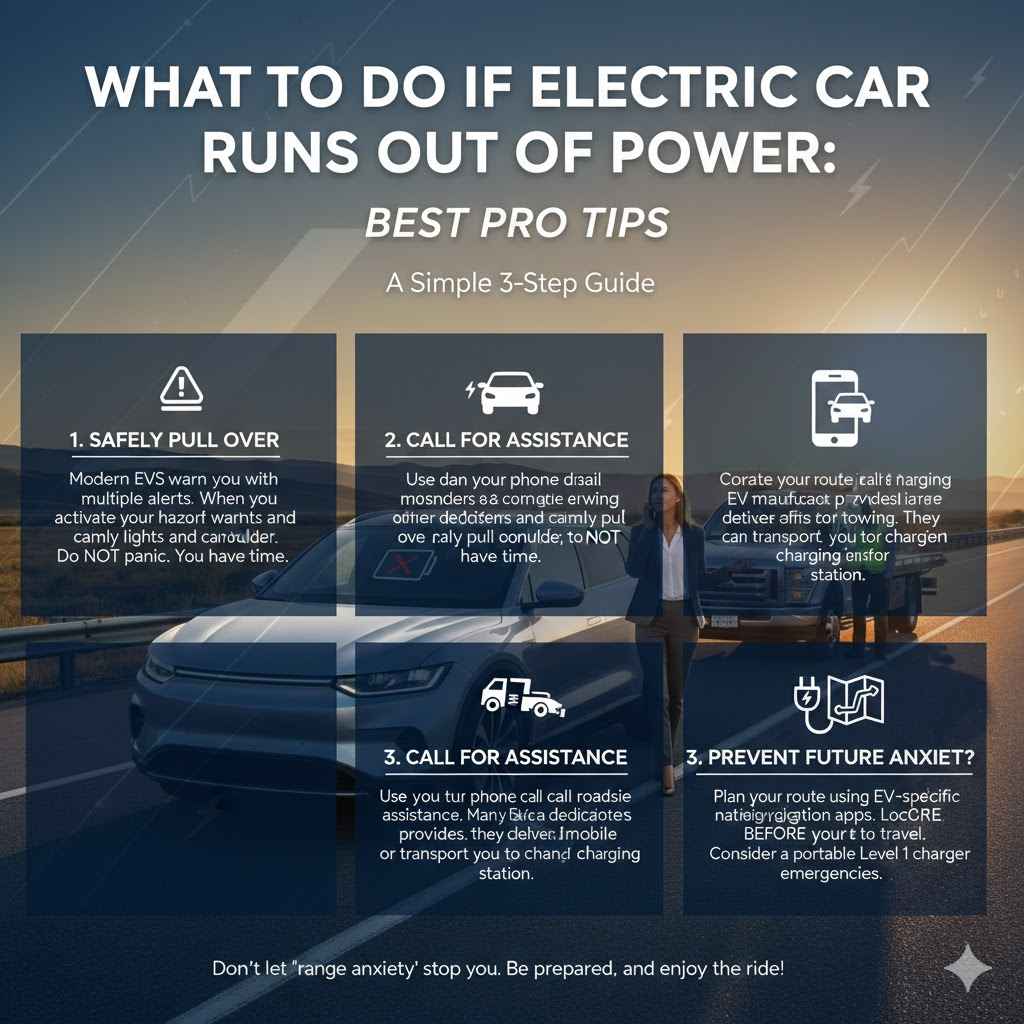
1. Stay Calm and Pull Over Safely
The single most important thing to do is to remain calm. Panicking won’t help. As soon as you realize you won’t make it to a charger, focus on finding a safe place to stop. Look for:
- A wide shoulder on the highway.
- A nearby parking lot.
- A quiet residential street.
- An emergency pull-off area.
Use your remaining momentum to glide into the safest possible spot. Avoid stopping in a travel lane, on a blind curve, or on a bridge if you can help it. Once you’ve stopped, put the car in Park and engage the parking brake.
2. Be Visible and Stay Safe
Your next priority is making sure other drivers can see you. Even though the high-voltage battery is depleted, your car’s 12-volt battery (which powers lights, locks, and accessories) should still have plenty of power.
- Turn on your hazard lights (four-way flashers). This is the universal signal for a disabled vehicle.
- If it’s dark or visibility is poor, turn on your parking lights.
- Stay inside your vehicle, especially if you are on a busy road or highway. It is much safer to wait for help inside your car than standing outside it.
- Keep your seatbelt on while you wait.
3. Call for Help: Your Roadside Assistance Options
You’re not going to be able to fix this problem yourself, so it’s time to call in the professionals. The good news is that the roadside assistance industry has adapted to electric vehicles. You have several great options.
Manufacturer Roadside Assistance
Most automakers include a period of free roadside assistance with the purchase of a new EV. This is often your best first call, as they will be experts on your specific vehicle. Look for the contact number in your owner’s manual, on a sticker inside the driver’s door, or in your car’s mobile app.
Services they may offer include:
- Towing to the nearest certified dealership or charging station.
- In some areas, a mobile charging service to give you a few miles of range.
Third-Party Services (like AAA)
If you have a membership with an auto club like AAA, they are well-equipped to handle EVs. AAA, for example, has deployed a fleet of trucks with mobile charging capabilities in many major cities. These trucks can give your EV enough of a charge in about 15-20 minutes to get you to a nearby charging station.
When you call, be sure to tell them you are driving an electric vehicle and that the main battery is dead. This helps them dispatch the right kind of truck for the job.
Your Car Insurance Provider
Many comprehensive auto insurance policies include roadside assistance as part of the package or as an affordable add-on. Check your policy details or call the number on your insurance card. Like other services, they can arrange for a tow to a safe location.
| Assistance Option | Pros | Cons | Best For |
|---|---|---|---|
| Manufacturer’s Program | Often free with a new car; brand-specific knowledge. | Coverage may expire after a few years; may have location limits. | Owners of new or certified pre-owned EVs. |
| AAA / Auto Club | Wide coverage area; EV-specific services like mobile charging. | Requires an annual membership fee. | Anyone who wants comprehensive roadside coverage. |
| Insurance Provider | Conveniently bundled with your policy; often inexpensive. | Services can vary; may count as a claim on your record. | Drivers who have this benefit included in their policy. |
4. The Golden Rule of Towing an EV: Demand a Flatbed
This is critically important. If your EV needs to be towed, you must insist on a flatbed tow truck. A flatbed is a truck with a flat platform that the entire car rests on.
Why is this so important? Most EVs have electric motors connected directly to the wheels. If you use a traditional hook-and-chain tow truck that lifts only the front or rear wheels, the wheels left on the ground will spin. This can force the electric motor to turn, generating electricity with nowhere to go and potentially causing catastrophic damage to the motor, battery, or power electronics. It can be a multi-thousand dollar mistake.
When you call for a tow, say these exact words: “I have an all-electric vehicle that is out of battery and I need a flatbed tow truck.” Repeat it to be sure they understand. Don’t let a tow truck driver convince you otherwise.
What NOT To Do When Your EV Runs Out of Power
Knowing what not to do is just as important as knowing what to do. Avoid these common mistakes to prevent damage to your car or yourself.
- DO NOT try to push the car. EVs are extremely heavy due to their large batteries. You risk injury to yourself and it’s unlikely you’ll be able to move it very far.
- DO NOT let anyone tow your car with a rope or chain. This is called “dolly towing” and, as mentioned above, can destroy your car’s electric drivetrain.
- DO NOT attempt to charge the car from a standard wall outlet on the side of a building or home you don’t own. It’s unsafe, might be considered theft of electricity, and would take many, many hours to add even a single mile of range.
- DO NOT leave your vehicle unattended in a dangerous spot. Your safety is the top priority. Wait for help to arrive.
How to Prevent Running Out of Power in the First Place
The best way to deal with a dead EV battery is to never let it happen. With a little bit of planning, you can make range anxiety a thing of the past. Think of it like keeping your phone charged—it just becomes part of your routine.
Understand Your Car’s “Real World” Range
The range advertised by the manufacturer (the EPA estimate) is a great starting point, but your actual range will vary based on several factors. The U.S. Department of Energy provides great resources on what affects EV range. Learning how these affect your car will make you a much more confident driver.
| Factor | Impact on Range | Pro Tip to Maximize Range |
|---|---|---|
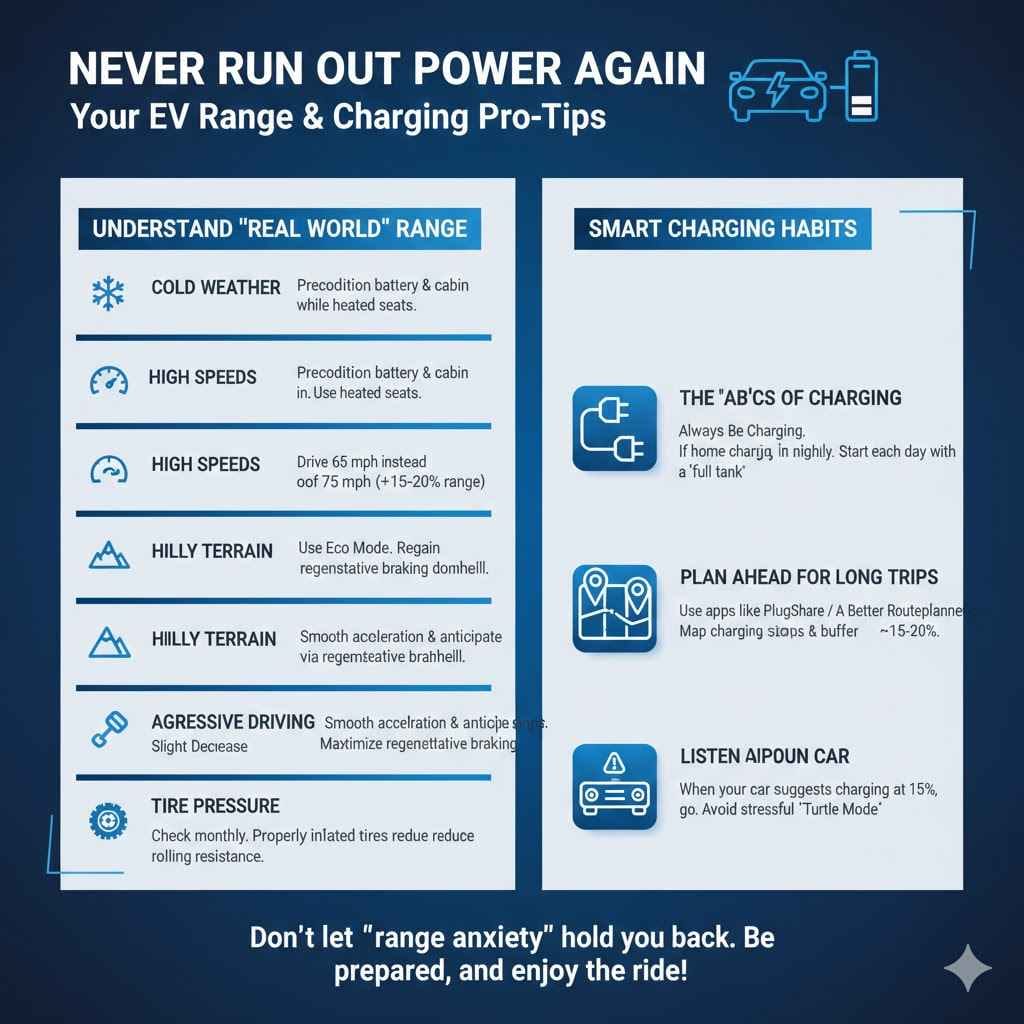
| High Speeds | Significant Decrease | Driving 65 mph instead of 75 mph can increase your range by 15-20%. |
| Cold Weather | Significant Decrease | Precondition (warm up) the battery and cabin while your car is still plugged in. Use heated seats instead of blasting the cabin heater. |
| Aggressive Driving | Moderate Decrease | Accelerate smoothly and anticipate stops to allow for regenerative braking to recharge the battery. |
| Hilly Terrain | Moderate Decrease | Use your car’s eco mode. You’ll lose some power going uphill but regain a surprising amount through regenerative braking on the way down. |
| Tire Pressure | Slight Decrease | Check your tire pressure monthly. Properly inflated tires have less rolling resistance, which saves energy. |
Follow the “ABCs of Charging”
It’s a simple mantra: Always Be Charging. If you have the ability to charge at home, make it a habit to plug in your car every night. You’ll wake up every morning with a “full tank,” which is more than enough for the average person’s daily commute. You wouldn’t drive a gas car until the fuel light comes on every day, so don’t do it with your EV.
Plan Ahead for Long Trips
For road trips, a few minutes of planning makes all the difference. Use apps like PlugShare or A Better Routeplanner (ABRP), or your car’s built-in trip planner, to map out charging stops along your route. These tools can even tell you how long you need to charge at each stop. Plan to arrive at each charger with a comfortable buffer of at least 15-20% battery remaining.
Listen to Your Car
It sounds simple, but when your car tells you it’s time to charge, listen! Don’t try to squeeze out those last few miles. Heading to a charger when you have 15% battery left is a calm, routine task. Trying to find one when you’re in Turtle Mode is a stressful emergency.
Frequently Asked Questions (FAQ)
1. Does an electric car just stop suddenly when it runs out of power?
No, not at all. It gives you multiple warnings on the dashboard starting around 10-15% battery. Before it stops completely, it will enter a low-power “turtle mode” that reduces speed and acceleration, giving you time to pull over safely.
2. Can you jump-start an EV’s main battery like a regular car?
No, the large, high-voltage battery that powers the motors cannot be jump-started. That battery requires a proper EV charger. You can, however, jump-start the small 12-volt battery if it dies, which is needed to turn on the car’s computers and accessories, but this won’t help if the main traction battery is empty.
3. Is it bad for the battery to run it down to 0%?
Yes, it’s best to avoid this. Completely discharging a lithium-ion battery can put stress on its chemistry and may reduce its long-term lifespan. While doing it once by accident won’t destroy the battery, you should avoid making it a habit. For daily driving, many experts recommend keeping the battery between 20% and 80% for optimal health.
4. How far can I drive in “turtle mode”?
This varies by car, but you should not count on it for more than a mile or two, at most. Turtle mode is not designed to get you to the next town; it’s an emergency system designed to help you get out of traffic and to the side of the road safely. As soon as it activates, your goal should be to stop.
5. Why is a flatbed tow truck so important for an EV?
A flatbed truck carries the entire car on its back, so none of the wheels touch the ground. Other types of tow trucks lift only two wheels, letting the other two roll on the pavement. For most EVs, this spins the electric motors and can cause severe, expensive damage to the drivetrain and electrical system. Insisting on a flatbed is the safest way to tow an EV.
6. Can I use a portable EV charger to get going again?
Yes, small portable chargers that plug into a standard wall outlet exist. However, they are very slow (Level 1 charging) and might only add 3-5 miles of range per hour of charging. They are a decent option to keep in your trunk for a dire emergency if you can find a friendly place to plug in, but a call to roadside assistance is almost always a faster and more reliable solution.
Conclusion: Confidence Comes from Knowledge
Running out of power in an electric car can feel like a daunting prospect, but it’s a situation that is both rare and entirely manageable. Your car is designed to give you plenty of warning, and a robust network of EV-aware roadside assistance providers is ready to help.
By understanding how your car communicates with you, knowing the simple and safe steps to take if you do run out of charge, and adopting a few easy charging habits, you can eliminate range anxiety for good. Driving an EV should be an enjoyable, quiet, and smooth experience. Now that you’re prepared for the worst-case scenario, you can drive with confidence, knowing you have the knowledge to handle anything the road throws your way.