
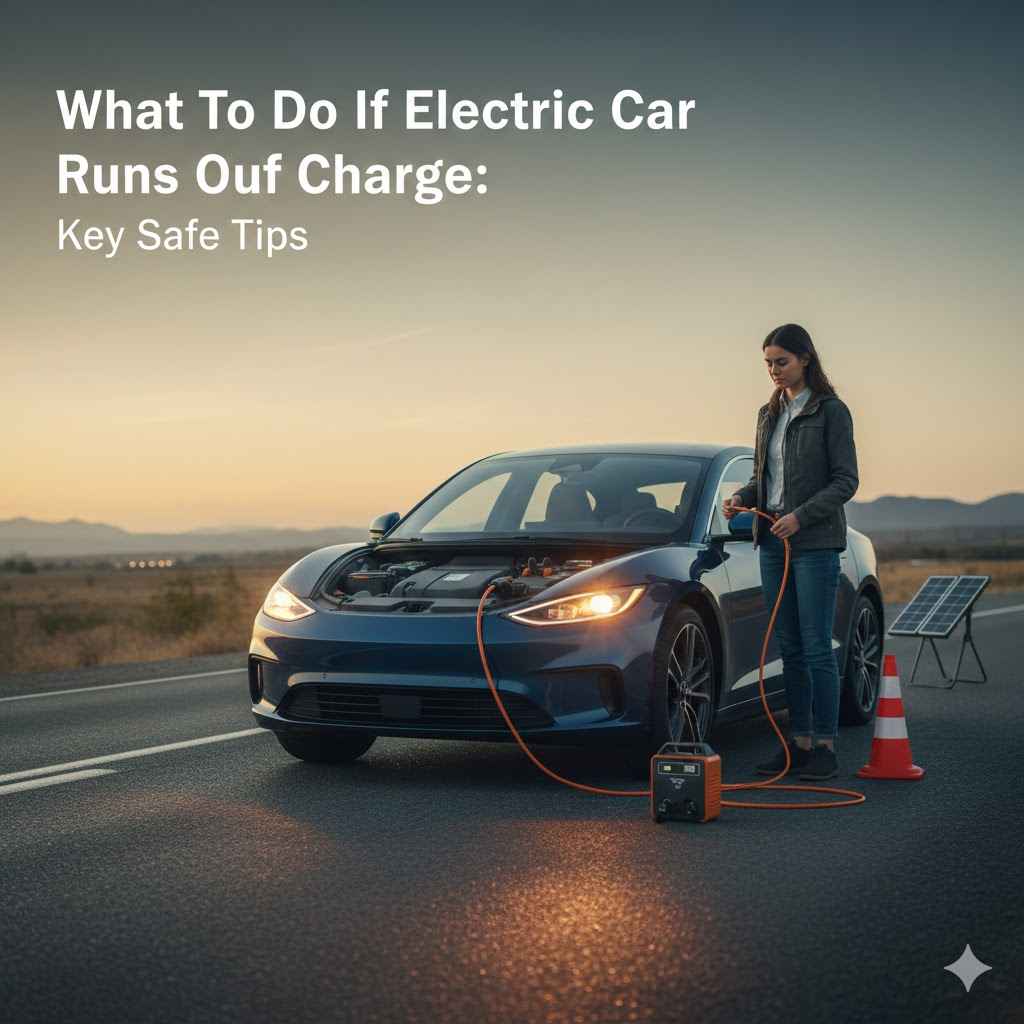
If your electric car runs out of charge, immediately pull over to a safe location and turn on your hazard lights. Your primary options are to call a roadside assistance service that offers mobile EV charging or to request a flatbed tow truck to take you to the nearest charging station. Never attempt to tow an EV with a traditional dolly.
There’s a term for it: “range anxiety.” It’s that little worry in the back of your mind about your electric car running out of power before you reach a charger. While it’s a common fear for new EV drivers, the good news is that it’s a rare event. And if it does happen, it’s not the disaster you might imagine.
Dealing with a dead EV battery can feel stressful, but you are not helpless. You have great options to get you back on the road safely. In this guide, we’ll walk you through the exact steps to take, from the moment your car warns you it’s low on power to getting it charged up again. Let’s make sure you feel confident and prepared for any situation.
First, Don’t Panic: Understanding Your EV’s Low Battery Warnings
Before your car stops completely, it will give you plenty of warning. Car makers know you need time to react. Unlike a gasoline car that might sputter and die suddenly, an EV gives you clear signals that its power is critically low. This is your cue to act, not to panic.
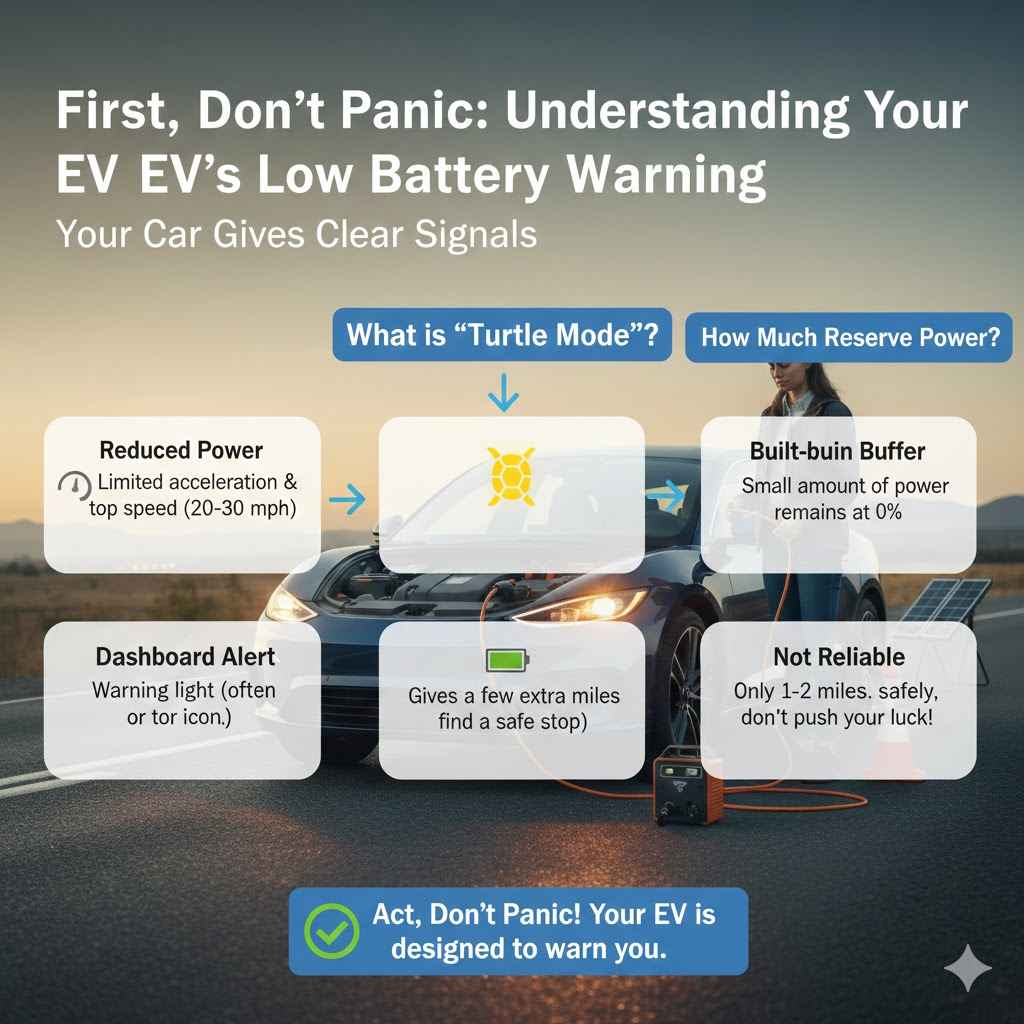
What is “Turtle Mode”?
The most important warning is often called “turtle mode.” When your battery reaches a very low state of charge, your car will automatically limit its power to conserve energy. You’ll notice:
- Reduced acceleration. The car will feel much slower.
- A lower top speed. You might not be able to go faster than 20-30 mph.
- A warning light on the dashboard, often shaped like a turtle or a snail.
This feature is designed to give you a few extra miles of range to find a safe place to stop or, if you’re very lucky, to limp to a nearby charger. Think of it as your car’s final effort to help you out.
How Much Reserve Power Do You Really Have?
When your dashboard shows 0% or 0 miles of range, you might still have a small amount of power left. This is a built-in safety buffer. However, this reserve is not something to rely on. It might only be a mile or two, depending on your car model, the weather, and the terrain. The moment your car enters a low-power mode, your goal should be to pull over safely, not to push your luck.
Your Car Is Slowing Down: Immediate Steps to Take
The second you feel the car’s power reducing or see a critical battery warning, it’s time for action. Every second counts, and your focus should be on safety and conserving the tiny bit of energy you have left.
1. Find a Safe Place to Pull Over
Your number one priority is safety. You need to get your car out of the flow of traffic as soon as possible. Follow these steps:
- Turn on your hazard lights immediately. This alerts other drivers that you are having a problem and are slowing down.
- Signal and move to the rightmost lane. If you’re on a highway, make your way to the shoulder.
- Look for a safe spot. An ideal spot is a well-lit area, a wide shoulder, or an emergency pull-off area. Avoid stopping just over a hill or around a sharp curve where other drivers can’t see you.
- Pull over as far as you can. The more space between your car and moving traffic, the better.
2. Conserve Every Last Electron
To maximize your chances of moving to a slightly better spot if needed, turn off everything that uses electricity. This includes:
- The climate control system (heating and air conditioning).
- The radio and infotainment screen.
- Any devices plugged into USB ports, like your phone.
- Heated seats or a heated steering wheel.
Your hazard lights are the only thing you should keep on, as they are essential for your safety.
Okay, You’ve Stopped. Now What? Your Step-by-Step Action Plan
You’ve safely pulled over. The car is stopped. Take a deep breath. You are in control, and this is just a temporary problem. Here’s exactly what to do next.
Step 1: Stay Safe Inside Your Vehicle
Once you are parked safely on the shoulder, the safest place to be is inside your car with your seatbelt on. The National Highway Traffic Safety Administration (NHTSA) advises that staying in your vehicle protects you from passing traffic. Only exit the vehicle if you are certain it is safe and you need to become more visible or set up emergency triangles.
Step 2: Assess Your Location
Take a moment to figure out exactly where you are. Use your phone’s map app to get your precise location. Note any cross streets, mile markers, or nearby landmarks. You will need this information when you call for help. Being able to give a clear, accurate location will make the rescue process much faster.
Step 3: Call for Help – Your Main Options
You’re not stranded forever. Help is just a phone call away. You have a few excellent options, and the best one depends on your situation and what services you have.
- Manufacturer’s Roadside Assistance: Most new EVs come with a few years of complimentary roadside assistance. This is often your best first call. The number is usually on a sticker inside the driver’s door or in your owner’s manual. They are experts in handling their own vehicles.
- Third-Party Roadside Service (like AAA): If you have a service like AAA, give them a call. Be sure to tell the dispatcher that you drive an electric vehicle and need either a mobile charge or a flatbed tow.
- Mobile EV Charging Services: Some companies specialize in bringing a charge to you. Services like SparkCharge or Onward are growing in popularity. A quick search on your phone for “mobile EV charging near me” might show local options.
Getting a Charge: Exploring Your Roadside Assistance Options
When you call for help, you’ll likely be offered one of two solutions: a mobile charge or a tow. It’s important to understand the difference and know what to ask for.
Mobile EV Charging Services
This is the most convenient option. A service vehicle equipped with a large battery and a charger will come to your location. They will plug into your car and give you enough charge to get to the nearest public charging station. This usually takes about 15-30 minutes to provide 10-20 miles of range. It’s a quick fix designed to get you moving again, not to fully charge your car.
Getting a Tow to a Charging Station
If mobile charging isn’t available, you’ll need a tow. This is extremely important: you must request a flatbed tow truck. Electric vehicles should not be towed with their drive wheels on the ground (dolly towing). Doing so can cause serious and expensive damage to the electric motors and drivetrain. When the tow truck arrives, remind the driver that your vehicle is electric and must be loaded onto the flatbed completely.
Portable EV Chargers
For the truly prepared driver, a portable EV charger can be a lifesaver. These are small, gas-powered generators or large battery packs that you can keep in your trunk. They won’t charge your car quickly, but they can provide enough power in an hour or two to get you to a proper station. This is more of a preventative measure than a roadside solution, but it’s an option to consider if you often travel in remote areas.
Table: Comparing Roadside Charging Solutions
Here’s a quick breakdown of your main options when you run out of charge.
| Option | How It Works | Pros | Cons |
|---|---|---|---|
| Mobile EV Charging | A van with a charger comes to you and provides a partial charge. | Fast, convenient, no need for a tow. | Not available in all areas; only provides enough range to get to the next station. |
| Flatbed Tow | A truck transports your entire car to a charging station. | Available almost everywhere; can take you to a fast charger for a full charge. | More time-consuming; must specify a flatbed to avoid damage. |
| Portable Charger | You use your own device to slowly add charge to the car. | Self-reliant; works anywhere. | Requires you to buy and store the equipment; very slow charging speed. |
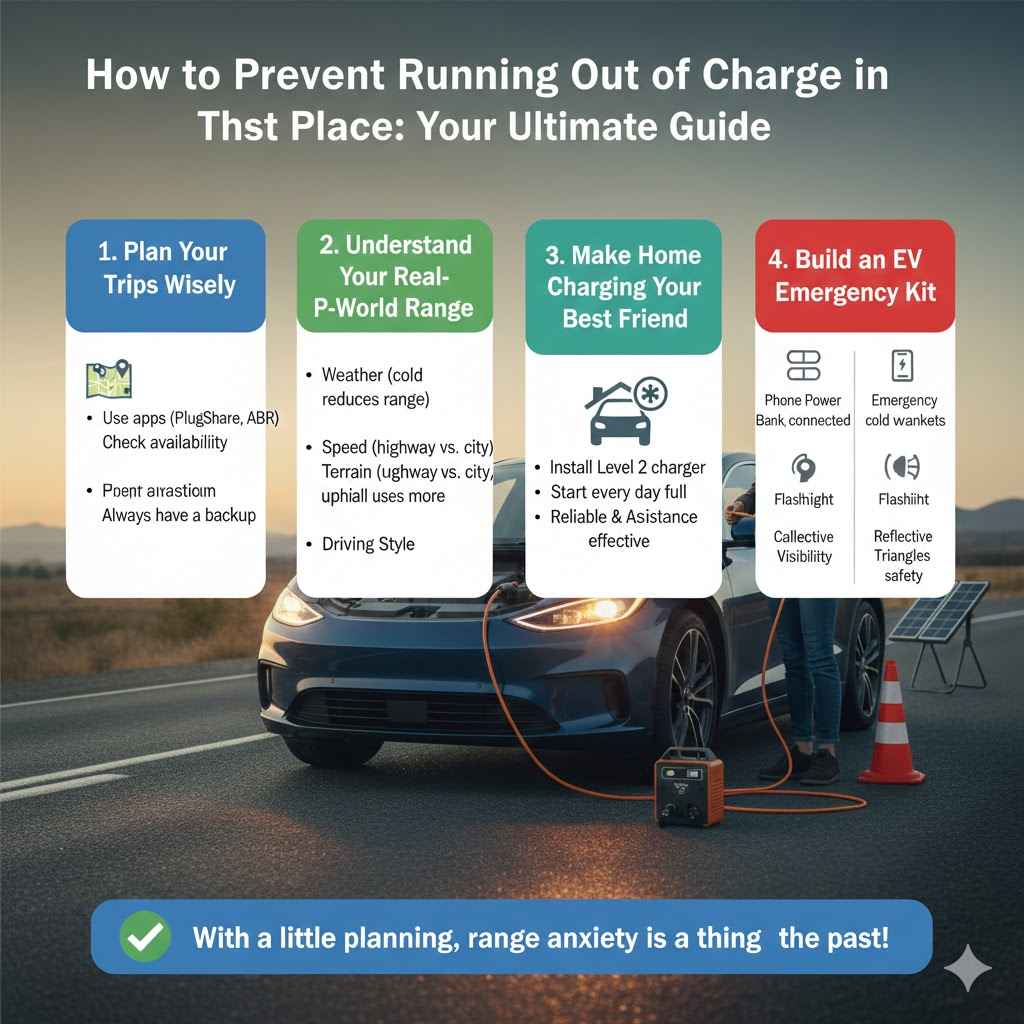
How to Prevent Running Out of Charge in the First Place
The best way to deal with a dead EV battery is to never have one. With a little bit of planning, you can make sure range anxiety is a thing of the past.
Plan Your Trips Wisely
For longer trips, always plan your charging stops before you leave. Use apps like PlugShare, A Better Routeplanner (ABRP), or your car’s built-in navigation system. These tools not only show you where chargers are but can also tell you if they are available and working. Always have a backup charging station in mind, just in case your first choice is occupied or out of service.
Understand Your Real-World Range
The range advertised for your car is an estimate. Your actual range can be affected by several factors:
- Weather: Cold temperatures can reduce battery range by 20% or more.
- Speed: Driving at high speeds on the highway uses much more energy than driving in the city.
- Terrain: Driving uphill requires more power.
- Driving Style: Aggressive acceleration uses more energy than smooth driving.
Pay attention to your car’s efficiency meter to get a feel for how your driving habits impact your range.
Make Level 2 Home Charging Your Best Friend
The easiest way to ensure you never run low is to start every day with a full “tank.” Installing a Level 2 charger at home is the most reliable and cost-effective way to charge your EV. It allows you to charge your car fully overnight, so you wake up with all the range you need for your daily commute and errands.
Build an EV Emergency Kit
Just like with any car, it’s smart to have an emergency kit. For an EV, you might want to add a few specific items.
| Item | Why You Need It |
|---|---|
| Phone Power Bank | To ensure your phone is charged so you can call for help. |
| Emergency Blankets | If you run out of charge in the cold, you won’t be able to use the car’s heater. |
| Roadside Assistance Numbers | Have the numbers for your car’s service and any other provider written down. |
| Flashlight | Essential if you are stranded at night. |
| Reflective Triangles | To increase your visibility to other drivers. |
Frequently Asked Questions (FAQ)
How far can an electric car go on 0% battery?
Most EVs have a small, hidden battery reserve that might give you an extra 1-5 miles after the display reads 0%. However, this is not guaranteed and varies greatly by car model and conditions. You should never rely on this reserve and should pull over as soon as your car gives you a critical low-battery warning.
Does running out of charge damage an EV battery?
No, running out of charge will not damage your car’s main high-voltage battery. EVs have sophisticated battery management systems (BMS) that shut the car down before the battery is drained to a level that would cause harm. The only risk is to the smaller 12-volt battery (which powers accessories), as it may drain if the car is left sitting for a very long time after running out of power.
Can I use a regular extension cord to charge my EV in an emergency?
It is strongly discouraged. Standard household extension cords are not designed to handle the high, continuous electrical load required for car charging and can create a serious fire hazard. You should only use the Level 1 charging cable that came with your vehicle, plugged directly into a standard outlet, or a heavy-duty extension cord specifically rated for EV charging.
Do all roadside assistance services offer EV charging?
Not all of them, but the number is growing quickly. Major providers like AAA are actively expanding their fleets to include mobile EV charging trucks. When you call, always specify that you have an electric vehicle and ask if mobile charging is an option in your area. If not, they will arrange for a flatbed tow.
What is “turtle mode” on an electric car?
“Turtle mode” is a low-power safety feature in most EVs. When the battery charge becomes critically low, the car automatically reduces its power and speed to conserve energy. This gives you a final few miles of range to find a safe place to stop. You’ll usually see a turtle icon on your dashboard when this mode is active.
Can another EV give my car a charge?
Some new electric vehicles, like the Ford F-150 Lightning and the Hyundai Ioniq 5, have a feature called Vehicle-to-Load (V2L) or bidirectional charging. This allows them to output power and act as a mobile generator. With the right adapter, they can give a slow, emergency charge to another EV, but this is not yet a standard feature on all electric cars.
How much does a mobile EV charge cost?
The cost can vary. If the service is included with your vehicle’s manufacturer warranty or a premium roadside assistance plan like AAA, it may be free. For on-demand services, you can expect to pay a service call fee plus a per-kilowatt-hour rate for the energy, often totaling between $50 and $100 for a basic emergency charge.
A Final Word of Reassurance
Running out of charge in an electric car is a manageable situation, not a catastrophe. Modern EVs are designed with safety features like “turtle mode” to give you plenty of warning, and a growing network of roadside services is ready to help. Remember the key steps: get to a safe location, turn on your hazards, and call for the right kind of help—either a mobile charger or a flatbed tow truck.
By planning your trips, understanding your car’s real-world range, and charging regularly at home, you can drive with confidence. You’ve got this!