
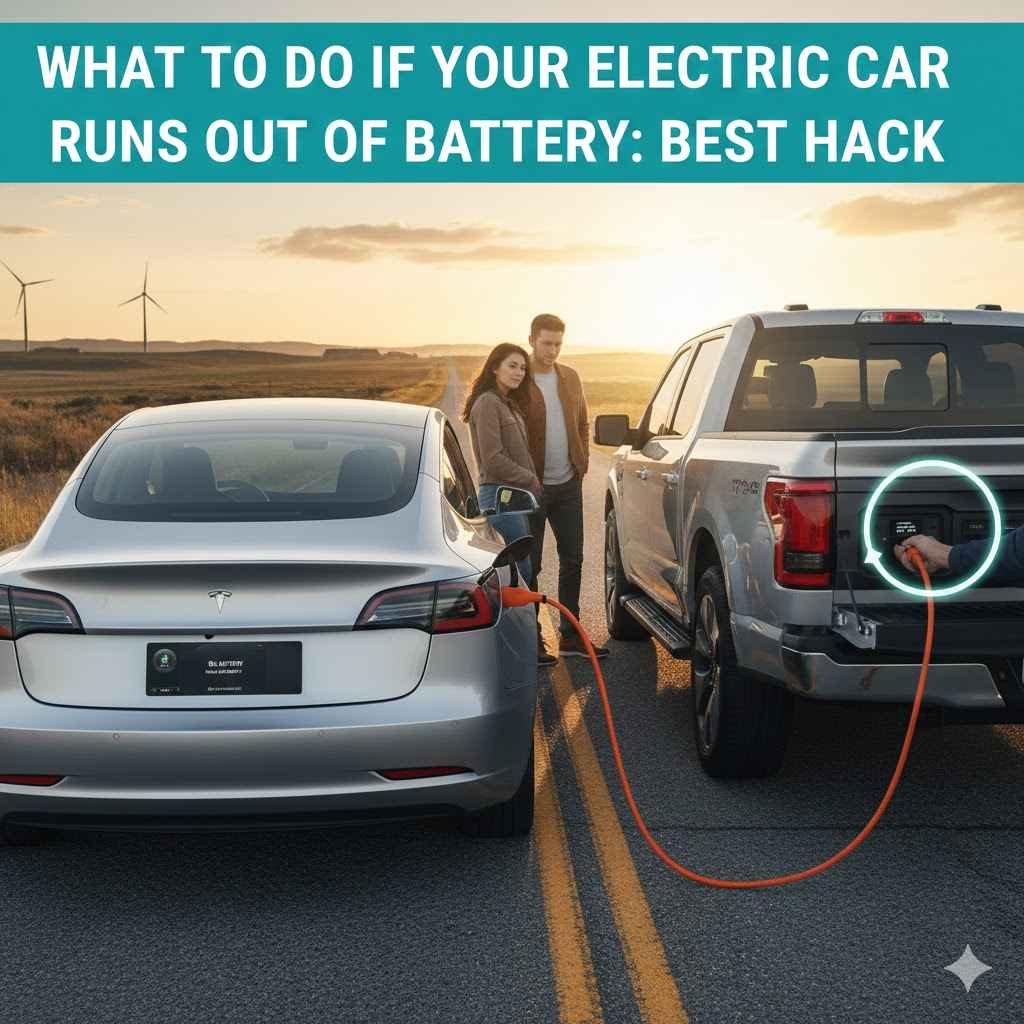
If your electric car runs out of battery, stay calm and pull over safely. Your best option is to use a roadside assistance app or service to request a mobile EV charger to come to you. If that’s not available, call for a flatbed tow truck to take you to the nearest charging station.
It’s a fear many new electric car owners have. You’re driving along, and the battery percentage drops faster than you expected. What happens if it hits zero? Will you be stranded for good? Don’t worry. Running out of battery in an electric vehicle (EV) is not as scary as it sounds. It’s a simple problem with simple solutions.
This guide will walk you through exactly what to do. We will show you the best and fastest ways to get help. You will learn how to handle the situation with confidence. Let’s get you prepared and back on the road.
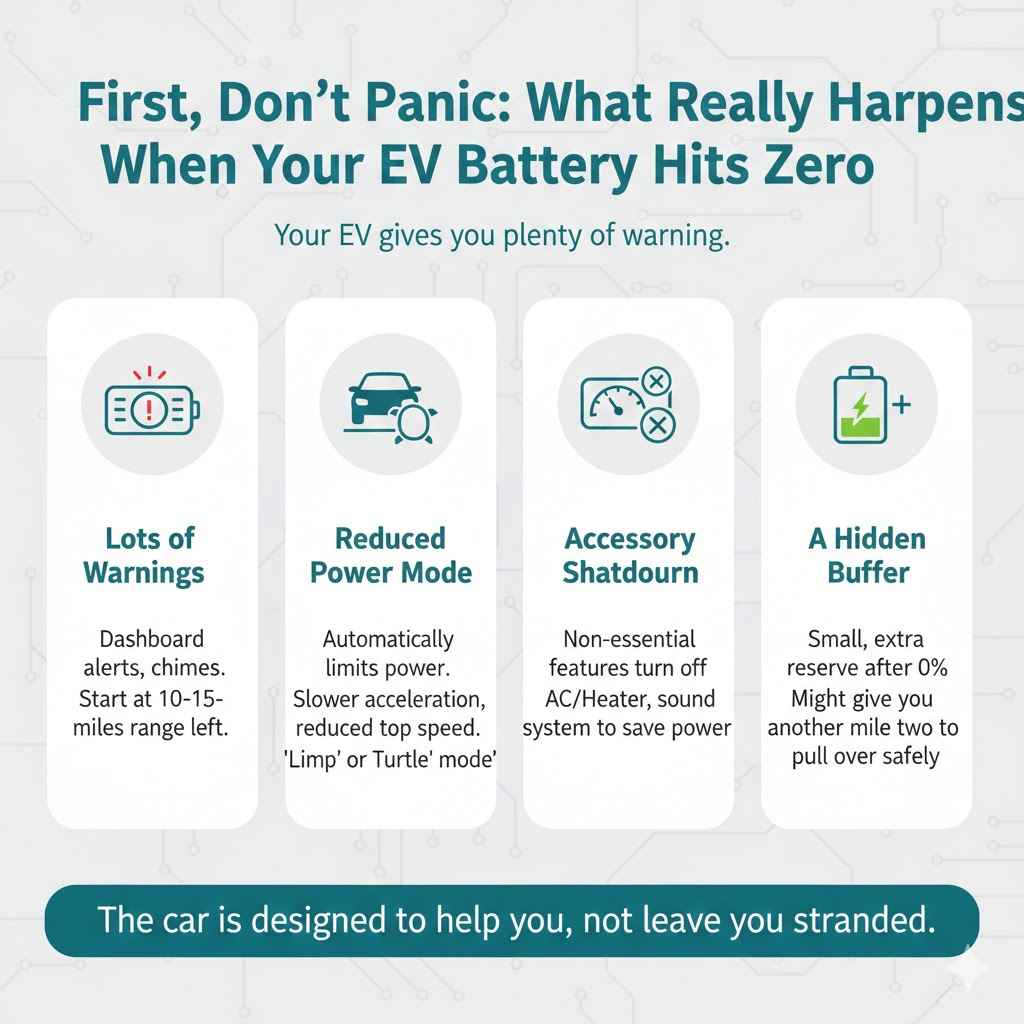
First, Don’t Panic: What Really Happens When Your EV Battery Hits Zero
The good news is that your electric car won’t just stop dead in the middle of the road. Car makers know this is a big worry, so they build in safety features to help you. When your battery gets very low, your car gives you plenty of warning.
Here is what you can expect:
- Lots of Warnings: Your car’s dashboard will light up with alerts. You will see messages and hear chimes telling you to charge soon. These warnings often start when you have 10-15 miles of range left.
- Reduced Power Mode: As the battery gets critically low, your car will automatically limit its power. You might hear this called “limp mode” or “turtle mode” (because a turtle icon might appear on your dash). Your acceleration will be much slower, and your top speed will be reduced. This saves the last bit of energy to help you find a safe place to stop.
- Accessory Shutdown: To save every last electron for the wheels, your car might turn off non-essential features. This could include the air conditioning, heater, or the fancy sound system.
- A Hidden Buffer: Most EVs have a small, hidden battery reserve. Even when the dashboard shows 0% or 0 miles left, there is often a little extra power. This buffer might give you another mile or two to pull over safely. Do not count on this, but know it’s likely there.
The car is designed to help you, not leave you stranded suddenly. Your main job is to pay attention to these warnings and act quickly.
The “Best Hack” Is A Plan: Your Step-by-Step Emergency Guide
The best “hack” for a dead EV battery isn’t a secret trick; it’s a calm, simple plan. Knowing these steps ahead of time turns a stressful moment into a minor inconvenience. Follow these steps in order for the best result.
Step 1: Safely Pull Over
As soon as you realize you won’t make it to a charger, your first priority is safety. Do not try to push the car for every last foot of range. This is dangerous.
- Turn On Your Hazard Lights: As soon as you see the final warnings, press the button with the red triangle. This tells other drivers that you have a problem and are slowing down.
- Find a Safe Spot: Look for a safe place to stop. A parking lot, a quiet side street, or a wide shoulder on the highway are all good options. Avoid stopping just over a hill or around a sharp curve where other drivers can’t see you.
- Pull Over Completely: Get your car as far off the road as possible. Give other cars plenty of room to pass you safely.
- Stay Safe: Once you’ve stopped, put your car in Park and apply the parking brake. If you are on a busy road, it is often safest to stay in your vehicle with your seatbelt on.
Step 2: Assess Your Location and Options
Now that you are safely stopped, take a deep breath. It’s time to figure out the best way to get a charge. Use your smartphone to help.
- Check Your Car’s App: Many EV manufacturers, like Tesla and Ford, have apps that can help locate nearby chargers.
- Use a Charging App: Apps like PlugShare, ChargePoint, or Electrify America show maps of all public charging stations. You might be surprised to find one is just a short walk away. Check the app to see if the charger is working and available.
- Consider Your Surroundings: Are you near a shopping center, hotel, or car dealership? These places often have chargers available for public use, sometimes for free.
Step 3: Call for Help (The Right Way)
If you can’t walk to a charger, you’ll need to call for help. You have a few great options, and one is much better than the others for an EV.
The best choice is to get a charge delivered to you. The last resort is getting your car towed.
| Type of Help | How It Works | Best For |
|---|---|---|
| Mobile EV Charging Service | A van with a large battery and charger comes to your location. They give you enough of a charge (usually 10-20 miles) to get to the nearest charging station. | This is your best option. It’s fast, convenient, and designed specifically for EVs. |
| Manufacturer Roadside Assistance | Most new EVs come with a few years of free roadside assistance. Call the number on the sticker in your car. They will either send a mobile charger or a flatbed tow truck. | Checking here first. It might be free! |
| Flatbed Towing | A tow truck with a flat, level bed lifts your entire car off the ground and transports it. You must specify that you need a flatbed. | Your last resort. Use this if mobile charging isn’t available. |
Unpacking Your Emergency Charging Options
Getting stranded is stressful, but technology has made it easier than ever to get help. Let’s look closer at your options, from the best to the last resort.
Mobile EV Charging: The Future of Roadside Help
This is the game-changer for EV owners. Instead of moving the car to the power, the power comes to the car. Companies like AAA and dedicated startups like SparkCharge offer this service.
A van equipped with a powerful mobile charger will meet you where you are. They plug into your car just like a regular charging station. In about 30 to 60 minutes, they can give you enough range to confidently drive to a nearby fast charger. This avoids the hassle and potential damage of towing.
- Pros: Fast, safe for your car, and very convenient.
- Cons: Not yet available in all rural areas. Can be more expensive than a standard tow if not covered by a membership.
Portable EV Chargers: Your Personal Power Bank
A portable charger is something you can keep in your trunk. Most EVs come with a Level 1 charger, which is the kind that plugs into a standard wall outlet (like the one you use for a lamp).
This is where a little kindness from a stranger can be a huge help. If you run out of power near a home or a business, you could politely ask if you can plug into an exterior outlet for an hour. This is a very slow way to charge. A Level 1 charger might only add 3-5 miles of range per hour. However, that might be all you need to get to a proper charging station.
Remember to always have your own heavy-duty, outdoor-rated extension cord if you plan to rely on this method.
Towing to a Charging Station: The Last Resort
If mobile charging isn’t available, towing is your final option. But you cannot tow an electric car like a gas car. This is very important.
You MUST use a flatbed tow truck.
An EV’s wheels are connected to the electric motors. If you tow it with the wheels spinning on the pavement (this is called “dolly towing”), it can force the motors to turn. This can generate electricity and seriously damage the battery and the entire drivetrain. The repair bill could be thousands of dollars.
A flatbed truck lifts all four wheels of your car off the ground. It is the only way to safely transport an EV. When you call for a tow, repeat the words “I need a flatbed for an electric vehicle” to the dispatcher. For more information on EV safety procedures, you can review guidelines from the National Highway Traffic Safety Administration (NHTSA).
Prevention Is the Real Secret: How to Avoid a Dead EV Battery
The best way to deal with a dead battery is to never have one. With a little bit of planning, you can make sure “range anxiety” is a thing of the past.
Know Your Car’s True Range
The range estimate on your dashboard is just that—an estimate. It’s often called a “Guess-O-Meter” for a reason. Real-world range is affected by many things:
- Temperature: Cold weather is the biggest enemy of battery range. Batteries are less efficient in the cold, and running the heater uses a lot of power. Expect up to 30-40% less range in freezing temperatures.
- Speed: Driving fast, especially on the highway, uses much more energy than driving at lower speeds in the city.
- Terrain: Driving uphill requires a lot of power and will drain your battery faster.
- Driving Style: Aggressive acceleration and hard braking use more energy than smooth, gentle driving.
Pay attention to how your range changes in different conditions. This will give you a much better sense of how far you can really go on a charge.
Master the 20-80% Charging Rule
For daily driving, it’s best to keep your battery between 20% and 80% charged. This is the sweet spot for long-term battery health. However, before a long road trip, it is perfectly fine to charge to 100%. This gives you the maximum possible range to start your journey. Just don’t let the car sit at 100% for many days at a time.
Build Your EV Emergency Kit
Having a few key items in your trunk can make a big difference in an emergency.
| Item | Why You Need It |
|---|---|
| Level 1 Portable Charger | This came with your car. Never take it out! It lets you plug into any standard wall outlet. |
| Heavy-Duty Extension Cord | A 25- or 50-foot, 12-gauge, outdoor-rated cord will help you reach an outlet that isn’t right next to your car. |
| Charging Adapters | An adapter that lets you plug into different types of outlets (like a NEMA 14-50 at an RV park) can open up more charging options. |
| Roadside Assistance Info | Keep the phone number for your car’s manufacturer assistance or your AAA card handy. |
Use Your Car’s Smart Features
Modern EVs are packed with technology to help you save energy. Use it!
- Eco-Mode: Nearly every EV has an “Eco” or “Economy” driving mode. It softens your acceleration and reduces power to things like the climate control, stretching your remaining range.
- Regenerative Braking: This feature captures energy when you slow down and sends it back to the battery. Set it to its highest level to maximize your range, especially in city driving.
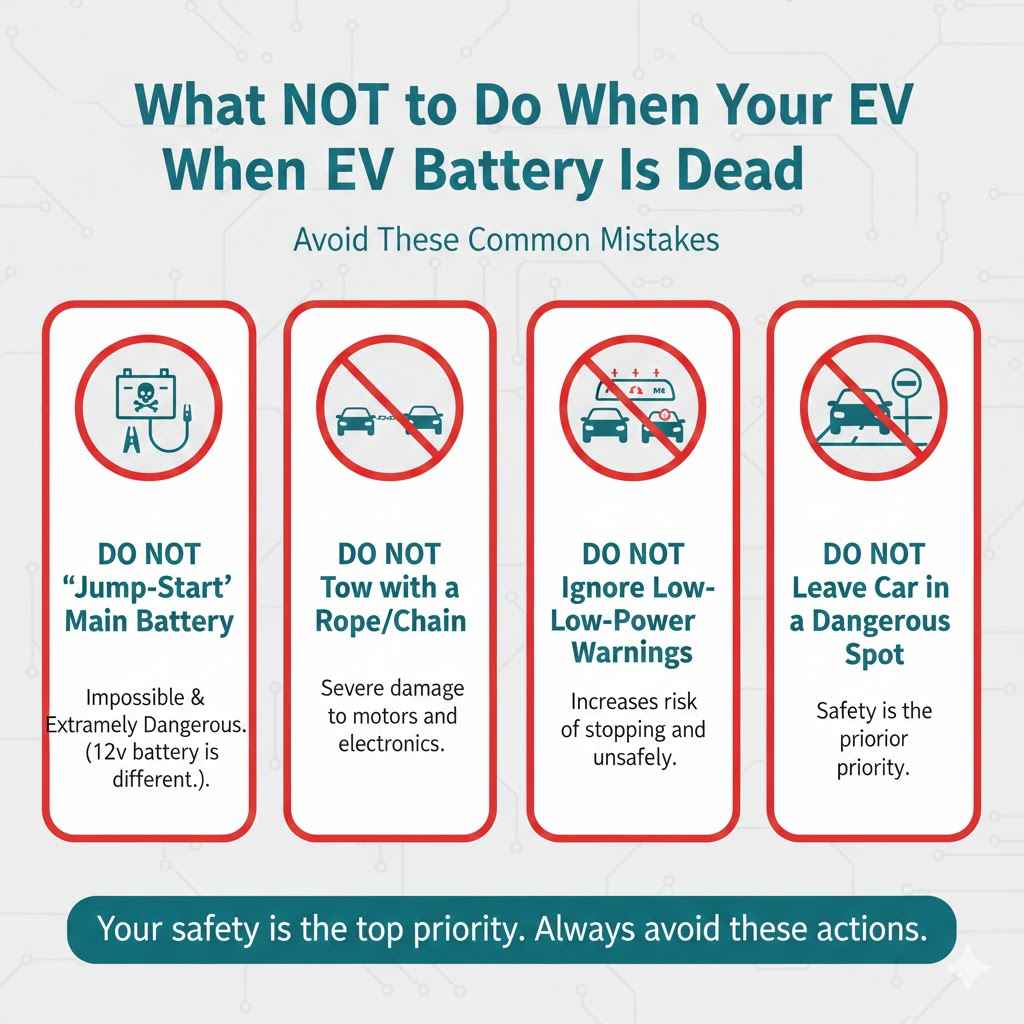
What NOT to Do When Your EV Battery Is Dead
Knowing what not to do is just as important as knowing what to do. Avoid these common mistakes.
- DO NOT let anyone try to “jump-start” your main high-voltage battery. It is impossible and extremely dangerous. (Note: The small 12-volt battery that runs accessories can be jumped, but that is a different problem.)
- DO NOT try to tow your EV with a rope or chain attached to another car. This will cause severe damage to the motors and electronics.
- DO NOT ignore the car’s low-power warnings and try to drive until it is completely stopped. This increases your chances of stopping in an unsafe location.
- DO NOT leave your car in a dangerous spot, like in a lane of traffic or on a blind curve, even for a moment. Your safety is the top priority.
Frequently Asked Questions (FAQ)
Can an EV be jump-started like a gas car?
No, you cannot jump-start the large, high-voltage battery that powers the car’s wheels. That battery is completely different. However, an EV also has a small 12-volt battery for lights and electronics, which can go dead. This 12-volt battery can be jump-started just like in a gas car.
How much does mobile EV charging cost?
The cost varies. If you have a premium roadside assistance plan like AAA Premier, the service might be included. If you pay out-of-pocket, you can expect to pay between $75 and $150 for a service call, depending on your location and the provider.
Does cold weather really drain an EV battery faster?
Yes, absolutely. Cold temperatures slow down the chemical reactions inside the battery, making it less efficient. On top of that, running the cabin heater uses a significant amount of energy. It is common to see a 30% or greater reduction in range in freezing weather.
What is “turtle mode” in an electric car?
“Turtle mode” is a nickname for the reduced power mode that an EV enters when the battery is critically low. A turtle icon may appear on your dashboard. The car will limit your speed and acceleration to conserve the last bit of energy, giving you time to pull over safely.
Can you tow an electric car with all four wheels on the ground?
No, never. This is extremely important. Most EVs must be towed on a flatbed truck with all four wheels off the ground. Towing with the wheels spinning on the road can destroy the electric motors and the drivetrain, leading to very expensive repairs.
How long does it take to get a useful charge from a mobile service?
A mobile charging service can typically provide about 10-20 miles of range in 30 to 60 minutes. The goal is not to fully charge your car, but to give you enough power to safely drive to the nearest DC fast-charging station.
What’s the difference between a Level 1, 2, and 3 charger?
It’s all about speed. Level 1 uses a standard wall outlet and is very slow (3-5 miles of range per hour). Level 2 is what you find in many public places and home chargers, providing 20-30 miles of range per hour. Level 3, or DC Fast Charging, is the quickest, able to add hundreds of miles of range in under an hour.
Your Journey Is Just Beginning
Running out of battery in your electric car can feel like a big deal, but it doesn’t have to be a disaster. Now you know that your car gives you plenty of warning and that help is just a phone call away. The best “hack” is simply being prepared.
Remember the simple steps: pull over safely, assess your location, and call for the right kind of help—ideally, a mobile charging service. By keeping your emergency kit in the car and understanding your vehicle’s true range, you can drive with confidence, knowing you’re ready for anything. Welcome to the world of electric driving; you’ve got this.