
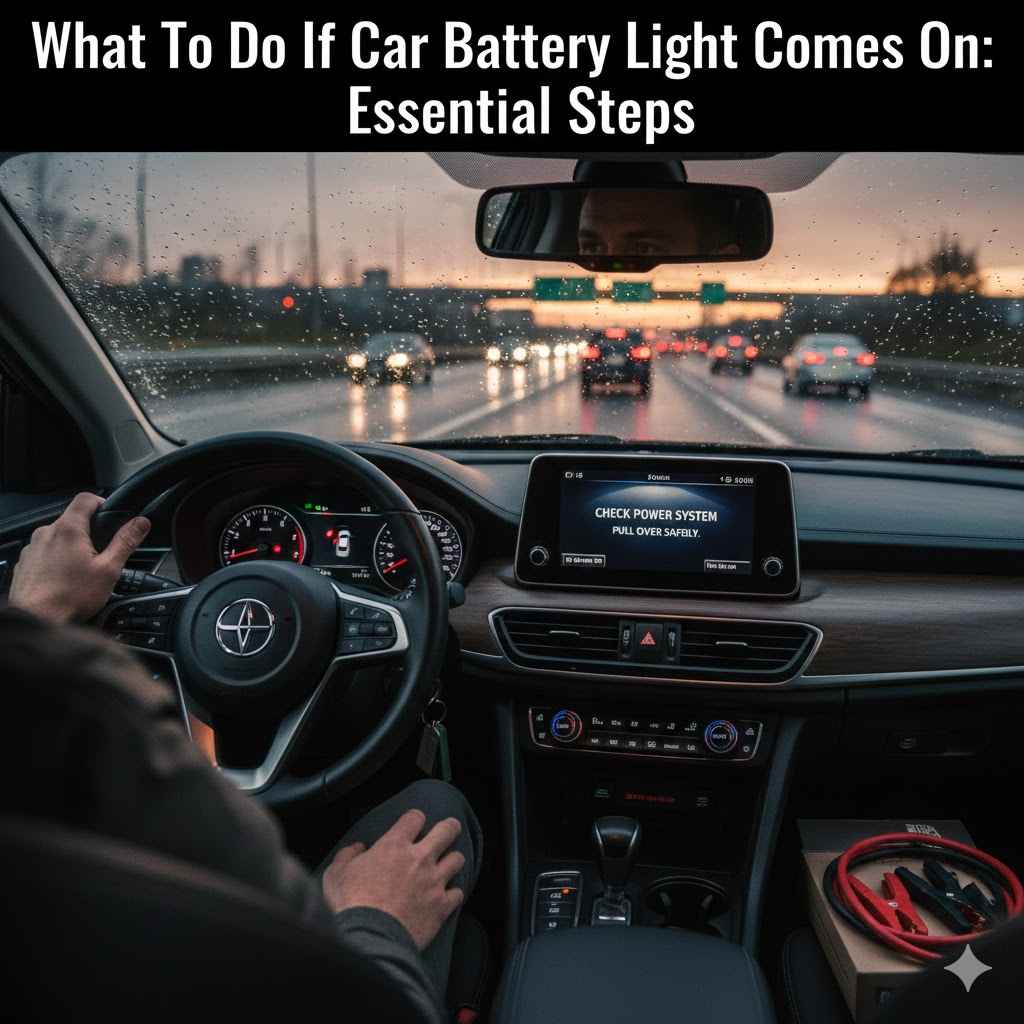
If your car battery light comes on, don’t panic. Turn off non-essential electronics like the radio and A/C to conserve power. Find a safe place to pull over immediately. The light often signals a problem with the alternator or charging system, not just the battery. Driving further could leave you stranded.
Seeing a warning light flash on your dashboard can be stressful. The little red battery icon is one of the most common—and misunderstood—lights you might see. It can make you worry about being stranded with a dead car.
But there’s good news. This light is just your car’s way of talking to you. It’s giving you a heads-up that something needs attention. You don’t need to be a master mechanic to understand what’s happening or what to do next.
In this guide, I’ll walk you through everything, step by step. We’ll cover what that light really means, what to do right away, and how to figure out the cause. You’ll learn how to handle this common issue with confidence and keep your car running smoothly.
What Does the Car Battery Light Really Mean?
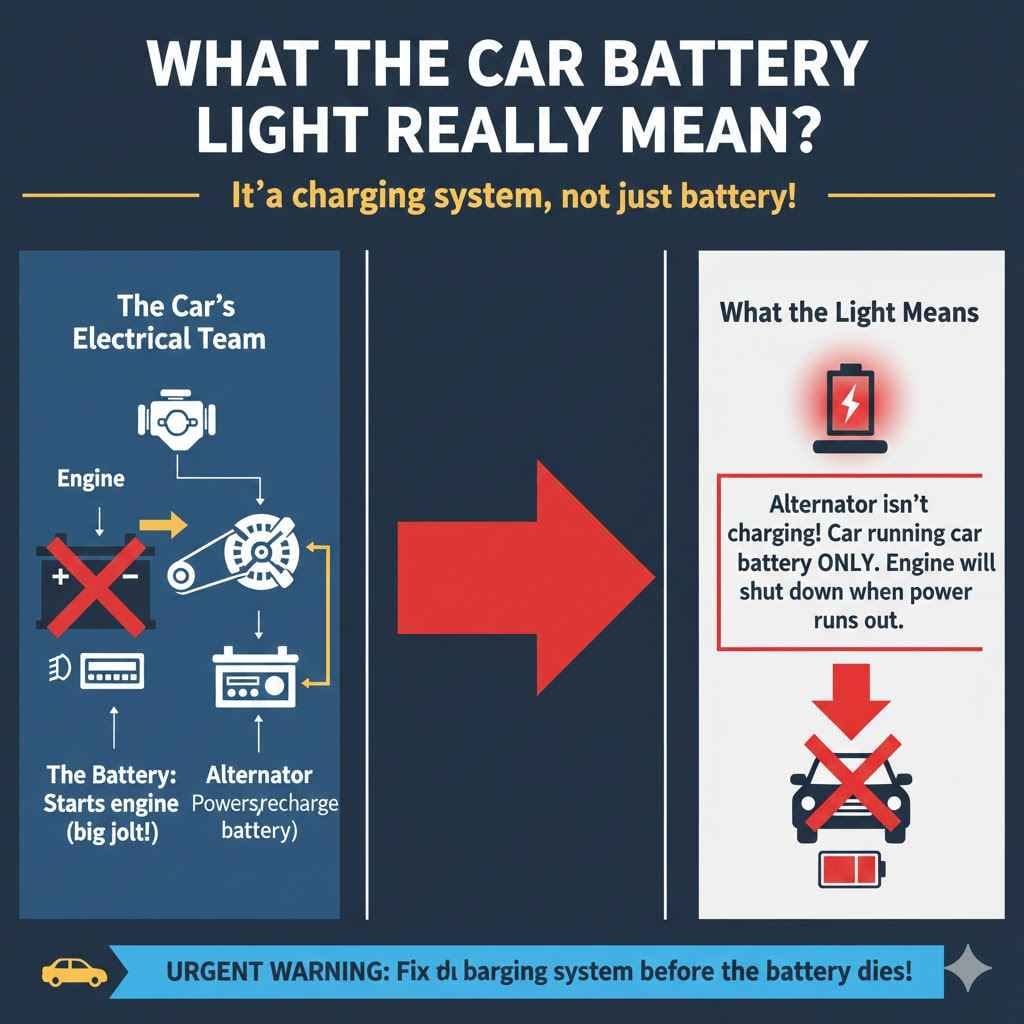
It’s easy to think the battery light means your battery is dead, but that’s usually not the case. The light is actually a warning for your car’s entire charging system. Your car’s electrical power comes from a team effort between the battery and the alternator.
- The Battery: Its main job is to start the engine. It provides the big jolt of electricity needed to get things running.
- The Alternator: Once the engine is on, the alternator takes over. It generates electricity to power your headlights, radio, and other electronics. It also recharges the battery as you drive.
The battery light turns on when your car detects that the alternator isn’t producing enough voltage to run the car and recharge the battery. Essentially, your car is running only on battery power, and once that power runs out, the engine will shut down. So, the light is an urgent warning: “My electrical system isn’t recharging itself!”
First Steps: What to Do Immediately When the Light Comes On
Seeing that red light while you’re driving can be alarming. Your first reaction is the most important. Follow these steps to handle the situation safely.
Step 1: Stay Calm and Don’t Panic
Your car will not shut off instantly. You have some time—though maybe not a lot—to react safely. Panicking can lead to bad decisions on the road. Take a deep breath and focus on the road ahead.
Step 2: Turn Off All Unnecessary Electronics
Your car is now running on limited battery power. To make that power last as long as possible, you need to reduce the electrical load. Turn off everything you don’t absolutely need, including:
- The radio or stereo system
- The air conditioning or heater fan
- Heated seats or steering wheel
- Any devices plugged into USB or 12V outlets (like phone chargers)
Do not turn off your headlights if it’s dark or your windshield wipers if it’s raining. Safety comes first. However, every little bit you turn off helps extend your driving time.
Step 3: Find a Safe Place to Pull Over
Your goal is to get off the road before the car loses all power. Look for a safe spot to pull over, like a parking lot, a quiet side street, or the shoulder of the highway. Avoid stopping in a high-traffic lane or on a blind curve. Signal your intentions to other drivers and pull over smoothly.
Step 4: Don’t Turn Off the Engine (Yet)
This might sound strange, but if the charging system has failed, you may not be able to restart the car once you turn it off. The battery might not have enough power left to crank the engine again. Keep the engine running until you are safely parked and ready to investigate or call for help.
Safely Parked? Here’s Your Initial Diagnosis Checklist
Once you are safely off the road, you can do a few quick visual checks. For these steps, turn the engine off and take the key out of the ignition. Always prioritize your safety.
Checking the Battery Terminals
The connection between your battery and your car is critical. A poor connection can trigger the battery light.
- Locate the Battery: It’s usually a rectangular box in the engine bay with two posts on top, marked with a plus (+) and a minus (-).
- Look for Corrosion: Check the metal terminals where the cables connect to the battery posts. Do you see any white, blue, or greenish fuzzy buildup? This is corrosion, and it can block the flow of electricity.
- Check for Tightness: Gently try to wiggle the cable connectors on the battery posts. They should be completely solid and unmovable. If either one is loose, it could be the source of your problem.
Inspecting the Serpentine Belt
The serpentine belt (sometimes called a drive belt) is a long rubber belt that winds through several pulleys in your engine. One of its most important jobs is to spin the alternator. If this belt is broken or slipping, the alternator can’t generate power.
- Locate the Belt: Look at the side of your engine. You should see a long, black rubber belt wrapped around multiple wheels (pulleys).
- Check its Condition: Is the belt still there? If it has snapped, you’ve found your problem. If it’s there, look for signs of heavy wear, like cracks, fraying, or a glazed, shiny appearance.
- Check its Tension: Carefully (with the engine OFF), press down on the belt in a long, straight section. It should feel tight and only give a little. If it feels very loose, it might be slipping.
Listening for Strange Noises
Before you noticed the light, did you hear any unusual sounds? A failing alternator often makes a distinct noise.
- Grinding or Whining: A whining sound that changes pitch as you rev the engine can be a sign of failing bearings inside the alternator.
- Squealing: A loud squeal, especially when you first start the car or turn on the A/C, often points to a loose or worn-out serpentine belt.
The Top 5 Reasons Your Battery Light Is On
While a few things can cause the battery light to appear, it usually comes down to one of these common culprits.
1. A Failing Alternator
This is the most common reason for the battery light to come on. The alternator is a small generator that works hard to power your car. Like any part, it can wear out over time, typically lasting anywhere from 80,000 to 150,000 miles. When it starts to fail, it can’t produce enough voltage, and the light comes on. Other signs of a bad alternator include dimming headlights, slow-moving power windows, and a “burning rubber” or “hot wire” smell.
2. An Old or Damaged Battery
Although the light usually points to a charging issue, a very old or damaged battery can sometimes be the cause. If the battery has an internal short or can no longer hold a proper charge, it can disrupt the entire electrical system. If your battery is more than 3-5 years old and you’ve had trouble starting the car recently, it might be the problem.
3. Loose or Corroded Battery Cables
This is the simplest problem to fix! The battery terminals are the bridge between your battery and the rest of the car. If they are caked in corrosion or the clamps are loose, electricity can’t flow properly. The alternator might be working perfectly, but if the charge can’t get to the battery, the system will think there’s a problem.
4. A Worn or Broken Serpentine Belt
The serpentine belt is the link between your engine and the alternator. If this belt breaks, the alternator stops spinning instantly, and your car will lose all charging ability. If it’s just loose or slipping, the alternator may spin inconsistently, causing the light to flicker on and off. A broken serpentine belt is a serious issue, as it often powers other critical components like the water pump (which cools your engine) and the power steering pump. If you suspect a broken belt, do not drive the car.
5. Faulty Wiring or a Blown Fuse
Sometimes, the issue isn’t a major component but the wiring that connects everything. A wire could have frayed, disconnected, or shorted out. The charging system also has fuses that can blow. This is less common but can be tricky to diagnose without the right tools.
Quick Symptom Checker
Use this table to help narrow down the potential cause based on what you’re experiencing.
| Symptom | Most Likely Cause | What to Do |
|---|---|---|
| Dimming headlights, slow power windows, whining noise from engine | Failing Alternator | Get the car to a mechanic as soon as possible. Do not drive far. |
| Car struggles to start, light comes on after a jump start | Old or Bad Battery | Have the battery tested at an auto parts store or by a mechanic. |
| White/green crust on battery, flickering lights | Loose or Corroded Terminals | Clean terminals and tighten connections (if you are comfortable doing so). |
| Loud squealing noise, loss of power steering, engine overheating | Broken or Slipping Serpentine Belt | Pull over immediately and call for a tow. Do not drive the car. |
How to Test Your Car’s Charging System
If you’re a bit adventurous and have a simple tool called a multimeter, you can run a quick test to see what’s going on. Multimeters are inexpensive and available at most hardware or auto parts stores.
Using a Multimeter: A Simple DIY Test
This test will help you determine if your battery is holding a charge and if your alternator is producing one.
- Set Up the Multimeter: Turn the dial on your multimeter to “DC Voltage” (look for a V with a solid line and a dotted line). The 20V setting is usually perfect.
- Test Battery Voltage (Engine Off): Connect the red probe to the positive (+) battery terminal and the black probe to the negative (-) terminal. A healthy, fully charged battery should read around 12.4V to 12.6V. If it’s below 12.2V, the battery is low or failing.
- Test Alternator Voltage (Engine On): Now, safely start your car. Be careful of moving parts in the engine bay. Reconnect the multimeter probes to the same terminals. With the engine running, the reading should jump up to somewhere between 13.7V and 14.7V. This shows the alternator is working and recharging the battery.
Understanding the Voltage Readings
| Reading | What It Means |
|---|---|
| ~12.6V (Engine Off) | Your battery is healthy and fully charged. |
| Below 12.2V (Engine Off) | Your battery is discharged or may be unable to hold a charge. |
| ~14.2V (Engine On) | Your alternator is working correctly. The problem may be intermittent or elsewhere. |
| Below 13.0V (Engine On) | Your alternator is not producing enough charge. It is likely failing. |
| Above 15.0V (Engine On) | Your alternator is overcharging, which can damage the battery and electronics. |
If the voltage doesn’t increase when the engine is on, or if it stays at the battery’s resting voltage (around 12V), your alternator is almost certainly the problem.
When to Visit a Professional Mechanic
DIY checks are great for simple issues, but some problems require an expert. It’s time to call a mechanic if:
- You are not comfortable working on your car.
- Your visual checks and multimeter test don’t reveal an obvious problem.
- You suspect a broken serpentine belt.
- The problem seems to be related to complex wiring.
- You’ve cleaned the terminals and charged the battery, but the light is still on.
A professional mechanic has advanced diagnostic tools that can pinpoint the exact cause quickly and safely. According to the National Highway Traffic Safety Administration (NHTSA), regular vehicle maintenance by a qualified technician is key to ensuring your safety on the road.
Preventing Future Battery Light Scares
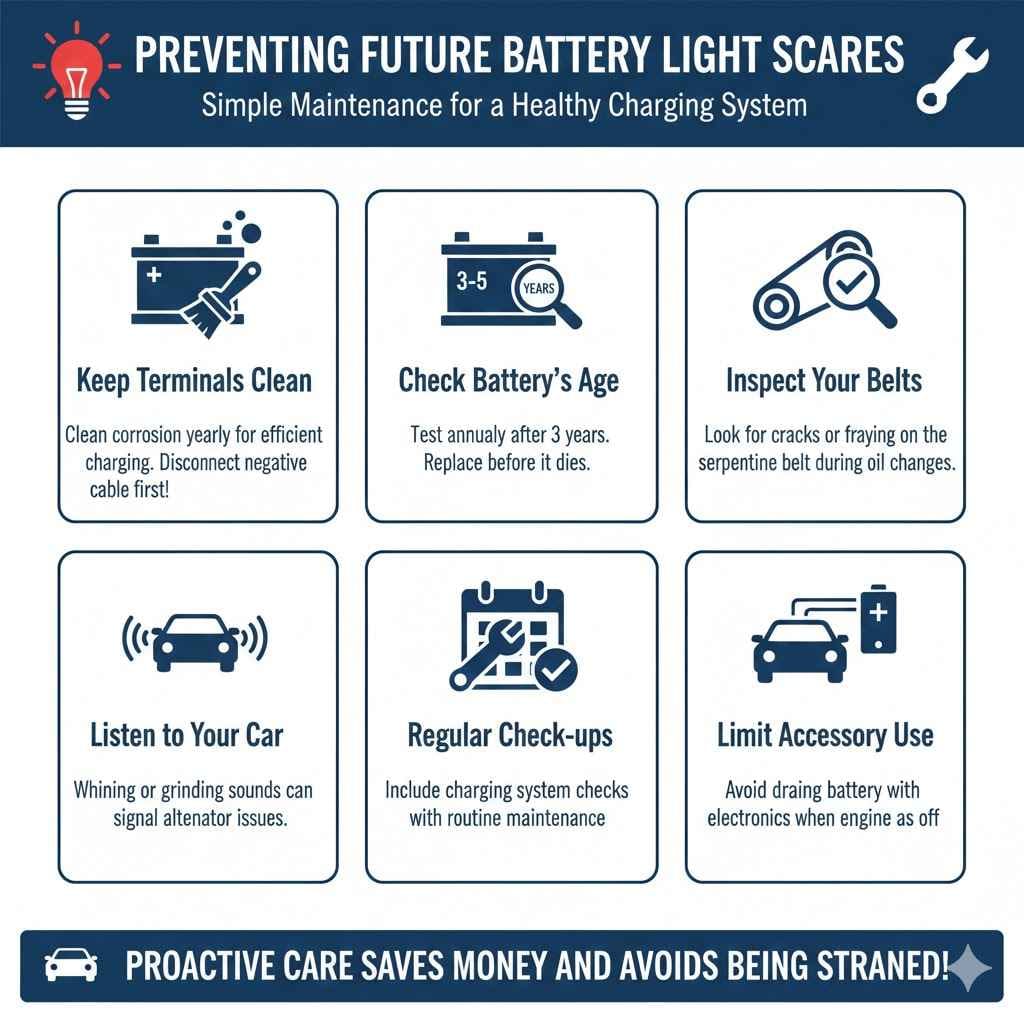
The best way to deal with the battery light is to never see it. A few simple maintenance habits can keep your charging system healthy for years.
- Keep Your Battery Terminals Clean: Once a year, disconnect your battery (negative cable first!) and clean the terminals and clamps with a wire brush and a baking soda/water solution.
- Check Your Battery’s Age: Most car batteries last 3 to 5 years. If yours is getting old, have it tested for free at most auto parts stores during your next oil change.
- Visually Inspect Your Belts: When you check your oil, take a quick look at the serpentine belt. Look for any visible cracks or fraying.
- Listen to Your Car: Pay attention to any new sounds. A whining or grinding noise is an early warning that your alternator may be on its way out.
Frequently Asked Questions (FAQ)
Can I drive my car with the battery light on?
It is not recommended. The light indicates your car is running on battery power alone, which will eventually run out, leaving you stranded. You should pull over as soon as it is safe to do so.
How long can I drive with the battery light on?
This depends on the age and condition of your battery and how much electricity you are using. It could be anywhere from a few minutes to maybe 30 minutes. The longer you drive, the higher the risk of the car shutting down completely.
Does the battery light always mean I need a new battery?
No, this is a common misconception. More often, the light points to a problem with the alternator or another part of the charging system. A bad battery is just one of several possibilities.
How much does it cost to fix a battery light issue?
The cost varies widely depending on the cause. A simple battery terminal cleaning might be free if you do it yourself. A new battery can cost $100-$300. Replacing an alternator is more expensive, typically ranging from $400 to $1,000 or more, depending on your vehicle.
Why did my battery light come on and then go off?
This often points to an intermittent problem. It could be a loose connection, a slipping serpentine belt, or an alternator that is just beginning to fail. Even if the light goes off, you should have the system checked soon.
Can a jump start fix the problem?
A jump start can get your car started if the battery is dead, but it will not fix the underlying charging system problem. If the alternator is bad, the car will die again shortly after the jumper cables are removed.
Is the battery light the same as the check engine light?
No, they are different warnings. The battery light specifically points to a problem with the electrical charging system. The check engine light can indicate a huge range of issues, from a loose gas cap to a serious engine problem.
Your Road to Confidence
That little red battery light doesn’t have to be a source of stress. Now you know it’s simply your car’s way of asking for help with its charging system. By staying calm, taking a few simple safety steps, and knowing what to look for, you are in complete control of the situation.
Whether it’s a simple fix like cleaning a battery terminal or a sign you need to visit a trusted mechanic, you now have the knowledge to make a smart decision. Taking care of your car is a journey, and every step you learn builds your confidence for the road ahead. Drive safely!