
Everywhere we look, electricity powers our lives. From lighting our homes to running massive factories, electrical systems are all around us. But when it comes to vehicles and machines, you’ll often hear a specific term: auto electrical. Many people wonder, what is the difference between auto electrical and electrical? Is it just about cars, or is there more to it?
Understanding this difference is important, especially if you want to work in engineering, repair, or even just keep your car in good shape. In this guide, you’ll discover what sets auto electrical apart from general electrical systems, how their components work, and why these differences matter. You’ll also see real-world examples, practical insights, and even common mistakes people make when mixing these two fields. By the end, you’ll have a full, clear understanding—whether you’re a car owner, a student, or just curious about how things work.
Defining Auto Electrical And Electrical
Before diving into the differences, let’s define both terms clearly.
What Is Electrical?
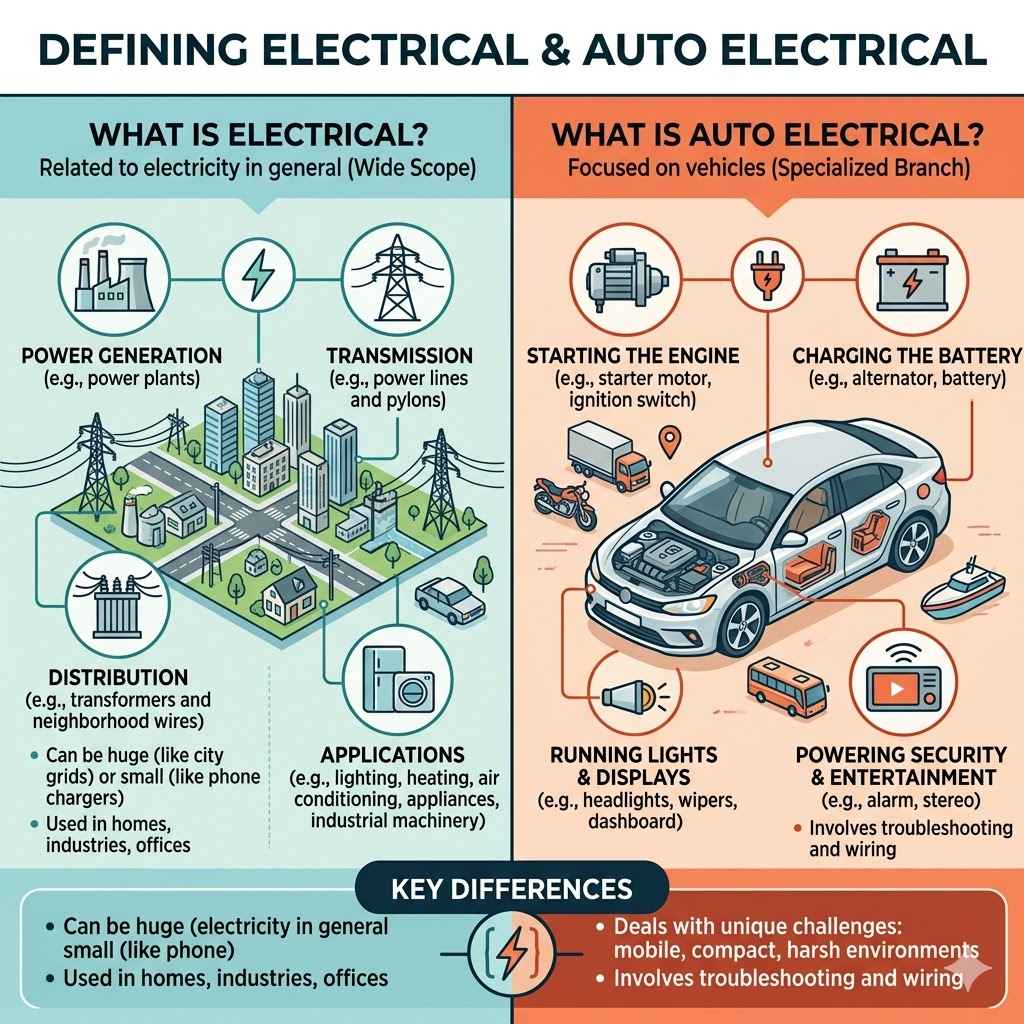
The word electrical refers to everything related to electricity in general. This includes:
- Power generation (like power plants)
- Transmission (power lines)
- Distribution (transformers and wires in neighborhoods)
- Applications in homes, industries, and offices
Electrical systems can be huge (like city grids) or small (like a phone charger). They cover lighting, heating, air conditioning, appliances, industrial machinery, and more.
What Is Auto Electrical?
Auto electrical is a specialized branch of electrical work. It focuses on vehicles—cars, trucks, motorcycles, buses, even boats. Auto electrical systems include:
- Starting the engine
- Charging the battery
- Running lights, wipers, and dashboard displays
- Powering security systems and entertainment
Auto electrical deals with the unique challenges of mobile, compact, and often harsh environments inside vehicles. It also involves troubleshooting and repairing vehicle-specific electrical faults.
Main Differences Between Auto Electrical And Electrical
While both fields work with electricity, their purpose, components, and challenges are not the same. Here’s how they compare:
| Aspect | Auto Electrical | Electrical |
|---|---|---|
| Scope | Vehicles and mobile machines | Buildings, industries, infrastructure |
| Power Source | Low voltage DC (batteries, alternators) | High voltage AC (power grid, generators) |
| Components | Starters, alternators, ECUs, sensors | Switches, circuit breakers, transformers |
| Wiring | Flexible, compact harnesses | Fixed, heavy-duty cabling |
| Environments | Heat, vibration, moisture, limited space | Stable, controlled, spacious |
| Safety Risks | Fire, battery acid, shorts | Electrocution, fire, overloads |
| Diagnosis Tools | OBD scanners, multimeters, oscilloscopes | Multimeters, insulation testers, clamp meters |
Let’s go deeper into these differences.
Power Sources: Dc Vs Ac
One of the biggest differences lies in the type of electricity used.
Auto Electrical: Direct Current (dc)
Vehicles mostly use direct current (DC). This means electricity flows in one direction, at a constant voltage. The main power source is the vehicle battery (usually 12V for cars, 24V for trucks). The alternator recharges the battery while the engine runs.
DC is chosen because:
- It’s safer for low-voltage circuits
- Batteries can store and provide DC easily
- Electronic components (like sensors and computers) work best with DC
Electrical: Alternating Current (ac)
Most building and industrial systems use alternating current (AC). Here, the electricity changes direction back and forth, usually 50 or 60 times per second (50Hz or 60Hz). AC is used because:
- It can travel long distances with less loss
- It’s easy to change voltage levels with transformers
- Most appliances and machines are designed for AC
Example:
- Car headlights work on 12V DC from the battery.
- Your house lights use 220V or 110V AC from the power grid.
Components And Their Roles
Both fields use wires and switches, but the actual parts are quite different.
Key Auto Electrical Components
- Battery – Stores energy to start the engine and power electronics when the engine is off.
- Alternator – Generates electricity to recharge the battery and run systems when the engine is running.
- Starter Motor – Uses high current to turn the engine over.
- ECU (Electronic Control Unit) – The “brain” of modern vehicles, controls fuel, ignition, safety, and more.
- Sensors – Detect engine temperature, speed, oxygen levels, etc.
- Relays & Fuses – Protect circuits and allow small switches to control large currents.
- Wiring Harness – Bundled wires connecting all electrical parts inside the vehicle.
Key Electrical Components
- Circuit Breakers & Fuses – Protect against overloads and short circuits.
- Transformers – Change voltage levels up or down for safe use.
- Switchboards – Distribute power to different circuits in buildings.
- Motors & Generators – Convert electricity into motion or vice versa.
- Lighting Fixtures – Bulbs, LEDs, and fittings for illumination.
- Sockets & Switches – For plugging in and controlling appliances.
Comparison Table: Typical Components
| Component | Auto Electrical System | General Electrical System |
|---|---|---|
| Power Source | 12V/24V battery, alternator | 110V/220V AC supply |
| Control Unit | ECU, relays | Manual switches, circuit breakers |
| Load | Lights, wipers, starter motor | Fans, pumps, ovens, computers |
| Protection | Fuses, fusible links | Circuit breakers, fuses |
Wiring And Installation
Wiring is one area where the difference becomes clear, even for non-experts.
Auto Electrical Wiring
- Uses flexible, thin, and color-coded wires (often bundled into harnesses)
- Must fit into tight spaces behind dashboards or under seats
- Designed to handle vibration, moisture, and temperature swings
- Often includes special insulation to resist oil and chemicals
Electrical System Wiring
- Uses thicker, sometimes rigid cables (often fixed inside walls or conduits)
- Planned for safe, long-term installation (often decades)
- Less exposed to movement or vibration
- Insulation is often for fire resistance and safety
Example:
A car’s wiring harness may have hundreds of small wires, all bundled together, running in every direction. In a house, wires are neatly routed, often inside walls, following strict codes.
Environment And Safety Challenges
The working environment shapes the design and safety methods in both fields.
Auto Electrical Challenges
- Heat and vibration: Engines get very hot, and roads are bumpy. Wires and connectors must stay secure.
- Moisture and dust: Cars face rain, mud, and snow. Connections must be waterproof and corrosion-resistant.
- Limited space: Everything must fit in small areas, so parts are compact and multi-functional.
- Battery hazards: Batteries contain acid and can release dangerous gases if not handled right.
Electrical Challenges
- High voltage risks: Electric shocks can be deadly in building and industrial systems.
- Fire danger: Poor wiring or overloaded circuits can start fires.
- Accessibility: Repairs often happen in controlled, easy-to-reach places, but sometimes in risky areas (e.g., rooftops).
Non-obvious Insight:
Auto electricians must often diagnose problems without seeing the wires directly, using special tools to test hidden circuits. In contrast, building electricians can usually see and access most of their wiring.
Skills And Training Required
While both fields require knowledge of electricity, the training paths are different.
Auto Electrician Skills
- Deep understanding of vehicle electronics (ECUs, sensors, digital displays)
- Ability to read car wiring diagrams
- Skills in using diagnostic tools (OBD scanners, oscilloscopes)
- Experience with both mechanical and electrical parts
- Quick problem-solving in tight spaces
General Electrician Skills
- Understanding of building codes and safety standards
- Ability to install and repair wiring, outlets, lighting
- Experience with high-voltage systems
- Skills in reading blueprints and circuit diagrams
- Strong focus on long-term safety and reliability
Common Mistake:
Many people think auto electricians only replace car batteries or fix lights. In reality, they handle complex computer systems, advanced sensors, and even diagnose “invisible” faults that can disable a modern vehicle.
Diagnostic And Repair Methods
Finding and fixing problems is different in each field.
Auto Electrical Diagnostics
- Use of On-Board Diagnostics (OBD) scanners to read error codes
- Visual checks for blown fuses, corroded connectors, or damaged wires
- Testing sensors, actuators, and relays
- Resetting or reprogramming ECUs after repairs
Electrical System Diagnostics
- Use of multimeters to check voltage, current, resistance
- Insulation testing for old or damaged wires
- Thermal imaging to find overheating spots in panels
- Systematic process: Test circuit → isolate problem → repair
Example:
A car that won’t start may have a dead battery, a faulty starter motor, or a failed sensor. An auto electrician checks each part, often without removing it, using special tools. In a home, if a light doesn’t work, the electrician checks the bulb, switch, then wiring.
Tools Used
The tools of the trade also reflect the challenges of each field.
Tools For Auto Electrical Work
- OBD II/EOBD scanners
- Automotive multimeters
- Test lights and probes
- Oscilloscopes (for checking waveforms)
- Wire strippers, crimpers, and terminal tools
- Special pliers for tight spaces
Tools For General Electrical Work
- Standard multimeters
- Clamp meters (for measuring large currents)
- Voltage testers
- Wire cutters, pliers, and screwdrivers
- Cable pullers and fish tapes
- Insulation resistance testers
Non-obvious Insight:
Modern auto electrical work often involves more “software” than hardware. For example, a fault may be fixed not by replacing a part, but by updating the ECU software—a task most traditional electricians never perform.
Industry Standards And Regulations
Both fields follow strict rules, but the standards are not the same.
Auto Electrical Standards
- Vehicle manufacturers set their own wiring codes and colors
- International standards (like ISO, SAE) for safety and emissions
- Regular updates as new technologies (e.g., hybrids, electric vehicles) appear
General Electrical Standards
- National and international codes (like NEC, IEC)
- Strict rules for wire sizes, colors, and installation methods
- Regular inspections for homes and businesses
Example:
A home’s wiring must meet the National Electrical Code (NEC) in the USA. A car’s wiring must follow the manufacturer’s manual and often additional standards for airbags, anti-lock brakes, and emissions.
Application Areas
Where you find these systems also tells you a lot about their differences.
Auto Electrical Application Examples
- Cars, trucks, motorcycles, buses
- Boats and yachts
- Construction equipment (excavators, cranes)
- Agricultural machines (tractors, harvesters)
- Emergency vehicles (ambulances, fire trucks)
Electrical Application Examples
- Homes and apartments
- Office buildings
- Factories and warehouses
- Power stations and substations
- Street lighting and traffic systems
Data Point:
The global automotive electronics market was valued at over $230 billion in 2022 and is expected to grow rapidly as vehicles become more digital and electric.
Impact Of Technology And Innovation
Both fields are changing fast, but not in the same way.
Auto Electrical: Rapid Digitalization
- More vehicles use advanced driver-assistance systems (ADAS)
- Electric and hybrid cars need new types of batteries, motors, and sensors
- Connected vehicles (with Wi-Fi and GPS) add even more electronics
- Repairs now often require computer programming skills
Electrical: Smart Homes And Industry 4.0
- Homes and offices use smart lighting, climate control, and appliances
- Factories use automation, robotics, and remote control systems
- Renewable energy (solar, wind) changes how power is distributed
- Electricians now work with both high and low voltage, plus data networks
Non-obvious Insight:
The line between auto electrical and general electrical is blurring in areas like electric vehicle charging. Setting up home charging stations requires knowledge of both fields.
Typical Problems And Solutions
Let’s look at some common issues in each field.
Common Auto Electrical Problems
- Battery drains quickly
- Starter motor clicks but does not turn engine
- Dashboard warning lights stay on
- Power windows or locks stop working
- Headlights dim or flicker
Solutions:
- Test and replace battery, alternator, or starter
- Check fuses and relays
- Repair or replace faulty wiring
- Reset or reprogram ECU if needed
Common Electrical Problems
- Power outlet stops working
- Circuit breaker trips repeatedly
- Lights flicker or buzz
- Burning smell near panel or socket
- Appliance does not turn on
Solutions:
- Replace faulty outlets or switches
- Inspect and repair wiring
- Upgrade or replace circuit breakers
- Ensure load does not exceed circuit capacity
Data Point:
Electrical faults cause over 51,000 home fires in the US each year, according to the National Fire Protection Association.
Career Paths And Job Roles
Choosing between these fields depends on your interests and skills.
Auto Electrician
- Specializes in diagnosing and fixing vehicle electrical problems
- Works in repair shops, dealerships, or for fleet companies
- Increasing need for skills in hybrid/electric vehicles
General Electrician
- Installs, maintains, and repairs wiring in buildings
- May work in construction, maintenance, or industrial settings
- Career growth with experience and additional certifications
Comparison Table: Career Focus
| Role | Auto Electrician | General Electrician |
|---|---|---|
| Main Work Area | Vehicles | Buildings/Infrastructure |
| Typical Tools | OBD scanner, test light | Clamp meter, voltage tester |
| Key Skills | Diagnostics, ECU programming | Installation, code compliance |
| Growth Areas | Electric cars, ADAS | Smart homes, renewables |
Why The Difference Matters
Understanding the difference between auto electrical and electrical isn’t just academic. It affects:
- Who you call for a repair (auto electrician vs. general electrician)
- What tools and parts you need
- How problems are diagnosed and fixed
- The safety steps you must take
Trying to use the wrong skills, tools, or parts can damage equipment—or worse, cause injury.
For example, connecting a home AC wire directly to a car can destroy the car’s electronics. Likewise, using auto wire in a building could create a fire risk.
Expert Tips For Beginners
- Never mix auto and building electrical parts. They are rated for very different voltages and conditions.
- Learn to read wiring diagrams. Both fields use diagrams, but symbols and layouts are different.
- Use the right tools. An OBD scanner is useless in your house, and a clamp meter won’t read car computer codes.
- Follow safety rules. Always disconnect the battery before working on auto electrical. Turn off the breaker before working on home wiring.
- Stay updated. Both fields change fast—new standards, tools, and technologies appear every year.
Real-world Example
Suppose your car won’t start. You might think, “It’s just an electrical problem. ” But a home electrician may not know how to test a starter motor or reset an ECU. In the same way, an auto electrician may not be trained to safely rewire a kitchen.
Both are experts, but their expertise is focused and specific.
Further Learning
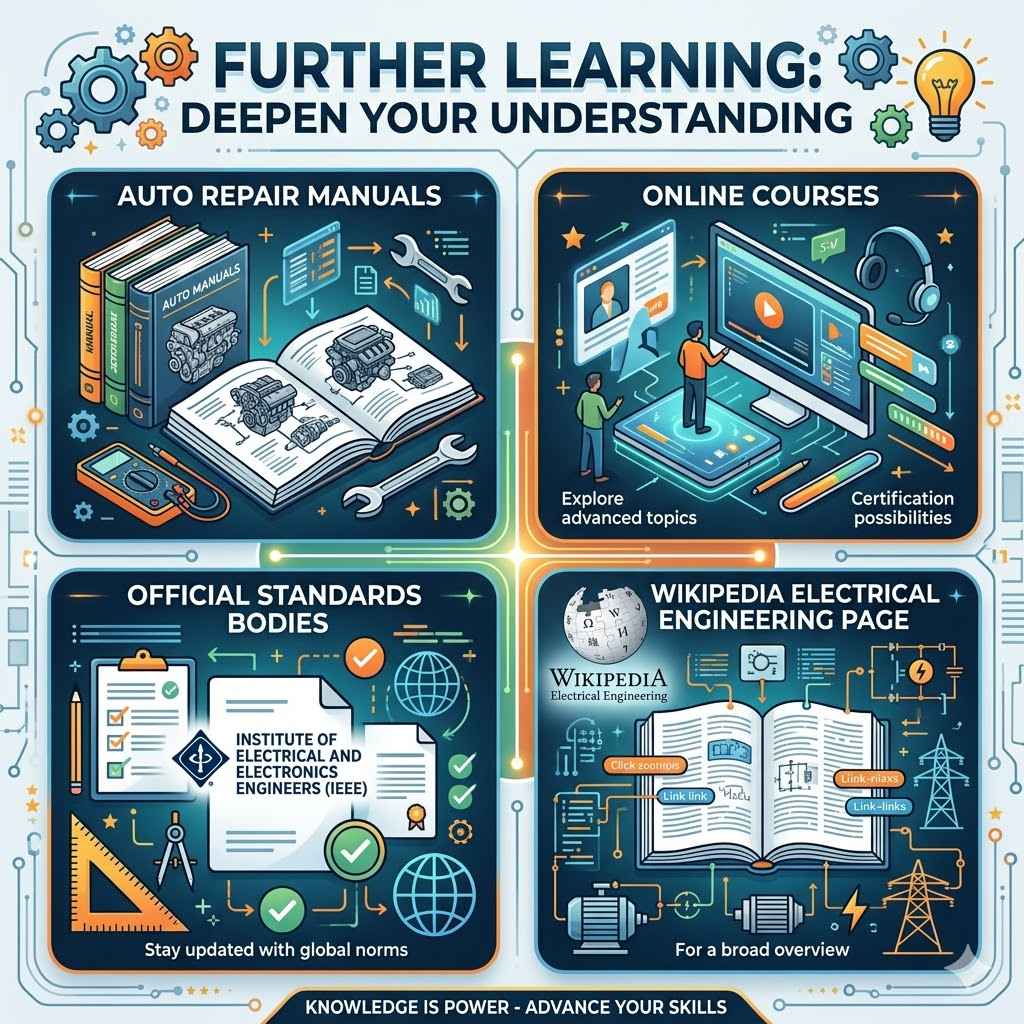
If you want to go deeper, good resources include auto repair manuals, online courses, and official standards bodies like the Institute of Electrical and Electronics Engineers (IEEE). For a broad overview of electrical engineering, you can visit the Wikipedia Electrical Engineering page.
Frequently Asked Questions
What Is The Main Difference Between Auto Electrical And Electrical?
The main difference is that auto electrical deals with the electrical systems inside vehicles, using low-voltage DC power, compact wiring, and specialized parts like ECUs and sensors. Electrical refers to the broader field of electricity in homes, buildings, and industry, mostly using high-voltage AC power and larger, fixed installations.
Can A General Electrician Work On Car Electrical Systems?
Usually, no. While both fields share basic principles, auto electrical work requires special knowledge of vehicle electronics, diagnostic tools, and wiring methods. Most general electricians are not trained for modern car systems.
Why Do Cars Use Dc Power And Homes Use Ac Power?
Cars use DC power because batteries store and supply DC, and most electronics work best with it. Homes use AC because it travels long distances more efficiently and can be easily transformed to different voltages.
What Are Some Common Auto Electrical Problems?
Common problems include a dead battery, faulty alternator, bad starter motor, blown fuses, malfunctioning sensors, or wiring issues causing lights or accessories to fail.
Are Auto Electrical And Electrical Safety Standards The Same?
No. Auto electrical systems follow vehicle industry standards, focusing on DC safety, compact spaces, and vibration resistance. General electrical systems follow building codes, focusing on AC safety, fire prevention, and long-term reliability.
Understanding the difference between auto electrical and electrical helps you make safer choices, solve problems faster, and even choose the right career path. Whether you’re fixing a car, a house, or just curious, having this knowledge gives you a real advantage in today’s technology-driven world.