
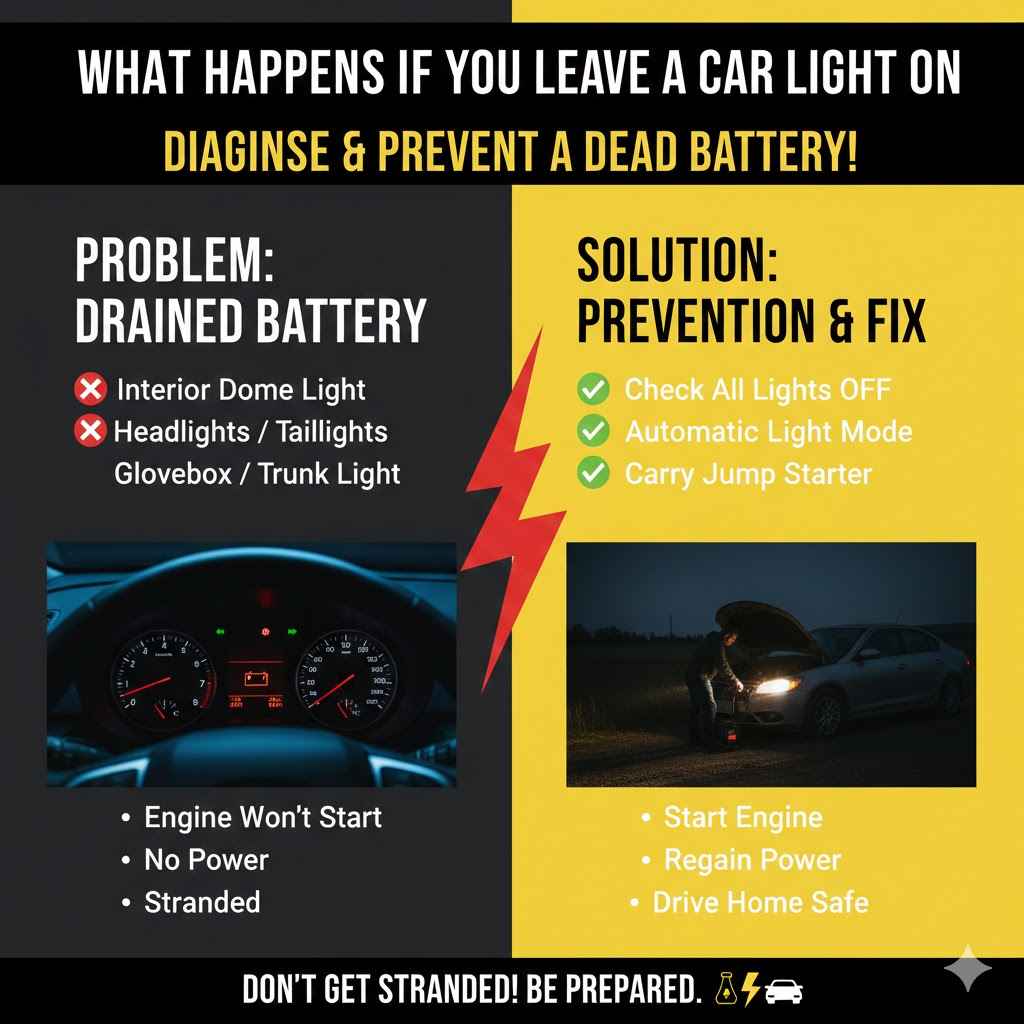
It happens to the best of us. You’re busy, you’re tired, and you forget to turn off your car’s lights. Then you wonder, what happens if you leave a car light on? This is a common worry, especially for new drivers, and it can feel a little stressful.
But don’t worry! It’s usually not a big deal, and we’ll walk you through exactly what to expect and what to do in simple steps. Let’s get this sorted out.
Understanding Your Car’s Lights
Cars have different types of lights, and each serves a purpose. Headlights are for seeing the road at night or in bad weather. Parking lights are smaller and used when you’re parked to make your car visible.
Interior lights, like dome lights, help you see inside the car. Leaving any of these on for too long can cause issues, but the severity often depends on how long they were on and your car’s battery condition.
Headlights The Power Drain
Headlights are designed to be bright, which means they use a good amount of electricity. When you leave your headlights on overnight, they can drain your car’s battery significantly. A car battery typically provides enough power for the engine to start and run the car’s electrical systems.
If the battery is drained, your car won’t have enough power to crank the engine.
A car battery is a rechargeable energy storage device. It uses a chemical reaction to create electrical energy. This energy is crucial for igniting the spark plugs, which start the engine.
It also powers the car’s lights, radio, air conditioning, and other electronics when the engine is off.
The capacity of a car battery is measured in amp-hours (Ah). A typical car battery might have a capacity of around 50-70 Ah. Leaving headlights on means this stored energy is being used up.
The longer the lights are on, the more of that stored energy is depleted.
- Battery Voltage
This is the electrical pressure that pushes the electricity through the car’s system. A standard car battery operates at 12 volts. When this voltage drops too low, the starter motor won’t have enough power to turn the engine over. - Battery Capacity
This refers to how much energy the battery can store and deliver. A larger capacity battery can power the lights for longer before being drained. However, even a large battery has its limits. - Battery Age and Condition
An older or less healthy battery will drain faster and may not hold a charge as well. If your battery is nearing the end of its life, leaving the lights on for even a few hours could be enough to prevent your car from starting.
Parking Lights and Their Impact
Parking lights are less powerful than headlights but can still drain your battery if left on. They are usually smaller bulbs located at the front and rear of the vehicle. Their main purpose is to make your car visible to others when parked on a street or in a dimly lit area.
While they use less energy, leaving them on for an extended period, like an entire night, can still deplete a significant portion of your battery’s charge.
These lights are often designed to be less of a drain on the battery, allowing them to be left on for longer durations without completely draining the power source. However, this is a relative comparison. They still consume power, and over many hours, this consumption adds up.
The wattage of parking lights is typically much lower than headlights. For example, a headlight bulb might be 55-65 watts, while a parking light bulb might be only 3-5 watts. Even with multiple parking lights on, the total power draw is considerably less.
The key difference in impact comes down to the total energy consumed over time. A lower power draw means it takes longer to deplete the battery’s reserves. This is why some vehicles have an automatic shut-off feature for parking lights after a certain period, preventing a dead battery.
- Reduced Visibility Drain
Parking lights consume less power than headlights, meaning they will take longer to drain your battery. However, they still use energy. - Automatic Shut-Off Features
Many modern cars have systems that automatically turn off parking lights after a set time, such as 10-15 minutes, to prevent battery drain. This is a safety feature built into the car’s electronics. - Effect on Battery Health
While less severe than leaving headlights on, prolonged use of parking lights can still contribute to battery wear, especially if the battery is already old or weak.
Interior Lights A Subtle Drain
Interior lights, such as the dome light or vanity mirror lights, are usually the least power-hungry. They are designed to provide soft illumination inside the cabin. Even if you leave a dome light on all night, it’s unlikely to completely drain a healthy car battery.
However, if your battery is already weak or old, even this small drain could be enough to cause starting problems.
These lights are often LEDs or small incandescent bulbs. LEDs, in particular, are very energy-efficient. This means they use very little electricity to produce light.
This efficiency is why they are popular in modern cars and for household lighting.
The total power consumption of interior lights is minimal compared to exterior lights. A typical dome light might draw less than 1 watt of power. To put this into perspective, a 5-watt parking light uses significantly more energy.
Therefore, the impact of an interior light left on is much smaller.
However, it’s important to remember that any continuous electrical load will draw power from the battery. If the car is left for several days with an interior light on and the battery is not being charged (e.g., by driving), it’s still possible for the battery to lose enough charge to affect starting, especially if the battery’s condition is not optimal.
- Low Power Consumption
Interior lights use very little power, making them unlikely to drain a healthy battery completely. - Cumulative Effect
While individually small, the combined drain from multiple interior lights or a very old battery can still have an effect over extended periods. - Modern LED Technology
Many new cars use LED interior lights, which are extremely energy efficient and have a negligible impact on battery life.
What Happens When Your Car Battery Dies
When your car battery dies due to a drained state, you will typically notice a few symptoms. The most common is that your car won’t start. When you turn the key or press the start button, you might hear a clicking sound, or nothing at all.
The lights might be dim or not turn on, and the dashboard indicators may flicker or not light up.
This inability to start is due to a lack of sufficient electrical energy. The starter motor requires a significant surge of power to crank the engine, and a depleted battery cannot provide this surge. The clicking sound often heard is the starter solenoid trying to engage but not having enough power to fully activate the starter motor.
A car battery’s primary role is to provide the power needed to start the engine. Once the engine is running, the alternator takes over, supplying power to the car’s systems and recharging the battery. If the battery is too low, the alternator cannot do its job effectively, and the engine won’t start.
The state of the battery is crucial. A fully charged battery will have a voltage of around 12.6 volts. If the voltage drops below 12.0 volts, it’s considered discharged.
If it drops much lower, it can become difficult or impossible to start the car.
The Clicking Sound Explained
The clicking sound you often hear when trying to start a car with a dead battery comes from the starter solenoid. The solenoid is an electromagnetic switch that engages the starter motor when you turn the ignition. It also pushes the starter gear to mesh with the engine’s flywheel.
When the battery has very little charge, there’s just enough power to activate the solenoid’s electromagnet, causing it to click. However, there isn’t enough power to engage the starter motor itself or to turn the engine. So, the solenoid clicks, but the engine doesn’t turn over.
This is a direct indication that the battery’s voltage has dropped too low to power the heavy-duty starter motor. The starter motor is designed to draw a lot of amperage for a short period, which a partially charged battery cannot supply.
Think of it like trying to push a heavy door. You can exert a little force (the click), but you don’t have the strength to open it fully (start the engine). The solenoid is doing its job, but the power source is insufficient.
- Solenoid Activation
The solenoid is an electrical switch. It requires a certain voltage to activate. A weak battery might provide just enough voltage for the solenoid to “click” as it tries to engage. - Starter Motor Power Draw
The starter motor itself requires a significant amount of electrical current (amperage) to turn the engine. A depleted battery cannot supply this high current, so the starter motor doesn’t spin. - Indicator of Battery Health
The clicking sound is a strong indicator that the battery is severely discharged. It’s a clear sign that the battery needs to be recharged or replaced.
Dim Lights and Dashboard Issues
When a battery is low on charge, the electrical system in your car doesn’t have enough power to operate at full capacity. This often manifests as dim headlights and interior lights. Even the dashboard lights might appear faded, flicker, or not illuminate at all.
The brightness of lights is directly related to the amount of electrical power available. Lower voltage means less power, resulting in dimmer illumination. The car’s computer systems also need a stable voltage to function correctly.
If the voltage is too low or fluctuates, these systems can malfunction, leading to dashboard lights acting strangely.
This dimming effect is a visual cue that the battery is struggling to supply adequate power. It’s similar to how a flashlight bulb dims as its batteries weaken.
Consider the dashboard. It contains numerous electronic components that need a steady supply of electricity. When this supply is compromised, error messages might appear, or various warning lights could illuminate, even if there isn’t an actual mechanical problem with those systems.
It’s the electrical system signaling its distress.
- Reduced Illumination Intensity
With less voltage available, the bulbs in your headlights, tail lights, and interior lights will glow less brightly. - Dashboard Malfunctions
The sensitive electronics in your car’s dashboard rely on a stable power supply. Low battery voltage can cause these systems to behave erratically, leading to flickering or non-functional lights and displays. - Warning Sign
Dim lights and dashboard issues are crucial warning signs that your battery is weak and may not be able to start your car reliably.
Potential for Other Electrical Problems
While a dead battery is the most immediate concern, leaving lights on can, in rare cases, lead to other electrical issues, particularly in older vehicles or those with compromised wiring. A severely drained battery can sometimes cause voltage irregularities that might affect sensitive electronic modules in the car. This is less common with modern, well-maintained vehicles but is a possibility.
Modern cars are equipped with sophisticated electrical systems that include voltage regulators and surge protectors designed to maintain a stable power supply. However, extreme voltage drops can still stress these systems. It’s like a sudden power surge or dip in your home’s electricity, which can sometimes damage appliances.
The car’s onboard computer, known as the Engine Control Unit (ECU) or Powertrain Control Module (PCM), is particularly sensitive to voltage fluctuations. While designed to be resilient, prolonged periods of abnormally low voltage might, in theory, cause minor glitches or require a reset of these modules.
The alternator is also a critical component. If the battery is severely depleted, the alternator will work harder to try and recharge it. This increased workload, especially over an extended period, could potentially lead to premature wear on the alternator.
- Stress on Electronics
While uncommon, severe battery drain can sometimes lead to voltage fluctuations that put stress on sensitive car electronics, like the ECU. - Alternator Strain
The alternator works harder to recharge a severely depleted battery. Prolonged strain could potentially shorten its lifespan, though this is rare from just leaving lights on overnight. - System Reset Needs
In very rare instances, a deep discharge might require a reset of some of the car’s electronic modules to restore normal function.
How To Deal With A Dead Battery
If you discover your car won’t start because you left the lights on, don’t panic. The most common solution is to get a jump start. You can do this with another vehicle using jumper cables, or by using a portable jump starter pack.
Once the car is started, let it run for a while to allow the alternator to recharge the battery.
A jump start essentially uses the battery from another car to provide the necessary power to start your car’s engine. Once your engine is running, your car’s alternator will begin to recharge your battery.
If the battery is old or has been drained too many times, it might not hold a charge anymore. In such cases, you may need to replace the battery.
Getting A Jump Start
To jump-start a car, you’ll need another car with a working battery and a set of jumper cables. Park the assisting car close to your car, but not touching. Connect one end of the red (positive) cable to the positive (+) terminal of your dead battery.
Then, connect the other end of the red cable to the positive (+) terminal of the assisting car’s battery.
Next, connect one end of the black (negative) cable to the negative (-) terminal of the assisting car’s battery. Finally, connect the other end of the black cable to an unpainted metal surface on your car’s engine block or chassis, away from the battery. This provides a ground connection and prevents sparks near the battery.
Start the assisting car and let it run for a few minutes. Then, try to start your car. Once your car starts, carefully remove the cables in the reverse order: black from your car’s metal, black from the assisting car, red from the assisting car, and finally red from your car’s battery.
Keep your car running for at least 15-20 minutes to allow the alternator to recharge the battery.
The positive terminals are usually marked with a ‘+’ symbol, and the negative terminals with a ‘-‘ symbol. Ensure the cables are securely connected to avoid poor contact. A poor connection can prevent the jump start from working or even cause damage.
- Connect Red Cables First
Attach the red jumper cable to the positive (+) terminal of the dead battery, then to the positive (+) terminal of the good battery. - Connect Black Cables Last
Attach the black jumper cable to the negative (-) terminal of the good battery. Then, attach the other end to an unpainted metal surface on the engine block or chassis of the car with the dead battery, far from the battery itself. - Start Assisting Car and Then Your Car
Let the assisting car run for a few minutes to build up a charge in your battery. Then, try to start your car. Remove cables in reverse order once your car is running.
Using A Portable Jump Starter
A portable jump starter, also known as a jump box or booster pack, is a convenient alternative to using another car. These devices are battery packs with built-in jumper cables. Simply turn on the jump starter, connect the red clamp to the positive (+) terminal of your car’s battery and the black clamp to the negative (-) terminal.
Most jump starters have indicator lights to show when they are ready to start your car. Once the indicator is green, try to start your engine. After your car starts, turn off the jump starter and disconnect the clamps, removing the black clamp first, then the red clamp.
These devices are becoming increasingly popular due to their portability and ease of use. They are especially useful if you often find yourself in situations where another car isn’t readily available. They come in various sizes and capacities, so choose one that suits your needs.
It’s important to ensure the jump starter is fully charged before storing it. Regular checks of its charge level are recommended, as they can lose charge over time, just like any battery.
- Simple Connection Process
Connect the positive clamp to the positive battery terminal and the negative clamp to the negative terminal. Follow the specific instructions for your jump starter model. - Indicator Lights for Readiness
Most jump starters have LED indicators that signal when the device is properly connected and ready to provide power for starting. - Self-Contained Power Source
Unlike traditional jump-starting, a portable jump starter does not require another vehicle, making it a convenient option for solo drivers or remote locations.
When To Consider Battery Replacement
If your car battery frequently dies, even after being jump-started or recharged, it might be time for a replacement. Batteries have a lifespan, typically around 3-5 years. If your battery is older than this, or if it struggles to hold a charge after being drained, it’s likely nearing the end of its life.
A weakened battery can’t reliably store and deliver the electrical power your car needs. This can lead to recurring starting problems and other electrical issues. Mechanics can test your battery’s health to determine if it needs replacing.
They check its voltage, cranking amps, and overall capacity.
Signs that your battery needs replacing include:
Frequent jump starts
Dimming headlights even when the engine is running
A swollen or leaking battery case
A sulfur or rotten egg smell coming from the battery
Corrosion on the battery terminals
Replacing a battery is a straightforward process that can be done by most auto parts stores or mechanics. It ensures your car’s electrical system functions reliably.
- Battery Age
Car batteries generally last 3 to 5 years. If your battery is older, its performance will degrade, making it more susceptible to draining. - Repeated Draining
If your battery dies frequently, especially after a jump start, it might not be able to hold a charge effectively anymore, indicating it needs replacement. - Professional Testing
Auto parts stores and mechanics can perform a load test on your battery to assess its health and determine if it needs to be replaced for reliable performance.
Preventing Future Battery Drain
The best way to avoid the hassle of a dead battery is to be mindful of your car’s lights and electrical accessories. Make a habit of checking that all lights are off before you leave your car. For longer periods of parking, consider disconnecting the battery if you know a small drain is present and unavoidable.
Some cars have features that can help prevent battery drain. For instance, many vehicles have an automatic shut-off for headlights if they are left on for a certain period. Pay attention to any such features in your car’s manual and utilize them.
Regular maintenance of your car’s battery is also key. Keep the terminals clean and free of corrosion, which can impede electrical flow. If you have a car that sits for long periods, consider using a battery tender to maintain its charge.
The Importance of Regular Checks
Making a quick visual check before leaving your car is a simple but effective habit. This includes ensuring headlights, interior lights, and any accessory power outlets are off. A few seconds of attention can save you a lot of trouble.
When you park, especially at night or in dimly lit areas, glance at your car’s exterior lights. Ensure only the intended lights (like brake lights when parked briefly) are illuminated. This simple step is the most direct way to prevent leaving lights on accidentally.
For those who regularly use accessories that draw power when the car is off (like dashcams or aftermarket alarms), it’s wise to monitor the battery’s health more closely. These accessories, while convenient, can contribute to battery drain over time if not managed properly.
- Visual Sweep
Before locking your car, take a moment to look for any lights left on, both inside and outside the vehicle. This quick habit is your first line of defense. - Accessory Awareness
If you use aftermarket accessories, understand their power draw and how they might affect your battery, especially when the car is off. - Parking Location Considerations
If parking in a very dark area, using parking lights is important for visibility, but remember to turn them off when leaving the car for extended periods.
Utilizing Car Features for Battery Saving
Modern vehicles often come equipped with intelligent features designed to conserve battery power. Many cars have automatic headlight shut-off systems. These systems will turn off your headlights a set amount of time after you switch off the engine, even if you forget to turn the light switch to the ‘off’ position.
Some cars also feature battery management systems that monitor the battery’s state of charge. These systems can sometimes limit the use of non-essential accessories if the battery level drops too low, prioritizing power for starting the engine. Familiarize yourself with your car’s manual to understand these features.
Other useful features can include timed interior lights that turn off automatically after a few minutes, or key-fob operated systems that ensure certain accessories disengage when the car is locked. Maximizing the use of these built-in conveniences is a smart strategy.
- Automatic Headlight Shut-Off
Many cars automatically turn off headlights after a predetermined period when the ignition is off, preventing accidental drain. - Battery Management Systems
Sophisticated systems monitor battery health and can limit accessory power to conserve charge for starting. - Timed Interior Lights
Dome lights and other interior lighting often have a timer that automatically switches them off after a short duration.
Long-Term Battery Care
For drivers who don’t use their car daily or who park it for extended periods, a battery tender or trickle charger can be a valuable investment. These devices maintain the battery’s charge level without overcharging it, extending its lifespan and ensuring it’s ready when you need it.
Keeping battery terminals clean is also crucial. Corrosion can build up over time, creating resistance that hinders electrical flow and can prevent a full charge. Cleaning the terminals with a wire brush and a mixture of baking soda and water, followed by a protective spray, can significantly improve battery performance and longevity.
Regularly inspect your battery for any signs of damage, such as cracks, leaks, or bulging. Any physical damage to the battery casing is a sign that it needs to be replaced immediately due to safety concerns.
- Battery Tenders/Trickle Chargers
For cars parked for extended periods, these devices keep the battery charged, preventing deep discharge and extending its life. - Terminal Cleaning
Regularly clean battery terminals to remove corrosion. This ensures a good electrical connection and allows the battery to charge and discharge effectively. - Physical Inspection
Periodically check the battery casing for any signs of damage. A damaged battery is a safety hazard and needs immediate replacement.
What Happens If You Leave A Car Light On Frequently
If you find yourself frequently leaving a car light on, it suggests a pattern of forgetfulness or perhaps an issue with your car’s warning systems. While occasional draining of the battery isn’t catastrophic for a healthy battery, making it a habit can lead to premature battery wear. A battery that is repeatedly drained and recharged is subjected to more stress than one that is kept consistently charged.
This repeated stress can shorten the overall lifespan of the battery. Instead of lasting 3-5 years, a frequently drained battery might only last 1-2 years. This means you’ll have to replace it more often, incurring additional costs.
Furthermore, consistent battery drain can put a strain on your car’s alternator. The alternator’s job is to recharge the battery and power the car’s electrical systems while the engine is running. If it’s constantly working harder to recharge a deeply discharged battery, it can lead to premature wear and potential failure of the alternator itself.
This is a more costly repair than a battery replacement.
It’s also worth considering why this habit is occurring. Are you distracted? Does your car have audible warnings that aren’t working?
Addressing the root cause is important for long-term vehicle health and your peace of mind.
The Cumulative Effect on Battery Lifespan
A car battery’s lifespan is influenced by various factors, including temperature, driving habits, and the depth of discharge it experiences. When a battery is repeatedly drained significantly, especially if it’s not fully recharged, it can lead to a phenomenon called sulfation. Sulfation is the formation of lead sulfate crystals on the battery plates, which reduces the battery’s capacity and ability to hold a charge.
The more often a battery undergoes deep discharge cycles, the faster sulfation progresses. This effectively shortens the battery’s active life. Imagine a marathon runner who constantly runs at their maximum effort without adequate rest; their performance will decline much faster than someone who paces themselves.
The same principle applies to a car battery under constant heavy demand.
While modern batteries are more resilient than older types, they are not immune to the effects of frequent deep discharges. Battery manufacturers often have warranties that are voided if the battery shows evidence of being consistently discharged below a certain voltage. This highlights how detrimental frequent draining can be to a battery’s longevity.
- Accelerated Wear and Tear
Each time a battery is drained and then recharged, it experiences wear. Frequent draining means more wear cycles, leading to a shorter overall battery life. - Sulfation Formation
Deep discharges can cause sulfate crystals to form on the battery plates. These crystals impede the chemical reactions needed for charging and discharging, reducing battery capacity. - Reduced Performance Over Time
As the battery’s capacity diminishes due to frequent draining, you’ll notice it holds less charge, requiring more frequent jump starts and eventually replacement.
Impact on Other Vehicle Components
Beyond the battery and alternator, consistently low voltage can have ripple effects on other sensitive electronic components within your vehicle. Modern cars are packed with sophisticated control modules that manage everything from the engine and transmission to the infotainment system and safety features. These modules operate within specific voltage parameters.
When the voltage fluctuates dramatically due to a weakened battery or improper charging, these modules can sometimes experience glitches. This might manifest as minor issues like a radio resetting itself, a navigation system acting up, or dashboard warning lights illuminating incorrectly. In more severe cases, prolonged exposure to irregular voltage could potentially cause damage to these electronic control units (ECUs), leading to costly repairs.
The starter motor itself can also be affected. While it’s designed for a quick, high-power burst, consistently struggling to engage due to a weak battery can put additional wear on its components. This is less common than battery or alternator issues but remains a possibility with chronic neglect.
- Electronic Module Glitches
Fluctuating voltage can cause temporary malfunctions or require resets for various car computers and control modules. - Potential for Component Damage
While rare, prolonged exposure to irregular voltage levels could potentially lead to damage in sensitive electronic components. - Increased Wear on Starter Motor
Consistently struggling to start the engine due to a weak battery can place extra wear on the starter motor assembly.
Developing Better Habits and Using Technology
To combat the habit of leaving lights on, consider setting a reminder on your phone for when you park. You could also train yourself to perform a “light check” routine every time you turn off the engine. This involves a quick glance at the dashboard for light indicators and a quick walk around the car if you’re unsure.
Many cars now offer “headlight reminders” that audibly alert you if you try to exit the car with the headlights on. If your car doesn’t have this feature, an aftermarket solution might be available. Some key fobs also have a feature to flash the headlights briefly when you lock the car, serving as a visual confirmation that they are off.
Furthermore, if you frequently find yourself distracted, it might be worth investing in a portable jump starter. Knowing you have a reliable way to get back on the road can reduce the anxiety associated with a dead battery, encouraging you to be more vigilant about your car’s lights.
- Routine Checks
Establish a consistent routine when exiting your vehicle. Make checking lights a mandatory part of this routine, like locking the doors. - Audible Alerts
If your car lacks an audible warning for lights left on, investigate aftermarket solutions or set phone reminders to help break the habit. - Preventative Technology
Utilize your car’s built-in features like automatic shut-offs or consider aftermarket devices that can provide extra layers of protection against battery drain.
Frequently Asked Questions
Question: How long can car lights stay on before the battery dies?
Answer: The time varies greatly depending on the type of light, the car’s battery condition, and the battery’s size. Headlights might drain a battery in a few hours, while parking lights could take overnight or longer. A weak or old battery will drain much faster than a new, healthy one.
Question: Will leaving the interior light on kill my battery?
Answer: It’s very unlikely that leaving an interior light on will completely kill a healthy car battery. They use very little power. However, if the battery is already old or weak, it could drain enough power to make starting difficult.
Question: Can I drive my car after a jump start?
Answer: Yes, you should drive your car for at least 15-20 minutes after a jump start. This allows the alternator to recharge the battery sufficiently. Longer drives are better for a more thorough recharge.
Question: Is it bad for the battery if it dies because of lights?
Answer: While occasional deep discharge from leaving lights on isn’t ideal, it’s not catastrophic for a healthy battery. However, frequent deep discharges can shorten its lifespan and put strain on other components like the alternator.
Question: What should I do if my car won’t start and I think it’s the battery?
Answer: First, try turning on the interior lights. If they are very dim or don’t come on, it’s likely a battery issue. You will need to try a jump start or call for roadside assistance.
Wrap Up
So, what happens if you leave a car light on? Your battery might drain, leading to a car that won’t start. You can usually fix this with a jump start and by letting the car run to recharge.
Keep an eye on your lights, and remember that a healthy battery is key to a car that starts every time.