
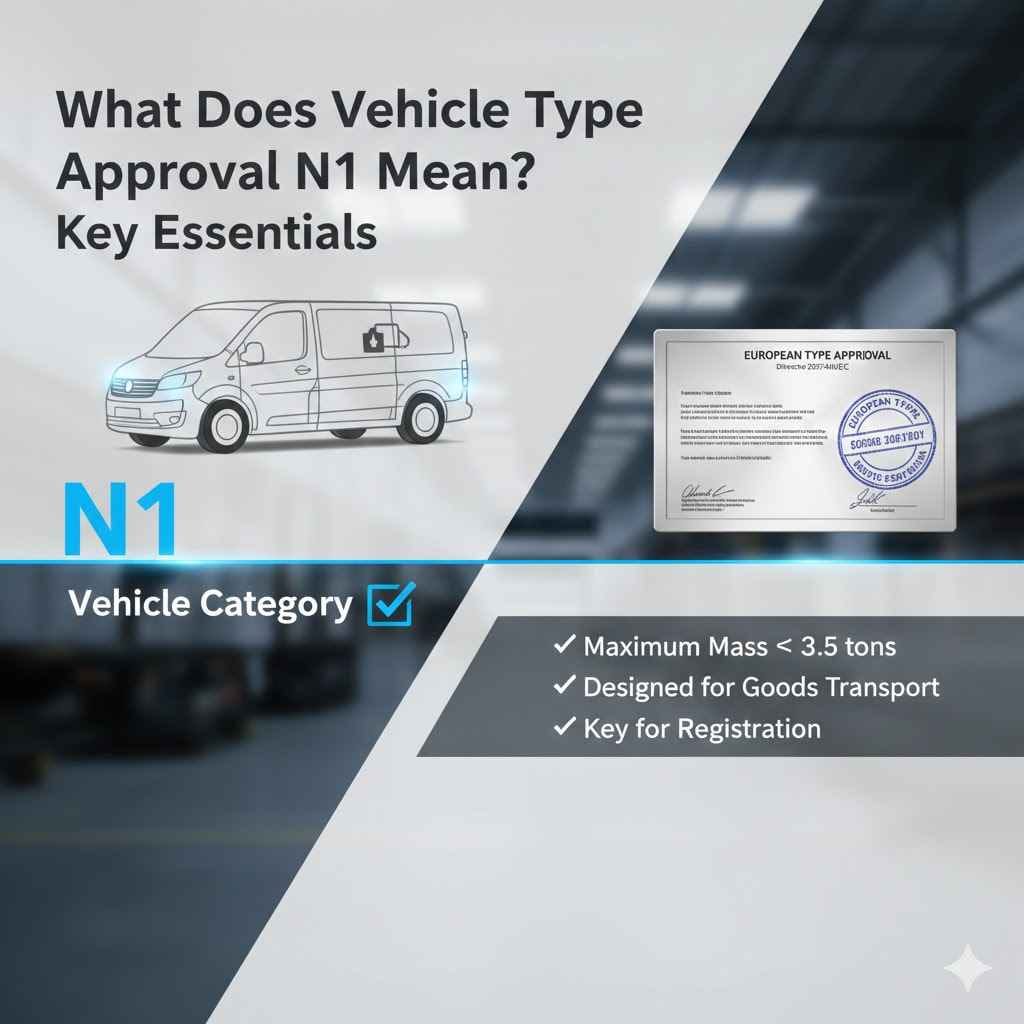
Vehicle Type Approval N1 is a European classification for light commercial vehicles designed to carry goods with a maximum mass not exceeding 3.5 tonnes (3,500 kg). This official certification ensures the vehicle model meets strict safety, environmental, and security standards before it can be sold or registered. It commonly applies to vans, pickup trucks, and chassis-cab vehicles.
Have you ever seen the code “N1” on a vehicle document and wondered what it meant? It might seem like technical jargon, but it’s actually very important. This simple code affects everything from your vehicle’s tax and insurance to its legal speed limits. Understanding it helps you stay safe, legal, and save money.
Feeling a little confused? Don’t worry. Many drivers find these terms puzzling at first. This guide is here to help. We will break down exactly what Vehicle Type Approval N1 means in simple, everyday language. I’ll walk you through everything you need to know, so you can feel confident about your vehicle. Let’s get started!
What is Vehicle Type Approval? Let’s Break It Down
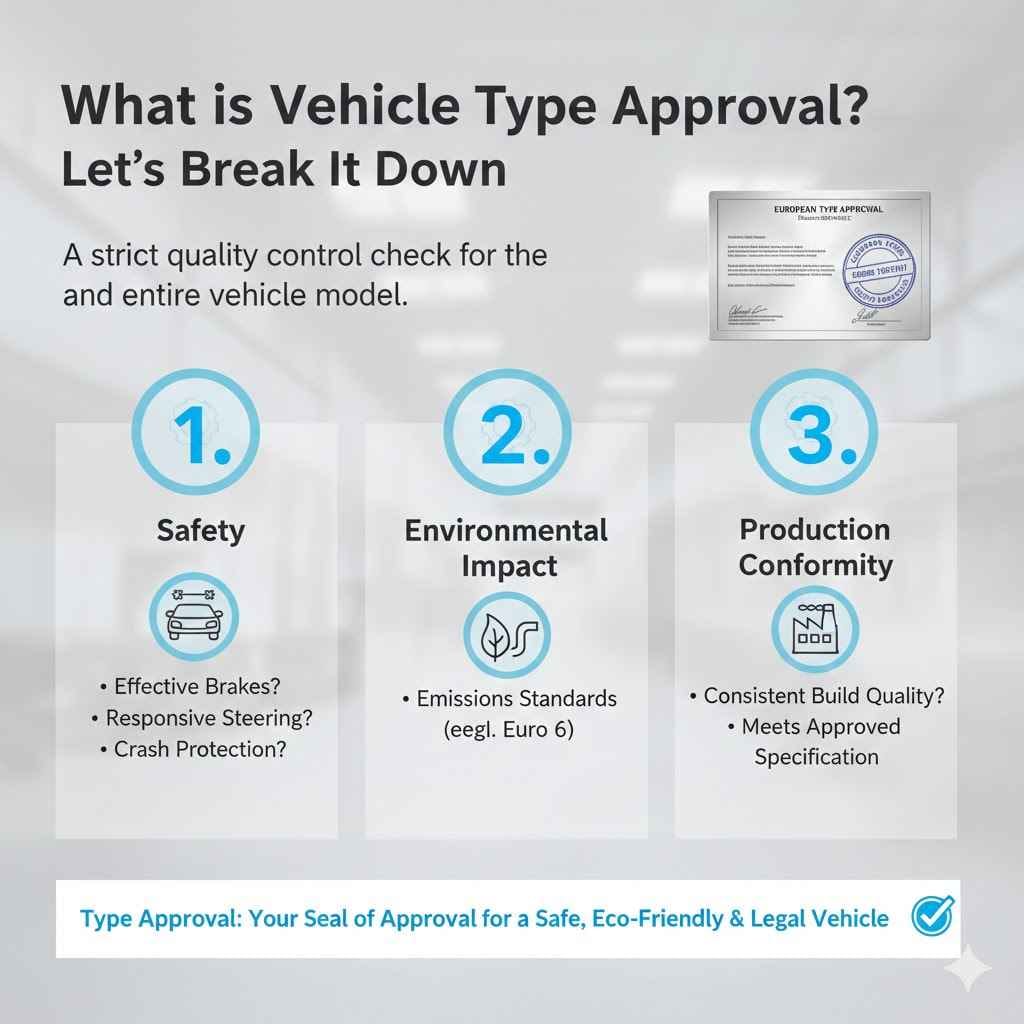
Before we dive into what “N1” means, let’s first understand the bigger picture: Vehicle Type Approval. Think of it as a strict quality control check for an entire vehicle model, not just a single car off the assembly line. Before a manufacturer can sell a new model of car, van, or truck, they must prove that the design meets a long list of official standards.
This process is managed by government authorities. They send a sample vehicle—a “prototype”—through a series of rigorous tests. These tests check for three main things:
- Safety: Are the brakes effective? Is the steering responsive? How well does it protect passengers in a crash?
- Environmental Impact: Does the vehicle meet current emissions standards (like the Euro 6 standard)? Is it too loud?
- Production Conformity: Can the manufacturer build every single vehicle of that model to the exact same high standard?
If the vehicle type passes all these tests, it receives “Type Approval.” This certification is like a seal of approval, confirming that the vehicle design is safe, environmentally friendly, and legal to be sold and used on public roads. It ensures that every vehicle of that model you see driving around has been built to the same approved specification.
Decoding the “N1” in Vehicle Type Approval
Now, where does “N1” fit in? The authorities use a simple category system to classify different types of vehicles. The main categories you’ll encounter are:
- Category M: Vehicles designed for carrying passengers (e.g., cars, SUVs, buses).
- Category N: Vehicles designed for carrying goods (e.g., vans, pickup trucks, lorries).
- Category L: Two or three-wheeled vehicles (e.g., mopeds, motorcycles).
- Category O: Trailers and semi-trailers.
The “N” in N1 tells us we are talking about a goods vehicle. The “1” specifies its size. Category N is further broken down by weight, specifically the Gross Vehicle Weight (GVW), which is the maximum legal weight of the vehicle including its load, fuel, and passengers.
Here’s how the N-categories are defined:
| Category | Description | Maximum Mass (GVW) |
|---|---|---|
| N1 | Light Goods Vehicles | Not exceeding 3.5 tonnes (3,500 kg) |
| N2 | Medium Goods Vehicles | Exceeding 3.5 tonnes but not exceeding 12 tonnes |
| N3 | Heavy Goods Vehicles | Exceeding 12 tonnes |
So, an N1 vehicle is simply a goods vehicle with a maximum weight of 3.5 tonnes. This is a crucial category because it includes the vast majority of vans and pickup trucks used by small businesses, tradespeople, and even for personal use.
Common examples of N1 vehicles include:
- Ford Transit Custom
- Volkswagen Transporter
- Ford Ranger
- Toyota Hilux
- Mercedes-Benz Sprinter (lighter versions)
Why Does N1 Type Approval Matter to You?
Okay, so you know what N1 means. But why should you care? The N1 classification has several real-world impacts, whether you use your vehicle for work or personal trips.
For Business Owners and Tradespeople
If you use a van or pickup for your business, the N1 classification is critical. Here’s why:
- It’s a Legal Requirement: You cannot legally register and use a new commercial vehicle on public roads without it having the correct type approval. The N1 classification proves it’s fit for purpose as a light goods vehicle.
- Tax Implications: The N1 category often brings tax advantages. For example, in the UK, commercial vehicles (N1) usually have a flat rate for Vehicle Excise Duty (VED), which can be cheaper than the emissions-based tax for passenger cars. You can also typically reclaim the Value Added Tax (VAT) on the purchase price if you are VAT-registered.
- Benefit-in-Kind (BIK) Tax: If you use a company van for private trips, the BIK tax is often much lower for an N1 vehicle compared to a company car of a similar value.
- Insurance Premiums: Insurers use the vehicle category to determine risk and set your premiums. Having the correct N1 classification ensures you get the right commercial vehicle coverage.
For Personal Use Buyers
More and more people are buying pickup trucks and vans for personal or recreational use. If this is you, the N1 classification still has important implications:
- Different Speed Limits: This is a big one that many drivers miss. In many countries, including the UK, N1 vehicles have lower speed limits on certain roads compared to cars. For example, a van based on a car chassis (a “car-derived van”) can follow car speed limits, but a standard N1 panel van is restricted to 50 mph on single carriageways and 60 mph on dual carriageways where the national speed limit applies. Always check local regulations!
- Payload and Towing: The N1 approval is based on the vehicle’s Gross Vehicle Weight. This means you must be mindful of how much weight you put in it (the payload). Overloading an N1 vehicle is illegal, unsafe, and can invalidate your insurance.
- Modifications: Thinking of converting your van into a camper? Or adding heavy-duty equipment? Be careful. Significant modifications can change the vehicle’s weight and characteristics, potentially invalidating its original N1 type approval. For major changes, you might need to get the vehicle re-inspected through an Individual Vehicle Approval (IVA) scheme.
The Key Essentials of the N1 Approval Process
You don’t need to be an engineer to understand how a vehicle gets its N1 approval. The process is handled by the manufacturer, but knowing the basics helps you appreciate why this certification is so important.
Here’s a simplified look at the journey from design to approval:
Step 1: Design and Prototyping
The manufacturer designs a new van or truck model. They build a prototype—the very first version of the vehicle. This prototype must represent the exact specifications of the final product that will be sold to the public.
Step 2: Rigorous Testing and Inspection
The prototype is handed over to an independent technical service and an approving authority. This is where the vehicle is pushed to its limits to ensure it meets dozens of legal requirements. Key areas of testing include:
- Braking Systems: Testers perform emergency stops at various speeds and loads to ensure the brakes are powerful and reliable.
- Emissions and Air Quality: The engine’s exhaust is analyzed to make sure it complies with the latest environmental standards (e.g., Euro 6d). This helps keep our air cleaner.
- Steering and Handling: The vehicle is tested for stability during sharp turns and lane changes.
- Noise Levels: Both the engine and the tyres are measured to ensure the vehicle isn’t excessively loud.
- Lights and Visibility: Headlights, brake lights, and indicators must be bright enough and correctly positioned. The driver’s field of vision is also checked.
- Interior Safety: Seat belt anchorages, airbags, and head restraints are tested to ensure they protect occupants in a crash.
- Weights and Dimensions: The vehicle is weighed and measured to confirm its Gross Vehicle Weight (GVW) and payload capacity fall within the N1 category limits.
Step 3: The Certificate of Conformity (CoC)
Once the vehicle type has passed every single test, the approval authority issues the type approval certificate to the manufacturer. From that point on, every vehicle built to that exact specification is considered “type-approved.”
To prove this, each individual vehicle that leaves the factory comes with a crucial document called the Certificate of Conformity (CoC). The CoC is like the vehicle’s birth certificate. It confirms that the specific vehicle you just bought conforms to the approved N1 type. You will need this document for the initial registration of a new vehicle.
N1 vs. M1: Understanding the Critical Difference
One of the most common points of confusion is the difference between N1 (goods vehicle) and M1 (passenger vehicle). This is especially tricky with vehicles like double-cab pickup trucks or combi vans, which can carry both people and cargo.
The primary distinction is the vehicle’s main purpose. Was it designed primarily to move goods or people? The authorities use specific technical criteria to decide, often based on the ratio of payload capacity to passenger weight.
Here’s a simple table to highlight the key differences:
| Feature | N1 (Light Goods Vehicle) | M1 (Passenger Vehicle) |
|---|---|---|
| Primary Purpose | Transporting goods | Transporting passengers |
| Maximum Mass (GVW) | Up to 3.5 tonnes | No specific weight limit, defined by seating |
| Typical Examples | Panel vans, pickup trucks, chassis cabs | Cars, SUVs, minivans, people carriers |
| Tax Rules (UK example) | Often a flat rate for VED; VAT may be reclaimable for businesses | VED is typically based on CO2 emissions |
| Speed Limits (UK example) | Often lower on single and dual carriageways | Standard national speed limits apply |
For double-cab pickups, the rule of thumb is often based on the payload. To be classified as N1, the vehicle must typically have a payload capacity of over 1 tonne (1,000 kg). If its payload is less than that, it may be classified as M1, making it subject to car tax and speed limits. As rules can vary, it is always a good idea to check official sources, such as the UK government’s guide on vehicle categories, for the most up-to-date information.
How to Check if Your Vehicle is N1 Approved
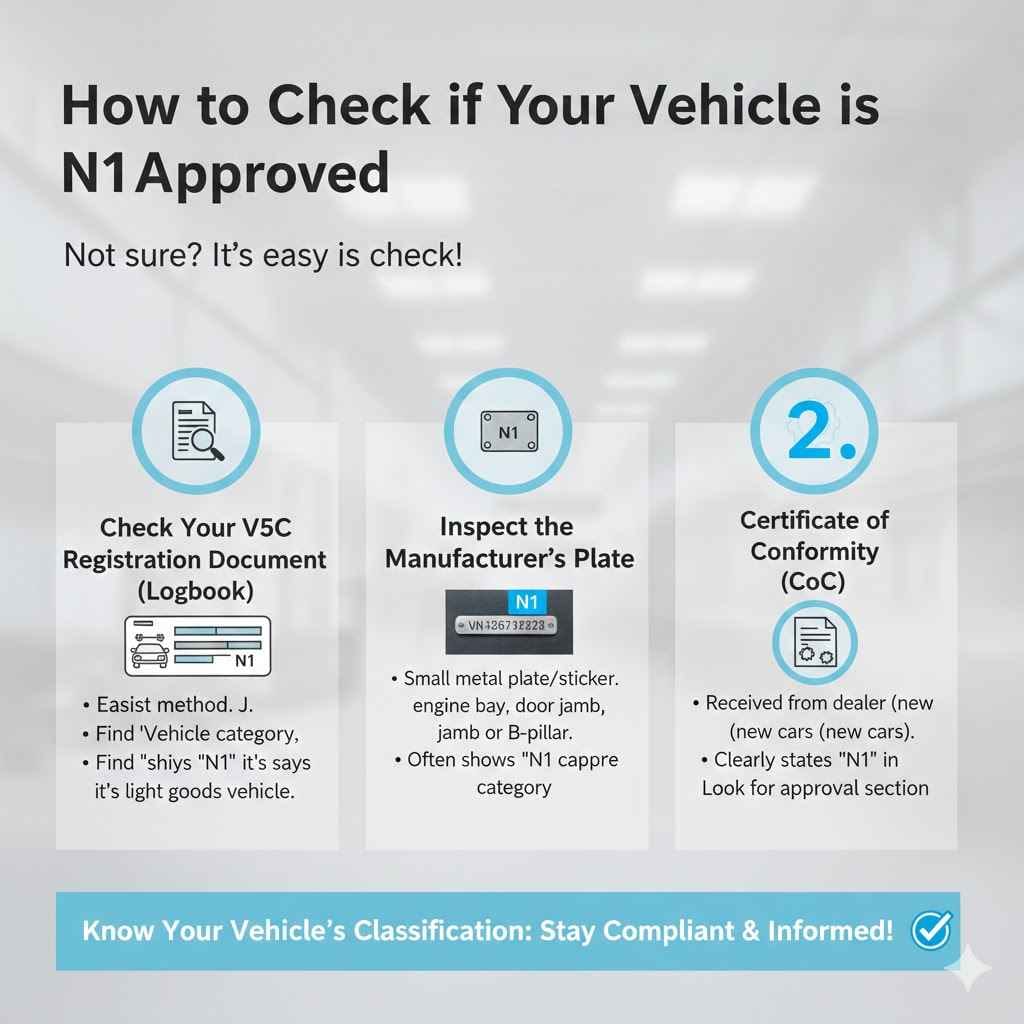
Not sure what category your vehicle falls into? It’s easy to check. You don’t have to guess. Here are three simple ways to find out:
- Check Your V5C Registration Document (Logbook): This is the easiest method. Look at your V5C document. In section ‘J’, you will find the “Vehicle category.” If it says N1, your vehicle is officially classified as a light goods vehicle.
- Inspect the Manufacturer’s Plate: Every vehicle has a small metal plate or sticker, often called the statutory plate or VIN plate. You can usually find it in the engine bay, on the driver’s side door jamb, or on the B-pillar when you open the door. This plate contains key information, including the vehicle’s weights and its type approval number. The vehicle category (e.g., N1) is often listed here.
- Refer to the Certificate of Conformity (CoC): If you bought the vehicle new, you should have received the CoC from the dealer. This document will clearly state the vehicle category under the type approval section.
Knowing your vehicle’s classification is empowering. It helps you stay compliant with the law, choose the right insurance, and understand your vehicle’s capabilities and limitations.
FAQ: Your N1 Type Approval Questions Answered
What is the main difference between an N1 and M1 vehicle?
The simplest difference is their primary purpose. N1 vehicles are designed mainly for carrying goods and have a Gross Vehicle Weight (GVW) up to 3.5 tonnes. M1 vehicles are designed for carrying passengers, like a regular car or SUV.
Are all vans N1 vehicles?
Most vans you see on the road are N1 vehicles, but not all. Smaller vans based on a car’s chassis (like a Ford Fiesta Van) are often called car-derived vans and may have different rules. Larger vans that exceed the 3.5-tonne weight limit fall into the N2 category.
Do N1 vehicles have different speed limits?
Yes, in many countries, they do. In the UK, for example, N1 vehicles (that are not car-derived vans) are typically limited to 50 mph on single carriageways and 60 mph on dual carriageways, which is lower than the limits for cars (M1 vehicles).
Can I convert an M1 vehicle to an N1?
It is sometimes possible but can be a complex and expensive process. It would involve significant modifications (like removing rear seats and fitting a bulkhead) and would require the vehicle to be inspected and re-certified by a relevant authority, likely through an Individual Vehicle Approval (IVA) test. It’s not a simple paperwork change.
Where do I find my vehicle’s category?
The easiest place is on your vehicle’s registration document (V5C in the UK) in section ‘J’. You can also find it on the manufacturer’s plate located in the door jamb or engine bay.
Does N1 approval affect my insurance?
Absolutely. Insurers need to know the correct classification to provide the right type of cover. An N1 vehicle used for business needs commercial vehicle insurance, which is different from a standard car insurance policy. Mis-declaring the vehicle’s use or category can invalidate your policy.
What happens if I heavily modify my N1 vehicle?
Major modifications, especially those that affect the vehicle’s weight, structure, or performance (like converting it to a campervan), can void its original type approval. You may be legally required to have the vehicle re-tested and approved to ensure it remains safe and roadworthy.
Conclusion: Driving with Confidence
The term “Vehicle Type Approval N1” might sound technical, but as you’ve seen, it’s a straightforward and important concept for any driver of a van or pickup truck. It’s the official stamp that confirms your vehicle was built to high standards of safety and environmental care. It’s a guarantee of quality that protects everyone on the road.
By understanding that N1 means your vehicle is a light goods vehicle under 3.5 tonnes, you can now make smarter decisions. You’ll know to check the speed limits that apply to you, be mindful of your payload to avoid dangerous overloading, and ensure you have the right tax and insurance. It’s not just about following rules—it’s about driving safely, legally, and cost-effectively.
So next time you see “N1” on a document, you won’t have to wonder. You’ll know exactly what it means for you and your vehicle, giving you the confidence to manage your vehicle like a pro.