
Vehicle Type Approval L3 is a European standard for two-wheeled motorcycles. It certifies that a motorcycle with an engine over 50cc or a top speed exceeding 45 km/h (28 mph) meets all required safety, environmental, and production conformity standards. This approval is essential for a manufacturer to legally sell the motorcycle within the European Union.
Have you ever looked at the specs of a motorcycle and seen a code like “L3”? It can feel like another piece of confusing jargon in the automotive world. You might wonder if it’s important, what it really means, and why you should care. It’s a common point of confusion, especially if you’re thinking about buying a new bike, importing one, or even just trying to understand your own vehicle better.
Don’t worry, it’s much simpler than it sounds. Think of it as a quality stamp that proves your bike is safe and legal for the road. In this guide, I’ll break down exactly what L3 means in plain, simple English. We will walk through everything step-by-step, so you can feel confident and knowledgeable. Let’s dive in and decode this mystery together.
What is Vehicle Type Approval in Simple Terms?
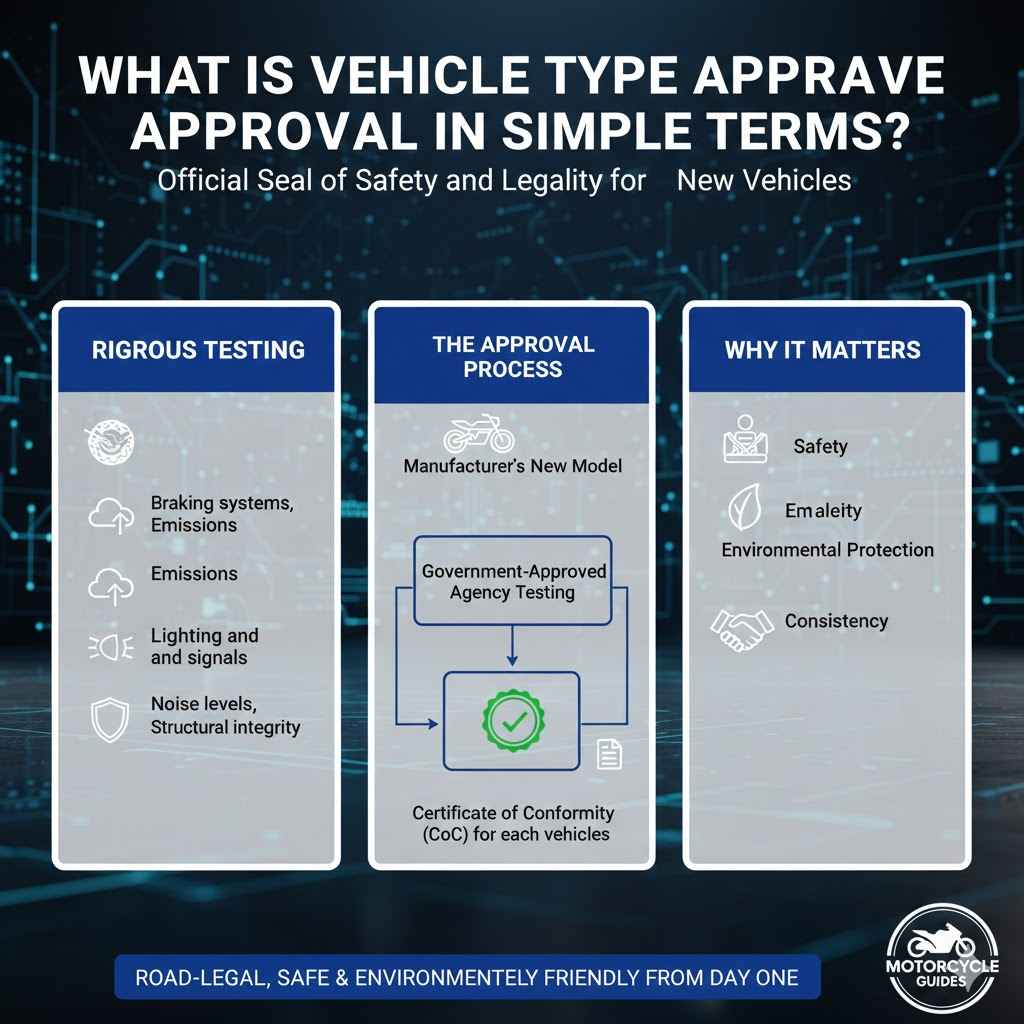
Before we get to “L3,” let’s start with the basics: What is Vehicle Type Approval? Imagine a vehicle manufacturer wants to sell a brand-new car or motorcycle model. Before they can sell a single one, they must prove that the design meets a long list of official rules. These rules cover everything from safety to environmental impact.
Vehicle Type Approval is the process of testing and certifying that a specific type or model of vehicle meets these standards. Government-approved agencies perform rigorous tests on things like:
- Braking systems: Do the brakes work effectively and safely?
- Emissions: Does the exhaust meet clean air standards?
- Lighting and signals: Are the headlights, taillights, and turn signals visible and correctly positioned?
- Noise levels: Is the vehicle quiet enough to be on public roads?
- Structural integrity: Is the frame strong and safe in case of an accident?
Once a vehicle model passes all these tests, it receives a “type approval.” This acts like a green light, allowing the manufacturer to mass-produce that model. Every vehicle that rolls off the assembly line is then issued a Certificate of Conformity (CoC), which is like a birth certificate proving it matches the approved, tested design. In short, type approval ensures that every new vehicle sold is road-legal, safe, and environmentally friendly from day one.
Understanding the “L” Category Vehicles
So, where does the “L” come from? In the world of vehicle regulations, especially in the European Union, vehicles are sorted into different categories. This helps create specific rules for specific types of vehicles. You wouldn’t test a moped the same way you test a heavy-duty truck, right?
The “L” category is a broad classification for two- or three-wheeled vehicles and light quadricycles. It covers everything from small scooters to powerful motorcycles and even some four-wheeled ATVs. Think of it as the family name for all things light and nimble on the road.
This system makes it easier for regulators to apply the right safety and environmental standards to the right vehicle. Each sub-category, from L1 to L7, has its own set of specific requirements based on its design, engine size, and top speed. Knowing these categories helps you understand exactly what kind of vehicle you’re looking at and what rules it had to follow to become road-legal.
The Different L Categories Explained
To really understand L3, it helps to see where it fits in the larger family. Here is a simple table breaking down the main L categories. This shows how each one is defined by its wheels, speed, and power.
| Category | Vehicle Type | Key Characteristics |
|---|---|---|
| L1e | Light Two-Wheel Moped | Max speed ≤ 45 km/h; Engine ≤ 50cc (or ≤ 4kW for electric) |
| L2e | Three-Wheel Moped | Three wheels; Max speed ≤ 45 km/h; Engine ≤ 50cc (or ≤ 4kW) |
| L3e | Two-Wheel Motorcycle | Max speed > 45 km/h OR Engine > 50cc |
| L4e | Motorcycle with Sidecar | Two-wheel motorcycle with a sidecar attached |
| L5e | Motor Tricycle | Three symmetrically arranged wheels; Max speed > 45 km/h |
| L6e | Light Quadricycle | Four wheels; Max speed ≤ 45 km/h; Unladen mass ≤ 425 kg |
| L7e | Heavy Quadricycle | Four wheels; Unladen mass ≤ 450 kg; Power ≤ 15 kW |
A Deep Dive into L3 Type Approval
Now we get to the main event: Category L3e. This is the classification for what most people simply call a “motorcycle.” It’s the most common category for standard two-wheeled bikes intended for road use.
To be classified as an L3e vehicle, a two-wheeled vehicle must meet at least one of these two conditions:
- Its maximum design speed is greater than 45 km/h (about 28 mph).
- If it has an internal combustion engine, its displacement is greater than 50 cubic centimeters (cc).
Basically, if it’s a two-wheeler that’s faster or more powerful than a basic moped (which falls under L1e), it’s an L3e vehicle. This category includes a huge range of bikes, from nimble city commuters to powerful cruisers and high-performance sport bikes.
Sub-Categories of L3e
To make things even more precise, the L3e category is broken down further based on performance. This helps apply appropriate rules, like different license requirements for riders. You don’t need to memorize these, but seeing them helps you understand the level of detail involved.
- L3e-A1 (Low-Performance Motorcycle): Engine displacement ≤ 125cc, power output ≤ 11 kW, and a power-to-weight ratio ≤ 0.1 kW/kg. These are great beginner bikes.
- L3e-A2 (Medium-Performance Motorcycle): Power output ≤ 35 kW, a power-to-weight ratio ≤ 0.2 kW/kg, and not derived from a vehicle of more than double its power. This is a common category for intermediate riders.
- L3e-A3 (High-Performance Motorcycle): Any two-wheeled motorcycle that exceeds the limits of the L3e-A2 category. This is where the most powerful bikes live.
Why L3 Type Approval Is Crucial for You
You might be thinking, “This is interesting, but why does it matter to me as a rider or owner?” The L3 type approval is more than just a bureaucratic label. It has a direct impact on your safety, your wallet, and your ability to legally ride on the road.
1. It Guarantees Safety Standards
The number one reason type approval matters is safety. The L3 approval process is incredibly thorough. It confirms that the motorcycle’s design and all its critical components have been tested and meet strict safety benchmarks. This includes:
- Braking Performance: Every L3e vehicle must now have an Anti-lock Braking System (ABS) or a Combined Braking System (CBS), depending on its size. This is a life-saving requirement.
- Lighting and Visibility: The approval ensures headlights, brake lights, and indicators are bright, durable, and positioned correctly so other drivers can see you.
- Tire Quality: The tires fitted to the bike are tested to ensure they can handle the bike’s speed and weight safely.
- Frame and Structural Strength: The chassis is tested to make sure it won’t fail under normal riding stress.
When you buy an L3-approved motorcycle, you are buying peace of mind. You know it’s not just a collection of parts, but a machine engineered and verified to be safe for public roads.
2. It Ensures Environmental Compliance
Modern vehicles face strict rules about pollution, and L3 motorcycles are no exception. The type approval process includes exhaust emissions testing to make sure the bike complies with the latest standards (like the Euro 5 standards in Europe). This ensures your bike is running as cleanly as possible, minimizing its impact on air quality. It also tests for noise levels, preventing excessively loud bikes from being sold, which helps reduce noise pollution.
3. It’s a Legal Requirement for Registration
You cannot register and insure a new vehicle without a valid Certificate of Conformity (CoC), which is only issued for type-approved vehicles. When you buy a new motorcycle from a dealership, they handle all this paperwork. The CoC is proof that your specific bike matches the L3-approved model. Without it, the vehicle licensing agency won’t issue you a license plate. This is especially critical if you are considering importing a motorcycle from another country. If it doesn’t have the correct type approval for your region, getting it on the road can be a nightmare of expensive tests and modifications—or it may be impossible altogether.
4. It Affects Resale Value
A motorcycle with proper documentation, including its CoC, is easier to sell. Buyers know it’s a legitimate, legal vehicle. A bike with a murky history or missing paperwork, especially one that was personally imported without going through the proper channels, will be much harder to sell and will fetch a lower price. The L3 approval is a mark of authenticity that adds value and trust.
The Type Approval Process: A Simplified Look
The journey for a new motorcycle model from a drawing board to a showroom floor is a long one, and type approval is a major milestone. While the full process is highly technical, here’s a simplified overview of what a manufacturer goes through.
Preparation and Documentation: The manufacturer compiles a massive technical file. This includes detailed engineering drawings, specifications for every part, and data on how the vehicle is built.
Choosing a Testing Authority: The manufacturer selects a government-approved technical service or agency to conduct the tests. These are independent bodies specialized in vehicle testing.
Prototype Testing: A production-representative prototype of the motorcycle is submitted for testing. This isn’t a one-day event; it’s a series of dozens of individual tests. Each system is checked against the regulations. For example, they’ll put the brakes on a special rig to measure stopping distance and test the engine on a dynamometer to measure emissions.
Factory Audit (Conformity of Production): The approval authority also inspects the factory where the motorcycle will be built. They need to ensure the manufacturer has quality control systems in place to guarantee that every single bike produced will be identical to the one that was tested. This is called “Conformity of Production” (CoP).
Issuing the Approval: If the prototype passes all tests and the factory audit is successful, the national authority grants the EC Whole Vehicle Type Approval (ECWVTA). The manufacturer receives an approval number for that vehicle type.
Certificate of Conformity (CoC): Now, the manufacturer can start mass production. Each individual motorcycle that comes off the line is issued its own Certificate of Conformity. This document, which includes the vehicle’s unique VIN, states that it conforms to the approved type. This is the paper you need to register your bike.
This rigorous process is why developing a new vehicle is so expensive and time-consuming, but it’s also what keeps our roads safe. For more details on the European framework, you can review the official regulations, such as Regulation (EU) No 168/2013, which governs the approval of L-category vehicles.
L3 vs. Other Categories: A Practical Comparison
Understanding the difference between L3 and its neighbors, L1 and L4, can help you make better choices when buying a two-wheeler. A small difference in classification can mean a big difference in license requirements, insurance costs, and where you can legally ride.
| Feature | L1e (Moped) | L3e (Motorcycle) | L4e (Motorcycle with Sidecar) |
|---|---|---|---|
| Top Speed | Capped at 45 km/h (28 mph) | Over 45 km/h | Over 45 km/h (based on the L3e bike) |
| Engine Size (Gas) | Up to 50cc | Over 50cc (or can be smaller if speed is >45 km/h) | Over 50cc (based on the L3e bike) |
| Typical License | Basic moped license (e.g., AM in the EU) | Full motorcycle license (e.g., A1, A2, or A) | Full motorcycle license, sometimes with sidecar-specific training |
| Highway Legal? | Generally no | Yes | Yes |
| Example | Vespa 50cc, small scooter | Honda CB500, Harley-Davidson Street Glide, Yamaha R1 | Ural motorcycle, a Royal Enfield with a sidecar |
What to Check When Buying an L3 Motorcycle
Now that you’re an expert on L3 approval, here’s how to use that knowledge in the real world. Whether you’re buying new or used, here are the key things to look for.
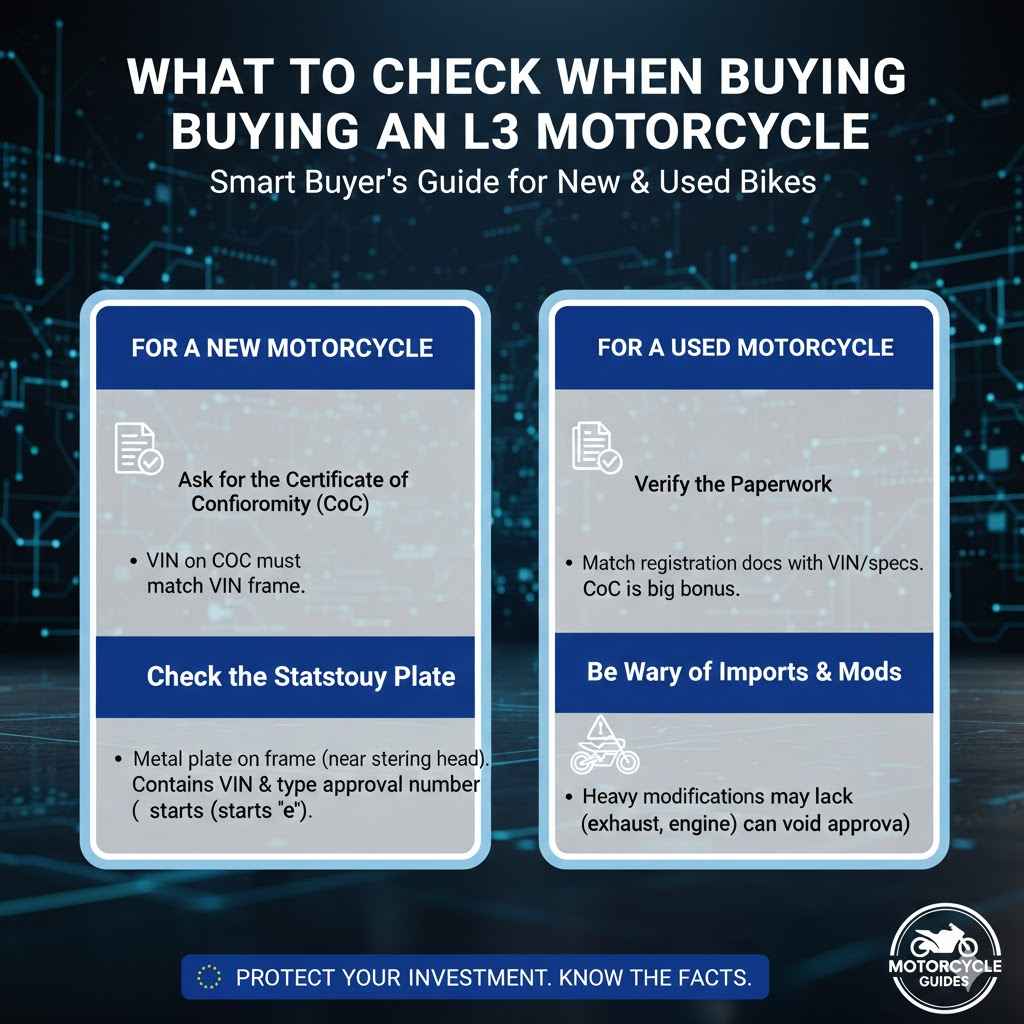
For a New Motorcycle
- Ask for the Certificate of Conformity (CoC): The dealer should provide this without question. It’s a critical document for registration. Make sure the Vehicle Identification Number (VIN) on the CoC matches the VIN on the bike’s frame.
- Check the Statutory Plate: Every approved vehicle has a metal plate or sticker, usually on the frame near the steering head. This plate contains key information, including the manufacturer’s name, the VIN, weight limits, and the all-important type approval number. The number will typically start with “e” followed by a country code and a series of other numbers. This is physical proof of approval.
For a Used Motorcycle
- Verify the Paperwork: Ask the seller for the original registration documents. These should align with the bike’s VIN and specs. If the seller has the CoC, that’s a huge bonus.
- Be Wary of Imports: If you’re looking at a used bike that was imported, be extra careful. A motorcycle from North America or Asia might not have the correct EU type approval. The seller should have documentation proving it was legally imported and modified to meet local standards. If they don’t, you could be buying a very expensive garage ornament.
- Check for Unapproved Modifications: Major changes, especially to the exhaust, engine, or frame, can technically void the original type approval. While many modifications are fine, be aware that a heavily modified bike might have trouble passing inspections or could have insurance issues.
Frequently Asked Questions (FAQ)
What’s the simplest way to know if a motorcycle is L3 approved?
Look for the manufacturer’s statutory plate on the bike’s frame, typically near the steering head. It will have a type approval number on it. Additionally, any new motorcycle sold by a legitimate dealer in a region with these regulations will be approved, and it will come with a Certificate of Conformity (CoC).
Is L3 approval the same in every country?
No. The L3e classification is part of the European Union’s framework. While other countries have their own similar vehicle certification systems (like the DOT and EPA standards in the United States), they are not identical. A bike with EU type approval may need additional testing or certification to be legal in a non-EU country, and vice-versa.
Can I modify my L3 motorcycle?
Yes, you can modify your motorcycle, but there are rules. Modifications to critical systems like brakes, lighting, and emissions (e.g., a full exhaust system) must often use approved parts. Major structural changes could invalidate the type approval and require the vehicle to be re-inspected and re-certified, which can be a complex process.
Does an L3 type approval ever expire?
The approval for a vehicle model does not expire. However, the standards are updated over time (e.g., from Euro 4 to Euro 5 emissions). A manufacturer must get new models approved under the current standards. An older, legally registered bike is still perfectly fine to ride, as it met the standards in place when it was first sold.
Is an electric motorcycle also an L3 vehicle?
Yes. The L3e category applies to electric motorcycles as well. Instead of engine displacement (cc), the classification is based on power output (kW) and maximum speed. If an electric two-wheeler has a top speed over 45 km/h or a continuous rated power over 4 kW, it generally falls into the L3e category.
Where can I find the type approval number on my motorcycle?
The type approval number is located on the vehicle’s statutory plate (or compliance plate). This is a small metal plate or sticker permanently attached to the frame, usually on the headstock (the part of the frame behind the handlebars) or another visible part of the chassis.
What happens if I ride a non-approved L3 vehicle on public roads?
Riding a non-approved vehicle is illegal. You would be unable to get it registered, insured, or get a license plate for it. If you were caught riding it, you could face significant fines, have the vehicle impounded, and potentially be held liable for any accidents without insurance coverage.
Conclusion: Your Confidence on Two Wheels
Understanding “Vehicle Type Approval L3” might have seemed like a deep dive into technical regulations, but as you can see, it’s a concept that directly connects to your experience as a rider. It’s not just a sticker on a frame or a line in a manual; it’s a comprehensive guarantee of safety, quality, and legality.
This approval ensures that every L3 motorcycle sold has passed a gauntlet of tests covering everything from its brakes and lights to its emissions and structural strength. It gives you the confidence that the bike you’re riding is fundamentally sound and built to recognized international standards.
So the next time you see “L3e” in a spec sheet or hear someone mention type approval, you’ll know exactly what it means. It’s the invisible system working behind the scenes to keep you, and everyone else on the road, safe. Now you can shop for your next bike with more knowledge, ride with greater peace of mind, and appreciate the incredible engineering and care that goes into the machine between your legs.