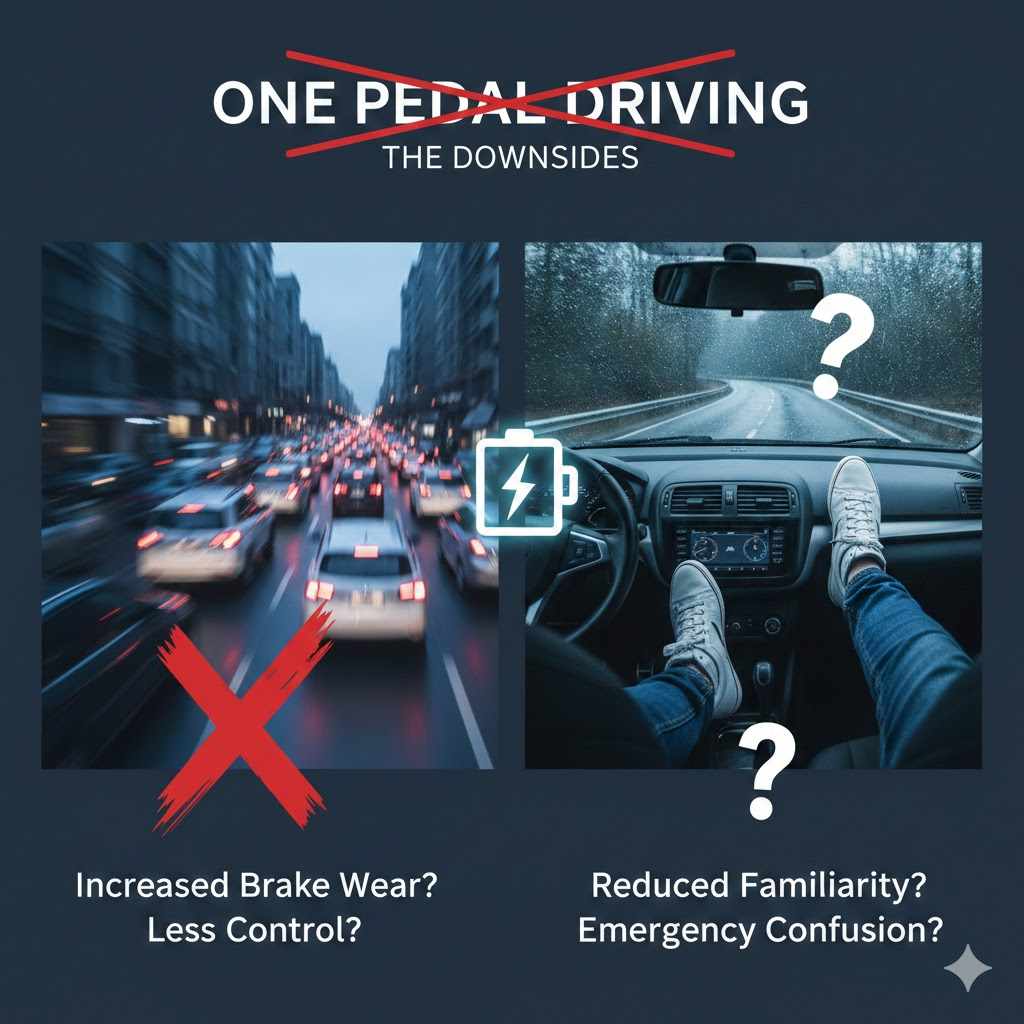
What Are the Disadvantages of One Pedal Driving?
Thinking about one-pedal driving in electric cars? It can feel strange at first! Many new drivers wonder, “What Are the Disadvantages of One Pedal Driving?” It’s totally normal to find it a bit tricky when you first start. But don’t worry, it’s not as complicated as it seems. We’ll break it down simply, step-by-step, so you can get the hang of it. Let’s explore what you need to know.
Understanding One Pedal Driving Challenges
One-pedal driving is a feature in many electric vehicles (EVs) that allows you to accelerate and brake using just the accelerator pedal. When you lift your foot off the pedal, the car uses regenerative braking to slow down, sending energy back to the battery.

MOSYFEIBI
Adjustable Left Foot Accelerator Pedal for Handicap…
- Ideal for Disabled, Elderly, and Post-Rehab Users: An excellent adaptive driving aid for individuals with permanent disabilities,…
- Universal Compatibility with Most Vehicles: Works seamlessly with the majority of automatic-transmission vehicles, such as sedans,…
- Quick Installation: Requires no drilling or modifications to your vehicle. Includes a clear installation guide, allowing for one-t…
As an Amazon Associate I earn from qualifying purchases.
This system can significantly change how you drive, and for many, especially those new to EVs, it presents a learning curve. The main questions people have revolve around its downsides, which is why exploring “What Are the Disadvantages of One Pedal Driving?” is important for a complete picture.
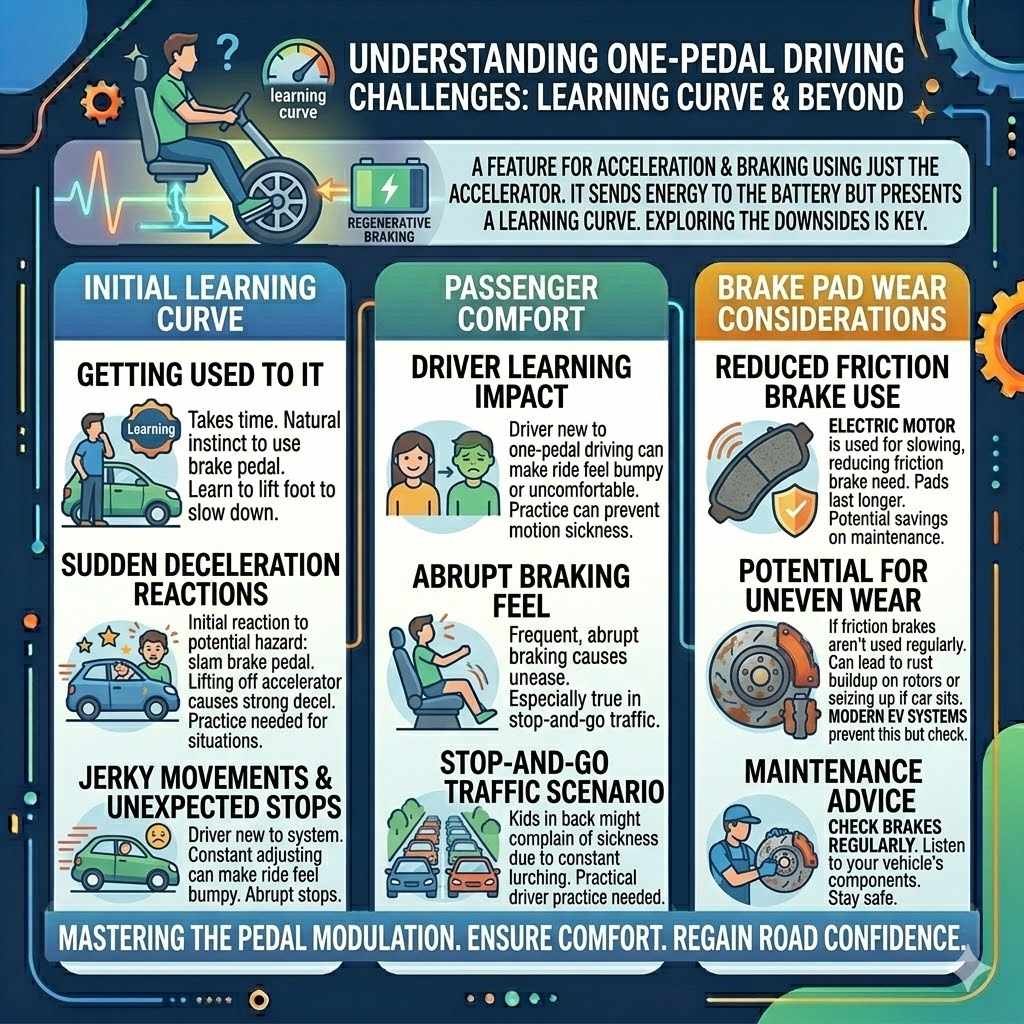
Initial Learning Curve
Getting used to one-pedal driving can take some time. Your natural instinct might be to use your brake pedal as you always have. It’s easy to over-brake or under-brake when you’re not accustomed to the car slowing down just by lifting your foot. This can lead to jerky movements or unexpected stops.
Sudden Deceleration Reactions
Many drivers find that their initial reaction to a potential hazard is to slam on the brake pedal. With one-pedal driving, lifting off the accelerator can cause a strong deceleration. If this happens unexpectedly, it can startle the driver or passengers, or even lead to a sudden stop if the driver is not prepared. Learning to anticipate situations and smoothly modulate the accelerator is key. It requires a different kind of anticipation compared to traditional driving.
Passenger Comfort
For passengers, a driver still getting used to one-pedal driving can make the ride feel bumpy or uncomfortable. Frequent, abrupt braking can cause motion sickness or just general unease. This is especially true in stop-and-go traffic where the driver is constantly adjusting the accelerator to maintain a slow speed or come to a complete stop.
For instance, imagine a family taking a road trip. If the driver is new to one-pedal driving, the kids in the back might complain of feeling sick because of the constant lurching. This highlights the importance of driver practice and passenger comfort.
Brake Pad Wear Considerations
While regenerative braking reduces wear on your traditional friction brakes, there are nuances to consider. Understanding how it impacts your vehicle’s components is part of knowing the full picture.
Reduced Friction Brake Use
One of the primary benefits of regenerative braking is that it uses the electric motor to slow the car, significantly reducing the need for your physical brake pads. This means your brake pads can last much longer, potentially saving money on maintenance over the life of the vehicle. Many owners report not needing to replace brake pads for tens of thousands of miles, or even the entire lifespan of the vehicle if they drive gently.
Potential for Uneven Wear
In some very specific driving scenarios, or with certain vehicle designs, there can be a slight concern about uneven wear on the friction brakes. This is more of a theoretical concern for most drivers. If the car primarily relies on regenerative braking, the friction brakes might not be exercised as regularly. This could lead to rust buildup on the rotors or brake components seizing up if the car sits for very long periods without the friction brakes being used. However, modern EV systems are designed to prevent this.
Specific Driving Scenarios and Challenges
Certain situations can make one-pedal driving more challenging. Recognizing these can help drivers prepare and adjust their technique.
Driving in Heavy Traffic
Stop-and-go traffic is a prime example where one-pedal driving can be both a blessing and a curse. Constant acceleration and deceleration can become mentally taxing if not managed well.
Constant Pedal Modulation
In heavy traffic, you’re constantly adjusting your speed. With one-pedal driving, this means continuously lifting and pressing the accelerator pedal. This can lead to a fatigued foot and ankle, especially during long commutes in congested areas. It requires a very fine touch to maintain a smooth, consistent speed or to creep forward without overshooting or braking too suddenly.
Consider a driver stuck in rush hour for two hours every day. If they are constantly making micro-adjustments with their foot on the accelerator, it can become quite tiring. This is a practical disadvantage for daily commuters in busy cities.
Risk of Accidental Brake Application
When inching forward in traffic, there’s a slight risk of accidentally fully lifting your foot off the accelerator, which could engage strong regenerative braking when you only intended a slight slowdown. This can surprise other drivers and lead to an abrupt stop. Many vehicles offer adjustable regenerative braking levels to mitigate this.
Driving on Slopes and Hills
Hills present a unique set of challenges for any driving system, and one-pedal driving is no exception.
Holding Position on Inclines
One of the most common challenges is holding the car stationary on an incline. In a traditional car with an automatic transmission, you might use the brake or gently use the accelerator to hold the car in place. With one-pedal driving, lifting your foot completely off the accelerator will cause the car to slow down or even roll backward depending on the slope and the car’s settings. This requires precise pedal control or using the actual brake pedal to hold the car still on a steep hill.
A common scenario is stopping at a traffic light on a hill. A driver new to one-pedal driving might lift their foot to stop and find the car starting to roll back. They then have to quickly apply the brake. Experienced drivers learn to keep their foot hovering over the brake pedal or use a very light touch on the accelerator to hold position.
Managing Downhill Deceleration
When going downhill, the car naturally wants to accelerate. Regenerative braking helps to control this speed. However, on very steep descents, regenerative braking alone might not be enough to maintain a safe speed, and you might still need to use the friction brakes. The key is to understand the car’s limits and when to supplement with the brake pedal.
Emergency Situations
While regenerative braking is efficient, it’s important to know its limitations in critical moments.
Brake Pedal Still Essential
It’s crucial to remember that one-pedal driving does not eliminate the need for the brake pedal. In true emergencies, where you need maximum stopping power, you will still need to apply the physical brake pedal. The friction brakes are there for a reason and are designed for rapid, hard stops. Regenerative braking is a supplementary system, not a complete replacement for conventional brakes.
A real-life example could be a deer suddenly jumping into the road. The driver’s immediate, instinctive reaction will be to brake hard. While the accelerator will decelerate the car, it’s the brake pedal that provides the necessary force for a sudden, life-saving stop.
System Limitations in Extreme Conditions
In very cold weather or when the battery is fully charged, the effectiveness of regenerative braking can be reduced. If the battery cannot accept more charge, the system may not be able to slow the car down as much as expected. This is why maintaining awareness of battery state and environmental conditions is important, and why the friction brakes are always the ultimate safety net.
Understanding Regenerative Braking Systems
Regenerative braking is the heart of one-pedal driving. Learning how it works helps understand its disadvantages.
How Regenerative Braking Works
When you lift your foot off the accelerator in an EV with one-pedal driving enabled, the electric motor switches roles. Instead of drawing power from the battery to turn the wheels, the wheels’ momentum forces the motor to spin. This spinning motor acts as a generator, creating electricity. This process creates resistance, slowing the vehicle down. The generated electricity is then sent back to the battery, recharging it slightly. This is often referred to as “regen.”
Motor as Generator
The electric motor in an EV is a powerful piece of technology. It’s not just for moving the car forward. When the vehicle is coasting or slowing down, the motor can be reversed in its function. The kinetic energy of the car (its motion) is used to spin the motor’s rotor. This mechanical action within the motor induces an electric current, effectively turning the motor into a generator. This generation process requires energy, and that energy is drawn from the car’s forward motion.
Energy Recovery Efficiency
The efficiency of regenerative braking varies between different EV models and driving conditions. Typically, it can recover a significant portion of the energy that would otherwise be lost as heat through friction brakes. This recovered energy extends the vehicle’s range. However, the amount of energy that can be recovered is limited by factors like the battery’s state of charge and temperature.
Adjustable Regeneration Levels
Most EVs allow drivers to adjust how strong the regenerative braking is. This is a key feature that helps manage some of the “disadvantages.”
Customizing the Driving Experience
Manufacturers understand that not everyone likes the same driving feel. Therefore, many EVs offer multiple settings for regenerative braking. You might find options ranging from “low” or “mild” regen, which feels more like traditional coasting, to “high” or “strong” regen, which provides aggressive deceleration. Some cars even have an “auto” mode that adjusts regen based on traffic conditions detected by sensors.
For example, a driver who prefers a smoother ride might set their EV to a lower regen level. This would make lifting off the accelerator less abrupt, providing a more comfortable experience for passengers. Conversely, someone looking to maximize range might opt for the highest setting.
Impact on Braking Feel
Changing the regen level directly impacts how the car slows down. A higher setting means more deceleration when you lift off the pedal, potentially allowing you to drive the entire commute without touching the brake pedal. A lower setting means less deceleration, requiring more frequent use of the actual brake pedal but offering a more natural coasting feel.
Here’s a simple comparison table:
| Regen Level | Deceleration Strength | Pedal Modulation Needed | Brake Pedal Usage |
|---|---|---|---|
| Low | Mild | More frequent | More frequent |
| Medium | Moderate | Balanced | Moderate |
| High | Strong | Less frequent, smoother | Minimal (for most stops) |
This table shows how different regen levels affect the driving experience, illustrating why adjustability is a key feature.
Technological Factors and Vehicle Design
The way an EV is designed and its technology play a big role in how one-pedal driving feels and performs.
Battery State of Charge
The battery’s charge level is a critical factor affecting regenerative braking.
Full Battery Limitations
When the EV’s battery is fully charged, it cannot accept any more energy. This means that regenerative braking cannot send any recovered energy back to the battery. In this situation, the car’s system will limit or disable regenerative braking to prevent overcharging. This can feel disconcerting to drivers who have become accustomed to strong regen, as the car will simply coast when they lift off the accelerator, behaving more like a traditional gasoline car.
Imagine driving an EV with a full battery right after charging it at home. If you then try to use one-pedal driving, you’ll notice it doesn’t slow down as much as it usually does. The car will feel like it’s rolling more freely. This is a common experience for EV owners and a clear disadvantage if not anticipated.
Impact on Driving Feel
This limitation means that the one-pedal driving experience isn’t always consistent. Drivers might notice a significant difference in deceleration on the first part of a trip (when the battery is full) compared to later in the trip (when the battery has discharged somewhat). This inconsistency can be a point of frustration for those who rely on predictable braking.
Software and Control Systems
The car’s software dictates how regenerative braking and friction braking work together.
Integration with Friction Brakes
Modern EVs have sophisticated software that blends regenerative braking with traditional friction braking. When you press the brake pedal, the car’s computer decides how much to slow down using regen and how much to use the physical brakes. This blending is designed to be seamless, but sometimes drivers can feel a slight difference in feel between pure regen and when the friction brakes engage.
Calibration and Updates
Vehicle software can be updated, and sometimes these updates can change the feel or performance of regenerative braking. While often intended to improve the system, drivers might find the changes take some getting used to. The calibration between the accelerator pedal position and the resulting deceleration is very precise and can be fine-tuned by manufacturers.
User Experience and Adaptation
Ultimately, the “disadvantages” often come down to how well a driver adapts to the new technology.
The Learning Curve Explained
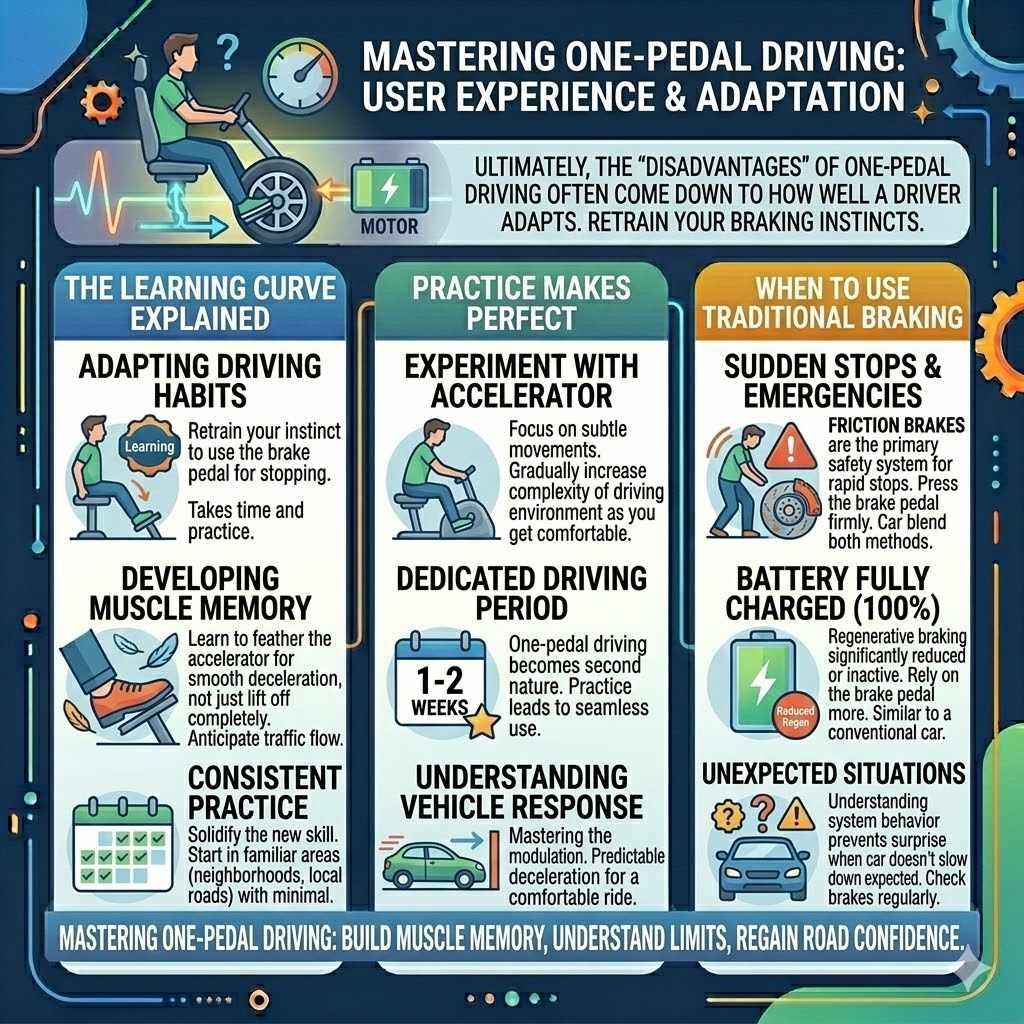
The biggest hurdle for many is simply adapting their driving habits. For years, we’ve been trained to use a brake pedal for stopping. One-pedal driving asks us to retrain that instinct.
Developing Muscle Memory
It takes time and practice to develop new muscle memory. Your foot needs to learn to feather the accelerator pedal for smooth deceleration, rather than just letting off completely. This involves learning to anticipate traffic flow and adjusting the pedal position with subtle movements. This adaptation period is where most of the perceived disadvantages lie.
Practice Makes Perfect
The best way to overcome these challenges is through consistent practice. Driving in familiar areas, like your neighborhood or local roads, with minimal traffic, allows you to experiment with the accelerator pedal. Gradually increasing the complexity of your driving environment as you become more comfortable will help solidify the new skill. Many owners find that after a week or two of dedicated driving, one-pedal driving becomes second nature.
When to Use Traditional Braking
It’s important to know when the one-pedal system might not be ideal or when to rely on the conventional brakes.
Sudden Stops and Emergencies
As mentioned, the friction brakes are the primary safety system for rapid stops. If you need to stop quickly, press the brake pedal firmly. The car’s systems will blend the two braking methods, but the friction brakes are the ultimate guarantor of stopping power in emergencies.
When Battery is Fully Charged
When the battery is at 100% charge, regenerative braking is significantly reduced or inactive. In these situations, you will naturally need to rely on the brake pedal more, similar to driving a conventional car. Understanding this behavior prevents surprise when the car doesn’t slow down as expected.
Frequently Asked Questions
Question: Is one-pedal driving safe
Answer: Yes, one-pedal driving is generally considered safe, provided the driver is accustomed to it and understands its behavior. The traditional brake pedal is always available for immediate and strong stopping power in emergencies.
Question: Will one-pedal driving wear out my brakes faster
Answer: No, one-pedal driving typically reduces wear on your friction brake pads because regenerative braking handles most of the slowing down. Your brake pads can last much longer.
Question: Can I drive without using the brake pedal at all
Answer: In many situations, yes, you can come to a complete stop using only the accelerator pedal. However, for very sudden stops or when the battery is full, you will still need to use the brake pedal.
Question: Is one-pedal driving better for battery range
Answer: Yes, one-pedal driving often improves battery range because it recovers energy that would otherwise be lost as heat during braking.
Question: What happens to one-pedal driving when the battery is full
Answer: When the battery is fully charged, regenerative braking capacity is reduced or disabled. The car will then coast more like a traditional vehicle, and you will need to use the brake pedal more frequently for stopping.
Summary
Navigating the challenges of one-pedal driving involves understanding its limitations like full battery regen and hill holds. It’s about adapting to new habits and knowing when to use the brake pedal. With practice, the advantages of efficiency and control usually outweigh the initial learning curve, making it a preferred driving mode for many EV owners.
Related pick: Check today's price on Amazon