
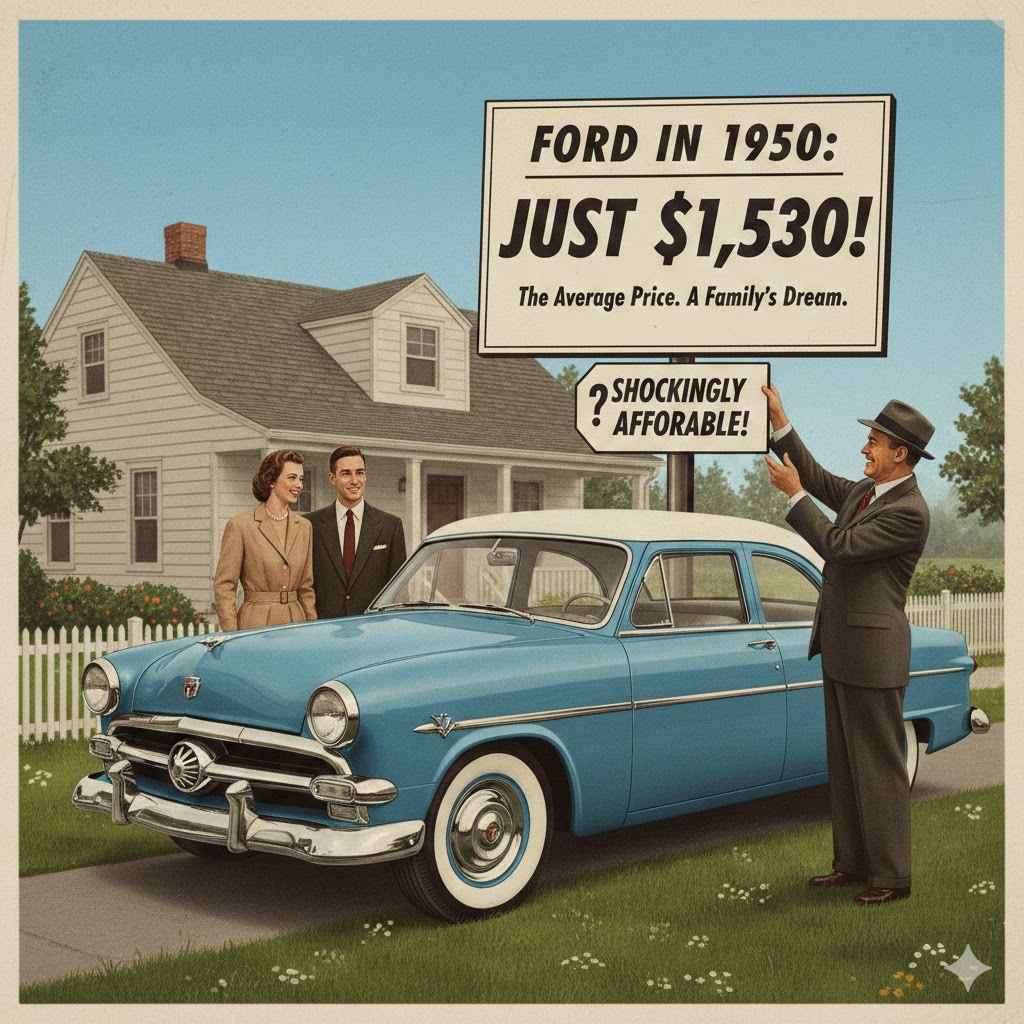
In 1950, a brand-new Ford car cost between $1,330 for a basic Deluxe Tudor Sedan and just over $2,000 for the top-of-the-line Country Squire station wagon. While these prices seem incredibly low today, they represented a major investment for the average American family, whose annual income was around $3,300.
Have you ever looked at a classic car from the 1950s and wondered what it cost brand new? It’s a fun question. Thinking about car prices from decades ago can feel like looking into a different world. The numbers seem so small! But what did that money really mean back then?
Today, we’re going to step back in time to the year 1950. We’ll explore the price tags on the shiny new Fords rolling off the assembly line. We will break down not just the cost, but what that cost meant to the average person. Get ready to see how the price of a family car has changed over the years. You might be surprised by what you learn!
A Glimpse into America in 1950
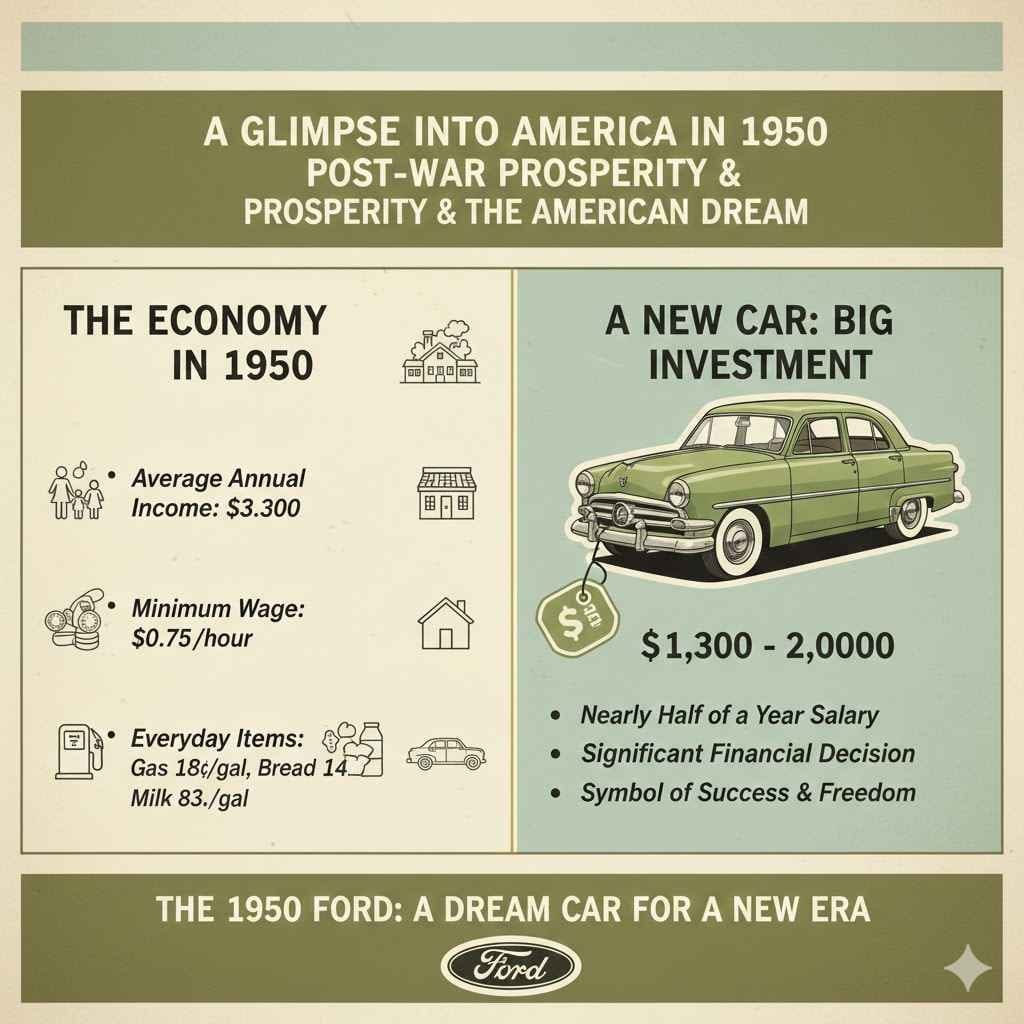
To really understand the price of a 1950 Ford, we need to paint a picture of the time. The year 1950 was a unique moment in American history. The country was riding a wave of post-World War II prosperity. The economy was booming, suburbs were expanding, and the American dream felt more attainable than ever. For many families, owning a home and a new car was a central part of that dream.
However, the financial landscape was vastly different. Let’s look at some key numbers to put things in perspective:
- Average Annual Income: In 1950, the median family income was approximately $3,300 per year.
- Minimum Wage: The federal minimum wage was just $0.75 per hour.
- Cost of a New House: The average price for a new home was around $8,500.
- Price of Everyday Items: A gallon of gasoline cost about 18 cents, a loaf of bread was 14 cents, and a gallon of milk was 83 cents.
When you consider these figures, spending over $1,300 on a new car was a massive financial decision. It represented nearly half of an entire year’s salary for the average family. This wasn’t a casual purchase; it was a significant, long-term investment that families saved up for and financed carefully. The car was a symbol of success, freedom, and modernity in a rapidly changing world.
The 1950 Ford Lineup: Models and Prices
In 1950, Ford simplified its lineup into two main series: the “Deluxe” and the more upscale “Custom Deluxe.” These models were known for their clean, modern “shoebox” design, which had been introduced in 1949 and was a radical departure from pre-war automotive styling. Within these series, Ford offered a variety of body styles to suit different needs and budgets, from practical sedans to stylish convertibles.
The pricing was structured to offer an entry point for budget-conscious buyers while also providing more luxurious options for those willing to spend a bit more. The Custom Deluxe models came with more chrome trim, better upholstery, and a few extra creature comforts that set them apart.
Here is a breakdown of the approximate base prices for the most popular 1950 Ford models. Keep in mind that these are Manufacturer’s Suggested Retail Prices (MSRP) and did not include taxes, destination charges, or any optional extras.
| Model Series | Body Style | Approximate Base Price (1950 USD) |
|---|---|---|
| Deluxe | Business Coupe | $1,330 |
| Deluxe | Tudor Sedan | $1,390 |
| Deluxe | Fordor Sedan | $1,440 |
| Custom Deluxe | Tudor Sedan | $1,510 |
| Custom Deluxe | Fordor Sedan | $1,560 |
| Custom Deluxe | Club Coupe | $1,530 |
| Custom Deluxe | Convertible | $1,950 |
| Custom Deluxe | Crestliner (Two-tone hardtop-style) | $1,720 |
| Custom Deluxe | Country Squire (Station Wagon) | $2,030 |
What Did That Price Actually Get You?
Buying a car in 1950 was a very different experience from today. The list of “standard features” was quite short. When you paid the base price for a 1950 Ford Deluxe, you were getting a very basic vehicle. Things we consider essential today, like a radio or even a heater, were often expensive add-ons.
Standard Features and Engine Choices
A standard 1950 Ford came with the basics needed for driving and not much else. The interior was simple, with durable but plain upholstery. The dashboard had essential gauges for speed, fuel, and engine temperature. Powering the car were two reliable engine choices:
- The 226 cubic-inch “L-head” inline-six engine: This was the base engine, producing about 95 horsepower. It was known for its reliability and decent fuel economy for the time.
- The 239 cubic-inch “Flathead” V8 engine: For a small extra cost (around $75), buyers could upgrade to the legendary Flathead V8, which delivered a more robust 100 horsepower. This engine was a major selling point for Ford, offering smooth power that competitors struggled to match at the same price point.
The “Ford-O-Matic” automatic transmission was introduced late in the 1950 model year, but most cars came with a standard three-speed manual transmission with a column-mounted shifter, often called “three on the tree.”
Popular Optional Extras
To make the car more comfortable and enjoyable, most buyers added a few optional extras. Each of these added to the final price tag, and it was easy for the cost to climb quickly. Some of the most common options included:
- Heater and Defroster: This might be shocking to modern drivers, but a heater was not standard. In colder climates, this was a necessary addition, costing around $50.
- AM Radio: Having music or news in the car was a luxury. A factory-installed AM radio could cost an additional $60 to $80.
- Whitewall Tires: For a touch of style, whitewall tires were a very popular option, adding to the car’s visual appeal.
- Turn Signals: Another feature we take for granted, turn signals were often an optional extra.
- Fog Lamps: For improved visibility in bad weather.
- Rear Fender Skirts: These covered the top portion of the rear wheels, giving the car a sleeker, more streamlined look.
Adding a heater, radio, and whitewall tires could easily increase the final price by more than 10%, pushing a $1,500 car closer to $1,700.
The Price in Today’s Dollars: The Real Shock
This is where the story gets truly interesting. A price of $1,500 sounds impossibly cheap. But when we adjust for inflation, we see the true financial weight of that purchase. Using the U.S. Bureau of Labor Statistics’ CPI Inflation Calculator, we can see what these 1950 prices would be in today’s money.
The results are eye-opening. That simple family car was a major purchase, equivalent to buying a well-equipped new car today. Let’s look at how the costs translate.
| 1950 Ford Model | 1950 Base Price | Approximate Price in Today’s Dollars |
|---|---|---|
| Deluxe Tudor Sedan | $1,390 | ~$18,000 |
| Custom Deluxe Fordor Sedan | $1,560 | ~$20,200 |
| Custom Deluxe Convertible | $1,950 | ~$25,200 |
| Country Squire Station Wagon | $2,030 | ~$26,300 |
Suddenly, the prices look much more familiar. A cost of $20,200 for a family sedan is very much in line with the price of a modern compact or mid-size car. The top-of-the-line Country Squire station wagon cost the equivalent of over $26,000, which is the starting price for many new SUVs and crossovers today. This conversion shows that while the dollar amounts have changed, the relative cost and financial commitment of buying a new family car have remained surprisingly consistent.
Comparing the Cost: 1950 Ford vs. a Modern Ford
When we compare a 1950 Ford Custom Deluxe to a modern car like a Ford Escape, the differences in value are staggering. For an inflation-adjusted price of around $26,000, a 1950 buyer received a car with a 100-horsepower engine, a manual transmission, and very few safety or convenience features.
For roughly the same inflation-adjusted price today, a buyer gets a vehicle packed with technology and safety features that would have been unimaginable in 1950:
Safety: Modern cars have a suite of airbags, anti-lock brakes (ABS), traction control, stability control, crumple zones, and often advanced driver-assist systems like lane-keeping assist and automatic emergency braking. A 1950 Ford had none of these; its primary safety feature was a steel body and a horn.
Technology and Convenience: Today’s cars come standard with air conditioning, power windows and locks, touch-screen infotainment systems with Bluetooth and smartphone integration, cruise control, and rearview cameras. In 1950, the height of technology was an optional AM radio.
Performance and Efficiency: A modern base engine can easily produce 180 horsepower or more while achieving fuel economy of 30+ miles per gallon on the highway. The 1950 Ford’s V8 produced 100 horsepower and got around 15-18 miles per gallon.
Reliability and Maintenance: A new car today can often go 100,000 miles or more with just routine maintenance like oil changes and tire rotations. A 1950s car required far more frequent service, including regular tune-ups, lubrication of chassis points, and more frequent fluid changes.
This comparison highlights that while the relative cost to a family’s budget might be similar, the value, safety, and capability received for that money have increased exponentially. We get far more car for our dollar today than our grandparents did in 1950.
The Value of a 1950 Ford Today
While a 1950 Ford was just a used car by the 1960s, its value has come full circle in the classic car market. These “shoebox” Fords are highly sought after by collectors and enthusiasts for their iconic design and historical significance. Their value today has little to do with their original price or inflation.
The condition of the car is the biggest factor in its current worth. Prices can range dramatically:
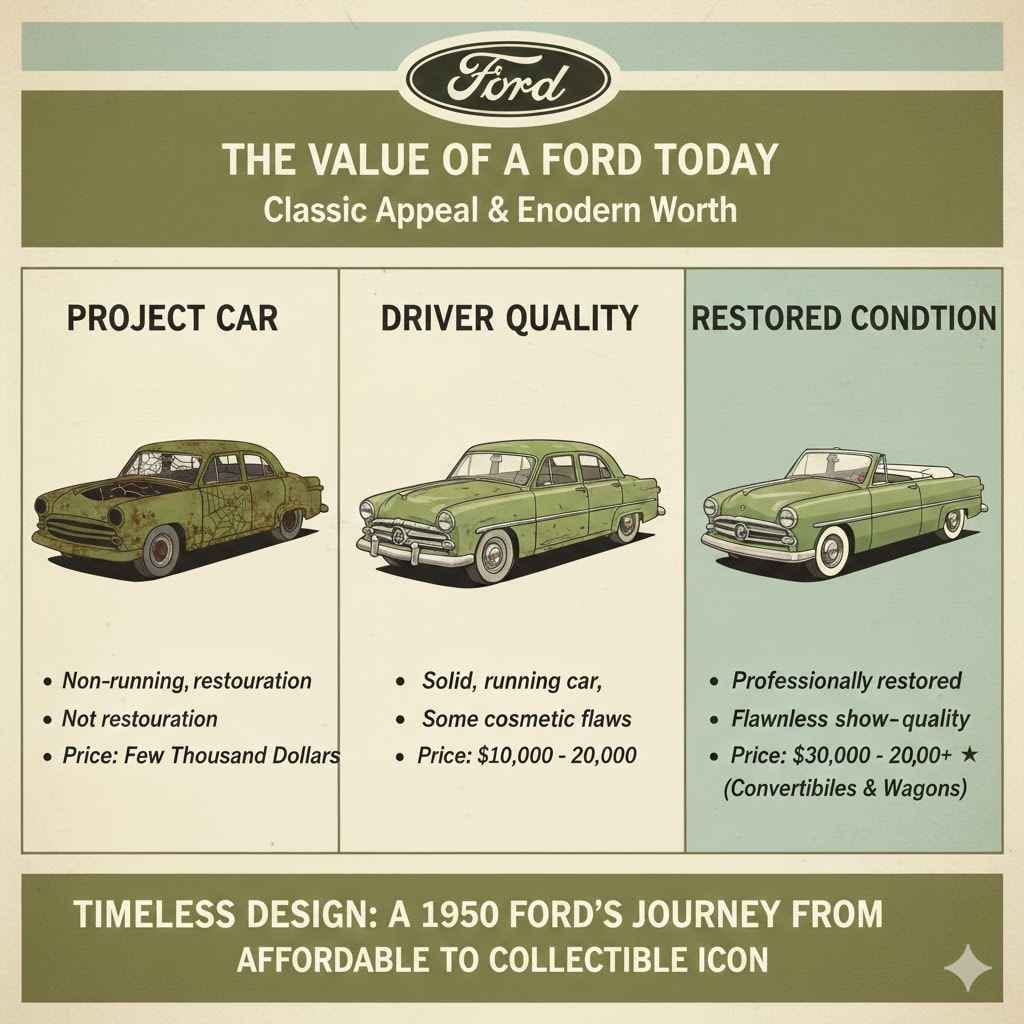
- Project Car: A non-running car in need of a full restoration might sell for a few thousand dollars.
- Driver Quality: A solid, running car with some cosmetic flaws can range from $10,000 to $18,000.
- Restored Condition: A professionally restored 1950 Ford, especially a desirable model like a convertible or a Country Squire station wagon, can command prices from $30,000 to $50,000 or even more at auction.
It’s fascinating to see that a fully restored convertible, which cost under $2,000 new, can now be worth more than 20 times its original price. This shows the enduring appeal and cultural importance of these classic American automobiles.
Frequently Asked Questions
What was the most expensive Ford model in 1950?
The most expensive Ford was the Custom Deluxe Country Squire station wagon. With its distinctive wood paneling, it was priced at over $2,000, making it the premium family vehicle in the Ford lineup.
What was the cheapest Ford you could buy in 1950?
The cheapest model was the Ford Deluxe Business Coupe, which was a very basic two-door car with a large trunk area instead of a rear seat. It was priced at approximately $1,330 and was primarily marketed toward traveling salesmen.
How did Ford’s prices compare to Chevrolet in 1950?
Ford and Chevrolet were fierce competitors and priced their cars very similarly. A 1950 Chevrolet Styleline Deluxe sedan was priced almost identically to the comparable Ford Custom Deluxe sedan. The choice between them often came down to brand loyalty or preference for Ford’s V8 engine versus Chevrolet’s reliable six-cylinder.
Was an automatic transmission available on a 1950 Ford?
Yes, but it was a late addition. The 3-speed Ford-O-Matic automatic transmission was introduced as an option during the 1950 model year. Most 1950 Fords were sold with the standard 3-speed manual transmission.
How many cars did Ford sell in 1950?
Ford had a very successful year in 1950, selling over 1.2 million cars. This made it the second-best-selling brand in America, just behind its main rival, Chevrolet.
What colors were popular for Ford cars in 1950?
Popular colors in 1950 were more subdued than the bright pastels of the later ’50s. Common choices included Hawthorne Green, Sportsman’s Green, Palisade Green, and Sunland Ivory. Two-tone color schemes, like those on the Crestliner model, were also becoming very fashionable.
Is a 1950 Ford a reliable classic car to own today?
Yes, they are considered quite reliable for their age. Their mechanical systems are simple and robust, especially the Flathead V8 engine. Parts are widely available, and a strong community of enthusiasts exists to provide support and advice, making them a great choice for someone entering the classic car hobby.
Conclusion
So, how much did a Ford car cost in 1950? On the surface, the answer is a simple one: between $1,300 and $2,000. But the real, more shocking answer lies in what those numbers represented. A new Ford was a major purchase, a symbol of post-war optimism that took up a significant portion of a family’s annual income. When adjusted for inflation, the cost is surprisingly comparable to what we pay for a new family car today.
Looking back at these prices is more than just a history lesson; it’s a reminder of how much has changed and, in some ways, how much has stayed the same. While our cars are now filled with incredible technology and safety features, the pride and excitement of buying a new car remain a cherished part of the American experience. The 1950 Ford, a simple, stylish, and dependable machine, perfectly captured the spirit of its time and earned its place as a true American classic.