
If your gas pedal feels sticky, unresponsive, causes erratic speed, or the “Check Engine” light is on, you likely have an issue. The main indicators are poor acceleration and inconsistent throttle response, often pointing toward a failing Accelerator Pedal Position (APP) sensor found in modern “drive-by-wire” systems.
Have you ever pressed the gas pedal in your car, only for nothing to happen immediately? Or perhaps your speed jumps unexpectedly? These frustrating moments are common, yet many drivers worry they need an expensive repair. Modern cars use electronic gas pedals, often confusing drivers used to mechanical linkages. These pedals connect to a sensor inside the car, not directly to the engine. When this sensor or the pedal assembly fails, your driving experience changes quickly. Don’t worry! Knowing the basic signs is the first step to fixing the issue simply and affordably. We are here to walk you through exactly what to look for, making you feel confident about your car’s health. Let’s explore the clear signs that tell you if your gas pedal assembly is truly the culprit.
Understanding the Modern Gas Pedal System (Drive-by-Wire)
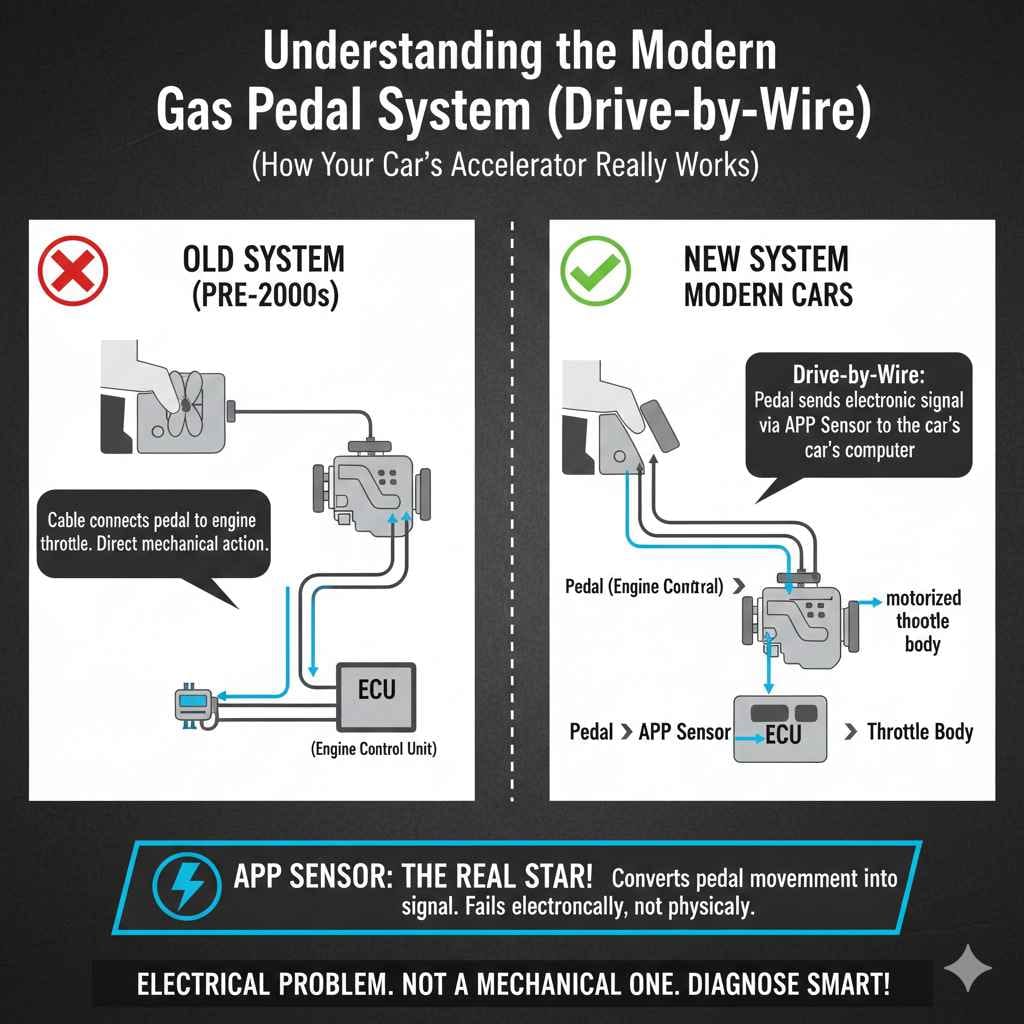
If your car was built in the last 15–20 years, you most likely have a “drive-by-wire” system. This is a crucial point because it changes how the pedal works and how it can fail. Back in the day, the gas pedal was physically connected to the engine throttle body with a cable. Push the pedal, the cable pulls open the throttle, and the engine gets more air. Simple!
Today’s setup works like a dimmer switch for your lights. When you press the gas pedal, you are not pulling a cable. Instead, you are sending an electrical signal to the car’s main computer, the Engine Control Unit (ECU) or Powertrain Control Module (PCM). The pedal assembly itself contains a component called the Accelerator Pedal Position (APP) sensor.
The APP sensor measures exactly how far down you press the pedal and sends this specific voltage reading to the ECU. The ECU then tells the throttle body exactly how much to open. If the sensor goes bad, the ECU gets confusing or incorrect information, leading to poor performance.
Why the APP Sensor is the Real Star
When drivers say the “gas pedal is bad,” they almost always mean the electronic sensor unit attached to the back of the pedal assembly is failing. It’s rarely the physical piece you touch with your foot that breaks.
Think of it like a light switch on the wall. Even if the switch plate looks fine, the internal mechanism that sends the electricity might wear out. In your car, the internal resistor or potentiometer wears down over time, causing unreliable signals. This is why diagnosing the issue often focuses on the electrical signal rather than the plastic pedal itself.
Essential Signs Your Gas Pedal Is Failing
Spotting a bad gas pedal assembly (or the APP sensor within it) is easier than you think if you know what to watch for during your daily drive. These symptoms often appear suddenly and can range from mildly annoying to downright dangerous.
Sign 1: Delayed or Intermittent Throttle Response
This is perhaps the most classic sign. You press the pedal, and there is a noticeable pause—a little dead spot—before the engine reacts. In serious cases, you might press the pedal all the way down, and absolutely nothing happens for a second or two.
- Lag Time: A normal pedal responds almost instantly. A failing sensor might cause a 1-2 second delay before acceleration kicks in.
- Intermittent Dead Spots: You press the pedal, the car accelerates, but then hits a spot where pressing harder does nothing, only for the speed to suddenly surge forward again when you move the pedal slightly.
Sign 2: Erratic Speed or “Surging”
This is the most unnerving symptom for drivers. If your car seems to speed up or slow down slightly even when you are holding your foot steady on the pedal, the sensor is sending erratic signals to the ECU. The car doesn’t know what speed you really want.
Imagine cruising on the highway. If the pedal assembly is faulty, the car might briefly accelerate (surge) and then settle back down, all without you moving your foot. This inconsistency makes maintaining a safe, steady speed very difficult.
Sign 3: Check Engine Light and Diagnostic Trouble Codes (DTCs)
Because the gas pedal assembly involves critical electronic communication, any major failure will trigger an immediate warning light. The ECU is programmed to monitor the voltage signals coming from the APP sensor.
If the voltage signal goes too high, too low, or doesn’t match what the ECU expects, it sets a code. You will see the dreaded Check Engine Light (CEL) illuminate on your dashboard.
Common codes often look like:
- P2121: Accelerator Pedal Position Sensor/Switch “A” Circuit Range/Performance
- P2122: Accelerator Pedal Position Sensor/Switch “A” Circuit Low Input
While you need an OBD-II scanner (available at most auto parts stores) to read these codes exactly, seeing the CEL immediately after throttle issues strongly suggests an electronic sensor failure, which often includes the pedal assembly.
Sign 4: Limp Mode Activation
This is the car’s self-preservation mode. If the ECU detects a critical error with the throttle system (believing the pedal is stuck wide open or completely closed), it will put the car into “Limp Mode” (or “Limp Home Mode”).
In Limp Mode, your car severely limits engine power and often locks the transmission into a single gear, usually second or third. This prevents high speeds, allowing you to safely drive slowly to the nearest repair shop.
If your car suddenly feels extremely sluggish, won’t rev above 2,000 or 3,000 RPM, and the CEL is on, run a scan. The pedal position sensor is a frequent trigger for this safety measure.
Sign 5: Cruise Control Malfunctions
Cruise control relies entirely on accurate feedback from the gas pedal sensor. If the APP sensor is sending inconsistent data, the cruise control system gets highly confused.
Symptoms related to cruise control failure include:
- Cruise control refuses to engage at all.
- Cruise control engages but constantly speeds up or slows down by itself.
- The cruise control indicator light flashes, signaling an internal system fault that the ECU has detected.
Sign 6: Hard Shifting or Transmission Issues
This might sound strange, but the gas pedal directly impacts transmission function. Why? Because the transmission needs to know how much power the driver is requesting to choose the right gear and shift smoothly.
If the APP sensor sends a jumbled signal, the transmission computer (TCM) might:
- Shift too hard or slam into gear.
- Refuse to downshift when you need power.
- Stay in a high gear too long, making the engine strain.
Troubleshooting: Is It the Pedal or Something Else?
It’s important to remember that the gas pedal sensor is just one piece of a larger puzzle that includes the throttle body, wiring harness, and the ECU itself. Before ordering a new pedal assembly, it helps to confirm the diagnosis. We want to save you time and money!
Step 1: Check for Wiring Damage
The wiring harness connecting the pedal to the rest of the car can sometimes get pinched, frayed, or chewed through by rodents. Inspect the wires leading away from the back of the pedal assembly for any visible signs of external damage.
Safety Note: Always disconnect the negative battery terminal before physically touching or manipulating wires connected to the main electrical system.
Step 2: Scan for Codes (The Crucial Step)
If the CEL is on, scanning the codes tells you what the car thinks is wrong. A code specifically pointing to the P212x range confirms the sensor is reporting outside of expected parameters. This is the strongest indication that the pedal assembly needs replacement.
For those interested in learning more about how electronic sensors are monitored by the ECU, resources like the Society of Automotive Engineers (SAE) detail the standards for these inputs, which helps mechanics know what is “normal” operation. (SAE International is a great resource for in-depth technical standards).
Step 3: Inspect the Throttle Body (A Common Culprit)
Since the APP sensor tells the throttle body what to do, sometimes the throttle body itself is sticking or dirty, causing performance issues that mimic a bad pedal sensor. If you have an older electronic throttle body, it might just need a good cleaning (using specific throttle body cleaner, not carb cleaner).
If cleaning the throttle body doesn’t resolve the issue, and you have confirmed APP-related codes, the pedal sensor is next.
Step 4: Testing the Pedal Sensor (Advanced Check)
If you are comfortable using a multimeter, you can test the output signal directly. This requires professional diagnostic tools or a good understanding of your vehicle’s wiring diagram, as you need to know which specific pins on the connector carry the signal voltage.
Generally (and this varies greatly by make/model), you are looking to see if the voltage changes smoothly and predictably as you move the pedal from 0% (closed) to 100% (fully depressed). A reading that jumps, drops to zero momentarily, or doesn’t change smoothly confirms the sensor is internally faulty.
Comparing Failures: Pedal vs. Throttle Body
It is very common for drivers to confuse symptoms caused by a failing gas pedal assembly with those caused by a failing throttle body. Both affect how the engine receives air/throttle input, but the fix is different.
Here is a simple chart to help distinguish between the two most likely causes when you have acceleration problems:
| Symptom Description | More Likely Cause | Why? |
|---|---|---|
| Hesitation/Surging when holding pedal steady. | Accelerator Pedal Position (APP) Sensor/Pedal Assembly | The input signal is inconsistent, even if your foot is steady. |
| Car goes into Limp Mode without any throttle input changes. | APP Sensor/Pedal Assembly (Major Sensor Failure) | A fundamental reporting error forces the ECU into safe mode. |
| Rough idle when the car is stopped. | Throttle Body (Dirty or Sticking) | The butterfly plate isn’t closing completely or is sticking slightly closed. |
| Inability to accelerate past a set low RPM only when the engine is warm. | Throttle Body (Often related to carbon buildup) | Build-up physically restricts the plate movement at specific positions. |
| Cruise control fails immediately. | APP Sensor/Pedal Assembly | Cruise control relies solely on the pedal input sensor for its baseline signal. |
The Repair Process: Replacing the Pedal Assembly
If you’ve determined that the gas pedal assembly is the culprit—usually confirmed by specific diagnostic codes—the good news is that this is often a very beginner-friendly repair. You generally do not need to take the car to a specialized shop.
Tools You Will Typically Need
You probably already own these basic items, which is great for keeping repair costs down!
- New Accelerator Pedal Position Sensor Kit: Ensure it matches your car’s Year, Make, and Model exactly.
- Basic Screwdriver Set (Phillips and Flathead).
- Socket Wrench Set (usually 8mm or 10mm needed).
- Safety Glasses.
- OBD-II Scanner (Optional, but highly recommended for checking codes).
Step-by-Step Replacement Guide
This process is simplified for common vehicles. Always consult your specific vehicle’s service manual for exact bolt locations and procedures.
Step 1: Safety First—Disconnect the Battery
Locate your car battery (usually under the hood or sometimes under the rear seat/trunk). Using a wrench, loosen the nut holding the negative (-) battery cable clamp. Twist the cable off the terminal and secure it away from the battery post so it cannot accidentally touch it. This prevents electrical shorts while you work.
Step 2: Locate and Access the Pedal Assembly
Open the driver’s side door fully. Look up behind the pedal—the assembly is usually secured to the firewall or bracket housing by two, three, or sometimes four bolts or nuts.
Step 3: Remove the Old Assembly
Using your socket wrench or screwdriver, carefully remove the fasteners holding the assembly in place. Keep these fasteners safe!
Once the bolts are off, the pedal assembly should swing down or pull away slightly. It will still be connected by a wiring harness plug. Unplug this connector—it usually has a locking tab you must depress before pulling firmly.
Step 4: Install the New Assembly
Plug the wiring harness into the new accelerator pedal assembly. You should hear or feel a distinct click when the lock engages.
Slide the new assembly into position and secure it using the original bolts or nuts. Tighten them firmly, but do not overtighten, as you could strip the plastic housing.
Step 5: Reconnect the Battery and Test
Reconnect the negative battery cable clamp and tighten it securely.
Start the car. The initial startup sequence might take a moment as the ECU “learns” the new sensor’s range. Check the dashboard for the Check Engine Light. If the repair was successful, the light should turn off after a few driving cycles (or immediately if you clear the old code with the scanner).
Gently test acceleration at low speeds first, ensuring the throttle feels smooth and immediate. If the light stays on, you may need to clear the code manually using the OBD-II scanner.
Preventative Care for Long-Term Reliability
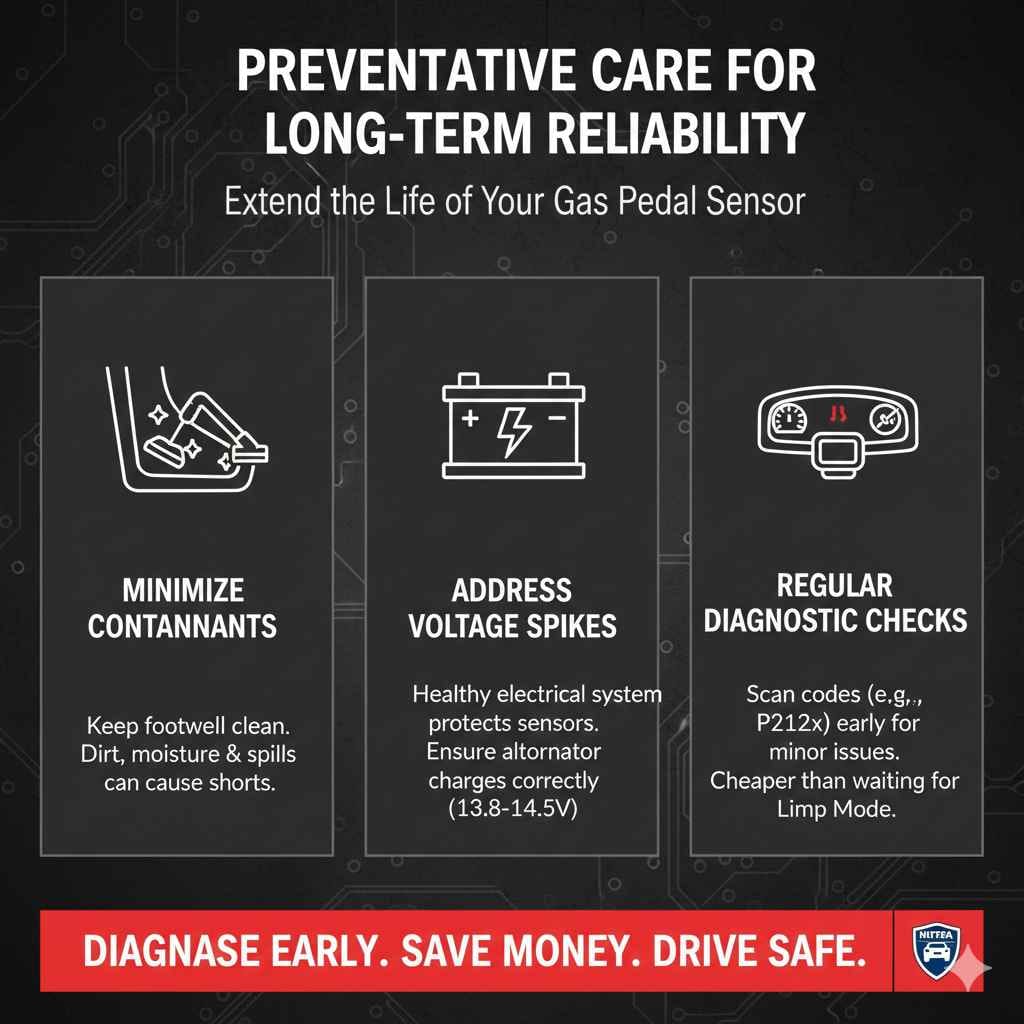
While electronic components eventually wear out, good driving habits and basic maintenance can extend the life of your gas pedal sensor significantly. Since this is an electronic rather than mechanical failure point, cleanliness and stable voltage are key.
Minimize Contaminants
Keep the driver’s footwell clean. Dirt, excessive moisture from wet shoes, or sticky residues (like spilled soda) can sometimes work their way into the electronics of the pedal assembly, causing shorts or corrosion internally.
Address Voltage Spikes
A healthy electrical system protects sensitive electronics. Ensure your alternator is charging within the correct voltage range (usually between 13.8 to 14.5 volts when the engine is running). High voltage spikes from a failing alternator can prematurely damage sensors like the APP.
Regular Diagnostic Checks
If you notice tiny hesitation issues before they become major problems, get the codes scanned early. Addressing a P212x code when it first appears (often manifesting only as minor lag) is much cheaper than waiting until the car goes into full Limp Mode on the freeway.
Understanding car electronics is becoming increasingly important for everyday drivers. For more insights into diagnosing modern vehicle sensor failures, the National Highway Traffic Safety Administration (NHTSA) provides excellent safety guidelines regarding vehicle control systems.
Frequently Asked Questions (FAQs)
Q1: Can I drive with a bad gas pedal sensor?
A: You might be able to drive short distances, especially if the car is in Limp Mode, but it is not recommended. Erratic acceleration is dangerous, and prolonged driving with a fault code can potentially damage other components like the transmission or catalytic converter. Get it checked as soon as possible.
Q2: How much does it cost to replace a gas pedal assembly?
A: The part itself usually costs between $80 and $250, depending on your vehicle’s make and model. If you do the simple replacement yourself, the total cost is just the part price. Professional labor might add $100 to $200 for diagnosis and installation time.