

Quick Summary: Transmission Control Protocol (TCP) is a set of rules ensuring reliable, ordered data delivery over the internet, focusing on accuracy. It is completely different from a “must-have,” which is a needed car part or tool for maintenance. TCP is software rule; a must-have is a physical item.
Hey there, I’m Dustin Hall, and if you’ve ever looked at a car repair bill or tried to set up home Wi-Fi and felt completely lost, you are not alone. Sometimes, the technical terms we bump into feel like a foreign language. Today, we’re tackling two phrases that sound totally different but can confuse people because they popped up in different contexts: “Transmission Control Protocol” (TCP) and “Must-Have.” Don’t worry; we are going to break this down simply. One is a crucial set of rules for the internet to work, and the other is that essential bottle of oil or that wrench you absolutely need for your car. We will clear up this confusion so you can drive forward feeling confident.
What Exactly Is Transmission Control Protocol (TCP)?
When we talk about TCP, we are strictly talking about the inner workings of the internet—the digital plumbing, if you will. It has absolutely nothing to do with your car’s automatic transmission fluid or transmission service.
Think of sending a large, important package across the country. You want to make absolutely sure every single piece of that package arrives, and it arrives in the right order. TCP is the careful system that makes sure this happens online.
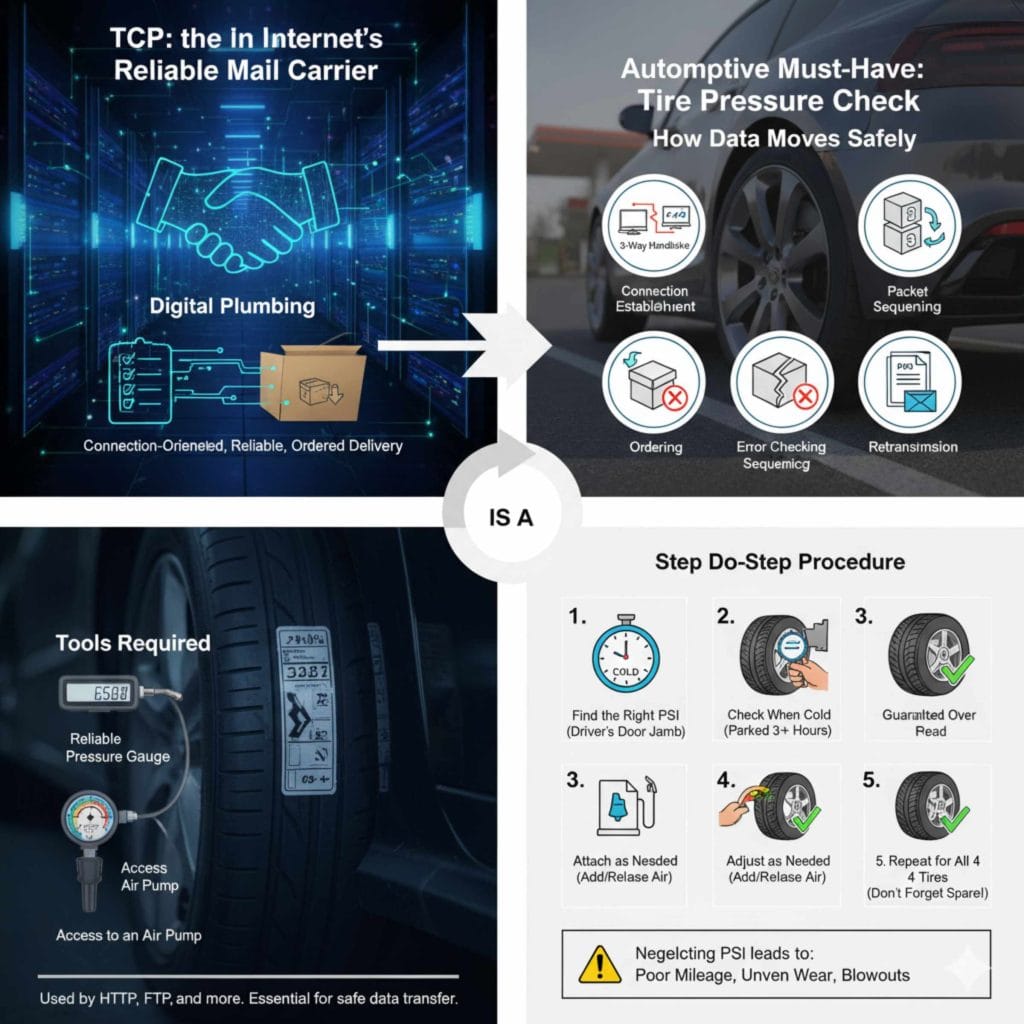
TCP: The Internet’s Reliable Mail Carrier
TCP sits at the heart of how data moves safely across networks, including the internet. Internet Protocol (IP) just handles the addressing—like putting the street address on the envelope. But TCP handles the guarantee—making sure the recipient confirms they got every page of a multi-page letter or every pixel of a photo.
Here’s what TCP does that makes it so important:
- Connection Establishment: Before sending anything, TCP sets up a formal handshake (a three-step process called the three-way handshake) between your computer and the server you are connecting to.
- Ordering: It numbers every piece of data (a packet) before sending it. If the packets arrive out of order, TCP waits and reassembles them correctly on the receiving end.
- Error Checking and Retransmission: If a packet gets lost or damaged along the way, TCP recognizes this missing piece and immediately asks the sender to send it again. That’s why when you download a file, it usually finishes perfectly!
If you’ve ever used HTTP (the protocol for viewing websites) or FTP (for transferring files), you’ve been using TCP underneath it all. It prioritizes accuracy over speed when accuracy matters most.
What Is a “Must-Have” in the Automotive World?
Now, let’s switch gears completely and look at the second term: “Must-Have.” In the context of car ownership, this term refers to essential items—things you need to keep your vehicle safe, running smoothly, or legally compliant.
This is entirely physical. A “must-have” is something tangible that you purchase, store, or perform regularly. It depends entirely on what kind of car you drive and what kind of maintenance you plan to do yourself.
Essential Car Care “Must-Haves”
As your guide to keeping your ride reliable, I stress preparedness. Having the right tools and supplies on hand saves time and prevents minor issues from turning into expensive roadside emergencies.
Here are three categories of automotive “must-haves”:
1. Safety and Emergency Gear
These items must stay in your trunk or cabin, ready for the unexpected, regardless of the weather conditions.
- Jumper Cables (or Portable Jump Starter): Dead batteries happen. A quality set of cables or a reliable lithium jump pack is non-negotiable.
- Spare Tire, Jack, and Lug Wrench: Make sure you know where these are and that the spare is properly inflated. Check the pressure on your spare tire at least twice a year!
- Basic First-Aid Kit: For minor scrapes that might happen during roadside inspection or simple DIY work.
2. Regular Maintenance Supplies
These are consumables you need to keep your car at peak health, following the schedule in your owner’s manual.
- The Right Oil and Filter: Using the viscosity and type of engine oil specified by your manufacturer is the single most important thing you can do for engine longevity. You can often find recommended specifications from organizations like the American Petroleum Institute.
- Washer Fluid: Essential for clear visibility in all weather.
- Windshield Wipers: Good visibility is worth every penny.
3. Basic DIY Tools
If you want to save money by handling simple tasks, a basic toolkit is your “must-have.”
Tools Dustin Recommends Every Driver Owns:
- Tire pressure gauge (accuracy is key!)
- Screwdriver set (Phillips and flathead)
- Adjustable wrench or basic socket set
- Duct tape (It’s shockingly versatile)
The Core Difference: Digital Rules vs Physical Items
Now that we’ve defined both, the difference becomes crystal clear. It’s comparing apples to a complex set of instructions on how to bake the apple pie!
TCP vs. Must-Have Comparison Table
This table highlights the fundamental separation between these two concepts:
| Feature | Transmission Control Protocol (TCP) | Automotive “Must-Have” |
|---|---|---|
| Nature | A set of abstract rules and software standards. | A physical object or a necessary consumable resource. |
| Function | Ensures reliable, ordered data transfer over networks. | Ensures vehicle safety, performance, or legal compliance. |
| Location | Operates on computers, servers, and network devices. | Stored in your garage, trunk, or under the hood. |
| Modification | Modified through software updates or protocol changes. | Replaced, refilled, or repurchased periodically. |
| Impact of Failure | Web pages won’t load correctly, files corrupt, or connections fail. | Car won’t start, safety is compromised, or you get a ticket. |
The Underlying Tech Connection: How TCP Relates to Internet Protocol (IP)
Even though TCP isn’t a “must-have” for your garage toolbox, it relates directly to another foundational term in computing: Internet Protocol (IP). Often, a beginner gets confused between TCP and IP. Understanding this relationship helps cement what TCP actually is.
TCP/IP: The Internet’s Dynamic Duo
TCP and IP work together so closely that they are almost always discussed as a pair: the TCP/IP suite. This suite (a collection of protocols) governs nearly all communications on the internet.
If IP is the postal worker who knows the route and the address, TCP is the reliable tracking system that follows up to ensure delivery.
TCP handles the “how” of reliable delivery, while IP handles the “where” (the addressing).
For instance, when you visit a secure website (HTTPS—which runs on top of HTTP/TCP/IP), here is the partnership in action:
- IP Steps In: Your computer uses IP addresses to figure out the best route to the web server.
- TCP Takes Over: Once the route is established, TCP breaks your request (like asking for a webpage) into small packets.
- TCP Confirms: TCP makes sure these packets arrive at the server in the right sequence and that the server acknowledges receipt.
- IP Delivers Reply: The server’s response travels back to you using the IP address, again managed for correctness by TCP.
This cooperative effort is what makes digital life possible. If you are curious about how routing works, the U.S. National Institute of Standards and Technology (NIST) provides excellent foundational concepts on network security and protocols that underpin this process.
Why the Confusion Happens: Context is Everything!
The primary reason people mix up these two terms is context.
If you are reading tech news or troubleshooting Wi-Fi, “TCP” comes up. If you are talking to your mechanic or preparing for a road trip, “must-have” comes up. Your brain just tries to place them both in the “important stuff I need to know” bucket.
Confusion Point 1: Abstraction Level
TCP is abstract. It’s invisible code logic. You can’t touch it. A “must-have” (like a new serpentine belt) is concrete. You hold it, you install it, and you dispose of it when it fails.
Confusion Point 2: Jargon Overload
In technical fields, people often use acronyms casually. If someone is talking quickly about “Internet setup,” they might mention TCP; if they are talking about maintaining a vehicle, they might mention the “must-have” safety kit. If you aren’t familiar with both domains, the terms sound like they could be related technical concepts.
TCP Speed vs. Reliability: A Trade-Off You Don’t Control
While this article is focused on distinguishing TCP from a “must-have,” understanding why TCP exists helps appreciate its importance compared to its internet sibling, UDP (User Datagram Protocol).
TCP exists for reliability; UDP exists for speed.
Imagine you are watching a live football game online. Dropping a few pixels (a lost packet) is okay; you might see a slight flicker, but you want the game to keep moving without stopping to re-download what you missed. That’s where UDP shines.
However, if you are downloading your bank statement or sending an email, you absolutely cannot afford to lose a single piece of data or have it arrive scrambled. That’s TCP’s job.
| Protocol | Main Goal | Reliability | Speed | Best For |
|---|---|---|---|---|
| TCP | Guaranteed Delivery | High (Uses confirmations and retransmissions) | Lower (Due to overhead) | Web Browsing, Email, File Transfer |
| UDP | Fast Delivery | Low (No confirmations) | Higher (Minimal overhead) | Live Video Streaming, Online Gaming |
This inherent trade-off is a core concept in networking, showing that TCP prioritizes the correctness of the data over how fast it arrives, which is a crucial design choice.
Essential “Must-Haves” for Your DIY Starter Kit (Tools to Build Confidence)
If you drive today, you need a few tools to gain confidence and avoid unnecessary trips to the shop. Trust me, knowing how to handle a simple flat or check your tire pressure yourself is empowering. Here are the true automotive “must-haves” for basic maintenance:
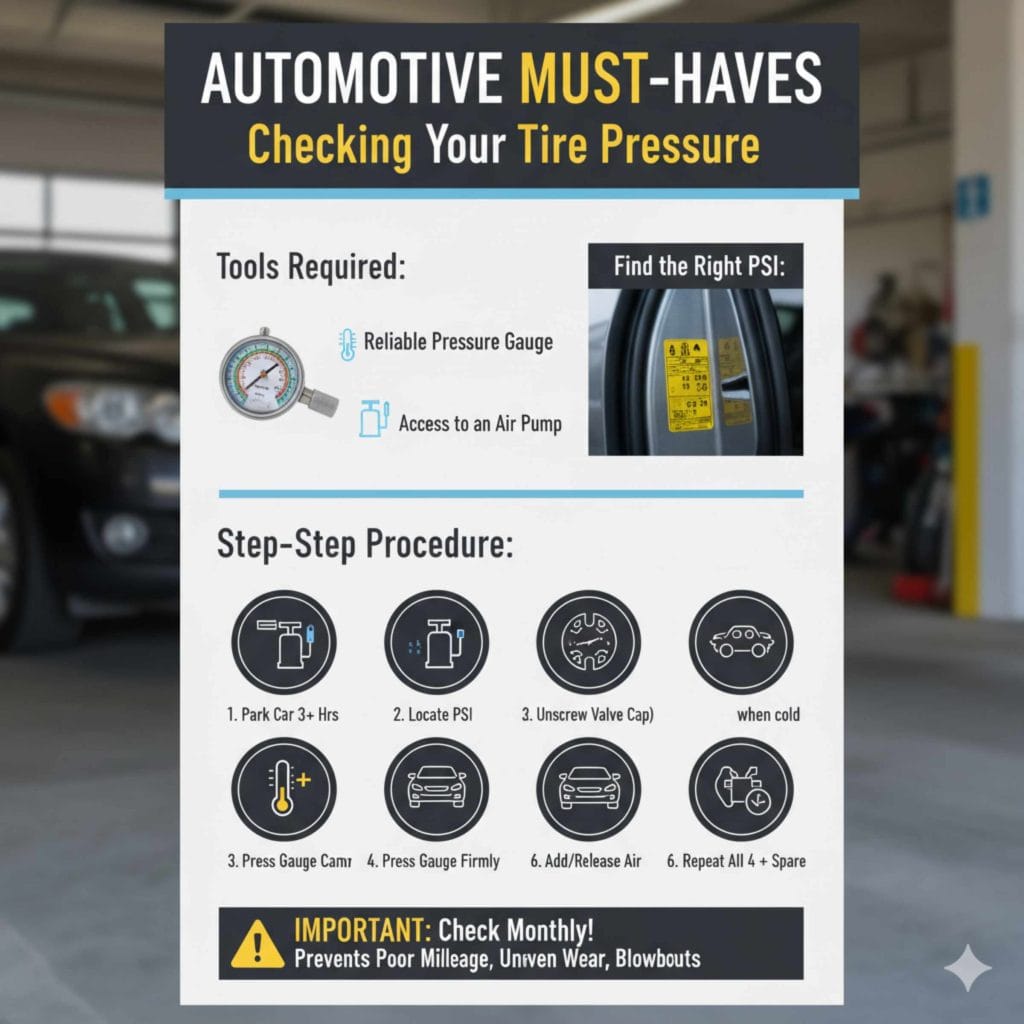
Step-by-Step: Checking Your Tire Pressure (A Must-Do Task)
Tire pressure is the number one maintenance item that drivers neglect, leading to poor mileage, uneven wear, and potential blowouts. It’s a must-do, requiring a must-have tool (a good gauge).
Tools Required:
- A reliable pressure gauge (digital or analog).
- Access to an air pump (often found at gas stations).
Procedure:
- Find the Right PSI: Never use the maximum pressure listed on the tire sidewall! Look for the sticker inside your driver’s side door jamb. This is the manufacturer’s recommendation.
- Check When Cold: Always check pressure when the car hasn’t been driven much in the last three hours, as driving heats the air inside and temporarily increases pressure readings.
- Uncover and Attach: Unscrew the valve stem cap from the first tire. Firmly press the gauge onto the stem until the hissing stops and a reading appears.
- Adjust as Needed: If the reading is too low, add air in short bursts, rechecking often. If too high, press the small pin in the center of the valve stem to release air.
- Repeat and Replace: Do this for all four tires (and check the spare if you can!). Replace the valve caps securely.
FAQs: Clearing Up Common Automotive and Simple Tech Questions
Got other quick questions rattling around? Let’s address some common uncertainties using simple, beginner-friendly answers.
Q1: If my website connection is slow, is that a TCP problem?
Maybe, but it’s hard to say without checking. Slowdowns can be caused by a busy server, slow Wi-Fi, or high network traffic. TCP ensures the data gets there reliably; if your connection is saturated (too much traffic), even TCP will seem slow because it has to wait longer to retransmit lost packets.
Q2: Do I ever need to worry about updating my car’s TCP settings?
No! Transmission Control Protocol (TCP) is software code that runs on routing equipment and computers, not inside your car’s mechanical systems like the engine computer (ECU). Your car simply uses the internet to connect to services, but the car itself runs on different internal communication protocols.
Q3: What is one absolute “must-have” fluid to check weekly?
Engine oil. Your engine oil is the lifeblood of your car. Check your owner’s manual for the correct method, but generally, pull the dipstick, wipe it clean, reinsert fully, pull out again, and check that the level falls between the two marks on the stick. Low oil leads to severe engine damage quickly.
Q4: Is the difference between TCP and IP related to security?
Not directly. IP handles the addressing (where it goes), and TCP handles the reliable transport (how it gets there). Security is added through another layer, usually TLS/SSL (which makes HTTP into HTTPS), that encrypts the data before TCP packages it up for reliable delivery.
Q5: If I hear a mechanic talk about “transmission trouble,” are they talking about TCP?
Absolutely not. They are referring to the hydraulic or electronic system that transfers power from the engine to the wheels. This system uses specialized transmission fluid, clutches, or torque converters. It has zero connection to digital network protocols.
Q6: What if I don’t have the “must-have” tool for a quick fix? Can I use something else?
Sometimes, but safety first! For basic tasks like checking fluids or tire pressure, improvising is dangerous. For example, never use water instead of coolant or use the wrong wrench size, as this can cause slips, injury, or damage. Stick to the right tools for automotive work.
Putting It All Together: Confidence in Both Worlds
We’ve navigated both the digital roadway and the physical demands of car ownership. Understanding the difference between Transmission Control Protocol and a “must-have” is really about understanding context:
When you are looking at a computer screen, TCP is critical infrastructure ensuring your connection is stable and accurate. It’s part of the highly engineered system that governs the flow of information across the globe.
When you are looking in your driveway or under the hood, a “must-have” is a tangible item—the right wrench, the correct engine oil, or a functional spare tire—that ensures your physical mobility and safety are guaranteed.
Don’t let complex jargon scare you away from either area. Whether it’s confirming that your data packets are reassembled correctly via TCP, or ensuring you have fresh wiper fluid for that next rainstorm (a simple, yet vital, must-have), knowledge gives you control. Keep learning the basics, trust your owner’s manual, and you’ll find that handling both digital upkeep and physical maintenance is rewarding and saves you money in the long run. You’ve got this!