
If your car won’t start suddenly, the most common culprits are a dead or weak battery, a faulty starter motor, or an issue with the fuel system. Before panicking, check the simple things like lights and horn operation to diagnose if the problem is electrical or mechanical. This guide provides easy steps to pinpoint the exact cause and fix it safely.
There’s nothing more frustrating than turning the key and hearing nothing—or just a sad clicking noise. Suddenly, your reliable ride turns into a very expensive paperweight. It happens to everyone, and while it feels like a major breakdown, most “won’t start” scenarios are caused by just a few common, fixable issues. You do not need to be a mechanic to troubleshoot this effectively. We are going to walk through simple checks, from the easiest fixes to the slightly more complex ones. By the end of this, you will know exactly why your car won’t start and likely have the confidence to tackle the solution yourself. Let’s diagnose this mystery together and get you back on the road.
Decoding the Silence: What Happens When You Turn the Key?
Understanding what your car is doing when it fails to start tells us a lot about the problem. The sound (or lack thereof) acts as the first clue in our automotive detective work. Before we dive into fixes, let’s categorize the typical failure sounds.
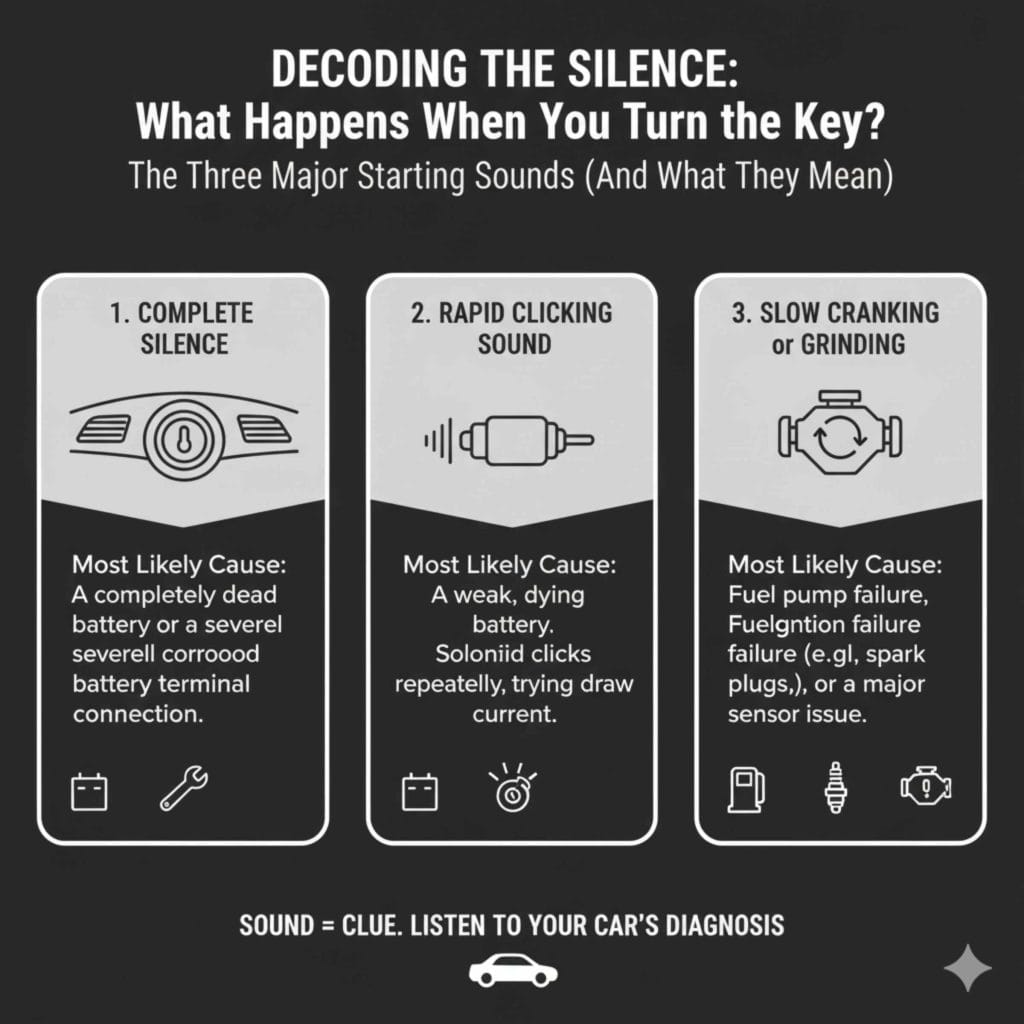
The Three Major Starting Sounds (And What They Mean)
When you try to start your car, listen closely. Is it completely silent, doing a rapid clicking noise, or cranking slowly but not catching?
1. Complete Silence (No Lights, No Sound)
If you turn the key and absolutely nothing happens—no dashboard lights, no radio, no horn beep—this points directly to a major lack of power reaching the electrical system.
- Most Likely Cause: A completely dead battery or a severely corroded/disconnected battery terminal connection.
2. Rapid Clicking Sound (The “Machine Gun” Noise)
This is the classic sound when you have some battery power, enough to engage the starter solenoid, but not enough muscle (amperage) to actually spin the engine over.
- Most Likely Cause: A weak, dying battery. The solenoid clicks repeatedly as it tries, and fails, to draw enough current.
3. Slow Turning or Grinding (The Engine Cranks, But Won’t Catch)
If you hear the engine turning over—that familiar “rur-rur-rur” sound—but the engine never fires up and runs on its own, the problem is likely not the battery. It means you have power, but something crucial is missing: fuel, spark, or air.
- Most Likely Cause: Fuel pump failure, ignition failure (like bad spark plugs or coil packs), or a major sensor issue.
Step 1: The Easiest Fixes First (The Beginner’s Checklist)
We always start with the easiest, most common issues before reaching for tools. This saves time and money.
Is It in Park or Neutral? (The Safety Interlock)
Most modern cars, especially automatics, have a safety feature (the neutral safety switch) that prevents them from starting unless the gear selector is firmly in Park (P) or, sometimes, Neutral (N).
- Ensure the shifter is firmly seated in “P.”
- If it still won’t start, wiggle the shifter slightly between Park and Neutral, and try starting again. Sometimes slightly sloppy linkages prevent the switch from engaging fully.
Check Your Battery Terminals
Dirty, loose, or corroded battery terminals are the number one cause of sudden starting failure, even if the battery itself is new. Corrosion creates resistance, blocking the strong electrical current needed to start the car.
- Visual Check: Look at the two posts on the battery. Do you see white or bluish-green fuzzy buildup?
- Wiggle Test: Gently try to wiggle the clamps connected to the battery posts. If they move easily, they are too loose.
Fixing Corrosion: You can clean this safely (with the engine OFF and gloves on!) using a stiff wire brush and a mixture of baking soda and water. For more technical advice on battery maintenance, check out resources from organizations focusing on vehicle safety and longevity, such as the National Highway Traffic Safety Administration (NHTSA) regarding general electrical safety.
The Headlight Test: Gauging Battery Health
This simple test tells you almost instantly if your battery is the main suspect.
- Turn your headlights on without unlocking the doors (if possible, or just before attempting to start).
- Try to start the car.
- Observation A: If the headlights dim significantly or go completely out when you turn the key to start, your battery is too weak to crank the engine.
- Observation B: If the headlights remain bright while trying to start, the battery likely has enough juice; the problem lies elsewhere (starter or ignition system).
Step 2: Diagnosing the Battery and Charging System
If the lights dimmed or you heard clicking, you are almost certainly dealing with a battery issue.
Test 1: Jump Start Attempt
The jump start is the definitive test for a weak battery. If the car starts immediately with a jump, the battery was the problem, or the alternator isn’t charging it properly.
Safety Note: Always connect the positive (+) cable first, then the negative (-) cable to a clean, unpainted metal surface away from the battery before starting the donor car. Disconnect in reverse order. Never let the clamps touch each other!
Test 2: Checking the Alternator (Post-Jump Test)
If the car starts with a jump but immediately dies when you remove the cables, or if it dies shortly after running, the battery isn’t being recharged. That means your alternator has failed.
Battery vs Alternator: What’s the Difference?
Think of it like this:
| Component | Job Description | Symptoms of Failure |
|---|---|---|
| Battery | Stores energy and provides the initial massive burst of power to start the engine. | Car won’t start, or cranks very slowly after sitting overnight. |
| Alternator | Creates electrical power while the engine runs, running the car’s systems and recharging the battery. | Car starts with a jump but dies soon after; dashboard battery light comes on. |
Fixing the Battery Issue
If the battery is old (over 3–5 years), replace it. If it’s newer, it might just need a full charge using a battery charger. If the alternator is bad, you’ll need a replacement, which is usually a job best left to a professional unless you are comfortable working with serpentine belts and electrical connections.
Step 3: Troubleshooting the Starter System
If your battery seems strong (lights are bright, car starts with a jump, but immediately dies or refuses to crank even after charging), the next component in the starting chain is the starter motor or the solenoid attached to it.
When the Starter is Suspect
If you turn the key and get a single, loud CLUNK sound, followed by silence, it often means the solenoid engaged but the starter motor itself is seized or broken.
DIY Starter Check (The Gentle Tap Method):
This method is generally for older vehicles, so proceed with caution and only if you can safely access the starter motor. Locate the starter (it’s usually bolted near the bottom of the engine where it meets the transmission).
- Have a helper turn the key to the “Start” position.
- While they hold the key, gently tap the body of the starter motor with the wooden end of a wrench or a small rubber mallet.
- If the car suddenly starts, the starter motor is failing and needs replacement soon. A temporary fix might allow you to drive to the shop.
Safety First: Never use metal tools to strike force components while the ignition is engaged, and ensure the transmission is still in Park!
When the Starter Motor Just Won’t Turn
If the starter is completely unresponsive, it could be a bad electrical connection to the starter itself, related to wiring or the starter relay/fuse. Check your owner’s manual for the location of the starter fuse or relay in your fuse box and check if it has blown.
Replacing a starter motor is a moderately involved DIY job. It often requires lifting the car safely onto jack stands or ramps and disconnecting heavy cables. If you are unsure, this is a great repair to have a trusted technician handle.
Step 4: Fuel, Spark, and Air (The Cranking But No-Start Scenario)
If your engine cranks robustly (“rur-rur-rur!”) but never fires up, the electrical system leading up to the engine is likely fine. The engine needs three things to run: fuel, spark, and air (compression). We usually investigate fuel and spark first.
Checking for Fuel Delivery Issues
If the fuel pump fails, the injectors get no gasoline, and the engine starves.
The Fuel Pump Preliminary Test
You can often listen for the fuel pump priming when you first turn the key to the “ON” position (not “Start”).
- Open the driver’s side door and turn the key to the “ON” position (just before starting).
- Listen carefully near the rear seat (where the fuel tank and pump are typically located).
- You should hear a low, distinct, brief hum or buzz for about two seconds. This is the pump pressurizing the system.
- If you hear absolute silence when turning the key “ON,” the fuel pump is the prime suspect, or its fuse/relay has failed.
Fixing Fuel Issues: If the fuse is blown, replace it. If the pump is silent, replacement is required. Fuel pump replacement is almost always a significant DIY job, involving dropping the fuel tank or accessing it from inside the car, and requires extreme caution around fuel lines.
Checking for Spark Issues
No spark means the fuel/air mixture can’t ignite. This is often caused by failing ignition coils, bad spark plugs, or a faulty Crankshaft Position Sensor (CPS).
- Crankshaft Position Sensor (CPS): This sensor tells the car’s computer (ECU) when to fire the spark plugs and inject fuel. If it fails, the ECU gets no signal, and the engine won’t start, even if the battery and fuel pump are perfect. This is a common culprit for a crank-but-no-start situation.
How to Check Spark (Safety Alert!): Checking for spark requires specialized tools (like an inline spark tester) and extreme caution, as you are dealing with high voltage. For beginners, if you suspect a spark issue, a mechanic can quickly test the coils and plugs.
When Simple Fixes Don’t Work: Advanced Diagnostics
If you have confirmed power, an operating starter, and believe you have fuel, the issue might involve sensors or the vehicle’s computer system. Modern cars rely heavily on electronic signals. A small, broken sensor can completely immobilize the car.
The Role of Fuses and Relays
Fuses protect circuits. Relays are electronic switches that allow a small current (from the key switch) to control a large current (like the starter motor or fuel pump).
If the car makes no sound (silence diagnosis), check the fuse box related to the ignition or starter solenoid. If the click is rapid (weak battery diagnosis), check the main battery fuse. Consult your manual for the exact location and diagram. Replacing an inexpensive fuse or relay can solve major headaches instantly. For reliable automotive fuse box diagrams and general repair information, resources like those provided by AAA, when available, often offer accessible guides.
Ignition Switch Failure
The ignition switch itself (where you put the key) is a mechanical and electrical component that wears out over time. If the switch wears down, it might not send the “start” signal clearly to the relay, even though the accessories (radio, dash lights) might still work.
Symptom: Everything seems fine, but turning the key fully to the start position does nothing or only provides a weak tap. If the key feels unusually loose or easily turns past the start position, the switch is a strong suspect.
Diagnosing Common “Won’t Start” Scenarios Summary Table
Use this table to quickly match symptoms to high-probability fixes once you’ve completed the basic checks.
| Symptom When Key is Turned | Likely Major Component Failure | First DIY Action |
|---|---|---|
| Complete Silence/No Lights | Dead Battery or Major Terminal Disconnect | Clean terminals; Inspect connection tightness. |
| Rapid Clicking Sound | Weak Battery | Attempt a jump start. |
| Single Loud CLUNK, then Silence | Failing Starter Solenoid or Starter Motor | Gently tap the starter motor (if accessible and safe). |
| Engine Cranks Normally, But Won’t Catch | Fuel Pump, Spark (Coil/Sensor), or Flooded Engine | Listen for fuel pump hum when switching key to ON. |
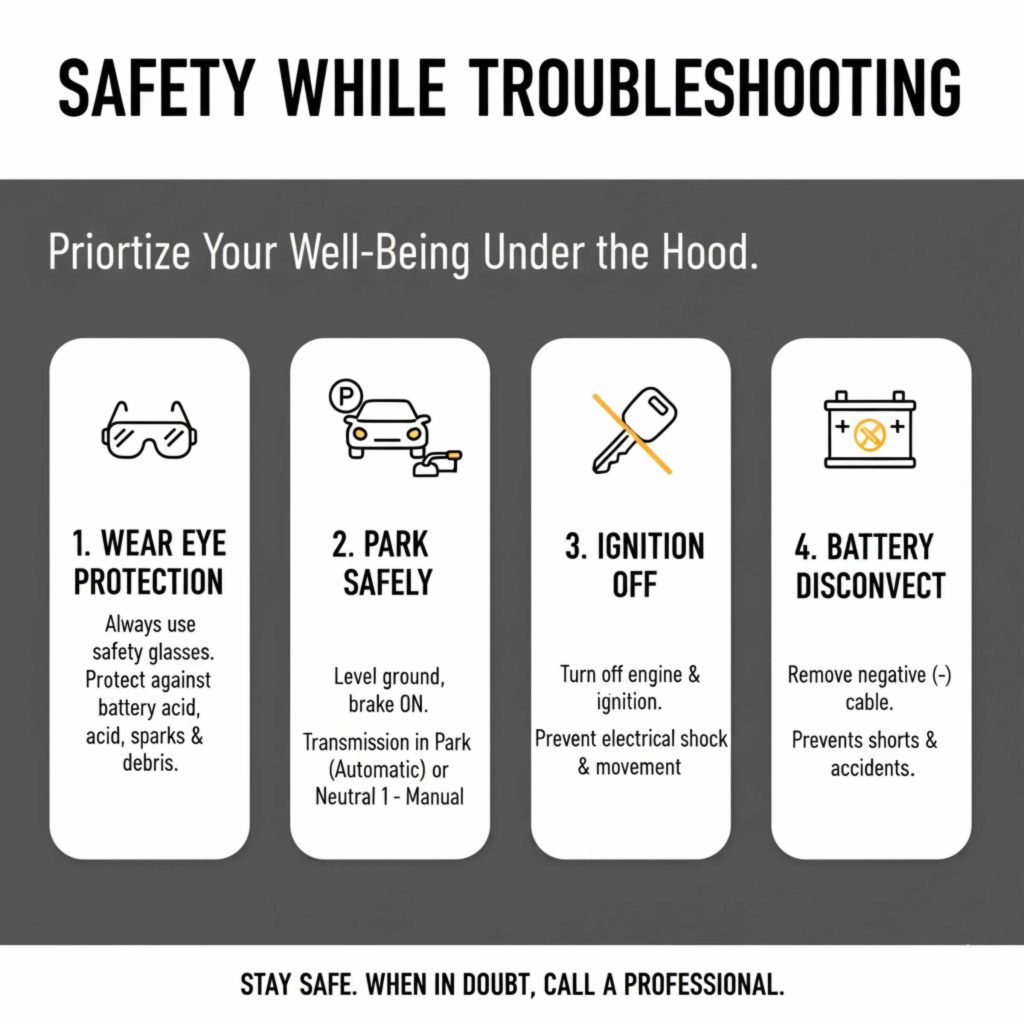
Safety While Troubleshooting
Working on cars, even simple troubleshooting, requires safety measures. You are dealing with electricity, moving parts, and potentially stored fuel pressure.
Always remember these basic safety rules:
- Wear Eye Protection: Always wear safety glasses when working near the battery or moving components.
- Park Safely: Ensure your vehicle is on level ground, the parking brake is firmly engaged, and the transmission is in Park.
- Ignition Off: Disable the ignition completely before touching any wiring or components under the hood, unless specifically testing the start sequence.
- Battery Disconnect: If working near the starter or alternator, disconnect the negative battery terminal first to prevent accidental shorts.
Building confidence comes from knowing you prioritized safety first. Never attempt a repair that feels beyond your comfort zone; knowing when to call a professional is part of being a smart car owner.
Frequently Asked Questions (FAQ) for Beginner Drivers
Q1: If my car starts after a jump, why does it die later?
A: This usually means the battery was drained by something you left on, OR the alternator is not producing enough charging power while the engine runs. Let it run for 20 minutes after a jump and see if it restarts once turned off.
Q2: How can I tell if my starter is bad without getting under the car?
A: If you have bright lights and hear a single, hard CLUNK when you turn the key, but the engine doesn’t turn, the starter motor is highly suspected. If all you hear is rapid clicking, the battery is more likely the issue.
Q3: Is it safe to keep trying to start a car that whines or clicks repeatedly?
A: No. If you hear rapid clicking, stop immediately. Each click drains the remaining weak battery charge further, making it harder to successfully jump-start later. Wait a few minutes between attempts.
Q4: My car suddenly won’t start, and I smell gas. What’s wrong?
A: You likely have a “flooded” engine, often caused by too many failed starting attempts, or a faulty injector or spark plug. Press the gas pedal down about halfway to the floor while cranking (this tells the computer to stop injecting fuel). Crank it for 5–10 seconds repeatedly to clear the excess fuel, then try starting normally.
Q5: How much does it cost to replace a dead battery versus a bad starter?
A: A new car battery kit usually costs between $100 and $250, depending on your car model. A starter motor replacement, including parts and labor, often ranges from $250 to $500 or more, as it is more labor-intensive.
Q6: Could weather (very cold or very hot) cause a car to suddenly not start?
A: Absolutely. Cold weather thickens engine oil and reduces battery efficiency, making starting harder. Extreme heat can cause starter components to overheat and temporarily seize, or affect fuel pump performance.
Conclusion: Taking Control of That “Won’t Start” Moment
A car that suddenly won’t start is frustrating, but in most cases it’s caused by a few common and manageable problems. A weak or dead battery, loose or corroded battery terminals, or a failing starter are the most frequent culprits. By paying attention to the sounds your car makes—or doesn’t make—you can quickly narrow down the issue. Starting with simple checks like the battery, gear position, and headlights can save you time, money, and stress. With basic troubleshooting and safety in mind, you can often identify the problem confidently and know whether it’s a quick DIY fix or time to call a professional.