
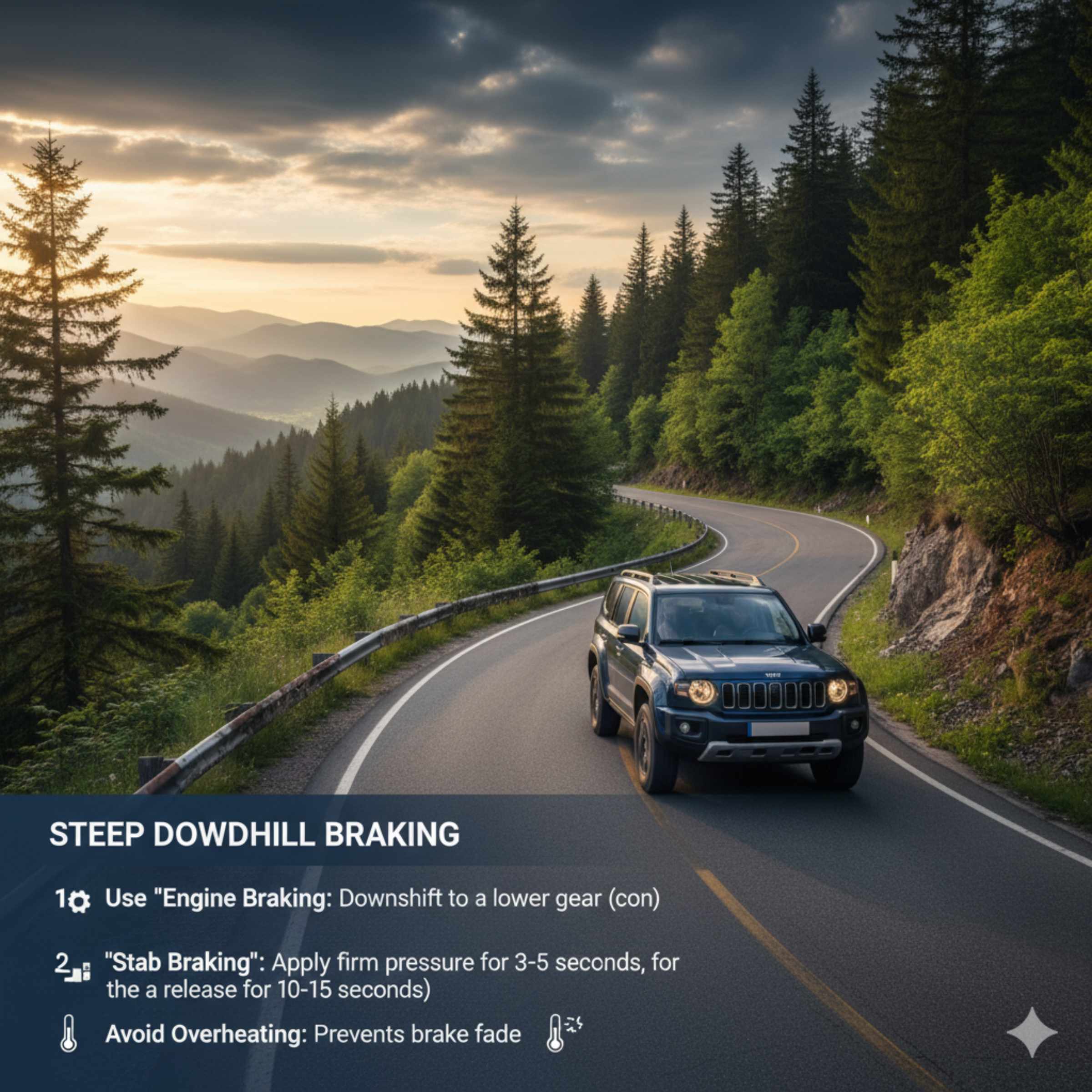
The best way to use the brake pedal on a steep downhill grade is to use a technique called “pump braking” or “intermittent braking,” combining moderate pressure with brief releases, while strategically using a lower gear to let the engine help slow the car down. This prevents overheating the brakes and maintains control.
Driving down a long, steep hill can feel scary. Your car wants to speed up, and you worry about pressing the brake pedal too hard or too much. If you do, the parts that stop your car can get super hot and might stop working right when you need them most! That’s called brake fade, and it’s something every driver should know how to prevent. Don’t worry; learning the right way to manage your speed on hills is simple. We will walk through the safest, easiest steps so you can handle any steep descent with confidence. Let’s get your brakes working for you, not against you!
Why Steep Downhills Are Tricky for Your Brakes
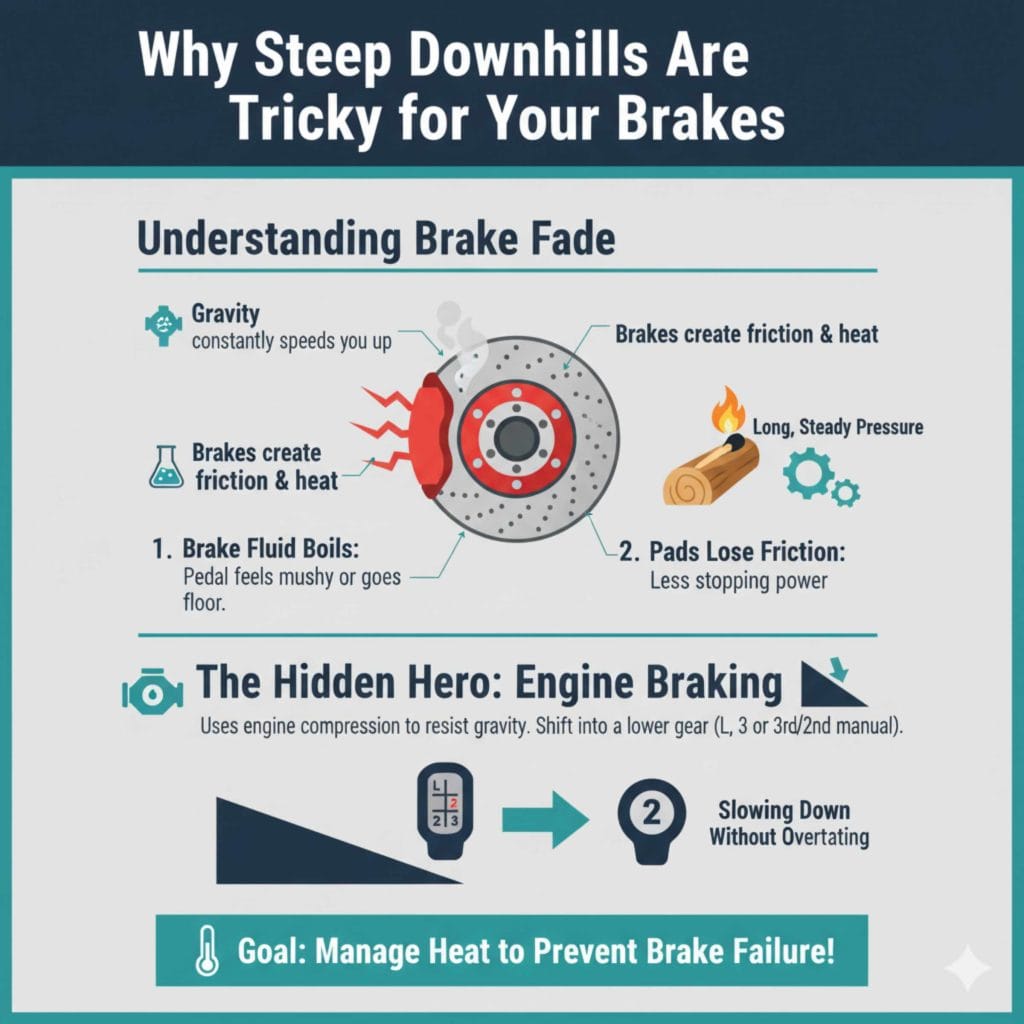
When you drive on flat ground, your regular stopping power keeps your car moving at a safe speed. However, gravity is a powerful force, and on a steep downhill slope, gravity constantly tries to speed your vehicle up. To fight this constant pull, your brake system has to work much harder than usual.
Understanding Brake Fade
The main reason we need a special technique going downhill is to avoid what’s known as brake fade.
Brakes work because when you press the pedal, brake pads squeeze against spinning metal discs (rotors). This friction creates heat. On flat roads, this heat dissipates quickly into the air. Downhill, however, you are applying steady pressure for a long time. This keeps the heat building up, much like holding a match in one spot.
When the brake components get too hot:
- The brake fluid inside the lines can start to boil, turning into gas. Gas compresses easily, unlike liquid, making your pedal feel mushy or go straight to the floor—this is very dangerous.
- The brake pads themselves can lose their ability to create friction effectively, meaning less stopping power for the same amount of foot pressure.
The goal of the downhill braking technique is to manage this temperature rise, keeping your brakes cool and ready.
The Hidden Hero: Engine Braking
Before we even touch the brake pedal, we need to talk about using your engine to help slow down. This is called “engine braking,” and it’s your first and best line of defense on a steep decline.
Think about it: when you drive up a hill, your engine works hard to push you against gravity. When you drive down, your engine can work in reverse to resist speed. You engage this by shifting into a lower gear.
For automatic transmissions, this usually means manually selecting a lower drive setting (like L, 2, or 3). For manual transmissions, you choose a lower gear number (like 3rd or 2nd). This uses the engine’s compression to create resistance, physically slowing the wheels down without relying solely on friction brakes.
The Best Technique: Intermittent (or Pump) Braking
When you combine a lower gear with the right brake pedal application, you achieve maximum safety and control. For steep downgrades, the absolute best method is intermittent braking, often confused with aggressive, quick tapping, but it’s much more controlled.
Step-by-Step: The Downhill Braking Method
Follow these steps as you begin your descent. Remember, this is all about being smooth, not jerky.
- Assess the Grade and Traffic: Look far ahead. Gauge how steep the hill is and how much traffic is around you. If the hill is short, you might use simpler methods, but for long, steep hills, stick to this plan.
- Downshift BEFORE You Brake: Before you even touch the brake pedal unnecessarily, shift your automatic transmission into the lowest gear that feels comfortable allowing the car to maintain a safe speed without accelerating too much (usually L or 2). If you have a manual, shift down one gear at a time. This engages powerful engine braking immediately.
- Identify Your Target Speed: Decide what speed you absolutely must not exceed. This should be a speed where you feel completely in control, often well below the posted limits for that road segment.
- Apply Moderate Brake Pressure: Firmly press the brake pedal until you slow down to about 5–10 mph below your target speed. You should press hard enough to actively slow down, but not so hard that everything locks up or you feel the ABS (Anti-lock Braking System) kick in aggressively.
- Release the Brakes Completely: Once you hit your desired slower speed, lift your foot completely off the brake pedal. This is the most crucial step! Letting off the pedal allows the brake pads and rotors to quickly cool down for several seconds.
- Maintain and Repeat: Let the car coast briefly, allowing the engine braking you started in Step 2 to keep your speed somewhat manageable. If you notice your speed creeping back up toward your target speed limit, repeat steps 4 and 5—apply pressure to slow down, then release completely to cool.
This cycle of Slow Down > Release > Coast/Hold Speed > Slow Down > Release prevents the continuous heat buildup that causes brake fade. You are using the brakes actively only in short bursts, allowing them recovery time.
When to Use the Gas Pedal (Yes, Really!)
If you are in a very low gear (like 1st or 2nd) and your car drops below a comfortable speed while descending, it can feel like the car is dragging awkwardly. In this scenario, briefly tapping the accelerator (gas pedal) for just a second or two can slightly increase the engine RPMs, which helps smooth out the engine braking resistance and bring your speed back up to a more comfortable rolling pace before you need to brake again. This keeps the overall driving experience much smoother and less taxing on the driver.
Automatic vs Manual Transmission Differences
While the goal (preventing fade) is the same, the mechanics of achieving it differ slightly based on your transmission type.
Handling Downhills with an Automatic
Modern automatics often have manual shifting options built in to help drivers.
Key Action: Look for markings like ‘L’ (Low), ‘1’, ‘2’, or ‘3’ on your gear selector.
- L or 1: Use this only for extremely steep or slow-speed descents. It provides the maximum drag but may cause your engine RPMs to run very high.
- 2 or 3: This is usually the sweet spot for most highway descents. It provides significant engine resistance without over-revving the engine loudly.
- Never “Pop the Car into Neutral”: Some drivers mistakenly shift into Neutral (N) to coast and save gas. This is extremely dangerous on a hill because you remove all engine braking, forcing your friction brakes to do 100% of the work. As detailed by the National Highway Traffic Safety Administration (NHTSA), keeping the car in gear provides essential control and safety margins.
Handling Downhills with a Manual
Manual drivers have the most direct control over engine braking.
Key Action: Use the gear selector to match the engine RPMs to a comfortable level.
- Downshifting Strategy: If you are in fourth gear and need to slow down, shift smoothly into third. If you need to slow more, shift into second. Always match your speed to the gear by briefly revving the engine slightly as you downshift to avoid jerking the car.
- Clutch Use: Avoid pressing the clutch in unless you are coming to a complete stop. Keeping the car “in gear” ensures the engine resistance is always active.
When Is It Okay to Just Press the Pedal?
Intermittent braking is primarily for long, steep grades—think mountain passes or long, sustained declines on major highways. For short stops or gentle slopes, standard braking is fine.
| Scenario | Recommended Brake Technique | Why? |
|---|---|---|
| Short Hill (Under 1/4 mile) | Standard gentle braking | Not enough time for significant heat to build up. |
| Moderate Grade (Steady slope) | Engage lower gear + Intermittent Braking | Prevents moderate heat buildup and maintains momentum safely. |
| Very Steep Grade (Extended descent) | Low Gear + Aggressive Intermittent Braking | Requires maximum engine resistance; brakes used strictly to scrub off speed bursts. |
| Coming to a Stop | Steady, firm pressure | Once speed is low and you are near the end, firm braking is needed for the final stop. |
If you find yourself riding the brakes (holding the pedal down continuously) for more than about 10 seconds, you should immediately try to adjust your speed using a lower gear or consciously lift your foot off the pedal to let things cool before reapplying pressure.
Safety Tips for Mountain Driving Confidence
Mastering the use of the brake pedal is just one part of navigating steep terrain safely. Here are a few extra pro-tips to keep you feeling secure.
Know Your Tires and Brakes
Your tires are the only things connecting you to the road, and your brakes are the only things stopping you. Ensure both are in top shape before attempting sustained mountain driving.
- Tire Condition: Check tire pressure before you leave. Under-inflated tires perform poorly when braking hard. Also, check tread depth. Good tread helps manage moisture and provides better grip on varied temperatures.
- Brake Inspection: If your brakes feel spongy or make loud noises on flat ground, do not attempt steep descents until you have them inspected by a professional. Overheating bad brakes is a recipe for disaster.
- Cooling Stops: If you feel any unusual smell or hear grinding noises, pull over safely at the next designated turnout. Turn off your engine, let the brakes cool completely (this can take 20–30 minutes), and assess the situation.
Stay Alert and Predictive
Mountain roads often feature curves, rockfalls, or wildlife. Your reaction time needs to be sharp.
When driving downhill, always look one car length further ahead than you do normally. This means looking around the next bend rather than just at the bumper directly in front of you. This extra distance allows you time to execute your pump braking sequence deliberately without panicking.
Common Mistakes to Avoid (The Don’ts)
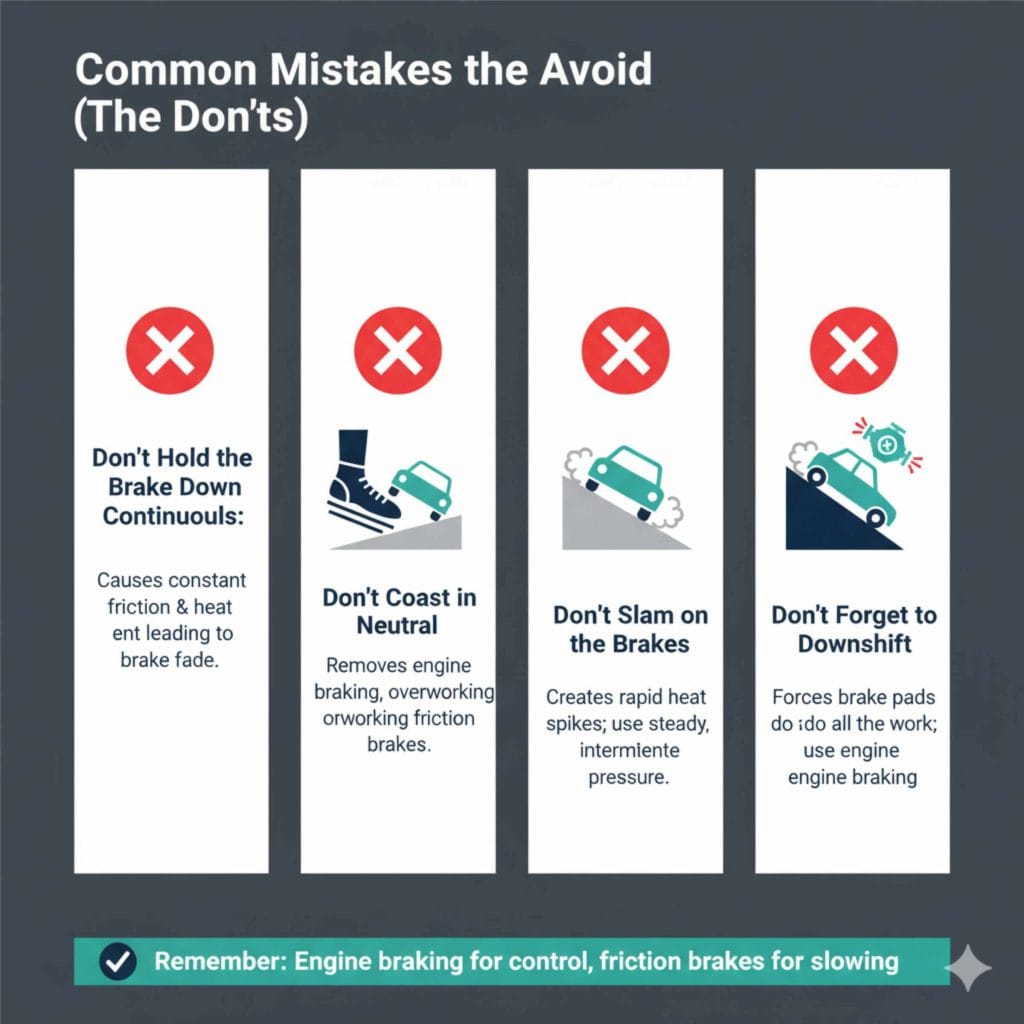
Knowing what not to do is just as important as knowing the correct steps. Avoid these common pitfalls when descending steep slopes:
- Don’t Hold the Brake Down Continuously: This is the number one cause of brake fade. Steady light pressure creates constant friction and heat.
- Don’t Coast in Neutral: As mentioned previously, this removes engine braking entirely, making your friction brakes 100% responsible for controlling speed and gravity.
- Don’t Slam on the Brakes Unless It’s an Emergency: While ABS will prevent wheel lockup in modern cars, repeatedly slamming the brakes generates massive, rapid heat spikes that are harder to dissipate than slowing down gradually. You want a steady application and release, not sharp, panicked stomps.
- Don’t Forget to Downshift: Skipping the engine braking step means you are forcing your brake pads to handle the entire job, guaranteeing extra wear and heat.
If you follow the pump/intermittent braking pattern and utilize engine braking, you significantly reduce the wear and heat on your brake system. Remember, the brakes are for slowing you down, but the transmission is for maintaining a safe speed boundary.
Expert Maintenance Checkpoints
To ensure your braking system is ready for heavy loads like downhill driving, make sure you are keeping up with these basic maintenance checks, which contribute directly to how effectively you can use the brake pedal.
| Component | Check Frequency | Sign of Trouble |
|---|---|---|
| Brake Fluid Level | Every Oil Change | Low level, or fluid looks very dark (should be clear/light amber). |
| Brake Pads/Shoes Thickness | Every 6 Months | A squealing or grinding noise when stopping; pads look thinner than a pencil eraser. |
| Rotors (Discs) | During Pad Replacement | Visible deep grooves or scoring marks across the surface. |
| Brake Line Hoses | Annually | Visible cracks, bulges, or wet spots near fittings. |
Frequently Asked Questions About Downhill Braking
Q1: Should I use my parking brake on a steep hill while driving?
A: No, you should not use the parking brake (emergency brake) for primary speed control while moving forward on a steep downhill. The parking brake is designed for holding a parked vehicle stationary. Using it while moving can cause the rear wheels to lock up unevenly, leading to a skid.
Q2: How do I know if I am in too low of a gear?
A: If you are in a gear that forces your engine RPMs (revolutions per minute) to stay above 4,000 or 5,000 RPM constantly without you pressing the gas pedal, that gear is likely too low. You will hear the engine sounding strained or extremely loud. Shift up one level for a less aggressive hold.
Q3: My car has Hill Descent Control (HDC)—do I still need to pump the brakes?
A: If your vehicle is equipped with modern features like Hill Descent Control (common on SUVs and trucks), you can usually rely on the system once activated. HDC automatically pulses the brakes for you at a very low, controlled speed. However, if you need to slow down quickly or manage speed above the system’s upper limit (often around 20 mph), you will still need to supplement it with manual, intermittent braking.
Q4: What is the difference between intermittent braking and hard pumping?
A: Hard pumping is usually done to prevent wheel lockup during panic stops on slippery surfaces (like ice or gravel). Intermittent braking for downhill driving is much smoother; it involves applying medium pressure to slow down to a safe speed, then releasing completely to cool, repeating this pattern gently, not aggressively.
Q5: Can driving downhill in a lower gear ruin my transmission?
A: No, not if done correctly. This is exactly what lower gears are designed for—they use the engine’s robust mechanical strength to manage loads. As long as you are not aggressively forcing the car into a gear that is far too low for your current speed (causing the engine to rev dangerously high), using lower gears for engine braking is safer for your overall system than relying only on your friction brakes.
Q6: Is it better to brake lightly the whole way down or brake hard and release?
A: It is much better to brake hard in short bursts and then release completely. Lightly braking the whole way down causes continuous heat buildup, leading to fade. Braking hard briefly allows maximum cooling time during the release phase, letting the system recover its heat dissipation ability.
Final Takeaway: Control the Hill, Don’t Fight It
Driving down a long, steep hill doesn’t have to feel intimidating or risky. The key is understanding that your brake pedal is not meant to do all the work alone. When you rely only on constant braking, heat builds up, control fades, and danger increases. But when you combine engine braking with smart, intermittent brake use, you turn a stressful descent into a controlled, predictable process.
The safest approach is simple and proven:
Downshift early, set a safe target speed, apply firm braking in short bursts, and release completely to allow cooling. This rhythm keeps your brakes effective, prevents fade, and gives you confidence no matter how long or steep the hill becomes. Gravity may be powerful, but your vehicle—when used correctly—is more than capable of managing it.
Remember, mountain and downhill driving rewards preparation, patience, and smooth control. Avoid riding the brakes, never coast in neutral, and always let your engine help you maintain speed. With these techniques, you protect your braking system, reduce wear on your vehicle, and most importantly, keep yourself and others safe on the road.
Master this skill once, and every downhill drive becomes easier, calmer, and far safer. The road may slope downward—but you stay firmly in control.