
If you try to start your car and nothing happens, it’s often a dead battery or a poor connection. Before calling for a tow, check your battery terminals. A loose or corroded connection can prevent power from reaching the starter. A quick wiggle or cleaning can be the simple, genius fix that gets you back on the road.
That feeling is the worst. You turn the key, and… nothing. Just silence. No engine rumble, no dashboard lights, nothing at all. It’s a moment that can fill any driver with dread. Your mind starts racing with thoughts of expensive repairs and complicated problems.
But what if I told you the solution is often incredibly simple? In many cases, you don’t need a mechanic or a tow truck. You just need a few minutes and a little bit of knowledge. We’re here to walk you through it, step-by-step. Let’s uncover the simple secrets to solving this frustrating problem and get you back in the driver’s seat with confidence.
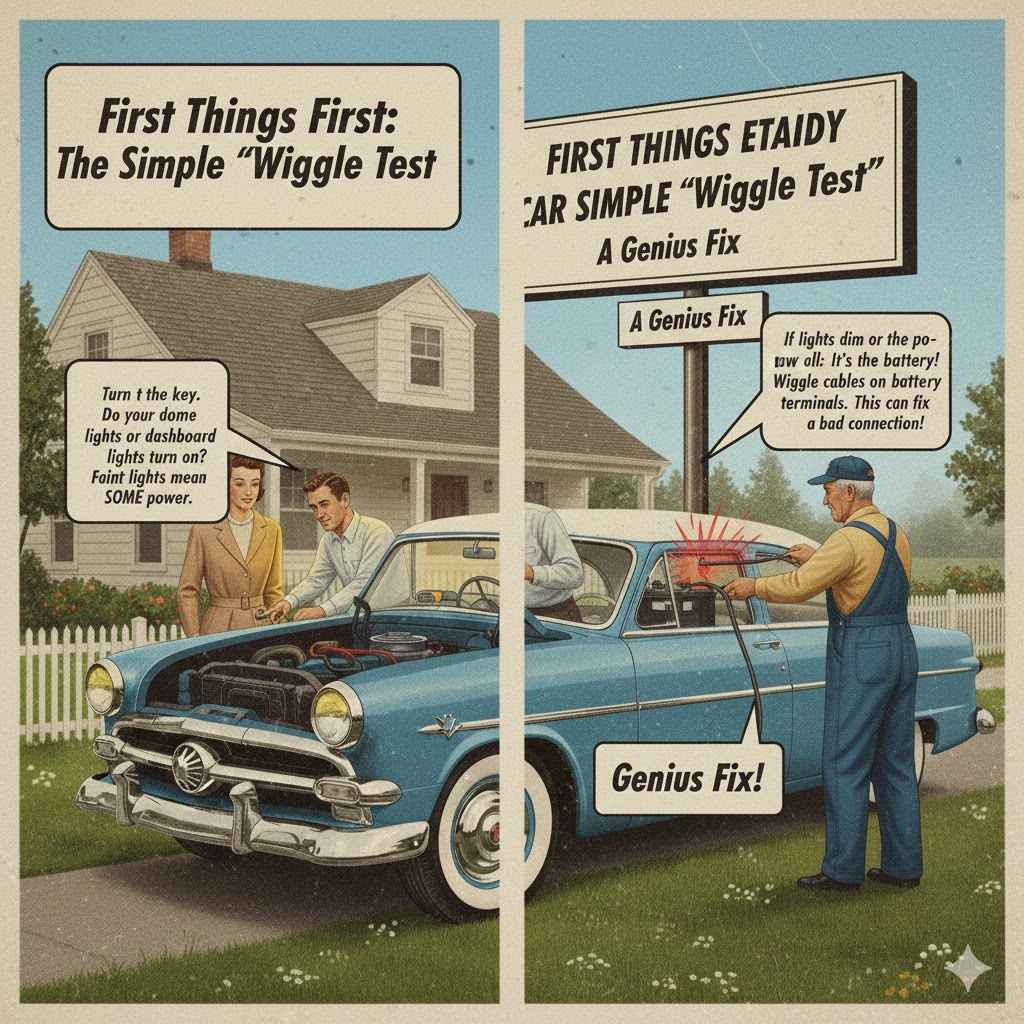
First Things First: The Simple “Wiggle Test”
Before you even open the hood, let’s try the easiest check of all. When you turn the key, do your interior dome lights or dashboard lights turn on? Even if they are very dim, it tells you there is some power in the battery. If you see lights, try turning them on and then attempt to start the car again. Do the lights dim significantly or go out completely? This is a classic sign of a weak battery or, more importantly, a bad connection that can’t handle the large power draw needed to start the engine.
If you get absolute silence and no lights at all, the problem is almost certainly at the battery. Don’t panic! This is where our genius fix comes in.
The Genius Fix: Check Your Battery Terminals
The single most common reason a car is completely dead is a poor connection at the battery. Your car battery is full of power, but that power has to travel through metal posts (terminals) and thick cables to get to the rest of your car. If that connection is loose or dirty, the electricity can’t get through. It’s like a kink in a garden hose.
This simple check takes less than a minute and solves the problem more often than you’d think.
How to Check and Secure Your Battery Terminals
Safety First: Make sure your car is in Park or Neutral with the emergency brake on. Remove the key from the ignition. It’s a good idea to wear gloves and safety glasses if you have them.
Locate the Battery: Pop your hood and find the car battery. It’s a rectangular box, usually black, with two connection points on top called terminals. One is marked with a plus sign (+) for positive, and the other with a minus sign (-) for negative. The positive terminal often has a red plastic cover.
The Wiggle Test: Gently grab the connector on the positive (+) terminal and try to wiggle or twist it. Then do the same for the negative (-) terminal. They should not move at all. If you can twist or move either one by hand, you’ve found your problem! A loose connection is preventing the power from flowing.
Tighten the Connection: If a terminal is loose, use a small wrench or a pair of pliers to tighten the nut on the connector clamp. You don’t need to crank it down with all your strength—just make it snug enough so it no longer moves.
Try Starting the Car Again: Get back in your car and try the key. In many cases, the car will start right up. You just saved yourself a headache and a potential towing fee!
What if the Terminals are Dirty or Corroded?
Sometimes, the terminals are tight but covered in a crusty, white, or greenish-blue powder. This is corrosion from battery acid and it’s a terrible conductor of electricity. It effectively blocks the power from leaving the battery.
Cleaning this off is an easy and highly effective fix.
Tools You’ll Need:
- A wrench or socket set to loosen the terminal clamps
- A wire brush (a dedicated battery terminal brush is best, but a stiff-bristled brush can work)
- Baking soda and water
- An old cloth or paper towels
- Gloves and safety glasses
Step-by-Step Cleaning Guide:
Disconnect the Battery: This is very important for safety. Always disconnect the negative (-) terminal first. Use your wrench to loosen the nut on the clamp and pull the connector off the battery post. Tuck it to the side so it can’t accidentally touch the post again. Then, do the same for the positive (+) terminal.
Make a Cleaning Paste: Mix a tablespoon of baking soda with a little bit of water to create a thick paste.
Scrub the Terminals and Posts: Apply the paste to the battery posts and the inside of the connectors. You’ll see it start to fizz and bubble as it neutralizes the acid. Use your wire brush to scrub away all the corrosion. Get them as shiny and clean as you can.
Rinse and Dry: Use a clean, damp cloth to wipe away the baking soda paste and residue. Then, dry everything thoroughly with a paper towel. Make sure the posts and connectors are completely dry.
Reconnect the Battery: Now, do the reverse of how you disconnected it. Reconnect the positive (+) terminal first and tighten it. Then, reconnect the negative (-) terminal and tighten it. Make sure both are snug and don’t wiggle.
Start Your Engine: With clean and tight connections, try starting your car. It should now have the power it needs to turn over.
What if the Genius Fix Didn’t Work? Troubleshooting Next Steps
If you’ve checked, tightened, and cleaned your terminals and still get nothing, don’t worry. We just eliminated the most common and simplest problem. Now we can move on to other likely causes. Here’s a quick guide to what might be happening.
Symptom & Cause Quick Guide
Use this table to help match what your car is doing (or not doing) with the most likely cause.
| Symptom | Most Likely Cause | First Thing to Try |
|---|---|---|
| Complete silence, no lights on the dashboard or in the cabin. | Completely dead battery or a very bad connection at the terminals. | Check, clean, and tighten battery terminals. If that fails, try a jump-start. |
| A single, loud “click” sound when you turn the key, but the engine doesn’t turn over. | The starter solenoid is engaging, but the starter motor isn’t working. This can be due to a weak battery or a failing starter. | Try a jump-start first to rule out a weak battery. If that doesn’t work, the starter is likely the issue. |
| A rapid clicking or chattering sound when you turn the key. | The battery is very low on power. It has just enough juice to trigger the starter solenoid but not enough to turn the engine. | Jump-start the vehicle. The battery needs charging or replacement. |
| The dashboard lights work, but the engine cranks very slowly or not at all. | The battery is weak and cannot provide enough amperage to crank the engine properly. | Jump-start the vehicle. Have your battery tested soon. |
| The engine cranks normally but won’t start. | This is likely a fuel or spark issue, not an electrical one. | Check if you are out of gas. If not, this may require a mechanic to diagnose the fuel pump or ignition system. |
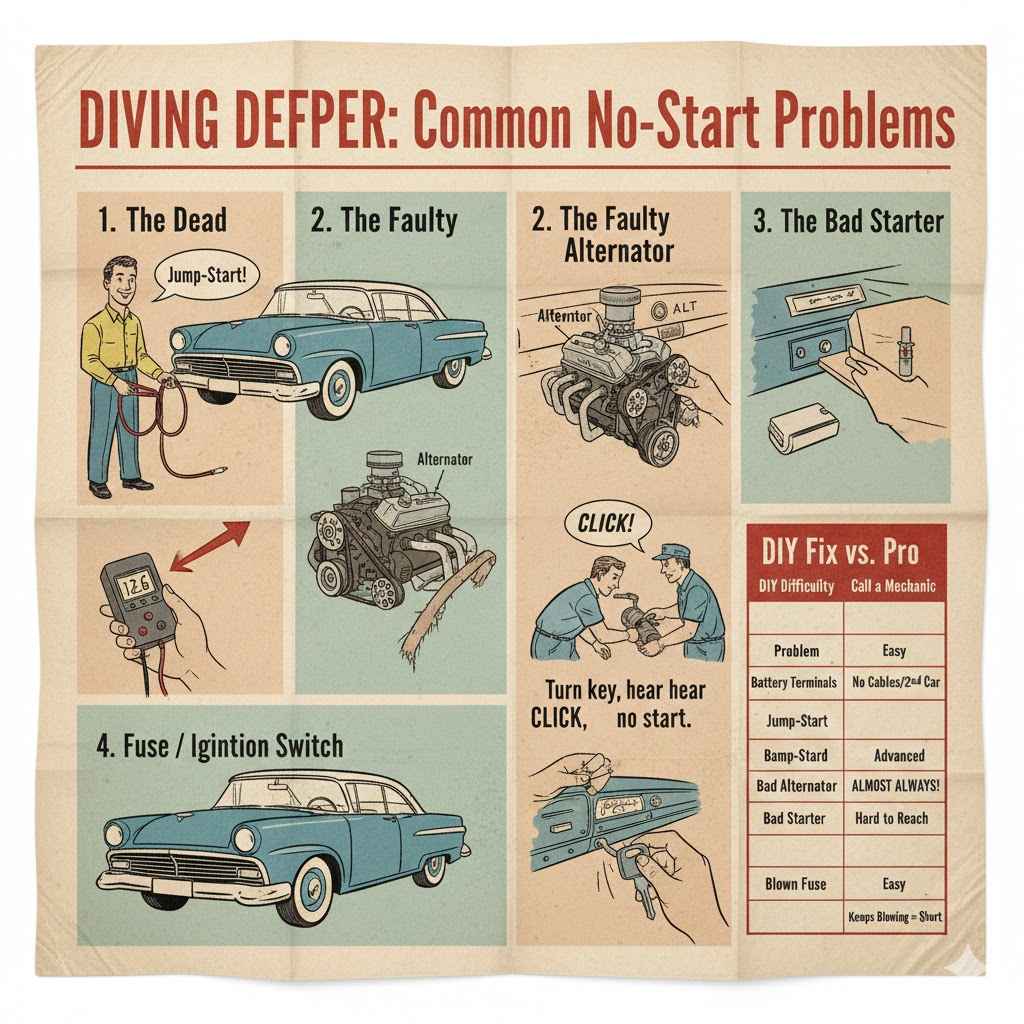
Diving Deeper: Common No-Start Problems
Let’s look at each of the main culprits in more detail.
1. The Dead Battery
A dead battery is the leading cause of a no-start situation. Car batteries typically last 3-5 years, and they can fail without much warning, especially in extreme hot or cold weather.
How to Be Sure It’s the Battery
If cleaning the terminals didn’t work, a jump-start is the definitive test. If the car starts immediately with a jump, you know for sure the battery was the problem. You can also test a battery’s voltage with a simple tool called a multimeter. A healthy, fully charged car battery should read around 12.6 volts or slightly higher. If it reads below 12.2 volts, it’s low on charge and may not have enough power to start your car.
The Solution: A Jump-Start
Jump-starting a car is a great skill for any driver to have. You’ll need a set of jumper cables and a second car with a good battery.
Safety is critical when jump-starting. The National Safety Council provides excellent guidelines. Here is a safe, step-by-step process:
- Park the “good” car close to the “dead” car, but do not let them touch. Turn off both engines.
- Attach one of the red (positive) clamps to the positive (+) terminal of the dead battery.
- Attach the other red (positive) clamp to the positive (+) terminal of the good battery.
- Attach one of the black (negative) clamps to the negative (-) terminal of the good battery.
- Attach the final black (negative) clamp to an unpainted metal surface on the dead car’s engine block, away from the battery. A thick bolt or metal bracket is a good spot. This is your ground connection and prevents sparks near the battery.
- Start the “good” car and let it run for a few minutes to charge the dead battery.
- Try to start the “dead” car. If it starts, you’re in business!
- Once it’s running, remove the cables in the reverse order you attached them: black clamp from the ground, black clamp from the good battery, red clamp from the good battery, red clamp from the newly started battery.
After a jump-start, let your car run for at least 20-30 minutes to allow the alternator to recharge the battery. If the car won’t start again after you turn it off, you likely need a new battery.
2. The Faulty Alternator
The alternator is like a small generator that recharges your battery while the engine is running. If the alternator fails, your battery will run out of power and the car will die, even while you’re driving.
Signs of a Bad Alternator:
- The battery or “ALT” warning light is on your dashboard.
- Your headlights and dashboard lights seem dim or flicker, especially when you are idling.
- The car starts fine with a jump-start but dies again after a short time.
- You hear a whining or grinding noise coming from the engine that gets louder with acceleration.
If you suspect a bad alternator, you’ll need to have it tested at an auto parts store or by a mechanic. Most parts stores will test it for free.
3. The Bad Starter
The starter is a small, powerful electric motor that turns the engine over when you turn the key. When it fails, you’ll have power to your lights and radio, but the engine itself won’t crank.
Signs of a Bad Starter:
- You hear a single, loud “click” when you turn the key, but nothing else happens.
- You hear a whirring or grinding noise, but the engine isn’t engaging.
- You turn the key and nothing happens, but your headlights are bright and don’t dim at all.
A temporary “trick” is to gently tap the starter motor with a wrench or hammer handle while someone else turns the key. Sometimes this can get it to work one last time, but it means the starter needs to be replaced immediately.
4. A Blown Fuse or Faulty Ignition Switch
Less common but still possible are issues with the electrical system that controls the starting process.
- Ignition Switch: This is the part your key physically turns. If it wears out, it might not send the signal to the starter. Signs include a key that feels loose or dashboard lights that flicker when you jiggle the key.
- Blown Fuse: Your car has a fuse box that protects its electrical circuits. There is usually a fuse for the ignition or starter system. If it blows, the car won’t get the signal to start. Your owner’s manual will show you where the fuse boxes are and how to check them.
DIY Fix vs. Call a Pro
Knowing what you can handle yourself and when it’s time to call a professional is key to saving money and staying safe.
| Problem | DIY Difficulty | When to Call a Mechanic |
|---|---|---|
| Loose or Corroded Battery Terminals | Easy | If you are uncomfortable handling tools or the corrosion is severe. |
| Dead Battery (Jump-Start) | Easy | If you don’t have cables, another car, or are worried about connecting them incorrectly. |
| Battery Replacement | Beginner to Intermediate | If the battery is hard to access or you don’t have the right tools to secure it. |
| Bad Alternator | Advanced | This almost always requires a professional. It involves removing belts and is a complex job. |
| Bad Starter | Intermediate to Advanced | Starters can be difficult to reach. It’s best to call a mechanic unless you are experienced. |
| Blown Fuse | Easy | If you replace the fuse and it immediately blows again, there is an underlying electrical short that needs a professional diagnosis. |
Conclusion: You’ve Got This!
The next time you turn the key and get nothing but silence, take a deep breath. Remember the genius fix and start with the simplest things first. Check those battery terminals for tightness and corrosion. More often than not, this simple, five-minute check is all you need to solve the problem.
By learning to diagnose these common issues, you empower yourself as a driver. You build confidence, save money, and turn a moment of panic into a moment of pride. Not every car problem requires an expert, and now you have the knowledge to handle one of the most common ones all by yourself. Happy driving!
Frequently Asked Questions (FAQ)
1. Why does my car make a rapid clicking sound but won’t start?
A rapid clicking noise is the classic sign of a battery that is too weak to start the car. The sound you hear is the starter solenoid trying to engage but not having enough power to turn the engine. A jump-start is usually the immediate solution.
2. Can a car battery die suddenly without any warning?
Yes, absolutely. A battery can work perfectly one day and be completely dead the next. This often happens due to an internal failure within the battery, a sudden temperature drop, or if something like a light was left on overnight.
3. How long does a car battery usually last?
On average, a car battery lasts between 3 to 5 years. Factors like your climate (extreme heat is harder on batteries than cold), driving habits (lots of short trips can wear a battery out faster), and the quality of the battery all play a role.
4. Is it bad to jump-start a car?
No, it is not bad to jump-start a car when done correctly. Following the proper procedure (positive to positive, negative to ground) is very safe for modern vehicles. However, if you find yourself needing a jump-start frequently, it’s a sign that your battery, alternator, or another part of your charging system needs to be checked.
5. What’s the difference between a dead battery and a bad alternator?
A dead battery simply lacks a charge. It can be recharged via a jump-start and driving. A bad alternator is the part that is supposed to do the recharging. If the alternator is bad, your car may start with a jump, but it will die again once the battery’s reserve power is used up because it isn’t being recharged as you drive.
6. Could my key fob be the problem if my car won’t start?
Yes, it’s possible. If your key fob battery is dead, the anti-theft system in your car may not recognize the key and could prevent the car from starting. Usually, you will still see dashboard lights turn on in this case. Check your owner’s manual for a way to start the car with a dead fob (often by holding it directly against the start button).
7. My lights work, but the car won’t crank. Is it the starter?
It’s very likely. If your battery has enough power to run the headlights and dashboard lights at full brightness, but the engine makes no attempt to turn over (or just makes a single, loud click), the problem is most likely with the starter motor or the ignition switch sending the signal to it.