
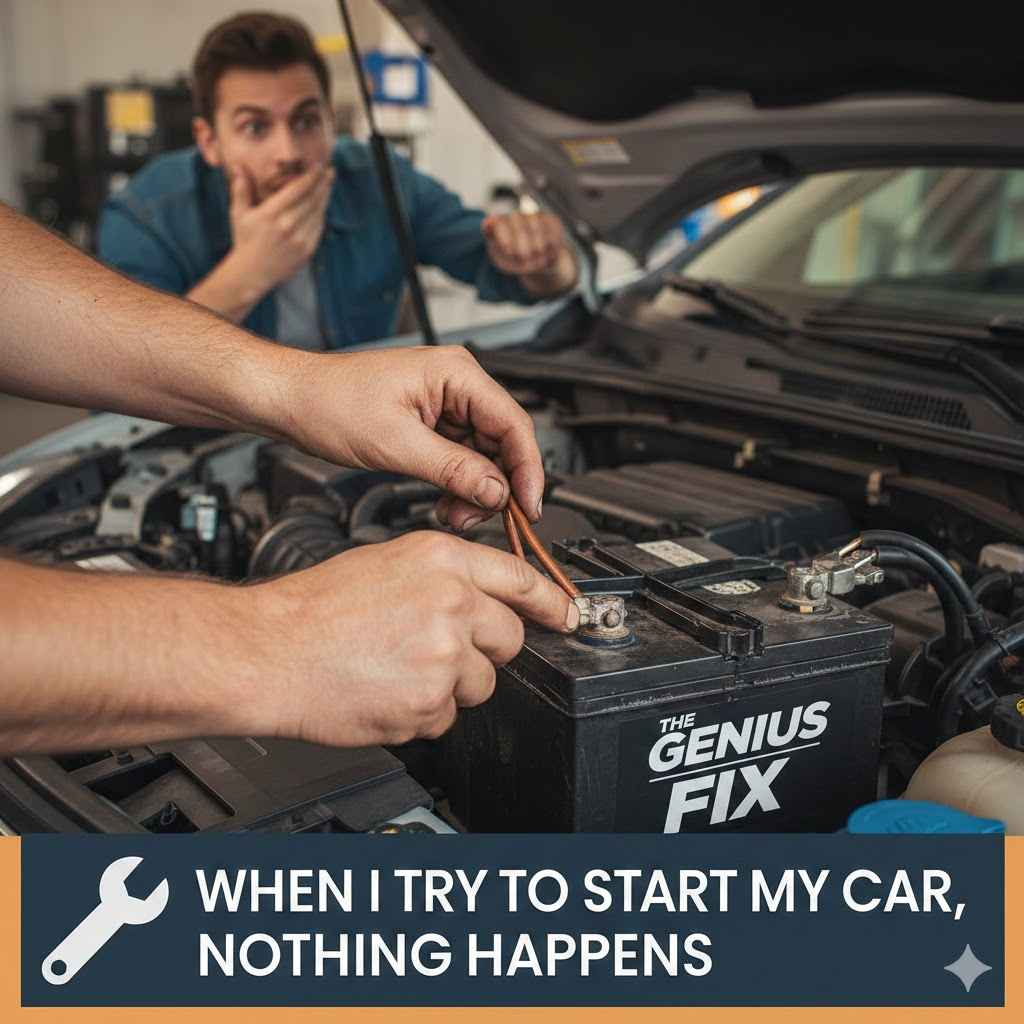
When you try to start your car and nothing happens, the most common cause is a weak or dead battery, or dirty battery terminals. The genius fix is often as simple as cleaning the battery terminals to restore the connection. Check for corrosion, ensure the cables are tight, and then try starting the car again before assuming you need a new battery.
That moment is the worst. You turn the key, and… silence. No engine noise. No clicks. Nothing. It is a frustrating feeling that can ruin your day. But don’t panic. You are not alone, and the fix is often much simpler than you think. You do not need to be a master mechanic to solve this.
This guide is here to help you. We will walk through the problem step by step. We will start with the easiest fixes first. You might be able to get your car running in just a few minutes. Let’s find out what is going on under the hood and get you back on the road.
Why Is My Car Not Starting? Understanding the Silence
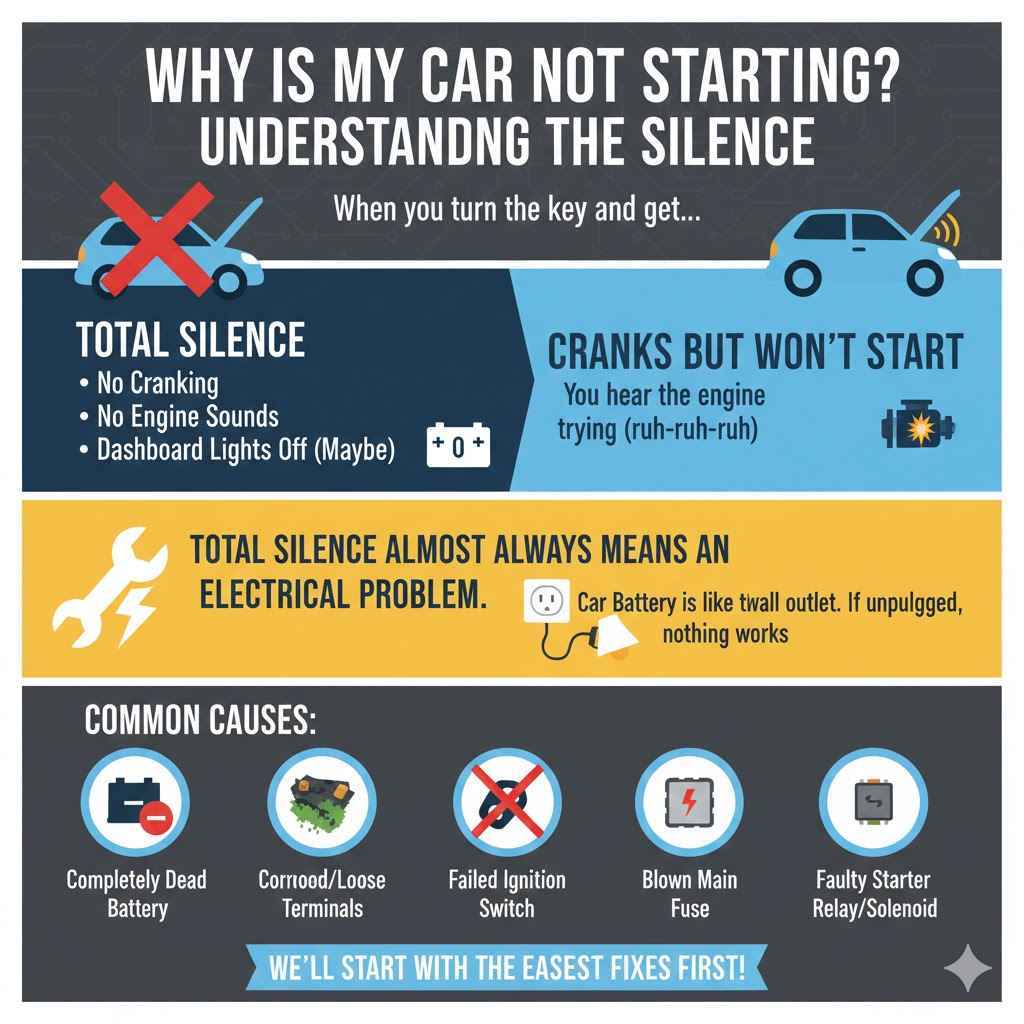
When you say “nothing happens,” it’s important to know exactly what that means. To a mechanic, “nothing happens” means total silence. There is no cranking, no clicking, and no sounds from the engine. The dashboard lights might not even turn on. This is different from a car that “cranks but won’t start,” where you hear the engine trying to turn over (that classic ruh-ruh-ruh sound).
Total silence almost always points to an electrical problem. Think of it like a lamp in your house. If the bulb is burnt out, you might get a flicker, but if it’s unplugged from the wall, you get nothing. Your car’s battery is the wall outlet. If the power can’t get from the battery to the rest of the car, everything stays off.
The most common reasons for this complete silence are:
- A completely dead battery.
- Corroded or loose battery terminals.
- A failed ignition switch.
- A blown main fuse.
- A faulty starter relay or solenoid.
Don’t let that list scare you. We are going to focus on the easiest and most likely problems first. Most of the time, the issue is with the battery or its connections.
Safety First: Before You Touch Anything
Before you open the hood or try any fixes, your safety is the top priority. Cars have heavy parts and powerful electrical systems. Always take a moment to make sure your work area is safe. It only takes a few seconds and can prevent an accident.
Follow these simple safety rules:
- Park on a flat, level surface. Never work on a car that is on a hill. It could roll.
- Put the car in “Park” or “Neutral.” If you have an automatic transmission, put it in Park. For a manual, put it in Neutral.
- Engage the parking brake. This is a crucial backup to keep the car from moving. Pull the lever up or press the pedal down firmly.
- Turn the car completely off. Take the key out of the ignition.
- Wear safety gear. It’s always a good idea to wear safety glasses and gloves, especially when working near the battery. Battery acid is corrosive.
- Keep metal away from the battery. Never let a metal tool like a wrench touch both battery terminals at the same time. This can create a dangerous spark. The National Safety Council offers great tips on general vehicle safety and maintenance.
By following these steps, you create a safe space to work and can focus on fixing the problem without worry.
The “Genius Fix”: A Simple Step-by-Step Guide
Now for the fun part! Let’s work through the possible solutions together. We’ll start with the simplest checks and move on from there. You might solve the problem on the very first step.
Step 1: Check the Simple Things First
Sometimes the solution is staring you right in the face. Before you get your hands dirty, let’s rule out the easy stuff.
- Is your key fob battery dead? Some modern cars won’t start if they can’t detect the key fob. If your key fob has a hidden physical key, try using that in the ignition. If not, try holding the fob directly against the push-to-start button, as this can sometimes work with a weak fob battery.
- Are you using the right gear? For an automatic car, make sure the gear selector is firmly in “Park” (P) or “Neutral” (N). The car is designed not to start in “Drive” or “Reverse” for safety. Try wiggling the shifter a bit while it’s in Park, then try the key again.
- Is the steering wheel locked? If the steering wheel is locked, it can sometimes prevent the ignition from turning. Jiggle the steering wheel back and forth gently while turning the key. You might feel a “click” as it unlocks.
If you’ve checked these and the car still does nothing, it’s time to move on to the most likely culprit: the battery.
Step 2: Investigate the Battery
Your car’s battery is the heart of its electrical system. When it’s weak or has a bad connection, nothing else will work. This is the number one reason for a no-start, no-sound situation.
Look for Telltale Signs of a Dead Battery
Even if you hear nothing when you turn the key, your car might be giving you clues. Try turning your headlights on. What do you see?
- Bright Headlights: If your headlights are bright and strong, your battery probably has enough power. The problem might be elsewhere, like the starter or ignition switch.
- Dim Headlights: If the headlights are very dim or look yellowish, your battery is very weak. It has some power, but not enough to start the engine.
- No Headlights at All: If the headlights and interior dome lights don’t turn on at all, your battery is likely completely dead or disconnected.
A completely dead battery means it’s time for a jump-start or a new battery. But before you do that, let’s check the connections. This is where our “genius fix” comes in.
The Wiggle Test and The Genius Fix: Clean Your Battery Terminals
The electricity from your battery flows to the rest of the car through two metal posts called terminals. Thick cables are clamped onto these terminals. If these connections are loose or dirty, the power can’t get through, even if the battery is fully charged.
First, do the wiggle test. Open the hood and locate the battery. It’s usually a black box with a red (+) and a black (-) terminal. Safely grab each cable connected to the terminals and try to wiggle it. They should be completely solid and not move at all. If you can twist or move a cable clamp, it’s too loose! You’ll need a wrench to tighten the nut on the clamp. This alone can solve the problem.
Next, look for corrosion. Do you see any white, blue, or greenish crusty stuff around the battery terminals? This is corrosion, and it’s like rust for your car’s electrical system. It blocks the flow of electricity.
| Terminal Condition | What It Means | Action to Take |
|---|---|---|
| Clean and Shiny | The connection is likely good. The problem might be the battery itself. | Proceed to test battery voltage or try a jump-start. |
| Dull or Dirty | A poor connection could be forming. Cleaning is a good idea. | Clean the terminals as a preventive measure. |
| White/Green/Blue Crust | Severe corrosion is blocking the electrical connection. This is a very likely cause. | This is the genius fix! Cleaning is required. |
How to Clean Corroded Battery Terminals:
- Disconnect the battery. This is a critical safety step. Using a wrench, always disconnect the black (negative, -) cable first. Then, disconnect the red (positive, +) cable. Tuck the cable ends to the side so they can’t accidentally touch the terminals.
- Clean the terminals and clamps. You can buy a special battery terminal cleaning tool for a few dollars, or you can use a stiff wire brush. A simple paste of baking soda and water also works wonders. Apply the paste and scrub away all the corrosion from both the battery posts and the inside of the cable clamps.
- Rinse and dry. Wipe away the cleaning paste and residue with a damp cloth. Then, make sure everything is completely dry with a clean, dry cloth. Moisture can cause new corrosion.
- Reconnect the battery. Now, do the reverse of step one. Connect the red (positive, +) cable first. Tighten it securely. Then, connect the black (negative, -) cable and tighten it. Make sure neither clamp can be wiggled.
Now, get in the car and try to start it. For thousands of drivers, this simple, free cleaning process is the “genius fix” that brings their car back to life.
Step 3: Check the Fuses
If the battery terminals are clean and tight, and the battery seems to have power (e.g., your interior lights work), the issue could be a blown fuse. Your car has a fuse box that protects its electrical circuits. There’s often a main fuse or an ignition fuse that, if blown, will prevent the car from starting.
Your car owner’s manual is your best friend here. It will show you where the fuse box (or boxes) is located and which fuse controls the ignition or starting system.
Here’s how to check a fuse:
- Locate the fuse box (often under the dashboard or in the engine bay).
- Open the cover. The inside of the cover usually has a diagram showing what each fuse does.
- Find the fuse for the “Ignition,” “Starter,” or “Main.”
- Pull the fuse out. Most cars come with a small plastic fuse puller in the fuse box.
- Hold the fuse up to the light. You should see a small metal wire inside the plastic. If the wire is broken or looks burnt, the fuse is blown and needs to be replaced.
Always replace a blown fuse with a new one of the exact same amperage rating. Using a higher-rated fuse is a serious fire hazard.
Deeper Dive: When the Simple Fixes Don’t Work
If you’ve tried everything above and still get nothing, the problem is likely a more complex component. At this point, you might need the help of a mechanic. However, understanding what might be wrong can help you have a more informed conversation with the repair shop.
The Starter Motor
The starter is a small, powerful motor whose only job is to turn the engine over to get it running. If the battery is good but the starter has failed, you won’t hear the engine crank. Often, a failing starter will make a single, loud “click” sound when you turn the key. But if it has failed completely, you might hear nothing at all.
The Ignition Switch
The ignition switch is the part you put your key into (or the button you press). It’s the electrical trigger that sends power to the starter motor. Over time, the electrical contacts inside can wear out. A sign of a failing ignition switch is if your dashboard lights flicker or don’t come on consistently when you turn the key to the “On” position. If the switch is completely broken, it won’t send the signal to start the car.
The Alternator
The alternator’s job is to recharge the battery while the engine is running. It doesn’t help the car start, but a bad alternator is what causes a battery to die in the first place. If you recently needed a jump-start to get going, but then the car died again after a short drive, you likely have a faulty alternator that isn’t recharging your battery. You might also see a battery warning light on your dashboard while driving if the alternator is failing.
| Symptom | Likely Cause | Next Step |
|---|---|---|
| Total silence, no lights | Dead battery or bad connection | Check and clean terminals; try a jump-start. |
| Dashboard lights work, but silence when turning key | Bad starter, ignition switch, or neutral safety switch | Try wiggling the shifter; listen for a faint click. May require a mechanic. |
| Single loud “click” then silence | Failing starter motor or solenoid | This is a classic starter failure symptom. Time to call a mechanic. |
| Engine cranks slowly but won’t start | Very weak battery | The battery has some power, but not enough. Needs a charge or jump-start. |
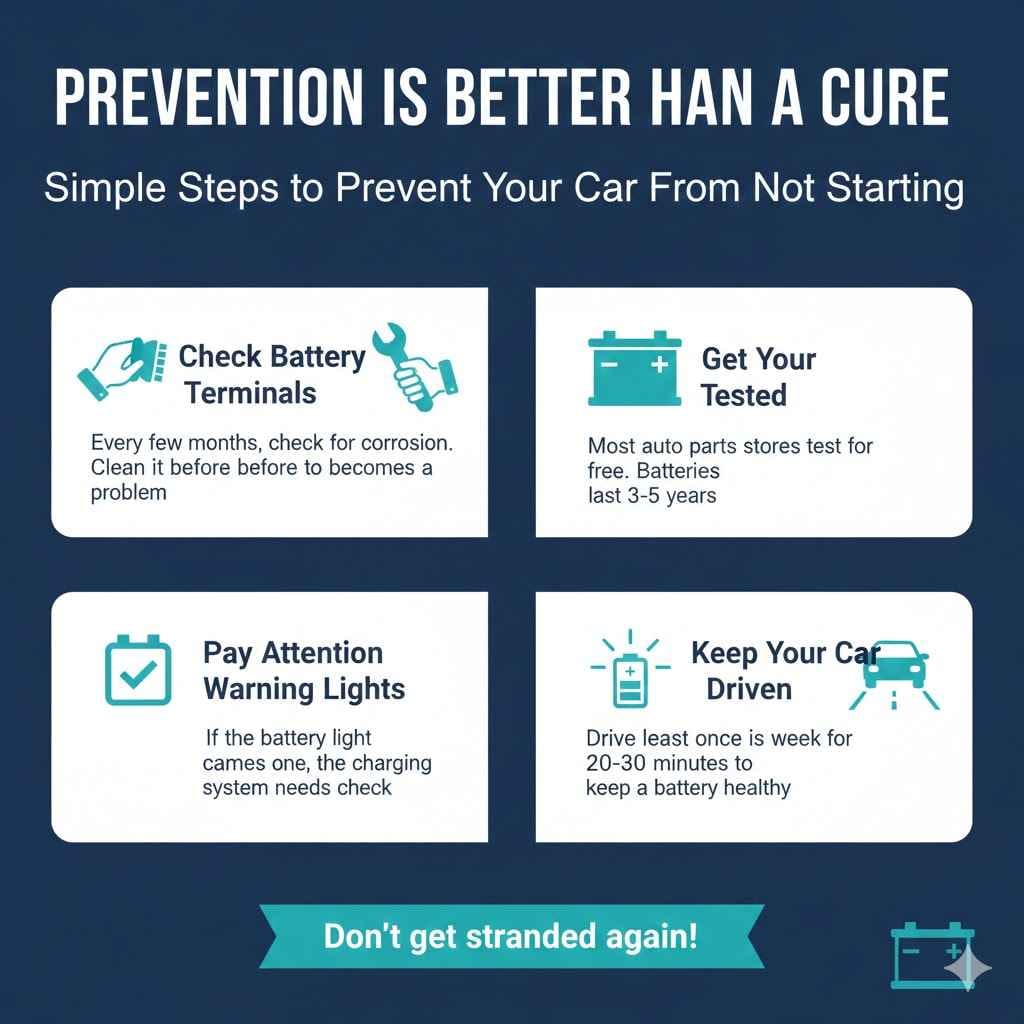
Prevention is Better Than a Cure
Once you get your car running again, you can take a few simple steps to prevent this from happening in the future.
- Regularly check your battery terminals. Every few months, just pop the hood and look at them. If you see any corrosion starting to form, clean it off before it becomes a problem.
- Get your battery tested. Most auto parts stores will test your battery for free. This can tell you if it’s getting old and weak before it leaves you stranded. Car batteries typically last 3-5 years.
- Pay attention to warning lights. If a battery light comes on your dash while you’re driving, don’t ignore it. It’s your car’s way of telling you the charging system (alternator) has a problem.
- Keep your car driven. If you let a car sit for weeks without starting it, the battery will slowly lose its charge. Try to drive your car at least once a week for 20-30 minutes to keep the battery healthy.
Frequently Asked Questions (FAQ)
1. Why is there a clicking sound when I try to start my car?
A rapid clicking sound usually means the battery is too weak. It has just enough power to activate the starter solenoid (the click you hear), but not enough to turn the engine. A single, loud click often points to a problem with the starter motor itself.
2. Can a brand new battery be dead?
Yes, although it’s rare. A battery can be faulty from the factory, or it can lose its charge if it sits on a store shelf for too long. It’s also possible that something in your car (like a light left on) drained the new battery after it was installed.
3. How do I know if I need a jump-start or a new battery?
A jump-start is a temporary fix. If the car starts with a jump and continues to run fine on future trips, you may have just left your lights on. If you need a jump-start again the next day, it means your battery can no longer hold a charge, or your alternator isn’t recharging it. In that case, you likely need a new battery.
4. Is it safe to handle a car battery?
It is safe if you follow proper precautions. Always wear gloves and eye protection. Never smoke or create sparks near a battery. Remember the rule for disconnecting: Negative Off First, Positive Off Second. When reconnecting: Positive On First, Negative On Second.
5. What is a neutral safety switch?
A neutral safety switch is a device that prevents your car from starting unless the transmission is in Park or Neutral. If this switch fails, it might not send the signal that it’s safe to start, even when you are in the correct gear. Wiggling the gear shifter can sometimes bypass a faulty switch temporarily.
6. Could cold weather be the reason my car won’t start?
Absolutely. Cold temperatures make it much harder for a car battery to produce power. An older, weaker battery that works fine in the summer can easily fail on the first cold morning of winter.
7. How much does it cost to fix a car that won’t start?
The cost varies wildly. If it’s just cleaning the battery terminals, it’s free! A new battery can cost between $100 and $300. A new starter or alternator can be more expensive, often costing between $400 and $800 or more, including labor.
Conclusion: You’ve Got This!
When your car refuses to start, that initial moment of silence can be stressful. But as you’ve seen, the solution is often simple and within your reach. By staying calm and working through these steps—checking the key, the shifter, and especially the battery terminals—you have a great chance of solving the problem yourself. The “genius fix” of cleaning away corrosion is a powerful tool in any driver’s toolkit.
Even if the issue turns out to be more complex, you are now armed with knowledge. You can speak confidently about whether the battery is strong, if you hear a click, or if there’s just silence. This helps you and your mechanic pinpoint the problem faster, saving you time and money. Remember to always prioritize safety, and don’t be afraid to get to know your car a little better. You might just surprise yourself with what you can fix.